
%201.svg)


HIPAA Compliance Checklist for 2025

AI spending is growing quickly across enterprises, and leadership teams are being asked harder questions about usage, cost, and risk. The challenge is that the conversation often pulls in multiple teams (IT, Finance, Security, and AI leaders), but no single group has the complete picture.
IT may discover new tools being used. Finance sees the invoices. Security focuses on governance and security risk. The CIO or CAIO is expected to explain whether the investment is delivering value.
So, who should actually lead continuous monitoring of AI consumption and cost optimization? What does ownership look like in practice? This blog explores where the ownership gap comes from and how enterprises can build a model that works as AI adoption grows.
TL;DR
- AI consumption ownership becomes difficult because usage, cost, and risk data live across different teams.
- Effective AI monitoring requires tracking usage patterns, spending allocation, and governance controls together.
- IT, Finance, Security, CIOs, and CAIOs each own different pieces of the problem.
- The strongest model uses shared visibility with one lead team and cross-functional accountability.
- CloudEagle.ai creates a unified view of AI usage, costs, and risks to simplify ownership and optimization.
1. Who Is Actually Watching AI Consumption Every Day? (No Centralized Ownership)
The reason is no single team sees usage, cost, risk, and accountability together. As AI adoption grows, everyone sees a part of an elephant but not the whole picture.
- IT discovers the problem but doesn't own spend decisions: IT often notices new AI tools, enterprise API activity, and growing usage first. But once the conversation moves to budgets and cost allocation, ownership shifts elsewhere.
- Finance owns the budget but has little visibility into usage: Finance sees the invoices but often cannot tell which teams used the tools or what drove the spending.
- Security owns risk but not cost optimization: Security teams focus on governance, unapproved tools, and data exposure. Their role is to reduce risk, not manage spending efficiency.
- The CIO or CAIO is accountable to the board but lacks complete data: Leadership is expected to answer questions around AI value, cost, and risk, but the information often lives across multiple teams.
The gap is not a people problem. It is a structural problem. AI consumption now sits across multiple functions, and none of them naturally have the whole view.
2. What Does Owning AI Consumption Actually Mean?
Before assigning ownership, enterprises need to define what the role actually includes. Owning AI consumption is not just about tracking spending. It also involves understanding AI usage control and maintaining control over risk.
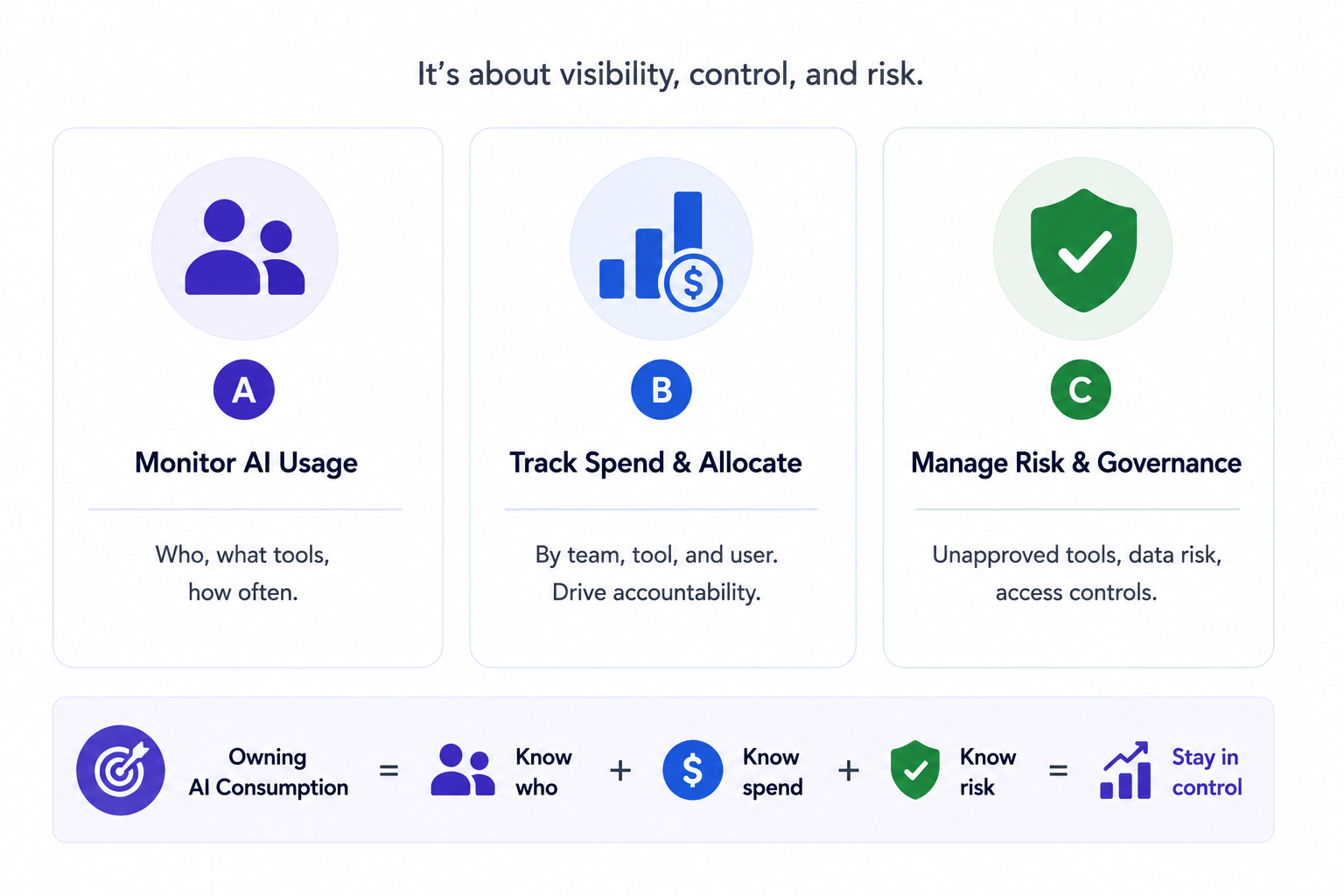
A. Monitoring Who Is Using AI Across the Organization
Understanding who is using AI, which tools they use, and how often they use them. This includes approved platforms as well as tools adopted independently by teams.
B. Tracking Spend and Cost Allocation Across Teams
Tracking AI spend by team, tool, and user instead of only viewing a total invoice amount. It also includes allocating costs back to business units through chargebacks, making spending visible and accountable.
C. Managing Security Risks and Governance Controls
Identifying unapproved tools, tracking sensitive data exposure, and reviewing access controls. It ensures that AI adoption happens within defined policies instead of creating shadow AI governance gaps.

3. Who Should Really Own AI Consumption Monitoring?
No single team fully owns AI consumption monitoring today because every function sees a different part of the problem. But if the question is who should lead, the answer becomes clearer.
The CIO often becomes the immediate executive owner because AI spending, governance, and business value eventually become leadership questions.
Over time, as enterprises build AI-specific capabilities, the CAIO or AI-focused FinOps function becomes the closest fit for day-to-day ownership and optimization.
A. IT: Provides Visibility Into AI Activity
IT has the strongest operational case because it sits closest to the environment. Teams rely on IT to identify new AI tools, monitor usage activity, and understand what is entering the organization.
The challenge is that IT does not own budgets or spending decisions. It can identify what is being used, but it cannot independently decide whether the cost is justified or whether spending should change.
B. Finance / Procurement: Brings Cost Accountability
Finance and Procurement naturally own budgets, contracts, renewals, and chargeback models. They are responsible for understanding where spending is happening and whether it aligns with business priorities.
However, invoices rarely explain who used a tool, how often it was used, or whether the investment delivered value. Without usage data, Finance can see AI spending but cannot fully explain or optimize it.
C. CISO / Security: Maintains Governance and Risk Control
The CISO has a clear role because AI adoption creates governance and security concerns. CISOs use AI Security tools to monitor unapproved tools, data exposure risks, and access controls across the environment.
But cost optimization sits outside their mandate. Their priority is reducing risk and enforcing policies, not deciding whether AI investments are efficient..
D. CIO: Drives Executive Accountability
The CIO has the strongest executive case because AI spending, governance, and business value eventually become leadership questions. When the board asks whether AI investments are controlled and delivering results, the answer often lands with the CIO.
The challenge is that the CIO depends on information coming from multiple teams. Usage data comes from IT, spending data comes from Finance, and risk data comes from AI Security. Without a shared view, the CIO is accountable for decisions without having all the inputs.
E. CAIO: Connects AI Strategy With Business Outcomes
The CAIO has the strongest strategic case because this role connects AI adoption with business outcomes. The CAIO focuses on where the organization should invest, what should scale, and whether AI initiatives are delivering value.
But many enterprises are still building this capability, and not every organization has a formal CAIO role today.
4. What Ownership Model Actually Works in Practice?
The answer is not giving every team equal ownership. When everyone owns everything, accountability becomes unclear. The model that works is one team leading the effort while other teams contribute the information needed to support decisions.
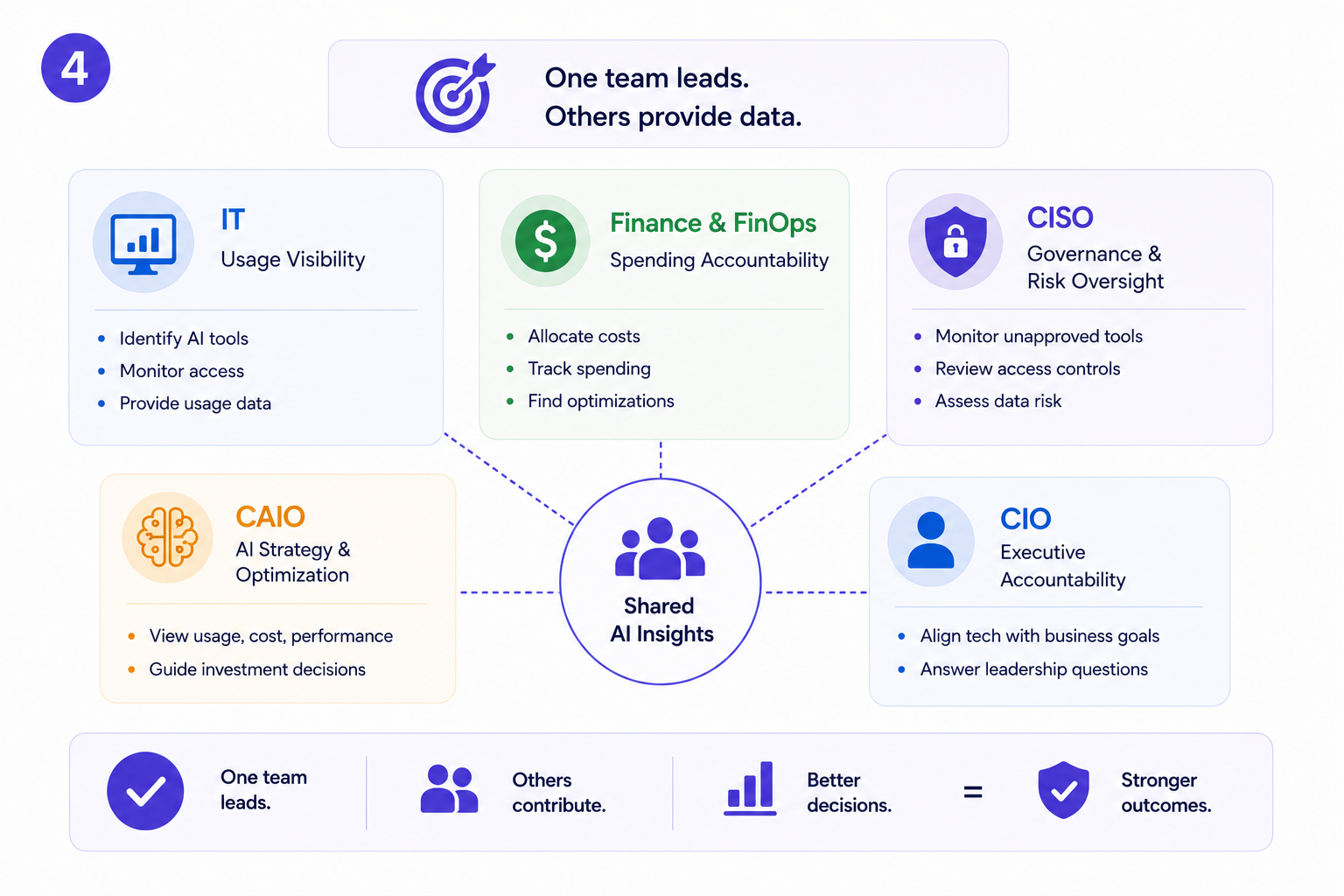
- IT provides usage visibility: IT identifies AI tools in use, monitors access activity, and feeds usage data into a shared system.
- Finance and FinOps manage spending accountability: Finance uses cost allocation and chargeback data, while FinOps monitors spending patterns and optimization opportunities.
- CISO owns governance and risk oversight: The CISO’s responsibility includes continuous monitoring of unapproved tools, access controls, and potential data exposure risks.
- CAIO owns AI strategy and optimization decisions: The CAIO uses a consolidated view of usage, cost, and performance to guide investment and adoption decisions.
- CIO owns executive accountability: The CIO uses the same information to align technology decisions with business goals and answer leadership or board-level questions.
5. How to Get Started If You Don't Have a CAIO Yet?
Many enterprises are still building formal AI leadership functions. That does not mean teams should wait before creating ownership around AI consumption. A practical starting point is assigning responsibilities across existing teams.
- CIO: Take interim ownership of the broader AI strategy and cross-functional coordination. The CIO is often in the best position to bring IT, Finance, and Security together around a shared approach.
- IT: Start identifying which AI tools are being used, who has access, and where usage is growing. You cannot manage AI consumption without understanding what already exists in the environment.
- Security: Identify unsanctioned tools, define usage policies, and monitor potential data exposure risks. Early guardrails help prevent larger governance issues later.
The goal is not to create a perfect structure immediately. It is to establish visibility, accountability, and clear ownership before AI spending grows further.
6. What Questions the Board Will Ask and Who Will Answer Them?
Boards and CFOs want clear answers around spending, value, and risk. The challenge is making sure the right teams have the right data available.
These questions may sound simple, but the answers rarely sit with one team. That is why ownership works best when teams contribute different inputs while operating from the same view of data.
7. Closing Thoughts
The enterprises making progress with AI consumption management are not waiting for a perfect org structure or a fully defined AI leadership team. They are starting with visibility first, creating a shared view across usage, cost, and risk, and assigning accountability from there.
Ownership becomes easier when every team works from the same information instead of building separate views of the problem.
CloudEagle.ai helps enterprises with AI visibility, align teams around the same data, and turn fragmented oversight into coordinated control. If you’re exploring how to operationalize this, you can learn more about how it works.


.avif)


.avif)
.avif)




.png)




.avif)
.avif)
.avif)


