.avif)
%201.svg)


HIPAA Compliance Checklist for 2025

A Chief Information Officer (CIO) is the senior executive responsible for an organization's technology strategy, IT operations, and the governance of how technology is adopted, managed, and secured across the enterprise.
The role sits at the intersection of business strategy and technology execution.
CIOs decide which technologies the organization invests in, how data is governed, how SaaS and AI tools are controlled, and how the entire technology function maps to business outcomes.
TL;DR
- A CIO leads IT strategy, digital transformation, and technology governance across the enterprise.
- The role has evolved from infrastructure management to owning business outcomes, risk, and AI governance.
- CIOs work across CISO, CFO, CTO, and CAIO and own what falls between those roles.
- SaaS sprawl and shadow AI are now the biggest operational and financial risks on the CIO's agenda.
- CloudEagle.ai gives CIOs the control layer to govern SaaS and AI at scale.
1. How the CIO Role Has Evolved
The CIO started as a technology implementer. The role is now one of the most strategically significant in the C-suite.
A decade ago, the CIO's mandate was keeping systems running and overseeing infrastructure projects. Technology was a cost center necessary, but not central to competitive strategy.
Three forces changed that:
- Cloud shifted the CIO's focus from infrastructure operations to strategy.
- Data became a competitive asset, putting the CIO at the center of how it is governed and used.
- AI made technology the engine of business differentiation, not just its foundation.
The result: CIOs have moved from managing IT as a support function to co-owning business strategy. Organizations have shifted from treating IT as a cost center to treating it as a mission-critical strategic unit.
Where the CIO Sits Today
2. What are the Core CIO Roles and Responsibilities?
a) IT Strategy and Business Alignment
The CIO translates business objectives into technology investments, owns the IT roadmap, aligns spend to growth priorities, and ensures the board understands the value and risk of every major technology decision.
b) Digital Transformation
CIOs lead modernization: retiring legacy systems, deploying cloud infrastructure, and building capabilities that let the business operate at speed.
This is the responsibility most visible to the C-suite and the one most likely to define a CIO's tenure.
c) Cybersecurity Oversight
The CIO owns the technology environment in which security operates.
Working with the CISO, they ensure every tool adopted and every access decision sits within a consistent security framework. When a breach happens, both roles answer for it.
d) Data and AI Strategy
CIOs govern how data is collected, stored, and used, and how AI tools are adopted, measured, and controlled.
This includes setting usage policies that prevent ungoverned AI adoption from becoming a liability.
e) SaaS and Vendor Management
The CIO is accountable for the full software portfolio: what is purchased, what is used, what it costs, and when contracts renew.
Without active governance, it leaks money and creates security exposure simultaneously.
f) Budget and Spend Oversight
CIOs own the IT budget and justify technology investments to the CFO in business terms: ROI, risk reduction, and competitive positioning.
g) Team Leadership and Talent Development
The CIO builds the technology team the organization needsfor two to three years ahead.
As McKinsey's research notes, skill gaps are consistently cited as the top obstacle to digital transformation. Closing them is a CIO's responsibility.

3. CIO in Organization: Where the CIO Sits?
The CIO's reporting line determines how much governance authority they can exercise.
Who does the CIO report to?
In most enterprises, the CIO reports to the CEO.
In financial services or SaaS companies, they may report to the CFO.
A CIO reporting to the CEO has direct board access and a seat in strategic planning.
A CIO under a COO has limited authority over the cross-functional decisions where modern governance challenges actually live.
Who reports to the CIO?
The CIO's direct reports vary by organization, but typically include:
- Head of IT Infrastructure
- Head of Software Development
- Head of Cybersecurity / CISO (in some structures)
- Head of Data and Analytics / CDO
- IT Project Managers
- Enterprise Architects
In organizations undergoing significant digital transformation, a Chief Transformation Officer or Chief Digital Officer may also sit under or alongside the CIO.
4. CIO vs CTO vs CISO vs CAIO: Who Owns What
As organizations grow more complex, the lines between technology roles blur. Clear ownership prevents governance gaps.
What is the difference between CIO and CTO?
The CIO owns the internal technology environment: infrastructure, systems, software governance, and data management.
The CTO owns external and product-facing technology: product architecture, engineering, and R&D.
The simplest distinction: the CIO runs technology for the business. The CTO builds technology for the business.
CIO vs CISO: Shared Accountability, Different Scope
The CIO owns the technology environment. The CISO owns the security posture within it.
In practice, the CIO decides which SaaS tools are adopted; the CISO determines whether they meet security requirements.
Both share accountability for access governance, especially onboarding, offboarding, and privilege management.
Where the CAIO Fits
Most organizations don't yet have a Chief AI Officer.
Until that role exists, AI governance: the tool catalog, usage policy, AI spend, and shadow AI detection defaults to the CIO.
Forrester projects 60% of Fortune 100 companies will appoint a head of AI governance in 2026. Until then, the CIO owns the problem.
For a full breakdown of how CAIOs operationalize AI governance, read How CAIOs Can Scale AI Adoption Without Creating Chaos.
5. Chief Information Officer Qualifications
Education and Experience
Most CIOs hold a bachelor's degree in computer science, information systems, or a related field, and many hold an MBA or MS in IT.
That said, in more than 30% of CIO appointments, accumulated experience mattered more than the field of study. CIOs increasingly come from finance, operations, or consulting backgrounds.
Organizations typically expect 10 to 15 years of technology management experience, with at least 5 years in a senior leadership role.
Hard Skills
- IT infrastructure and systems architecture
- Cybersecurity and risk management
- Data management and analytics
- Vendor negotiation and contract management
- Budget and financial governance
- SaaS portfolio management
Soft Skills
- Executive communication: translating technical decisions into business language
- Cross-functional influence: building governance models that work across Finance, Security, and HR
- Change management: driving adoption, not just deployment
- Strategic thinking: connecting today's technology decisions to where the business needs to be in 3-5 years
Certifications
Common credentials for CIOs:
- CGEIT (IT governance),
- PMP (project management),
- ITIL (service management),
- CISSP (security),
- PMI-ACP (agile transformation).
Salary and Job Outlook
According to Salary.com, the average CIO base salary in the US is $347,660 as of 2025, with median total compensation reaching $638,899.
The BLS projects 17% employment growth for IT managers by 2033, more than four times the national average.
6. The Top 3 CIO Leadership Skills
Technical competency is the baseline. What separates good CIOs from great ones is how they lead.
Strategic thinking: CIOs connect technology decisions to business outcomes 3-5 years ahead. They don't ask "what technology do we need?" They ask, "What outcomes do we need, and what technology enables them?"
Cross-functional influence: The CIO's governance mandate cuts across every department. Closing gaps between IT, Finance, Security, and business units requires influence, not authority.
Change management: Deploying technology is straightforward. Getting the organization to adopt, govern, and use it effectively is the hard part. The best CIOs invest equally in the human side of transformation.
7. The 4 Faces of the CIO
Effective CIOs don't operate in a single mode. They balance four distinct roles.
According to Deloitte's CIO leadership research, high-performing CIOs operate across four faces:
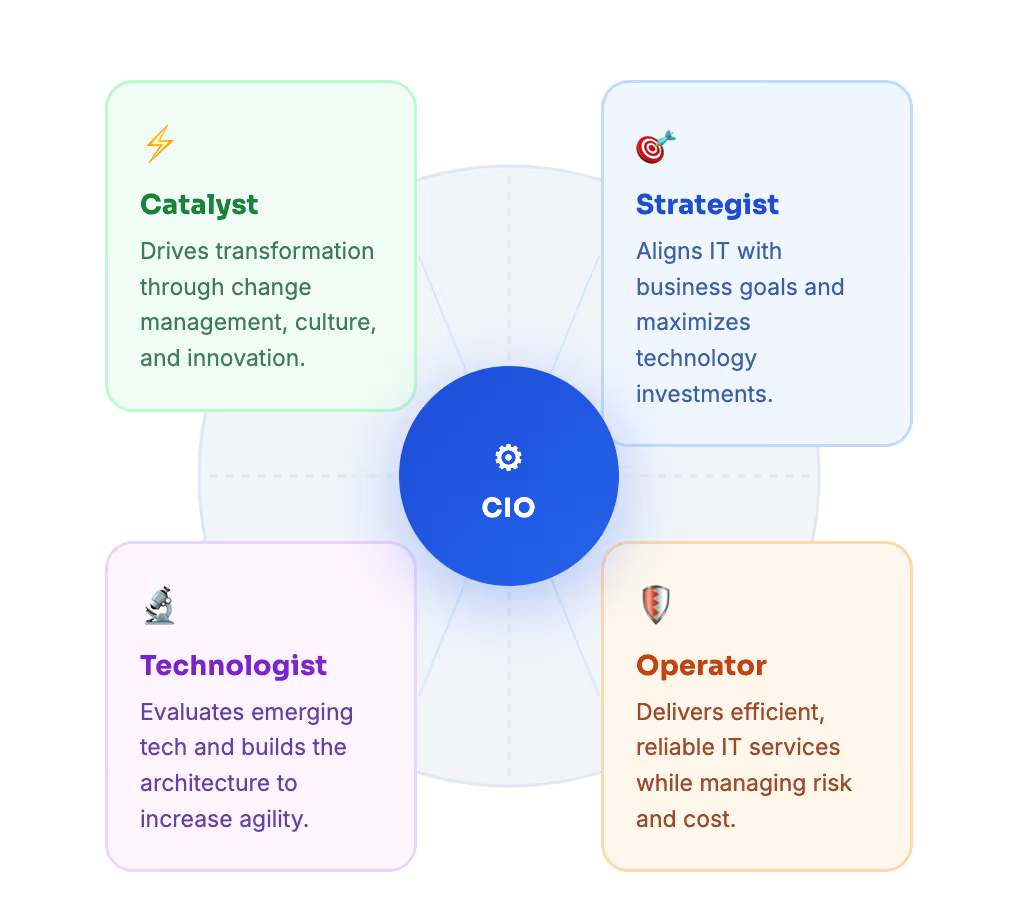
- Strategist: Aligns IT investments with business goals; focused on measurable value, not just stability.
- Catalyst: Drives transformation through change management, culture, and innovation.
- Technologist: Evaluates and deploys emerging tech to increase agility without creating sprawl.
- Operator: Delivers reliable IT services while managing cost, vendors, and governance.
Most CIOs lean toward one or two faces naturally. High-performing organizations need them to be effective across all four.
8. The Modern CIO's Biggest Governance Challenge
The hardest part of the CIO's job right now is not strategy. It is control.
Large enterprises now average 650 SaaS applications, many procured outside IT, without security review or budget approval. On top of that, AI tools are proliferating faster than any governance framework was designed to handle.
60% of AI and SaaS applications run as shadow IT, bypassing traditional IAM systems entirely, leaving CIOs with no visibility into what tools are in use, what data they access, or what they cost. Source: CloudEagle.ai Research
The CIO is the only executive with the cross-functional mandate to govern technology across all of those dimensions at once, and most are doing it without the right tools.
9. How CloudEagle.ai Helps CIOs Govern at Scale
CloudEagle.ai is a SaaS and AI governance platform built for teams, giving CIOs a single control layer across their entire software environment.
Most CIOs are governing a partial picture. Tools purchased by department heads, AI features embedded inside approved platforms, and ungoverned browser extensions, none of it reliably surfaces in standard IT inventories.
CloudEagle.ai closes that gap across five areas:
a) Full SaaS and AI Visibility
Most CIOs are governing a partial picture.
CloudEagle.ai pulls signals from SSO, finance data, browser logs, Zscaler, CrowdStrike, and HRIS to surface every SaaS and AI tool in use, including the 70% of embedded AI tools CIOs currently cannot see.
New tools are flagged automatically and routed to the right review workflow.
b) License and Spend Management
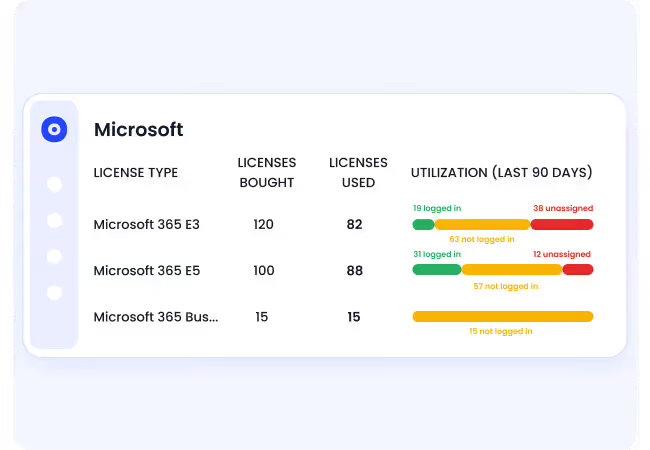
Unused licenses are the most predictable waste in any SaaS environment.
CloudEagle.ai provides 90-day active usage data per user, per application, showing exactly which licenses are dormant and where downgrade or cancellation is warranted.
c) Renewal Control
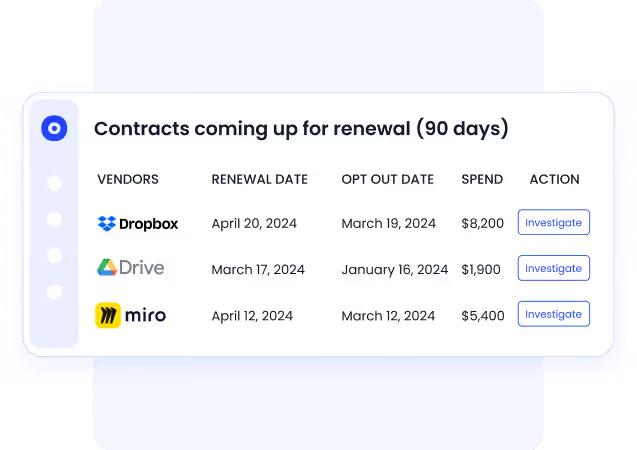
Contracts auto-renew because no one catches the opt-out date.
CloudEagle.ai extracts renewal dates, notice periods, and SKUs from contracts using AI, then alerts 90 days out with usage data and benchmark pricing attached, giving teams the leverage to negotiate.
d) Access Governance and Offboarding
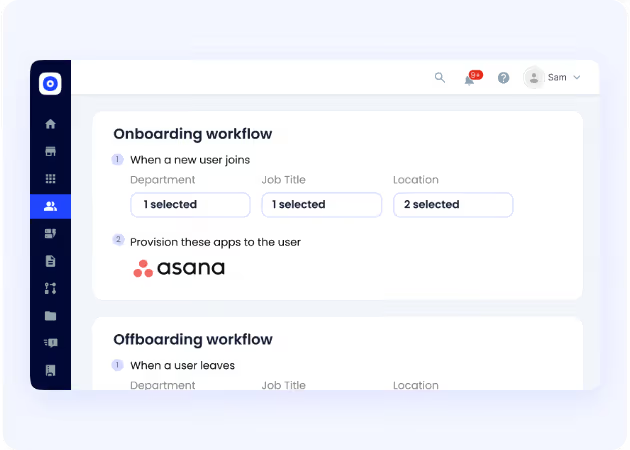
48% of former employees still have active access to corporate apps after leaving.
CloudEagle.ai automates provisioning and deprovisioning across SCIM and non-SCIM apps, tied to HRIS signals. Access reviews run on schedule. Overprivileged accounts surface automatically.
e) Shadow AI Detection
The harder problem is AI usage that never went through approval. CloudEagle.ai detects AI tools across browser activity, OAuth grants, expense data, and SSO logs. High-risk tools surface automatically.

IT can block access or push approved alternatives through the self-service app catalog.
60% of Your SaaS Stack Is Running Without You Knowing.


10. The CIO as Governor of What Comes Next
The CIO role has always required managing complexity. What has changed is the scale and speed of that complexity.
The enterprises where CIOs are most effective are not the ones with the best technology policies. They are the ones where governance is operationalized, where visibility is continuous, access is managed automatically, renewals are handled proactively, and AI adoption happens within a framework rather than around it.
That is what the modern CIO role and responsibilities demand. And it is what the right operating platform makes possible.
Ready to see what your full SaaS and AI footprint actually looks like? Book a demo with CloudEagle.ai and start with complete visibility.
11. FAQs
What is the difference between a CTO and a CIO?
The CIO owns internal technology infrastructure, SaaS governance, data, and access control. The CTO owns product and external-facing technology engineering, architecture, and R&D. The CIO runs technology for the business; the CTO builds technology as the business.
What are the top 3 CIO leadership skills?
Strategic thinking, cross-functional influence, and change management. Technical competency is assumed. These three determine whether a CIO can actually govern at scale.
Who is higher, CIO or COO?
The COO is typically second-in-command to the CEO and sits above the CIO in most org structures. In technology-led businesses, however, the CIO often carries equivalent strategic weight and in some organizations, reports at the same level.
What are the 4 faces of a CIO?
According to Deloitte: Strategist (aligns IT with business goals), Catalyst (drives transformation), Technologist (evaluates and deploys emerging tech), and Operator (delivers reliable IT while managing cost and governance).
What is the difference between a CIO and an IT Director?
An IT Director manages day-to-day IT operations: systems, staff, and infrastructure. A CIO operates at the strategic level: owning the technology roadmap, sitting in executive leadership, and making decisions that affect the entire organization. IT Directors report to the CIO. The distinction: an IT Director optimizes what exists; a CIO decides what should exist and why.


.avif)


.avif)
.avif)




.png)







.avif)
.avif)
.avif)


