%201.svg)


HIPAA Compliance Checklist for 2025

TL;DR
- ChatGPT's risk is not about OpenAI's infrastructure. It is about what happens after data leaves the prompt box, and how many of those paths a CISO cannot currently see
- Sensitive data exposure through prompts remains the highest-frequency risk, but it is no longer the least visible one
- Unsanctioned agent creation is the risk most risk registers do not have a line item for yet. One customer found over 100 agents built with zero approval process
- Personal accounts and unreviewed custom GPTs both bypass every enterprise control ChatGPT ships with
- Employees quietly migrating between AI tools for cost or quality reasons creates a moving target no single vendor's console tracks
- CloudEagle's AI governance module gives CISOs one place to see all of it: prompts, agents, personal accounts, and tool migration, without waiting for an incident to surface it
ChatGPT security risks rarely start with the tool itself.
They start with what a CISO's risk register does not have a line item for yet: agents nobody approved, personal accounts nobody reviewed, and quiet migrations to other tools nobody tracked.
This is not a rehash of prompt injection basics. It is the risk inventory a CISO should actually be building in 2026.
Understanding ChatGPT security risks at this level of specificity is what separates a reactive incident response from a proactive governance program.
1. Why ChatGPT Should Be on Every CISO's Risk Register in 2026
OpenAI's infrastructure security is not what this conversation is about.
The risk is the blast radius inside a specific company. Every path data or identity can move through ChatGPT is a line item on the risk register.
Not just a note that the tool exists, but a specific entry for each mechanism: prompt exposure, agent creation, personal accounts, connected integrations, and the migration patterns that happen when employees quietly stop using one tool and start using another.
The full scope of ChatGPT security risks extends well beyond prompt exposure. It covers every path that data, identity, or access can travel through the tool, sanctioned or not.
Most risk registers have the prompt line. Very few have the others.
2. What Are the ChatGPT Security Risks Every CISO Should Know in 2026?
Seven risks. Four are well documented. Two are almost entirely undocumented in most risk registers. One bridges them together.
1. Sensitive Data Exposure Through Prompts
This is the risk everyone knows. Employees paste source code, contracts, and PII into prompts to get work done faster. Samsung's 2023 ChatGPT ban followed exactly this pattern, when engineers pasted proprietary code and internal meeting notes into ChatGPT and the data was retained and potentially used for model training.
The open question for a CISO in 2026 is not whether this risk exists. It is whether prompt-layer DLP exists at all in your environment.
For a deep dive on governing this specific risk: 👉 ChatGPT Enterprise Security: How To Govern Your AI in 2026
2. Prompt Injection Through Connected Content
As ChatGPT reads webpages, documents, and emails as part of an agentic task, that content becomes untrusted input capable of steering its next action.
A malicious instruction embedded in a document the agent is asked to summarize is enough. The agent cannot reliably distinguish a legitimate instruction from a malicious one embedded in the data it is processing.
This risk requires controls at the permissions and network policy layer, not at the prompt layer.
This piece names it as a risk to track. The controls for it sit inside ChatGPT's own settings, not in an external governance platform.
3. Personal Accounts Operating Outside Enterprise Controls
A personal ChatGPT account has:
- No SSO
- No audit log
- No data retention policy tied to the company
- No visibility in any enterprise console
From the outside, it looks identical to enterprise usage. The only difference is that every enterprise control ChatGPT ships with is completely absent.
For the full breakdown on personal account governance: 👉 Your Employees Are Using Personal AI Accounts to Bypass Your Enterprise Token Limits
4. Unreviewed Custom GPTs Connecting to Internal Data
A custom GPT built by one team can quietly gain access to a shared drive, ticketing system, or internal knowledge base, with no formal security review unless one is built into the deployment process. Most are not.
This is one of the ChatGPT security risks that governance programs built around SSO and DLP consistently miss, because the tool is approved and the custom GPT built on top of it is invisible to both.
The tool is approved. The custom GPT built on top of it is not reviewed. That gap is where data exposure accumulates silently.
5. Unsanctioned Agent Creation and Sprawl
This is the risk most risk registers do not have a line item for yet.
Without a formal approval process, teams build agents the way they used to build spreadsheets: fast, useful, and completely untracked. A customer discovered more than 100 agents already created across their organization. The governance gaps were clear:
- No approval process: None of the agents had gone through formal review.
- No ownership: None had an assigned owner accountable for its behavior or access.
- No data visibility: Nobody knew what data each agent could access or what systems it touched.
- No central inventory: Security had no reliable way to know how many agents existed or where they were running.
The risk does not fit neatly into "prompt risk" or "account risk," which is exactly why most organizations do not have a governance answer for it yet. An unsanctioned agent is not a prompt someone typed once. It is a standing process with its own access, running continuously, owned by nobody.
More on why this category is the risk most CISOs are missing is covered in the next section.
6. Quiet Migration Between AI Tools
Employees do not always abandon ChatGPT publicly.
When a team is frustrated with cost or output quality, they quietly route work to a different assistant. That migration is invisible unless spend and usage are tracked centrally.
The migration can create several blind spots:
- Usage disappears: ChatGPT usage drops even though the team's AI activity has not.
- Spend moves elsewhere: The missing usage may show up as spend on another AI tool.
- Security review is bypassed: The replacement tool may never have gone through an approval process.
- Sensitive work follows the user: Employees may move the same workflows and data to an unreviewed assistant.
From a CISO's perspective, this is not just a procurement problem. It is a visibility problem. The tools that replaced ChatGPT for that team may have gone through no approval process at all.
7. Memory and Cross-Session Data Retention
ChatGPT's memory features can retain information across sessions in ways an employee may not realize.
A single risky prompt, a client name, a deal detail, a financial projection, can become a standing exposure rather than a one-time event if memory is enabled. The employee who typed it once assumes it is gone. It is not.
The risk is created by what persists after the original interaction:
- Sensitive information can persist: Details entered in one session may remain available beyond that interaction.
- Context can carry forward: Retained information can influence future conversations.
- Employees may not realize it: Users may assume ending a conversation means the information is no longer retained.
- Traditional DLP can miss it: Prompt-focused controls typically focus on what leaves a session, not what persists inside the AI system.
This is a newer risk category that most prompt-focused DLP tools were not designed to catch, because it is not about what leaves the session but what persists inside it.
📖 Worth a Read 👉 The Shadow AI Governance Gap: Why 63% of Enterprises Have No Shadow AI Policy
3. Why Unsanctioned Agent Creation Is the Risk Most CISOs Are Missing
Most AI risk registers were built around two categories: prompts and accounts.
Prompt risk is about what employees type. Account risk is about who has access. Both categories have governance answers: DLP for prompts, SSO and access reviews for accounts.
Of all the ChatGPT security risks on this list, agent sprawl is the one with the fewest governance answers available today, because it requires a different category of tooling than what most security teams have deployed.
Agents do not fit either category. An agent is not a prompt someone typed once. It is not an account someone logged into. It is a standing process that:
- Has its own data connections
- Runs continuously without human checkpoints
- Was built by a business user in a low-code environment
- Has no natural owner in most governance frameworks
Most organizations have no inventory of how many agents exist, because agents were never meant to be tracked as identities. They were built as features. They function as standing access with no review cadence.
The tool-migration risk compounds this. Employees who quietly shift work from ChatGPT to another AI tool often build new agents in that tool as well. Unless spend and identity are tracked centrally, both the migration and the new agents it created are invisible.
Both are sprawl problems. Neither prompt-DLP nor account-level SSO was built to catch either one.
Does Your Risk Register Have a Line Item for Unsanctioned Agents?


4. How Should CISOs Prioritize AI Security Risks Like These?
Not every risk needs the same response this quarter.
A useful way to prioritize: two axes, how many people or agents are already exposed, and how hard the exposure is to see. That gives a defensible order to work through rather than a flat list that treats prompt injection and agent sprawl as equally urgent.
Mapping ChatGPT security risks against blast radius and visibility gives a prioritization framework that holds up under board scrutiny, unlike a flat list that treats all seven risks as equally urgent.
The rough triage, based on frequency and visibility today:
Start with the risks that are simultaneously high blast radius and low visibility. That is unsanctioned agents and personal accounts, not prompt injection, which has the most governance tooling already built around it.
Rank by Blast Radius, Not Alphabetical Order
Correlate identity, agent inventory, and spend data to see which risk actually touches the most sensitive systems today.
A ChatGPT agent connected to your internal CRM with no owner is a higher priority than a prompt injection risk affecting a team using ChatGPT for public research. The identity and spend data surfaces that distinction. A policy document does not.
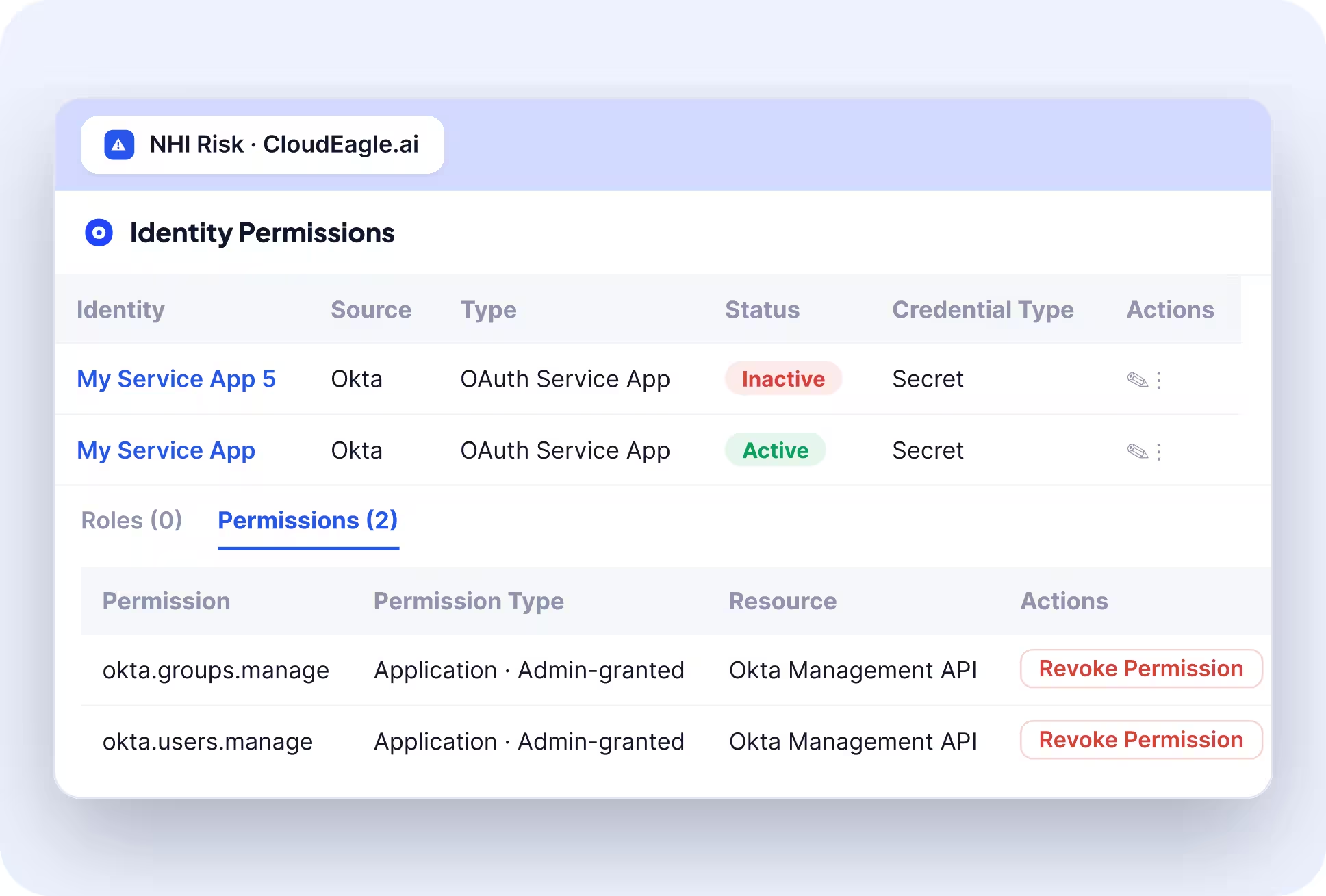
CloudEagle's AI governance module gives CISOs the inventory layer that makes this prioritization possible: which tools are in use, which agents exist, who owns them, and what they can reach.
Bring Agent Creation Under the Same Review as App Access
Every AI agent should be treated as a non-human identity with a named owner, a documented purpose, and a defined permission scope.
That means:
- An ownership record assigned at the moment of discovery
- Access scope documented against stated purpose
- A review cadence that fires when the owner leaves the organization
- Transfer or decommission when the use case ends. No third option
Applying this ownership model to every agent closes the most underdocumented ChatGPT security risk on the list without requiring a blanket restriction that pushes behavior underground.

CloudEagle's non-human identity governance capability treats each agent as an identity in the same governance layer as service accounts and API keys, not as a feature nobody tracks.
Set the Boundary Honestly
This governance layer covers visibility and ownership tracking across prompts, accounts, agents, and spend.
It does not inspect prompt content in real time or block specific outputs. That is a prompt-layer DLP and policy decision that the CISO's own team owns inside ChatGPT's settings and complementary DLP tooling.
Both layers matter. Neither substitutes for the other.
The webinar below covers how teams are actually discovering and governing the full scope of shadow AI and hidden access across their AI environments, including the agent sprawl and migration patterns above:
🎙️ Webinar 60% Invisible: Shadow AI and Hidden Access Crisis in SaaS and AI Environments. 👉 Watch now
Get Started
The ChatGPT security risks that matter most in 2026 are the ones your risk register does not have a line item for yet: agents nobody approved, personal accounts nobody reviewed, and tool migrations nobody tracked.
CloudEagle's AI governance module gives CISOs the inventory layer to surface all of it, agent sprawl, personal account usage, and cross-tool spend visibility, from one place rather than waiting for an incident to make them visible.
Book a demo with CloudEagle.ai to see what your ChatGPT footprint actually looks like before the next audit does.
Frequently Asked Questions
1. Is ChatGPT itself insecure?
No. The risk is how employees use it: what data they submit, what agents they build, what personal accounts they use, and which integrations they connect without review.
2. What's the difference between shadow AI and an unsanctioned agent?
Shadow AI is an unapproved tool. An unsanctioned agent is an unreviewed process built inside an approved tool. The first needs access governance; the second needs non-human identity governance.
3. Should CISOs ban ChatGPT agents until a policy exists?
Not necessarily. Blanket bans can push usage underground. Start by discovering existing agents, understanding their access and ownership, then decide which should be approved, restricted, or removed.
4. How do you find unsanctioned AI agents?
Look beyond your approved AI inventory. Correlate identity, application, agent, permissions, integrations, and usage signals to find agents, their owners, what they access, and whether they have been reviewed.
5. Who should own an AI agent after it is created?
Every production agent should have a named human owner accountable for its purpose, access, data scope, and lifecycle. Without ownership, agents can become orphaned non-human identities.
6. What should an AI agent governance policy cover?
Define who can create agents, required approvals, permitted data and systems, ownership, credential controls, review periods, and retirement rules. Approving an AI tool does not approve every agent built inside it.
Does Your Risk Register Have a Line Item for Unsanctioned Agents?


.avif)


.avif)
.avif)




.png)




.avif)
.avif)
.avif)


