HIPAA Compliance Checklist for 2025

Most enterprises are already using AI agents, but governing them remains a challenge. SailPoint's 2026 Horizons of Identity Security report found that 79% of enterprises have agents in production, while only 2% have identity tools designed to govern them.
Understanding AI agents starts with recognizing that they come in different types. Some follow predefined rules, while others learn from feedback, work toward specific goals, or collaborate with other agents to complete tasks.
This guide explains the main types of AI agents, how they differ in their decision-making, and how these differences affect their capabilities, use cases, and governance requirements.
1. What Are the Types of AI Agents?
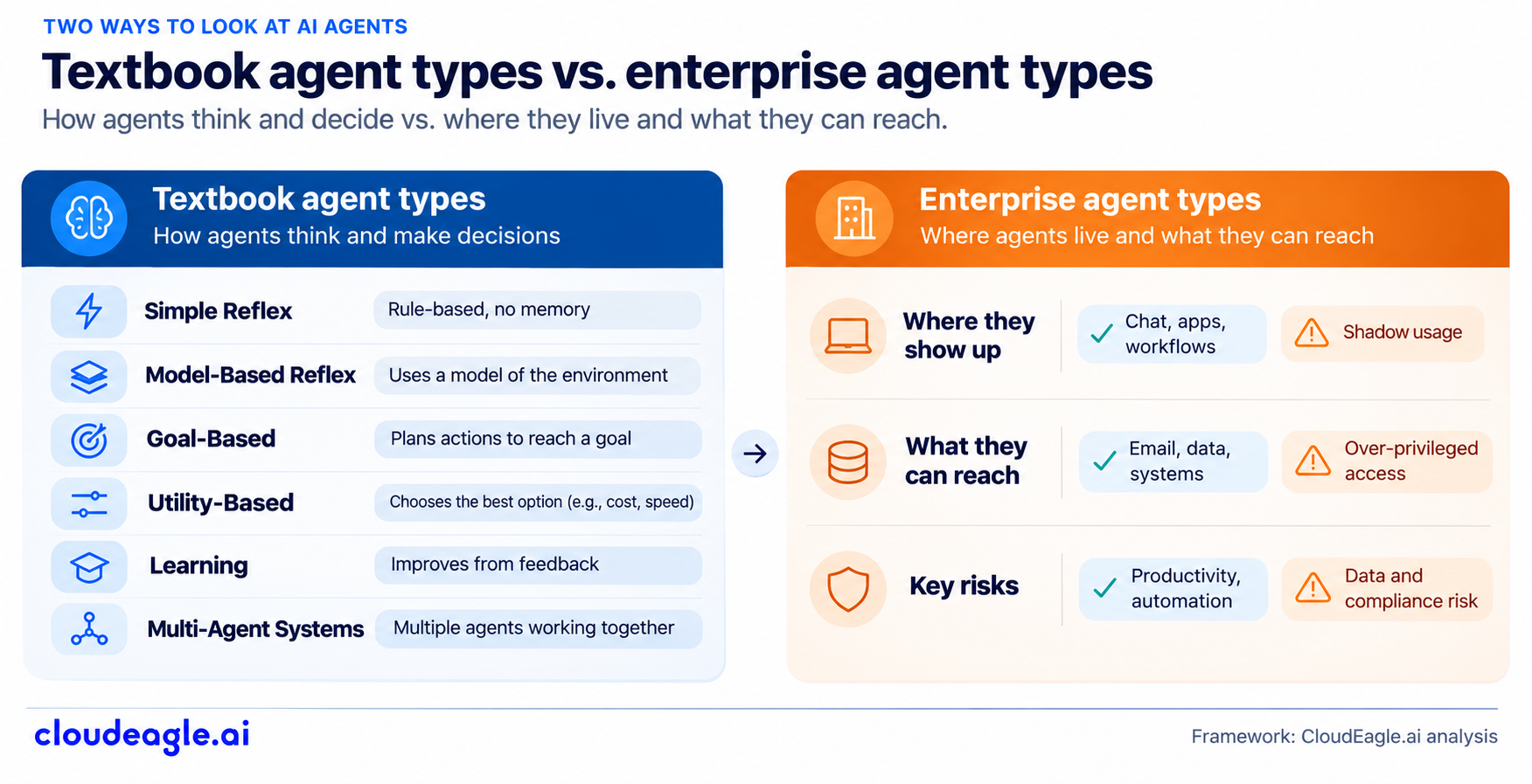
The classic types of AI agents are simple reflex, model-based reflex, goal-based, utility-based, and learning agents, plus multi-agent systems that combine several of them.
These types describe how an agent decides what to do, from fixed rules to learning from results.
Simple Reflex Agents
A simple reflex agent follows if-then rules on the current input, with no memory. An auto-reply rule that routes tickets by keyword is a simple reflex agent.
Model-Based Reflex Agents
A model-based reflex agent keeps an internal picture of its environment, so it can act on things it can't directly see right now. A monitoring agent that tracks system state over time is one example.
Goal-Based Agents
A goal-based agent plans a sequence of actions to reach a defined outcome. Most LLM agents that break a task into steps work this way.
Utility-Based Agents
A utility-based agent weighs options against a score, such as cost, speed, or risk, and picks the best one. Scheduling and routing agents often use this approach.
Learning Agents
A learning agent improves from feedback and past results. Its behavior can drift over time, which is why it needs ongoing review.
Multi-Agent Systems
A multi-agent system splits work across several specialized agents that pass tasks between them. One weak agent with broad access can expose every agent downstream.
Here's the catch. None of these types tells you who owns the agent or what it can touch.

2. Which AI Agent Types Show Up in the Enterprise?
In the enterprise, AI agents fall into six types by where they're built and what they can reach: copilots, low-code agents, SaaS-embedded agents, coding agents, custom agents, and third-party or MCP-connected agents.
Each one runs on a different kind of identity.
Assistant and Copilot Agents
Copilots like Microsoft 365 Copilot act on behalf of the user, with that user's permissions. They reach everything the user can reach, including files that were overshared years ago.
Low-Code and Citizen-Built Agents
Business users build these in tools like Microsoft Copilot Studio, Power Automate, and Salesforce Agentforce. They often run on their creator's connections, so they keep working after the creator moves on.
Picture this. A finance analyst builds an agent on a Friday afternoon. She changes teams in March. In June, it's still running on her connections.
Agents Embedded Inside SaaS Apps
Vendors are adding agents to the SaaS apps you already pay for, and some arrive switched on. They can read the app's data under the vendor's terms, which makes embedded AI a blind spot for most IT teams.
AI Coding Agents
Coding agents like Claude Code, GitHub Copilot, and Cursor run in developer environments with access to repositories, terminals, and tokens. Our guide to Claude Code security covers the risks in detail.
Custom Agents Built on APIs and Agent Frameworks
Engineering teams build these on platforms like Amazon Bedrock, Google Vertex AI, Microsoft Foundry, and open-source frameworks. They usually run on service principals or API keys, which are often long-lived and broadly scoped.
Third-Party and MCP-Connected Agents
External agents connect to your systems through OAuth grants or MCP servers. Many of those connections are approved by one user and never reviewed again.
That's why MCP servers are becoming an ungoverned access surface.
Worth a Read: Why Most of Your Non-Human Identities Are Now AI Agents and Not Service Accounts
3. Why Does Each Agent Type Need Different Governance Controls?
Each agent type needs different controls because each one runs on a different identity and reaches data in a different way.
The AI agent governance model stays the same, but the control that matters most changes by type.
The pattern holds across all six: identify the identity, then govern it.
Worth A Read: 5 Best Practices to Govern AI Agent Identities in Your Enterprise
4. How Do You Govern Every Type of AI Agent?
You govern every type of AI agent by finding it, treating it as a non-human identity with a human owner, and scoping its access to its job. Then you review it regularly and keep a way to stop it.
The full framework covers each step in depth.
Discover Agents Across Every Creation Channel
Agents get built in at least six places, so discovery can't rely on one platform's console. Read machine identities from your identity providers and connected apps.
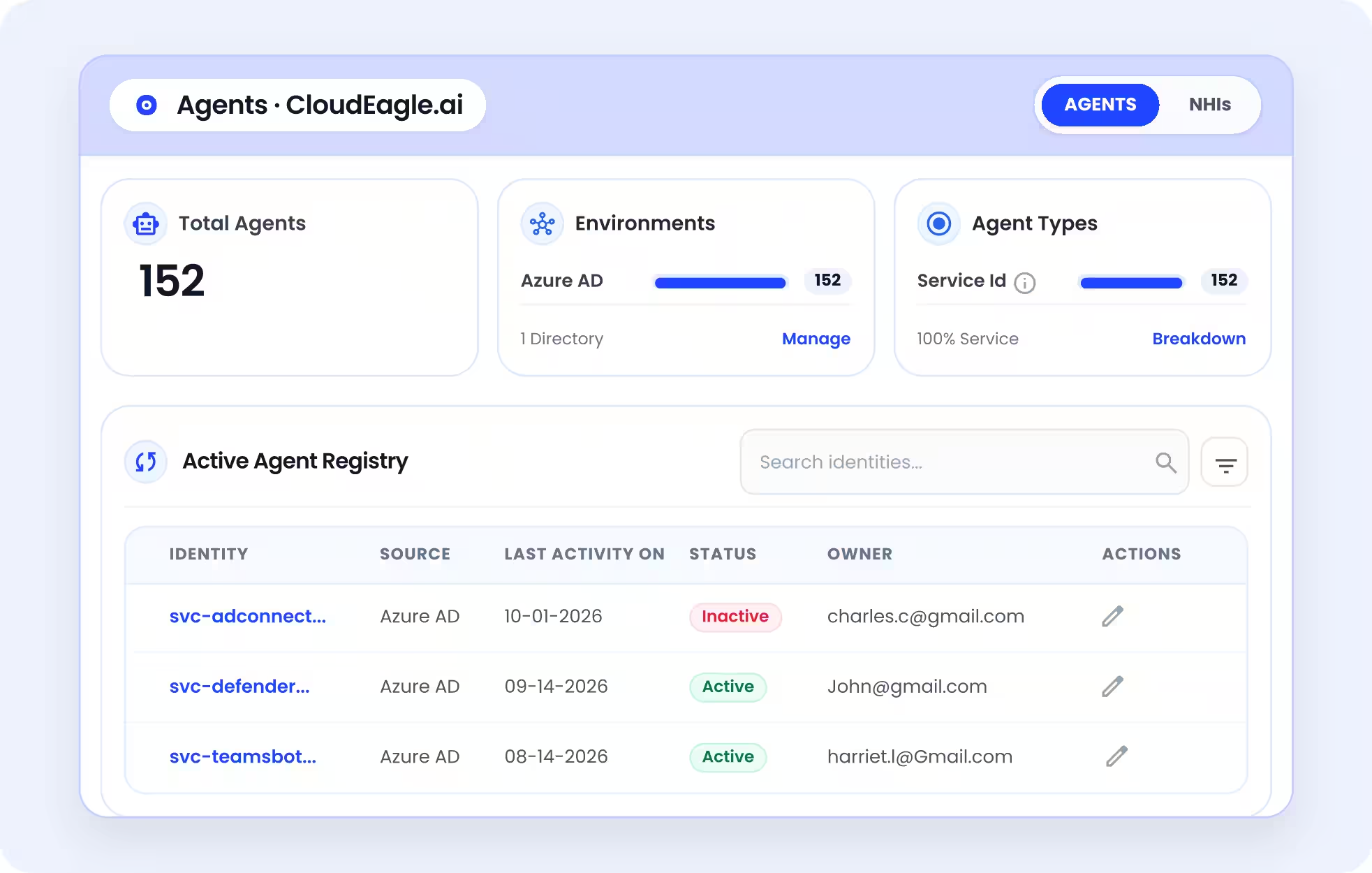
Pair that with shadow AI discovery to catch the tools where agents begin.
Embedded and MCP-connected agents are the easiest to miss. Look for AI features switched on inside SaaS apps and OAuth grants nobody has reviewed.
Treat Every Agent as a Non-Human Identity With a Human Owner
Whatever the type, every agent connects through an identity, and every identity needs a named owner. For low-code and coding agents, that's usually the builder. For custom agents, it's the team that ships them.
"The platform team" is not an owner. A name is.
Read this case study to see how Armorcode brought service accounts, API tokens, and AI agents under one rule.
As our identity environment expanded, governing non-human identities became just as important as managing human access. CloudEagle.ai gave us visibility into service accounts, API tokens, and AI agents, helping increase NHI visibility, remediate unmanaged identities, and reduce overprivileges, helping us govern NHI, the same way we did for people.”
Karthik Swarnam, Chief Security and Trust Officer, Armorcode
Scope Access by Agent Type and Data Sensitivity
- Copilots: fix data permissions at the user level.
- Custom and coding agents: use narrow API scopes and short-lived keys.
- Embedded agents: check which data the vendor's agent can reach.
The more sensitive the data, the tighter the scope and the shorter the credential's life.
Monitor Activity and Review Agents Continuously
Keep a log of what each agent did, changed, and touched, traced back to its owner.
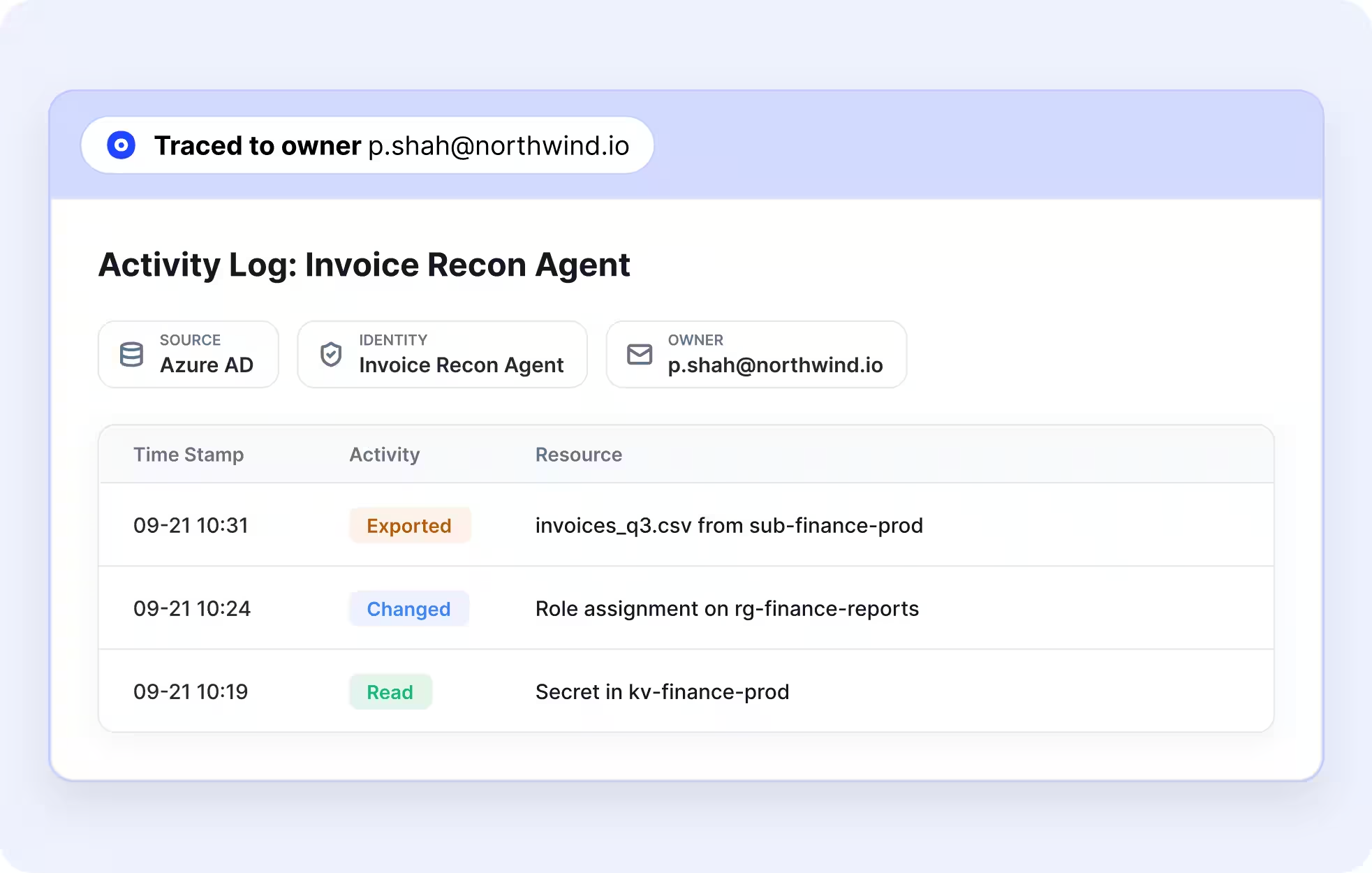
Put agents through access reviews alongside employees, with high-risk agents reviewed more often.
Keep a Kill Switch and Offboard Orphaned Agents
You need one place to revoke an agent's roles, rotate its secrets, or deactivate its identity. Check the agent's owner and access first, because disabling the wrong identity can break a business process.
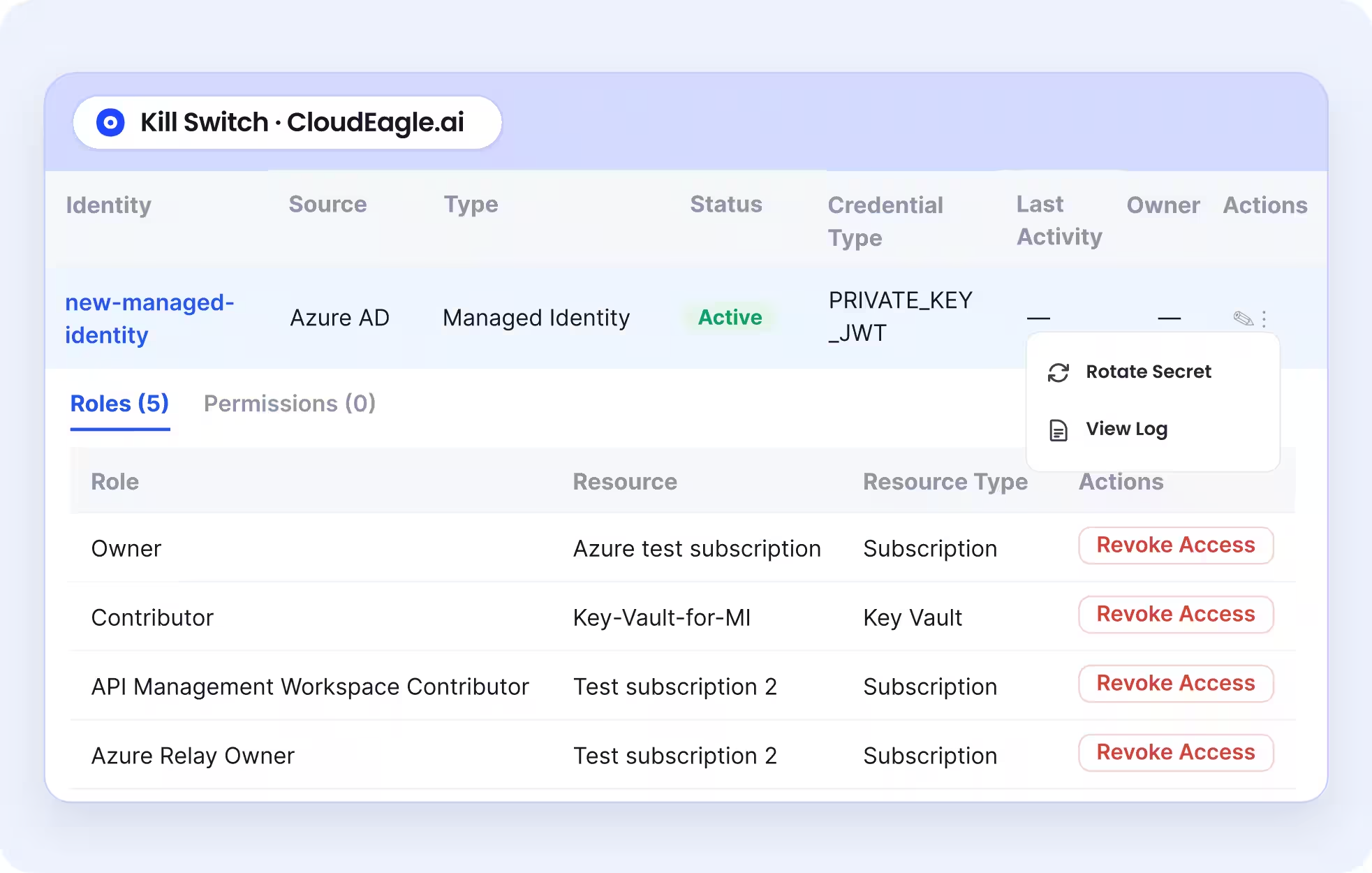
When an owner leaves, reassign or retire every agent they built.
Govern the Identity Behind Every Agent


5. What Mistakes Do Teams Make When Governing AI Agents?
- Writing policy around textbook types: "Goal-based agents need approval" is hard to enforce. "Low-code agents need an owner before they're published" is not.
- Governing only one platform's agents: Microsoft agents are visible in Microsoft's console, but your coding, embedded, and custom agents are not.
- Letting the builder's credentials stand in for the agent: When the builder leaves, the agent's access becomes nobody's responsibility.
- Treating embedded agents as the vendor's problem: The vendor ships the agent, but it reads your data.
Standalone detection tools help, but only if what they find gets an owner and a review.
Govern Every Type of AI Agent With CloudEagle.ai
The textbook types of AI agents explain how agents think. The enterprise types explain where they hide and what they reach, and AI agent governance has to follow that.
CloudEagle.ai brings AI, SaaS, and identity governance into one control plane, with 500+ direct integrations. We find agents across Entra ID, Okta, and your connected apps, tie each one to an owner, and let your admins revoke, rotate, or deactivate it from one view.
Our agent security platform governs agents alongside your people and SaaS access. See it in action in our agent governance walkthrough.
Govern Every SaaS and AI Identity. Don't let an agent you never classified find your gaps first. Watch this webinar or book a demo.
Frequently Asked Questions
- Which AI Agents Are Hardest to Discover?
SaaS-embedded agents and third-party or MCP-connected agents are the hardest to find. Embedded agents arrive inside apps you already own, and external agents connect through OAuth grants or MCP servers that one user approved and nobody reviewed.
- What Is the Difference Between an AI Agent and a Copilot?
A copilot assists one person with that person's permissions, and the person decides what happens next. An AI agent completes tasks on its own, often across several systems, using an identity of its own or one it borrowed.
- Which Type of AI Agent Carries the Most Enterprise Risk?
Of all the types of AI agents, custom agents and low-code agents usually carry the most risk. Custom agents often hold long-lived, broad API keys. Low-code agents keep their creator's access after the creator leaves.
- Are AI Agents Non-Human Identities?
Yes. Every agent connects through an identity, such as a service principal, API key, or OAuth grant. That's why NHI management now covers AI agents alongside service accounts and tokens.
- Who Should Own AI Agent Governance?
Security and IAM usually share AI agent governance. An AI or innovation team often approves new agents, while IAM governs the identities behind them. Every individual agent still needs one named human owner.
Govern the Identity Behind Every Agent