AI Governance

‍The 2026 Ultimate Guide to AI Agent Governance for Enterprises

Share via:
Written by:
CloudEagle.ai Team
Reviewed by
Nidhi Jain
Last Updated:
October 26, 2026
blog-cms-banner-bg
Little-Known Negotiation Hacks to Get the Best Deal on Slack
cta-bg-blogDownload Your Copy

HIPAA Compliance Checklist for 2025

Download PDF

Before implementing an AI agent governance framework, organizations need to understand how quickly agents are being deployed and why they can be difficult to track.

Teams build AI agents across internal platforms, third-party applications, and custom workflows, often faster than IT and security teams can inventory them. These agents may hold access to sensitive data, APIs, and business systems, creating risks when ownership, permissions, and activity go unreviewed.

The first step is to establish an inventory of AI agents, understand what they can access, and identify who is responsible for them. From there, organizations can build a governance framework that keeps agent access, ownership, and risk under control as adoption grows.

‍

1. What Is AI Agent Governance?

AI agent governance is the set of policies, owners, and controls that decide which AI agents can run in your company, what they can reach, and who answers for them.

It treats each agent as an identity that needs discovery, ownership, scoped access, oversight, and a proper retirement.

An agent acts. It reads files, calls APIs, updates records, and sends messages, all through credentials someone gave it. Governance makes sure every one of those credentials has a reason and an owner. Our agent governance walkthrough shows how this works in practice.

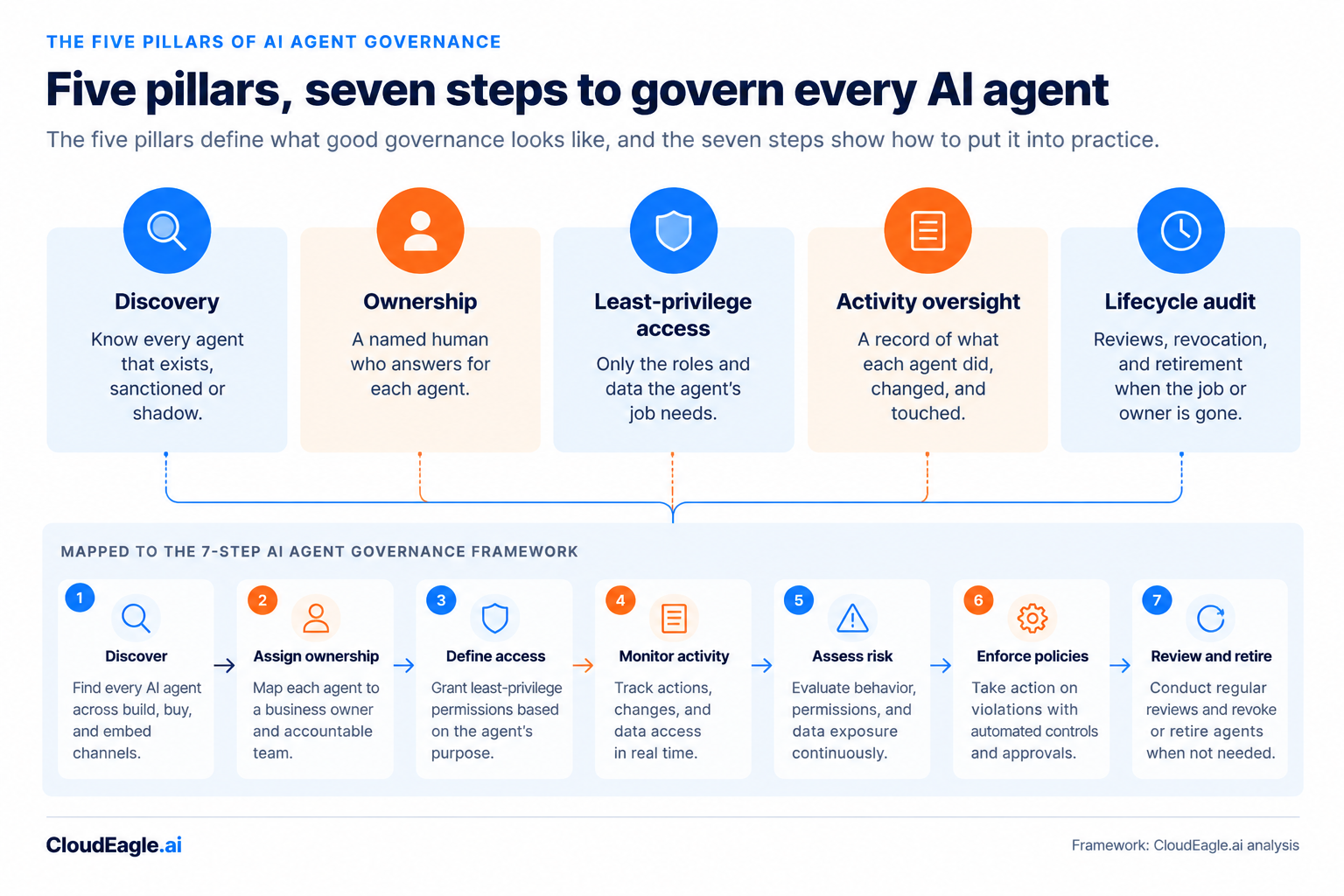
The Five Pillars of AI Agent Governance

  • Discovery: knowing every agent that exists, sanctioned or shadow.
  • Ownership: a named human who answers for each agent.
  • Least-privilege access: only the roles and data the agent's job needs.
  • Activity oversight: a record of what each agent did, changed, and touched.
  • Lifecycle audit: reviews, revocation, and retirement when the job or owner is gone.
‍

‍

How AI Agent Governance Differs From Traditional AI Governance

Traditional AI governance asks whether a model is fair, accurate, and safe to use. AI agent governance asks what an agent is allowed to do, and what happens when it does something wrong.

‍

Traditional AI governance AI agent governance
Core question Is the model fair, accurate, and safe? What can the agent do, and who answers for it?
What you govern Models and outputs Identities, access, and actions
Main risk Bad outputs Standing access used at machine speed
Key control Model review Ownership, least privilege, activity logs

‍

Models produce outputs. Agents take actions with standing access. That's why most frameworks built for models leave agents uncovered.

‍

2. Why Did Ungoverned AI Agents Become a Board-Level Risk in 2026?

Ungoverned AI agents became a board-level risk because they multiplied faster than anyone could track them.

Each one holds credentials, often too many, and often with no owner. When one misbehaves, nobody can say quickly what it touched or who should stop it.

Shadow Agents Built Outside IT

Business teams build agents in Copilot Studio, Salesforce Agentforce, low-code platforms, and MCP-connected tools without a security review. Many never pass through procurement or IT at all.

Teams that build across Copilot Studio, Azure AI Foundry, and AWS Bedrock hit the same wall. Weekly manual security reporting can't keep pace.

Overprivileged and Ownerless Agent Identities

Picture this. A sales ops manager builds an agent on a Friday. She changes roles in March. In June, the agent is still running with every permission she gave it.

Agents usually inherit the access of whoever built them, and nobody takes it back. That's why agent identities now make up a growing share of non-human identities, and why so many hold excess access.

Sensitive Data Reached at Machine Speed

A person might open a few sensitive files in a day. An agent with the same permissions can read thousands in minutes.

Mistakes and misuse scale the same way. One misconfigured agent can export a customer database before anyone notices.

Regulatory Pressure From the EU AI Act, NIST, and ISO 42001

Here is where each one stands in 2026:

‍

Framework Where it stands What it means for agents
EU AI Act The Digital Omnibus on AI took effect on July 27, 2026. High-risk obligations move to December 2, 2027 for standalone systems, and August 2, 2028 for AI embedded in regulated products. Deadlines moved, so plan now
NIST The AI Agent Standards Initiative launched on February 17, 2026, with a concept paper on AI agent identity and authorization. Identity sits at the center
Singapore IMDA's Model AI Governance Framework for Agentic AI arrived on January 22, 2026. Humans stay accountable, with oversight that can override or review agent actions
ISO 42001 The AI management system standard. Show who owns each AI system and how you control it

‍

A deferred deadline is not a reason to wait. Auditors will ask for agent inventories, owners, and access records well before 2027.

Worth a Read: AI Agent Lifecycle Management: A Complete Enterprise Guide

‍

You Can't Govern Agents You Can't Find.

Discover how to uncover shadow AI tools operating outside IT visibility before they create security and compliance gaps.
Find Hidden AI Tools

‍

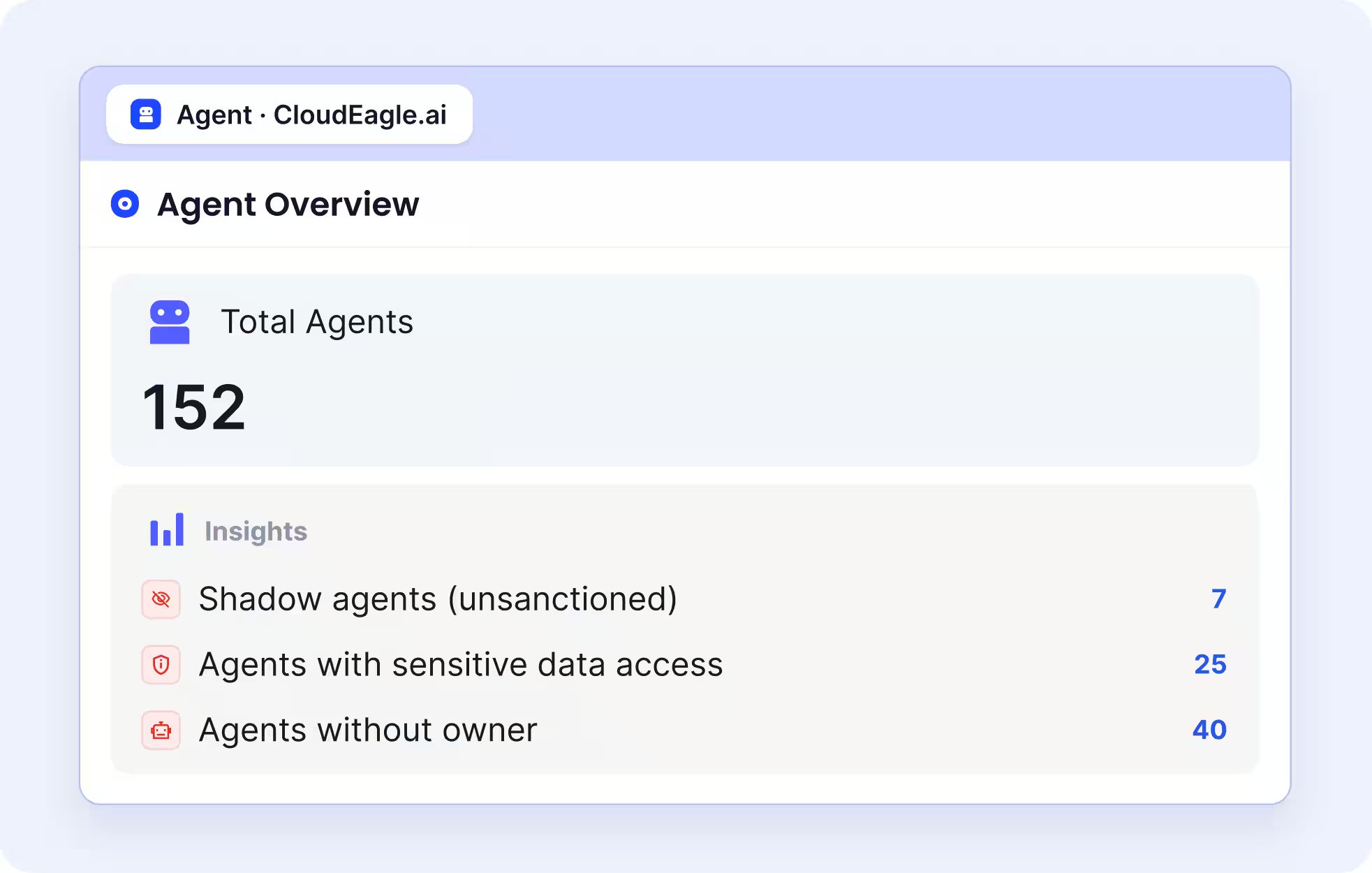
3. How Do You Build an AI Agent Governance Framework?

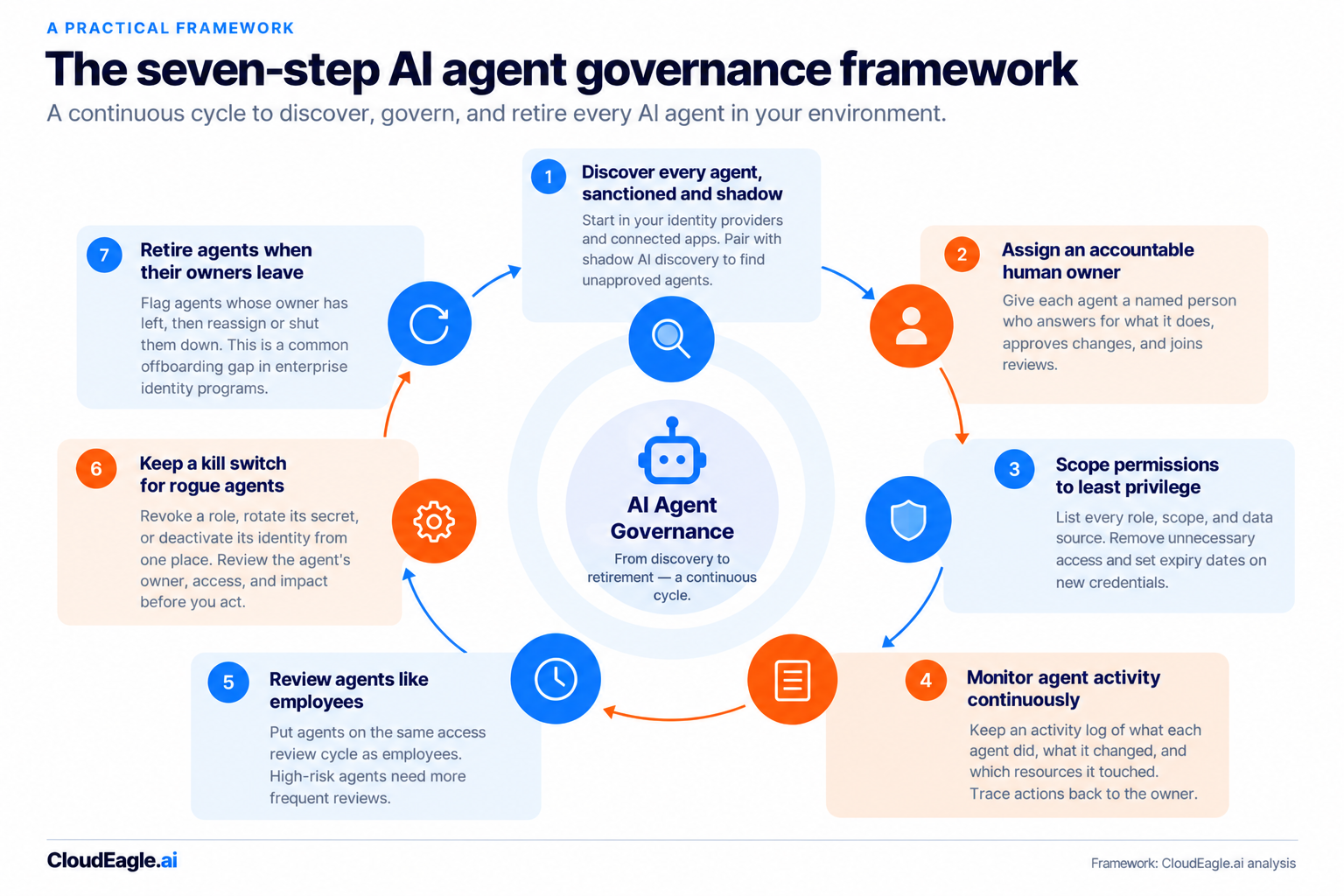
You build an AI agent governance framework by discovering every agent, giving each one an owner, and scoping its access. Then you record its activity and review it on a set cadence.
‍

‍

After that, add a way to stop the agent and a rule for retiring it.

Step 1: Discover Every Agent, Sanctioned and Shadow

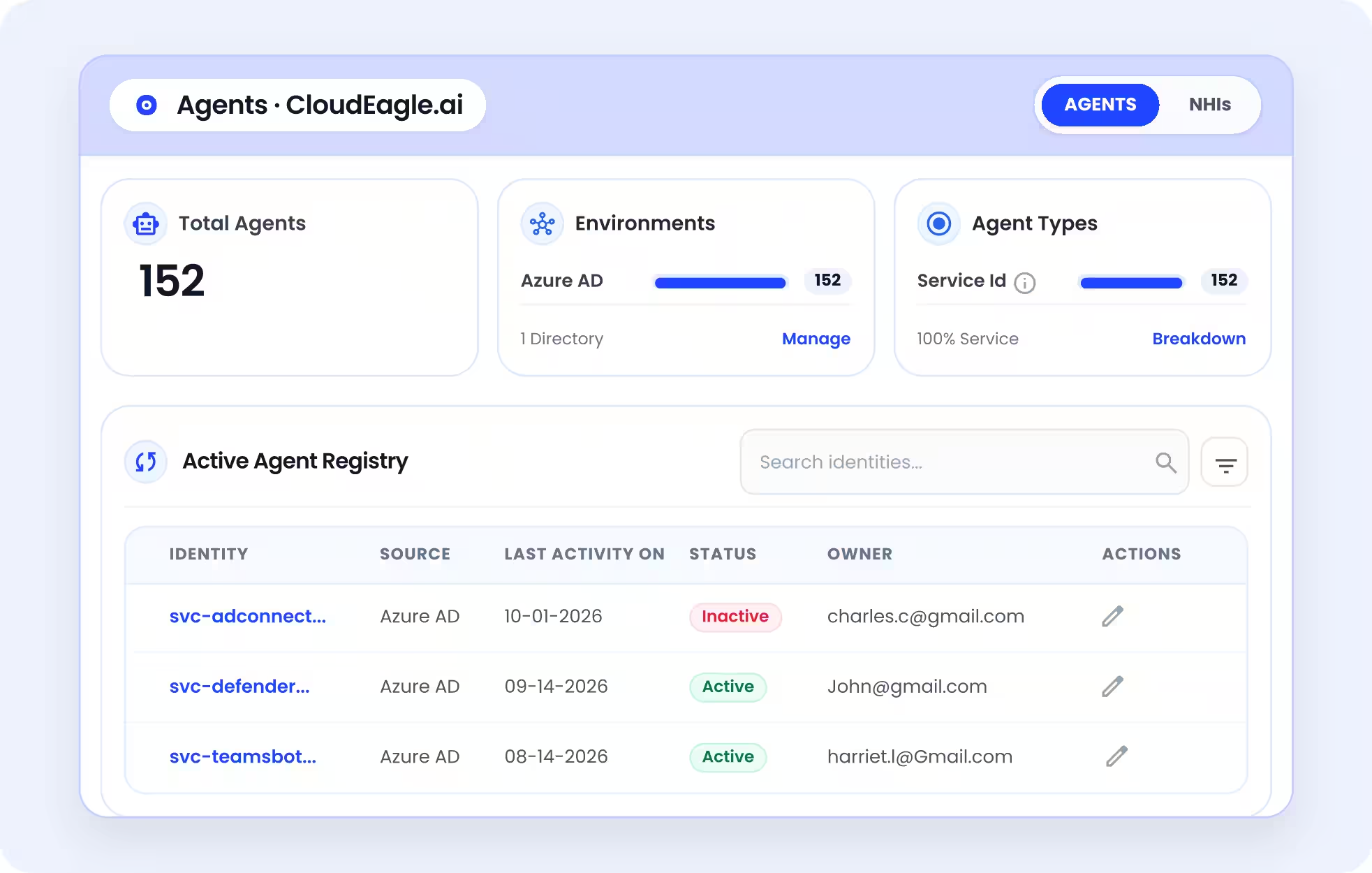
Agents run under machine identities, so start in your identity providers and connected apps rather than waiting for teams to register what they built.

Pair agent discovery with shadow AI discovery. Unapproved AI tools are often where unapproved agents begin.
‍

‍

Step 2: Assign an Accountable Human Owner to Each Agent

Every agent needs a named person who answers for what it does. "The marketing team" is not an owner.

Ownership also settles who approves changes, who joins reviews, and who gets the call when the agent misbehaves.

Step 3: Scope Agent Permissions to Least Privilege

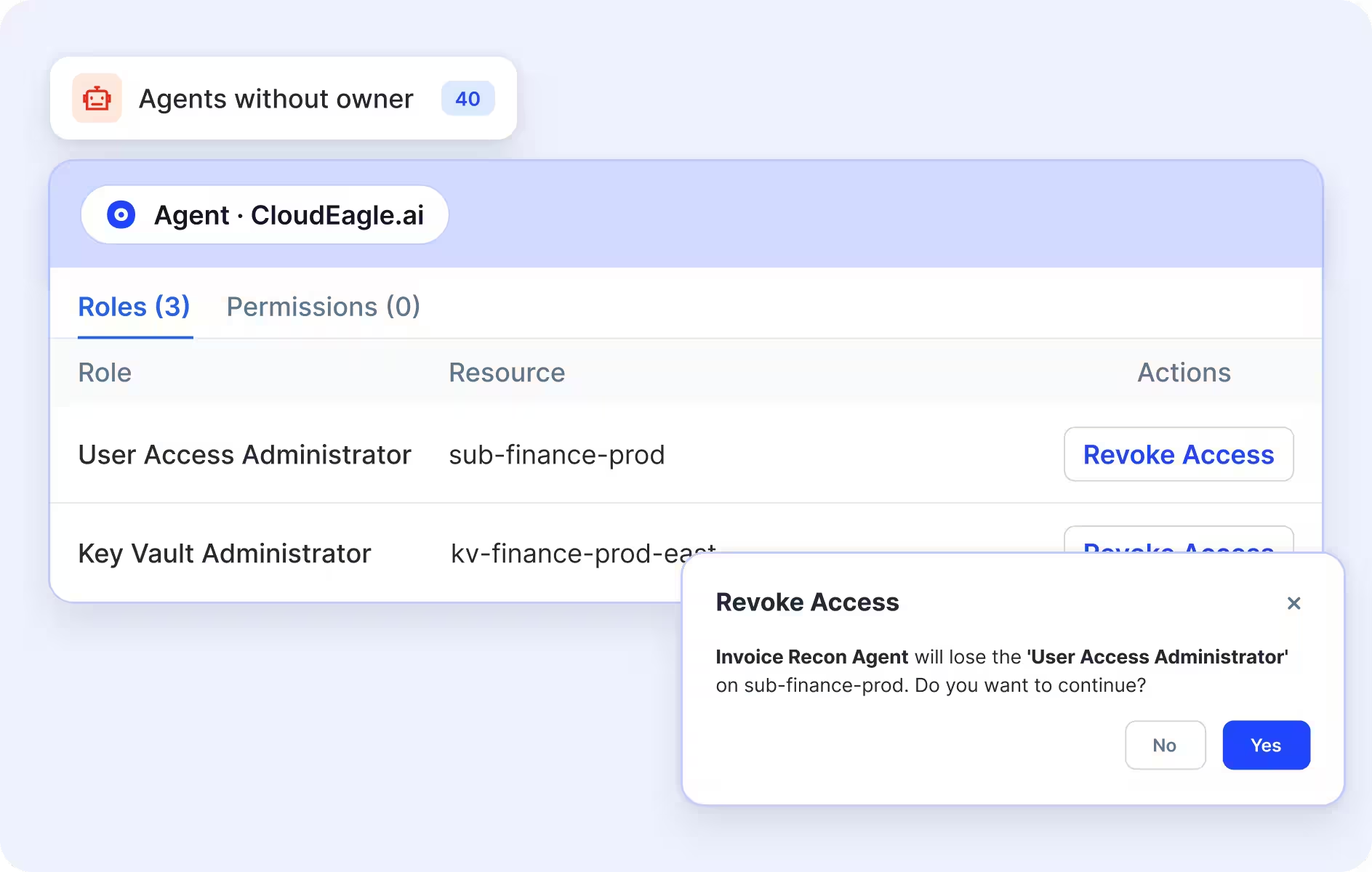
List every role, scope, and data source each agent holds. Remove anything its job doesn't need, including access it has never used.
‍

‍

Set expiry dates on new agent credentials so standing access can't build up again.

Step 4: Monitor Agent Activity and Data Access Continuously

Keep an activity log for every agent: what it did, what it changed, and which resources it touched. Trace each action back to the agent's owner.

Without that record, an incident review turns into guesswork.

Step 5: Put Agents on the Same Access Review Cycle as Employees

Agents should go through access reviews just as people do, on the same cadence and in the same tool.

High-risk agents need more frequent reviews than low-risk ones.

Step 6: Keep a Kill Switch for Rogue Agents

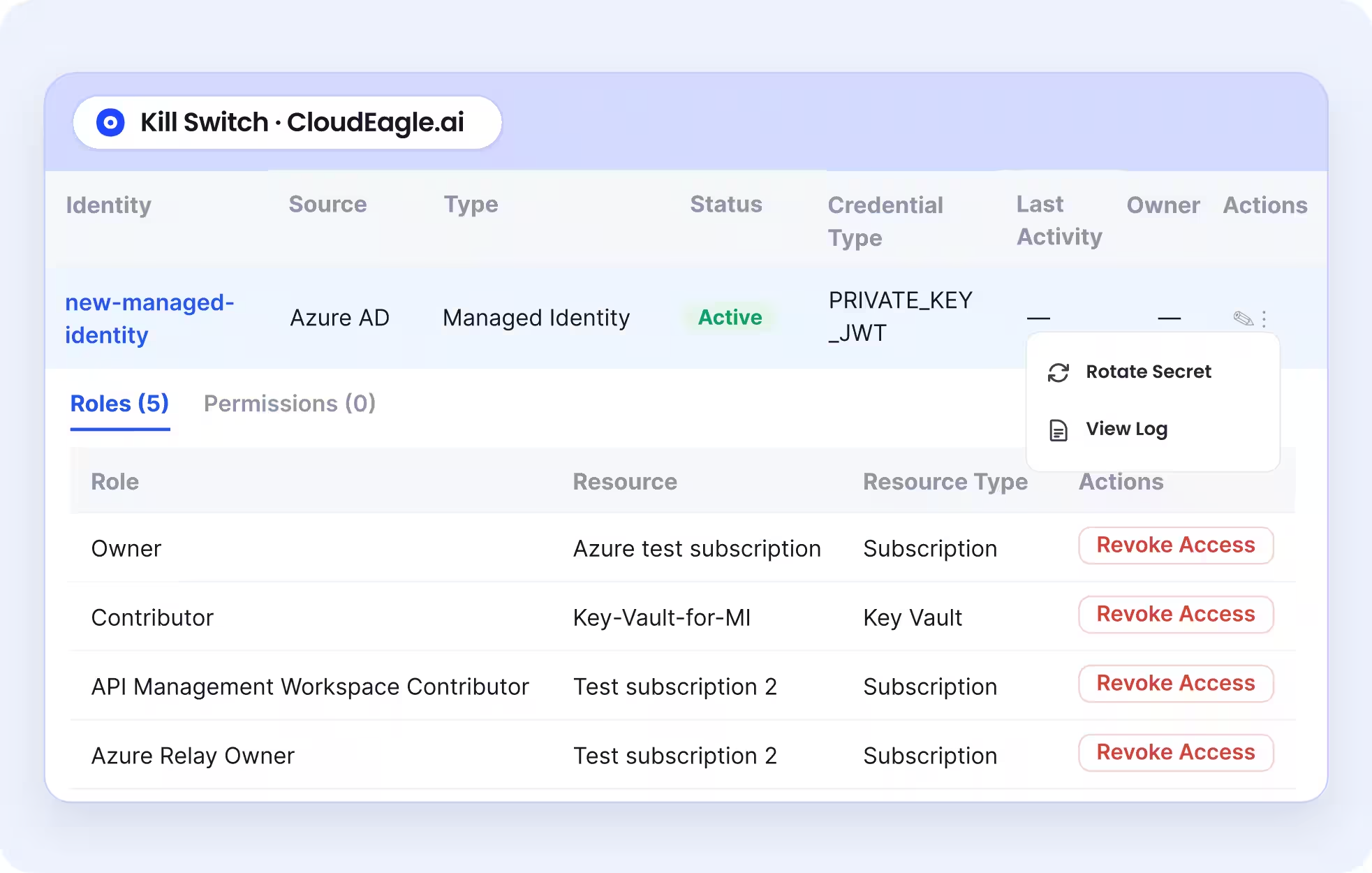
You need one place to stop a risky agent: revoke a role, rotate its secret, or deactivate its identity.
‍

‍

Context matters before you act. Disabling legacy machine identities blindly can take down critical systems, especially in large enterprises with thousands of users. A good kill switch shows the agent's owner, its access, and what it touches before an admin decides.

Step 7: Retire Agents When Their Owners Leave

When an employee leaves, their agents don't. Flag every agent whose owner has left, then reassign it or shut it down.

This is the most common offboarding gap in enterprise identity programs today.
‍

‍

Every AI Agent Has Access. Who's Checking It?

Identify identity risks caused by excessive permissions, unowned accounts, and access that outlives its purpose.
Get the Guide

‍

4. Which AI Agent Governance Practices Work, and Which Backfire?

The practices that work treat agents as identities from the moment they're created. The ones that backfire trust a single platform's view or review agents on a human-speed calendar.

Treat Agent Creation as a Governance Event

The day an agent is created, it should get an owner, a scope, and an expiry date. Adding them later means chasing agents that are already running.

Make creation a trigger in your workflow, not a line in a quarterly report.

Govern the Identity, Not Just the Model

Model reviews tell you whether an agent's outputs are safe. Identity governance tells you what the agent can reach and do.

Both matter, but identity is what an attacker or a mistake actually exploits.

Mistake: Trusting Each Platform's Own Agent Console

Microsoft, Salesforce, and others each show the agents built on their platform. None of them shows the others.

Your teams build in more than one place. A single inventory across platforms is the only way to answer "how many agents do we have?"

Mistake: Quarterly Reviews for Agents That Change Daily

Agents gain tools, connectors, and permissions between review cycles. A quarterly review signs off on access the agent may have outgrown weeks ago.

Review risky agents more often, and flag changes as they happen.

‍

5. What Should You Look for in an AI Agent Governance Platform?

A good AI agent governance framework needs a platform that finds agents across every identity source and governs humans and machines under one model.

It should also let admins act from the same view where they find a problem, with every action logged.

Cross-Platform Agent Discovery Across Entra ID, Okta, and SaaS Apps

The platform should read machine identities directly from Microsoft Entra ID, Okta, and your connected apps. That way, agents show up whether or not anyone registered them with IT.

One Governance Model for Human and Non-Human Identities

Running separate tools for employees, service accounts, and agents creates gaps between them. One model means the same ownership, reviews, and offboarding rules apply to everyone and everything.

See how identity governance now fits into SaaS management.

Built-In Remediation and Audit Trails

Finding a risky agent is only half the job. Admins should be able to revoke roles, rotate secrets, or deactivate the agent from the same view, and every action should be logged for auditors.

‍

‍

Govern Every AI Agent With CloudEagle.ai

AI agent governance comes down to one idea: every agent is an identity with a job. A strong AI agent governance framework finds each agent, assigns an owner, scopes its access, logs its activity, and retires it when the job ends.

CloudEagle.ai is the control plane for enterprise AI. With 500+ direct integrations, every agent sits in one inventory across Entra ID, Okta, and your connected apps, next to its owner, access, and activity, with a kill switch and audit-ready logs.

Govern Every SaaS and AI Identity.

Don't wait for an agent to find your gaps first. Watch this webinar or book a demo.

‍

Frequently Asked Questions

  1. How Can Organizations Identify Unmanaged AI Agents?

Organizations can start by auditing agent-building platforms, connected applications, service accounts, and API tokens to identify agents operating outside formal IT oversight. Each agent should have a documented owner, defined permissions, and a clear record of the systems and data it can access.

  1. Is an AI Agent a Non-Human Identity?

Yes. Every agent connects to apps and data through an identity, such as a service principal in Microsoft Entra ID. That identity holds the permissions that decide what the agent can reach, which is why NHI management covers agents too.

  1. Who Should Own AI Agent Governance in an Enterprise?

Usually security and IAM share AI agent governance. An AI or innovation team often approves new agents, while IAM governs the identities behind them. Every individual agent still needs one named human owner.

  1. How Is AI Agent Governance Different From Shadow AI Discovery?

Shadow AI discovery finds the AI tools people use. AI agent governance controls the agents those tools and teams create: their owners, access, activity, and retirement. You need both, and discovery usually comes first.

  1. Which Regulations Apply to AI Agents in 2026?

The EU AI Act applies, with high-risk obligations now due from December 2, 2027. NIST's AI Agent Standards Initiative and Singapore's agentic AI framework add agent-specific guidance. ISO 42001 covers AI management systems overall.‍

‍

Advertisement for a SaaS Subscription Tracking Template with a call-to-action button to download and a partial graphic of a tablet showing charts.Banner promoting a SaaS Agreement Checklist to streamline SaaS management and avoid budget waste with a call-to-action button labeled Download checklist.Blue banner with text 'The Ultimate Employee Offboarding Checklist!' and a black button labeled 'Download checklist' alongside partial views of checklist documents from cloudeagle.ai.Digital ad for download checklist titled 'The Ultimate Checklist for IT Leaders to Optimize SaaS Operations' by cloudeagle.ai, showing checklist pages.Slack Buyer's Guide offer with text 'Unlock insider insights to get the best deal on Slack!' and a button labeled 'Get Your Copy', accompanied by a preview of the guide featuring Slack's logo.Monday Pricing Guide by cloudeagle.ai offering exclusive pricing secrets to maximize investment with a call-to-action button labeled Get Your Copy and an image of the guide's cover.Blue banner for Canva Pricing Guide by cloudeagle.ai offering a guide to Canva costs, features, and alternatives with a call-to-action button saying Get Your Copy.Blue banner with white text reading 'Little-Known Negotiation Hacks to Get the Best Deal on Slack' and a white button labeled 'Get Your Copy'.Blue banner with text 'Little-Known Negotiation Hacks to Get the Best Deal on Monday.com' and a white button labeled 'Get Your Copy'.Blue banner with text 'Little-Known Negotiation Hacks to Get the Best Deal on Canva' and a white button labeled 'Get Your Copy'.Banner with text 'Slack Buyer's Guide' and a 'Download Now' button next to images of a guide titled 'Slack Buyer’s Guide: Features, Pricing & Best Practices'.Digital cover of Monday Pricing Guide with a button labeled Get Your Copy on a blue background.Canva Pricing Guide cover with a button labeled Get Your Copy on a blue gradient background.

Enter your email to
unlock the report

Oops! Something went wrong while submitting the form.
License Count
Benchmark
Per User/Per Year

Enter your email to
unlock the report

Oops! Something went wrong while submitting the form.
License Count
Benchmark
Per User/Per Year

Enter your email to
unlock the report

Oops! Something went wrong while submitting the form.
Notion Plus
License Count
Benchmark
Per User/Per Year
100-500
$67.20 - $78.72
500-1000
$59.52 - $72.00
1000+
$51.84 - $57.60
Canva Pro
License Count
Benchmark
Per User/Per Year
100-500
$74.33-$88.71
500-1000
$64.74-$80.32
1000+
$55.14-$62.34

Enter your email to
unlock the report

Oops! Something went wrong while submitting the form.

Enter your email to
unlock the report

Oops! Something went wrong while submitting the form.
Zoom Business
License Count
Benchmark
Per User/Per Year
100-500
$216.00 - $264.00
500-1000
$180.00 - $216.00
1000+
$156.00 - $180.00

Enter your email to
unlock the report

Oops! Something went wrong while submitting the form.

Get the Right Security Platform To Secure Your Cloud Infrastructure

Please enter a business email
Thank you!
The 2023 SaaS report has been sent to your email. Check your promotional or spam folder.
Oops! Something went wrong while submitting the form.

Access full report

Please enter a business email
Thank you!
The 2023 SaaS report has been sent to your email. Check your promotional or spam folder.
Oops! Something went wrong while submitting the form.

TL;DR

  • Every AI agent is an identity with a job. Govern the identity, and you govern the agent.
  • AI agent governance rests on five pillars: discovery, ownership, least-privilege access, activity oversight, and lifecycle audit.
  • Agents get built in Copilot Studio, Agentforce, low-code tools, and custom code. Each platform's console shows only its own agents.
  • The EU AI Act's high-risk deadline moved to December 2027, but NIST and Singapore now have agent-specific guidance.
  • CloudEagle.ai puts every agent in one inventory with its owner, access, activity, and a kill switch.

‍

Before implementing an AI agent governance framework, organizations need to understand how quickly agents are being deployed and why they can be difficult to track.

Teams build AI agents across internal platforms, third-party applications, and custom workflows, often faster than IT and security teams can inventory them. These agents may hold access to sensitive data, APIs, and business systems, creating risks when ownership, permissions, and activity go unreviewed.

The first step is to establish an inventory of AI agents, understand what they can access, and identify who is responsible for them. From there, organizations can build a governance framework that keeps agent access, ownership, and risk under control as adoption grows.

‍

1. What Is AI Agent Governance?

AI agent governance is the set of policies, owners, and controls that decide which AI agents can run in your company, what they can reach, and who answers for them.

It treats each agent as an identity that needs discovery, ownership, scoped access, oversight, and a proper retirement.

An agent acts. It reads files, calls APIs, updates records, and sends messages, all through credentials someone gave it. Governance makes sure every one of those credentials has a reason and an owner. Our agent governance walkthrough shows how this works in practice.

The Five Pillars of AI Agent Governance

  • Discovery: knowing every agent that exists, sanctioned or shadow.
  • Ownership: a named human who answers for each agent.
  • Least-privilege access: only the roles and data the agent's job needs.
  • Activity oversight: a record of what each agent did, changed, and touched.
  • Lifecycle audit: reviews, revocation, and retirement when the job or owner is gone.

‍

‍

How AI Agent Governance Differs From Traditional AI Governance

Traditional AI governance asks whether a model is fair, accurate, and safe to use. AI agent governance asks what an agent is allowed to do, and what happens when it does something wrong.

‍

Traditional AI governance AI agent governance
Core question Is the model fair, accurate, and safe? What can the agent do, and who answers for it?
What you govern Models and outputs Identities, access, and actions
Main risk Bad outputs Standing access used at machine speed
Key control Model review Ownership, least privilege, activity logs

‍

Models produce outputs. Agents take actions with standing access. That's why most frameworks built for models leave agents uncovered.

‍

2. Why Did Ungoverned AI Agents Become a Board-Level Risk in 2026?

Ungoverned AI agents became a board-level risk because they multiplied faster than anyone could track them.

Each one holds credentials, often too many, and often with no owner. When one misbehaves, nobody can say quickly what it touched or who should stop it.

Shadow Agents Built Outside IT

Business teams build agents in Copilot Studio, Salesforce Agentforce, low-code platforms, and MCP-connected tools without a security review. Many never pass through procurement or IT at all.

Teams that build across Copilot Studio, Azure AI Foundry, and AWS Bedrock hit the same wall. Weekly manual security reporting can't keep pace.

Overprivileged and Ownerless Agent Identities

Picture this. A sales ops manager builds an agent on a Friday. She changes roles in March. In June, the agent is still running with every permission she gave it.

Agents usually inherit the access of whoever built them, and nobody takes it back. That's why agent identities now make up a growing share of non-human identities, and why so many hold excess access.

Sensitive Data Reached at Machine Speed

A person might open a few sensitive files in a day. An agent with the same permissions can read thousands in minutes.

Mistakes and misuse scale the same way. One misconfigured agent can export a customer database before anyone notices.

Regulatory Pressure From the EU AI Act, NIST, and ISO 42001

Here is where each one stands in 2026:

‍

Framework Where it stands What it means for agents
EU AI Act The Digital Omnibus on AI took effect on July 27, 2026. High-risk obligations move to December 2, 2027 for standalone systems, and August 2, 2028 for AI embedded in regulated products. Deadlines moved, so plan now
NIST The AI Agent Standards Initiative launched on February 17, 2026, with a concept paper on AI agent identity and authorization. Identity sits at the center
Singapore IMDA's Model AI Governance Framework for Agentic AI arrived on January 22, 2026. Humans stay accountable, with oversight that can override or review agent actions
ISO 42001 The AI management system standard. Show who owns each AI system and how you control it

‍

A deferred deadline is not a reason to wait. Auditors will ask for agent inventories, owners, and access records well before 2027.

Worth a Read: AI Agent Lifecycle Management: A Complete Enterprise Guide

‍

You Can't Govern Agents You Can't Find.

Discover how to uncover shadow AI tools operating outside IT visibility before they create security and compliance gaps.
Find Hidden AI Tools

‍

3. How Do You Build an AI Agent Governance Framework?

You build an AI agent governance framework by discovering every agent, giving each one an owner, and scoping its access. Then you record its activity and review it on a set cadence.

‍

‍

After that, add a way to stop the agent and a rule for retiring it.

Step 1: Discover Every Agent, Sanctioned and Shadow

Agents run under machine identities, so start in your identity providers and connected apps rather than waiting for teams to register what they built.

Pair agent discovery with shadow AI discovery. Unapproved AI tools are often where unapproved agents begin.

‍

‍

Step 2: Assign an Accountable Human Owner to Each Agent

Every agent needs a named person who answers for what it does. "The marketing team" is not an owner.

Ownership also settles who approves changes, who joins reviews, and who gets the call when the agent misbehaves.

Step 3: Scope Agent Permissions to Least Privilege

List every role, scope, and data source each agent holds. Remove anything its job doesn't need, including access it has never used.

‍

‍

Set expiry dates on new agent credentials so standing access can't build up again.

Step 4: Monitor Agent Activity and Data Access Continuously

Keep an activity log for every agent: what it did, what it changed, and which resources it touched. Trace each action back to the agent's owner.

Without that record, an incident review turns into guesswork.

Step 5: Put Agents on the Same Access Review Cycle as Employees

Agents should go through access reviews just as people do, on the same cadence and in the same tool.

High-risk agents need more frequent reviews than low-risk ones.

Step 6: Keep a Kill Switch for Rogue Agents

You need one place to stop a risky agent: revoke a role, rotate its secret, or deactivate its identity.

‍

‍

Context matters before you act. Disabling legacy machine identities blindly can take down critical systems, especially in large enterprises with thousands of users. A good kill switch shows the agent's owner, its access, and what it touches before an admin decides.

Step 7: Retire Agents When Their Owners Leave

When an employee leaves, their agents don't. Flag every agent whose owner has left, then reassign it or shut it down.

This is the most common offboarding gap in enterprise identity programs today.

‍

‍

Every AI Agent Has Access. Who's Checking It?

Identify identity risks caused by excessive permissions, unowned accounts, and access that outlives its purpose.
Get the Guide

‍

4. Which AI Agent Governance Practices Work, and Which Backfire?

The practices that work treat agents as identities from the moment they're created. The ones that backfire trust a single platform's view or review agents on a human-speed calendar.

Treat Agent Creation as a Governance Event

The day an agent is created, it should get an owner, a scope, and an expiry date. Adding them later means chasing agents that are already running.

Make creation a trigger in your workflow, not a line in a quarterly report.

Govern the Identity, Not Just the Model

Model reviews tell you whether an agent's outputs are safe. Identity governance tells you what the agent can reach and do.

Both matter, but identity is what an attacker or a mistake actually exploits.

Mistake: Trusting Each Platform's Own Agent Console

Microsoft, Salesforce, and others each show the agents built on their platform. None of them shows the others.

Your teams build in more than one place. A single inventory across platforms is the only way to answer "how many agents do we have?"

Mistake: Quarterly Reviews for Agents That Change Daily

Agents gain tools, connectors, and permissions between review cycles. A quarterly review signs off on access the agent may have outgrown weeks ago.

Review risky agents more often, and flag changes as they happen.

‍

5. What Should You Look for in an AI Agent Governance Platform?

A good AI agent governance framework needs a platform that finds agents across every identity source and governs humans and machines under one model.

It should also let admins act from the same view where they find a problem, with every action logged.

Cross-Platform Agent Discovery Across Entra ID, Okta, and SaaS Apps

The platform should read machine identities directly from Microsoft Entra ID, Okta, and your connected apps. That way, agents show up whether or not anyone registered them with IT.

One Governance Model for Human and Non-Human Identities

Running separate tools for employees, service accounts, and agents creates gaps between them. One model means the same ownership, reviews, and offboarding rules apply to everyone and everything.

See how identity governance now fits into SaaS management.

Built-In Remediation and Audit Trails

Finding a risky agent is only half the job. Admins should be able to revoke roles, rotate secrets, or deactivate the agent from the same view, and every action should be logged for auditors.

‍

‍

Govern Every AI Agent With CloudEagle.ai

AI agent governance comes down to one idea: every agent is an identity with a job. A strong AI agent governance framework finds each agent, assigns an owner, scopes its access, logs its activity, and retires it when the job ends.

CloudEagle.ai is the control plane for enterprise AI. With 500+ direct integrations, every agent sits in one inventory across Entra ID, Okta, and your connected apps, next to its owner, access, and activity, with a kill switch and audit-ready logs.

Govern Every SaaS and AI Identity.

Don't wait for an agent to find your gaps first. Watch this webinar or book a demo.

‍

Frequently Asked Questions

  1. How Can Organizations Identify Unmanaged AI Agents?

Organizations can start by auditing agent-building platforms, connected applications, service accounts, and API tokens to identify agents operating outside formal IT oversight. Each agent should have a documented owner, defined permissions, and a clear record of the systems and data it can access.

  1. Is an AI Agent a Non-Human Identity?

Yes. Every agent connects to apps and data through an identity, such as a service principal in Microsoft Entra ID. That identity holds the permissions that decide what the agent can reach, which is why NHI management covers agents too.

  1. Who Should Own AI Agent Governance in an Enterprise?

Usually security and IAM share AI agent governance. An AI or innovation team often approves new agents, while IAM governs the identities behind them. Every individual agent still needs one named human owner.

  1. How Is AI Agent Governance Different From Shadow AI Discovery?

Shadow AI discovery finds the AI tools people use. AI agent governance controls the agents those tools and teams create: their owners, access, activity, and retirement. You need both, and discovery usually comes first.

  1. Which Regulations Apply to AI Agents in 2026?

The EU AI Act applies, with high-risk obligations now due from December 2, 2027. NIST's AI Agent Standards Initiative and Singapore's agentic AI framework add agent-specific guidance. ISO 42001 covers AI management systems overall.‍

‍

CloudEagle.ai recognized in the 2025 Gartner® Magic Quadrant™ for SaaS Management Platforms
Download now
gartner chart
5x
Faster employee
onboarding
80%
Reduction in time for
user access reviews
30k
Workflows
automated
$15Bn
Analyzed in
contract spend
$2Bn
Saved in
SaaS spend

Streamline SaaS governance and save 10-30%

Book a Demo with Expert
CTA image