HIPAA Compliance Checklist for 2025

Your employees are already pasting company data into ChatGPT, Claude, Copilot, and tools you never approved. At Plex, the team believed it had 30 sanctioned AI tools. We surfaced 73 shadow AI tools.
AI policy enforcement platforms decide what happens next. Does that data get caught, redirected, or logged for an audit you can't pass? Strong AI data loss prevention only works when it sits on top of discovery.
This guide ranks 10 platforms by where they enforce, what they can see, and what they miss.
1. What Are the 10 Best AI Policy Enforcement Platforms in 2026?
The best AI policy enforcement platforms in 2026 are CloudEagle.ai, Microsoft Purview, Netskope One, Zscaler, Palo Alto Networks Prisma AIRS, Nightfall AI, Harmonic Security, LayerX (now part of Akamai), Cyera, and Check Point AI Guardrails (formerly Lakera). They differ most in where they enforce your policy.
Forcepoint is a notable omission. It added AI-specific controls in 2026, but its strength is unified enterprise DLP rather than AI-first enforcement.
2. Why Can't Legacy DLP Enforce an AI Policy on Its Own?
Legacy DLP cannot enforce an AI policy on its own because it watches data, not decisions. It can flag a credit card number in a prompt. It cannot tell you which AI tools exist in your company, which accounts people use, or whether a tool should be allowed at all.
Picture this. Someone on your team opens a personal ChatGPT account on a laptop IT never enrolled. Your DLP sees nothing.
An AI policy has two halves:
- Which tools are allowed: sanctioned, tolerated, or banned, by team and by data type.
- What data can go into them: what's fine for Legal may be off-limits for Engineering.
DLP covers only the second half, and only on traffic it can inspect. An AI feature switched on inside a SaaS app you already pay for never reaches it either.
That's why DLP, CASB, and LLM gateways all miss the same browser gap. The fix is a platform that starts with discovery and treats data blocking as one action among several.
Worth a Read: https://www.cloudeagle.ai/blogs/shadow-ai-detection-tools
3. How Did We Evaluate These Platforms?
We scored each platform on five questions a CISO would ask before signing a contract:
- Enforcement point: where the policy actually runs, and what that leaves unseen.
- Discovery: whether it finds shadow AI before it tries to enforce.
- Action range: whether it can warn, redirect, and block, or only alert.
- Agent coverage: whether it extends to AI agents and the keys and service accounts they use.
- Evidence: whether it produces logs an auditor will accept for the EU AI Act, ISO 42001, and NIST AI RMF.
We used published vendor documentation and product pages, not analyst rankings or paid placements.
4. Which AI Policy Enforcement Platforms Protect Sensitive Data Best?
The platforms that protect sensitive data best match their enforcement point to where your AI risk actually lives. Browser-native tools win on shadow AI and personal accounts. SSE platforms win on managed network traffic. Runtime guardrails win on apps you build.
1. CloudEagle.ai: Best for Discovery-Led Enforcement Across Shadow and Sanctioned AI
You can't write rules for tools you don't know about. Most teams know about far fewer than they think.
Discover Shadow AI. Eliminate Excess Access. Reduce SaaS Risk.
"Once AI adoption accelerated across teams, visibility alone wasn't enough. We needed clear rules around who could use AI tools, under what conditions, and how those decisions were enforced and reviewed. CloudEagle.ai helped us move from ad-hoc approvals to structured, defensible AI governance."
Aditya Khosla, Chief Technology Officer, Iterative Health
CloudEagle.ai brings AI, SaaS, and identity governance into one control plane. Our policy enforcement software finds every AI tool your people use, then enforces your policy at the browser.
See how Plex blocked 18 high-risk AI tools handling regulated customer data without a signed DPA in this case study.
Find Every AI Tool, Sanctioned or Not
- Our shadow AI discovery correlates browser plugins, SSO, firewall logs, and finance data against our AI catalog.
- It surfaces tools used on personal accounts and off SSO.
- It finds AI agents and GenAI features switched on inside SaaS apps you already own.
- Independent risk scores show which tools to deal with first.
Warn, Redirect, and Block at the Point of Use
- Flash-page warnings appear the moment someone opens an unapproved AI tool, with a no-ticket approval request through Slack or Teams.
- Redirects send users to the sanctioned alternative, so governance doesn't stop work.
- Data blocks stop PII, credentials, PHI, financial data, and source code before submission, set by user, role, department, and data type.
Keep Audit-Ready Logs for Every Decision
- Every warning, block, and override is logged for audit and GRC review.
- You get a defensible AI governance record, not a dashboard screenshot.
- 500+ direct integrations tie AI governance to the SaaS and identity stack you already run.
Pricing: Module-based, custom quote. Free trial available.
2. Microsoft Purview DSPM for AI: Best for Microsoft 365 Copilot Environments

Purview DSPM for AI is the natural choice when Microsoft 365 Copilot is your main sanctioned AI. It reports on risky AI interactions across your tenant.
For third-party AI sites like ChatGPT and Gemini, it relies on onboarded devices and the Purview browser extension. Endpoint DLP can then warn or block sensitive data.
Pros
- Logs Copilot prompts and responses.
- Applies the sensitivity labels you already use.
Cons
- Third-party AI needs device onboarding.
- Coverage outside Microsoft depends on how many devices you've onboarded.
Pricing: Bundled into Microsoft licensing, not sold standalone. Cost-effective for E5-class tenants.
Best for: Microsoft-first organizations rolling out Copilot.
3. Netskope One: Best for SSE-Based GenAI Data Loss Prevention
Netskope One applies AI data loss prevention inline, as traffic passes through its security service edge. It scores GenAI apps for risk and coaches users in real time when they hit a policy.
Pros
- One DLP engine covers web, SaaS, and GenAI.
- Real-time user coaching.
Cons
- AI use that never routes through Netskope, like an unmanaged device or personal hotspot, stays invisible.
- Value depends on traffic steering.
Pricing: Custom quote; not publicly listed.
Best for: Enterprises already steering traffic through an SSE.
4. Zscaler: Best for Inline Inspection at Network Scale
Zscaler inspects AI traffic inside its Zero Trust Exchange. Security teams can allow, block, or isolate AI apps, and apply DLP to prompts at scale.
Pros
- One inline control point for GenAI apps.
- Browser isolation lets users reach an AI tool while paste and upload stay restricted.
Cons
- Reach ends where Zscaler-routed traffic ends.
- Personal devices off the proxy are missed.
Pricing: Custom quote; not publicly listed.
Best for: Global enterprises standardized on Zscaler for zero trust.
5. Palo Alto Networks Prisma AIRS: Best for Security Teams Standardized on Palo Alto
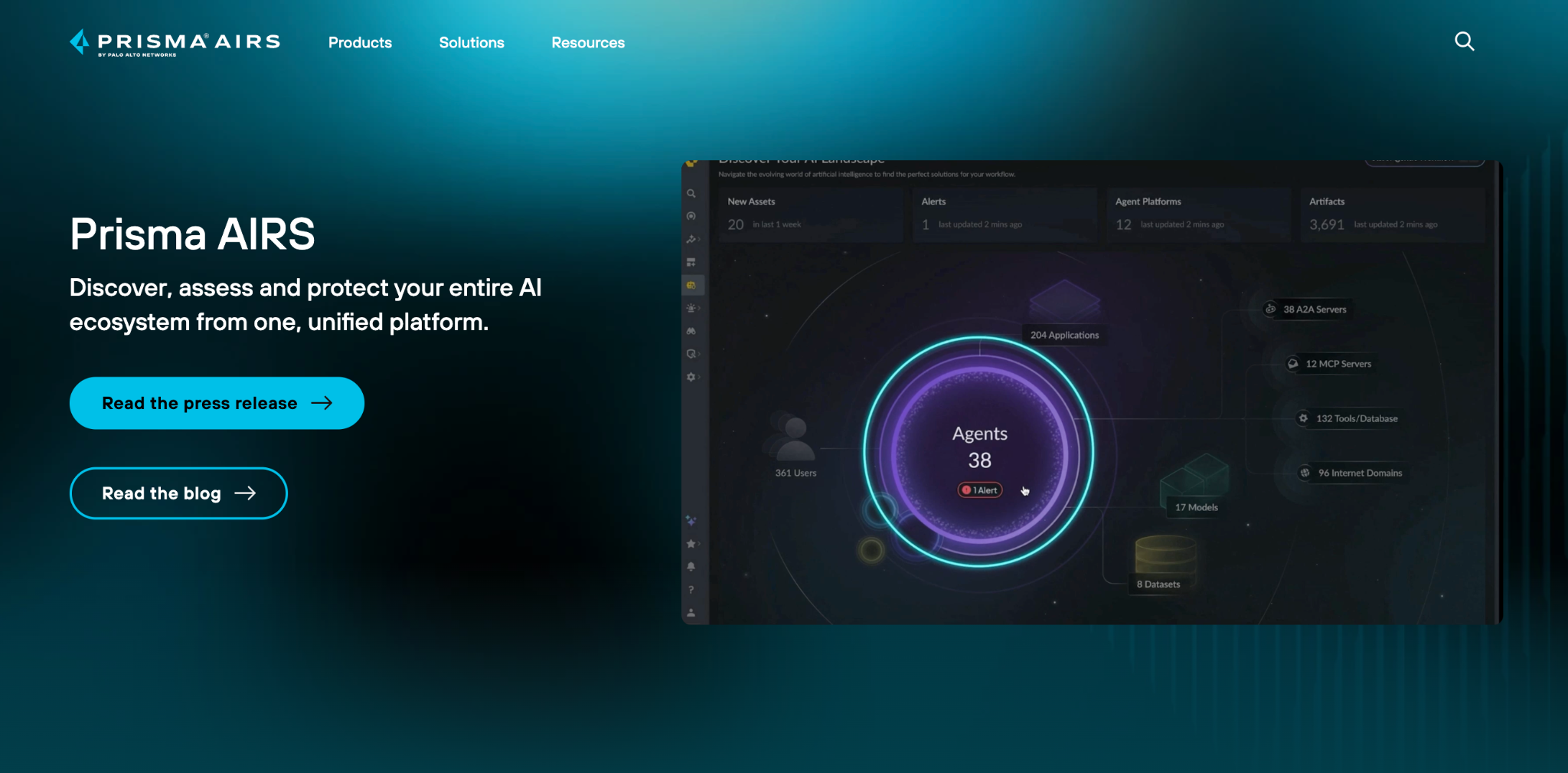
Prisma AIRS secures the AI apps and agents you build. It is built largely on Palo Alto's Protect AI acquisition.
Pros
- Model scanning, red teaming, and runtime protection against prompt injection and data leakage.
- Deepest integration for teams already on Palo Alto firewalls.
Cons
- Employee use of public GenAI tools is handled by the broader SASE stack, so the full picture means more than one product.
Pricing: Custom quote; not publicly listed.
Best for: Palo Alto shops securing both employee AI use and homegrown AI.
6. Nightfall AI: Best for API-First, AI-Native DLP
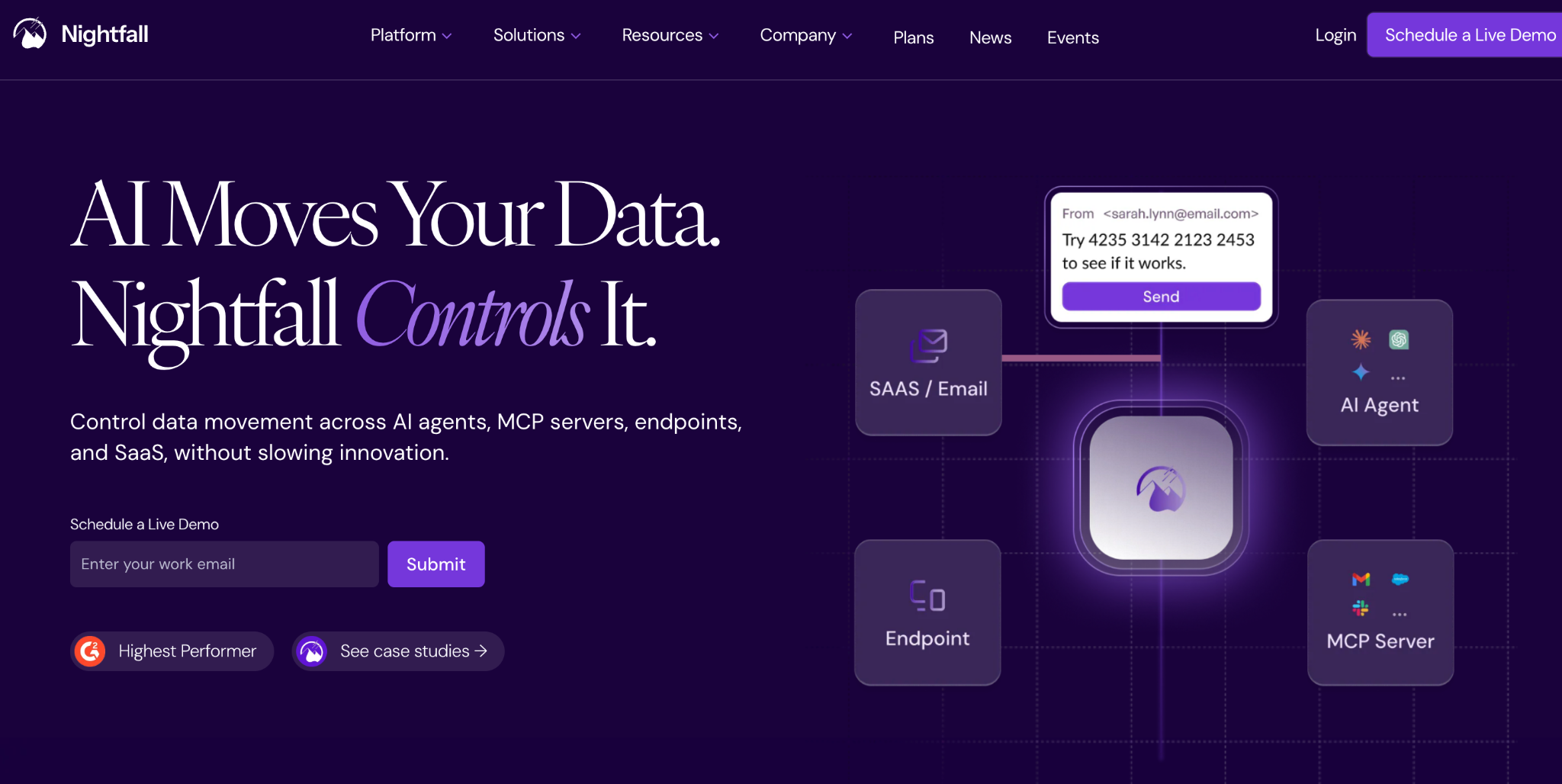
Nightfall AI detects sensitive data with AI-based classifiers rather than regex rules. It covers SaaS apps through APIs, plus browsers, endpoints, GenAI apps, and newer surfaces like MCP workflows and IDEs.
Pros
- AI-based classifiers cut false positives.
- Wide surface coverage for AI data loss prevention.
Cons
- DLP-first. Teams that need app approval workflows, risk-scored AI inventories, or license governance will need another tool.
Pricing: Per-user annual pricing across named editions; dollar amounts not published. Offers a 7-day proof of value.
Best for: Cloud-first teams that want accurate AI data loss prevention without legacy DLP overhead.
7. Harmonic Security: Best for Low-Friction Prompt Coaching
Harmonic Security uses small, purpose-built language models to read prompts and understand intent in real time. That lets it coach users at the moment of risk instead of simply blocking them.
Pros
- Coaching changes behavior without stopping work.
- Deploys as a browser extension through MDM tools like Intune or Jamf.
- Added an MCP gateway for agentic AI.
Cons
- Younger vendor. Confirm support and scale for large rollouts.
Pricing: Custom quote; not publicly listed.
Best for: Teams prioritizing user experience and behavior change over hard blocks.
8. LayerX (Akamai): Best for Browser-Extension Enforcement
LayerX adds security controls to the browsers employees already use. Akamai completed its acquisition of LayerX in July 2026.
Pros
- Visibility into prompts, file uploads, and SaaS activity, including agentic browsers.
- Catches personal accounts and off-network AI use that SSE tools miss.
Cons
- Ask how the roadmap changes as it folds into Akamai's zero trust portfolio.
Pricing: Custom quote; not publicly listed.
Best for: Teams that want deep browser-level control without replacing the browser.
9. Cyera: Best for Pairing Data Security Posture With AI Controls
Cyera extends its data security posture platform into AI with AI Guardian. AI Guardian combines AI security posture management (AI-SPM) with runtime protection. A browser extension called Browser Shield discovers public AI tool use and protects sensitive data.
Pros
- Data context: it knows which datastores and identities an AI tool can reach.
- Covers the data layer, browser, and runtime.
Cons
- The edge is strongest for teams already running Cyera DSPM.
Pricing: Custom quote; not publicly listed.
Best for: Data security teams that want AI controls built on an existing data map.
10. Check Point AI Guardrails (Lakera): Best for Runtime Guardrails on Homegrown AI Apps
Check Point AI Guardrails, formerly Lakera Guard, sits inline with LLM applications and agents. It draws on adversarial data from Lakera's Gandalf project.
Pros
- Blocks prompt injection, data leakage, and model manipulation.
Cons
- Not built for employee AI use. Pair it with an employee-facing enforcement tool.
Pricing: Custom quote; not publicly listed.
Best for: Product and AppSec teams shipping customer-facing AI.
5. How Do You Choose an AI Policy Enforcement Platform?
Choose by blind spot, not by feature count. Map where your AI risk actually lives, then pick the platform whose enforcement point covers it. Ask every vendor two things: what can't you see, and what evidence do you hand my auditor?
Enforcement Points and Their Blind Spots
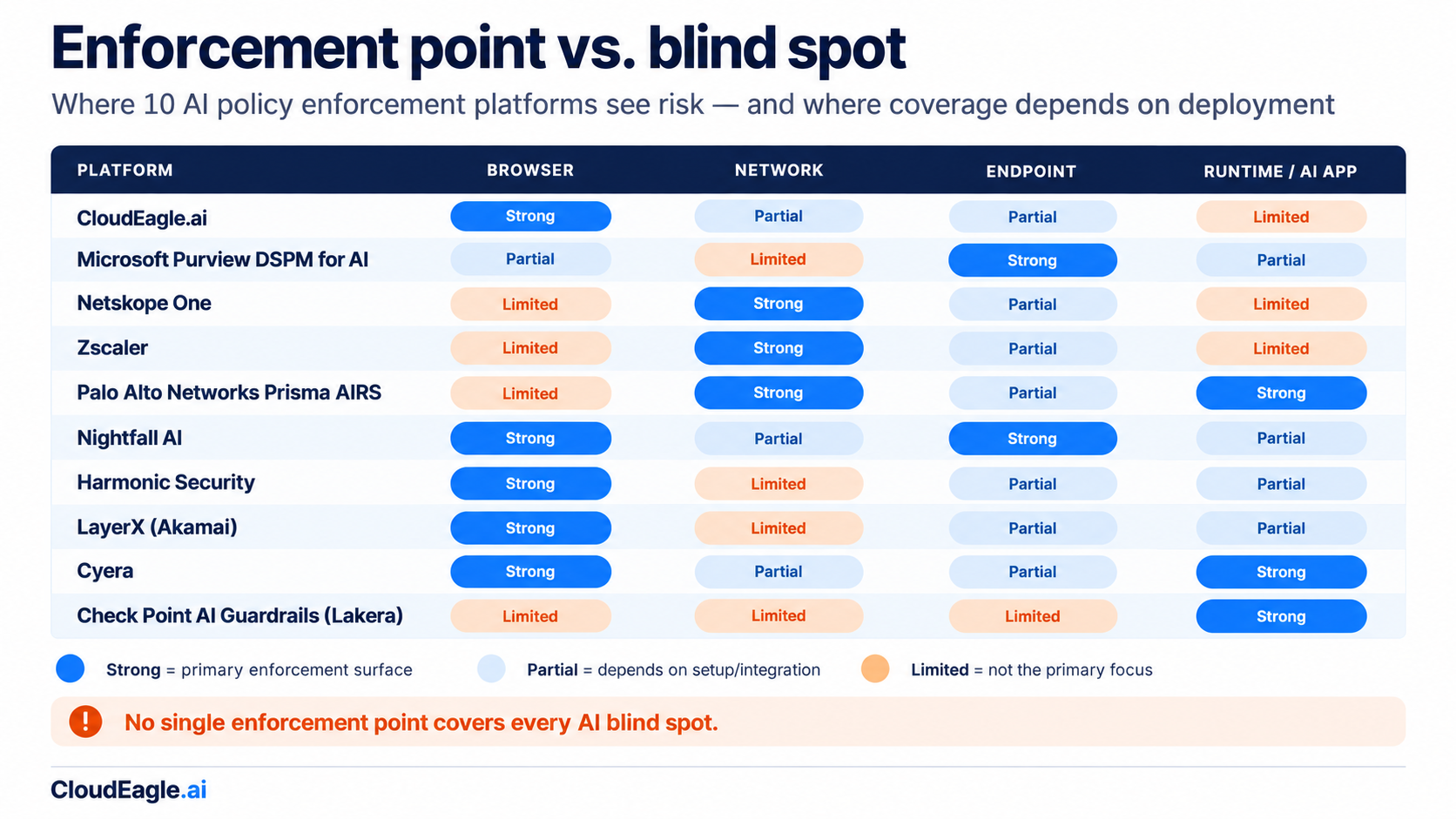
Each enforcement point sees some AI use and misses the rest:
- Browser: catches personal accounts and off-SSO tools, but misses desktop apps.
- Network: covers managed traffic at scale, but misses unmanaged devices.
- Endpoint: sees the device, but only devices you've onboarded.
- Runtime: protects apps you build, but sees no employee use of public AI.
Most enterprises need two. Decide which one is primary.
Shadow AI Discovery Before Enforcement
A policy only covers tools you know about. Discovery should pull from more than SSO: browser activity, finance records, social logins, and firewall logs.
Our guide to detection tools covers how to evaluate discovery depth.
Warn, Redirect, and Block Actions
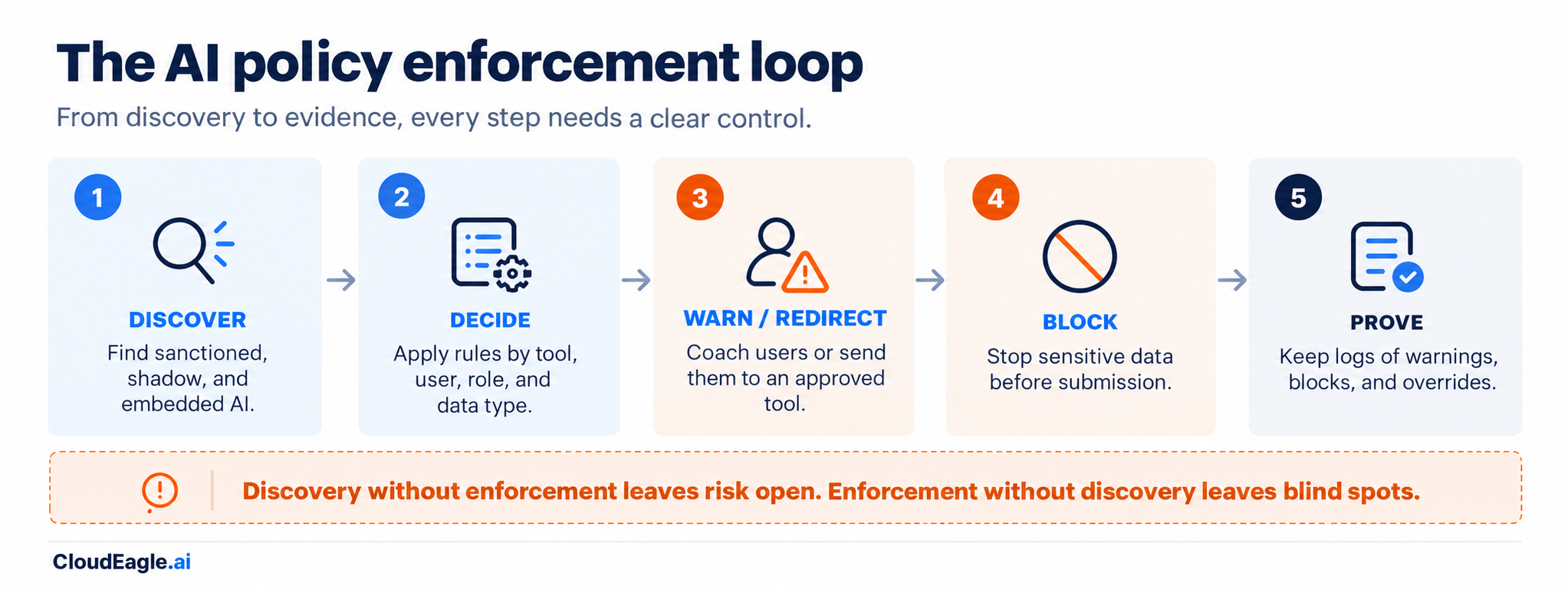
Hard blocks on day one push people to tools you can't see. Platforms that warn first, redirect to an approved tool, and hard-block only what must never leave change behavior without stopping work.
AI data loss prevention is the last step in that chain, not the first. See our guide on acceptable use enforcement that people actually follow.
Coverage for AI Agents and Service Accounts
AI agents act through API keys, tokens, and service accounts rather than people. Ask whether the platform inventories those credentials, assigns owners, and flags over-privileged access.
Non-human identity management closes the gap that prompt-level tools leave open.
Audit Evidence for the EU AI Act, ISO 42001, and NIST AI RMF
Auditors want proof of control, not dashboards. Look for immutable logs of every warning, block, and override, each tied to a policy owner.
Ask whether the evidence exports cleanly to your GRC workflow.
6. See How CloudEagle.ai Enforces AI Policy at the Point of Use
The best AI policy enforcement platforms match where they enforce to where your AI risk lives. Pair solid AI data loss prevention with discovery, and you cover both the tools people use and the data they send.
CloudEagle.ai is the AI command center for SaaS, identity, and AI governance. We find every AI tool, warn, redirect, and block at the browser, and keep audit-ready logs.
Don't let the audit find your gaps first. Watch this webinar or book a demo.
Frequently Asked Questions
- What Is an AI Policy Enforcement Platform?
An AI policy enforcement platform turns your AI usage policy into live controls. It discovers which AI tools people use, decides what's allowed, and warns, redirects, or blocks at the point of use. Read the full definition for more.
- How Do You Stop Employees From Pasting Sensitive Data Into ChatGPT?
Use a browser or inline control that detects sensitive data types like PII, credentials, and source code, and blocks them before the prompt is submitted. Pair it with redirects to an approved AI tool so people have a safe option.
- Is AI DLP the Same as AI Policy Enforcement?
No. AI DLP inspects data going into AI tools. AI policy enforcement also decides which tools are allowed, for whom, and under what conditions, and it keeps audit evidence. DLP is one action inside enforcement.
- Can AI Policy Enforcement Platforms Govern AI Agents?
Some can, in different ways. Runtime guardrails inspect agent inputs and outputs. Identity-focused platforms govern the API keys and service accounts agents use. Mature programs need both views.
- Do You Need a Separate Tool for Shadow AI Discovery?
Not if your enforcement platform discovers from multiple sources. Network-only and DLP-only tools usually need a separate discovery layer. Without one, they miss personal-account and off-SSO AI use, which is where most shadow AI lives.