HIPAA Compliance Checklist for 2025

AI observability helps teams understand how AI applications behave in production, from tracing LLM calls and debugging failures to monitoring response quality, latency, and costs.
While Holistic AI supports AI risk assessment, testing, and governance, organizations that need deeper application-level tracing or developer-focused debugging may explore other platforms.
The need for better monitoring is growing. According to Gartner's May 2026 forecast, 40% of organizations deploying AI are expected to use dedicated AI observability tools by 2028 to monitor model performance, bias, and outputs.
This guide compares 10 Holistic AI alternatives and Holistic AI competitors, highlighting their observability capabilities, use cases, and pricing considerations to help teams find the right fit for their AI stack and monitoring needs.
1. Why Consider Holistic AI Alternatives in 2026?
Holistic AI combines AI discovery, risk testing, monitoring, and governance in one platform. However, teams focused on application-level AI observability may need more specialized tools to trace LLM calls, debug agent workflows, evaluate outputs, and investigate production failures.
When evaluating Holistic AI alternatives, focus on the problems your team needs to solve:
- Trace complex AI workflows: Inspect prompts, model responses, retrieval steps, and tool calls to pinpoint where an LLM or agent workflow breaks.
- Catch quality regressions: Use evaluation datasets and automated tests to identify changes in accuracy, relevance, or response quality after prompt or model updates.
- Diagnose production issues: Track latency, failed requests, token usage, and cost spikes to identify performance bottlenecks and unexpected expenses.
- Monitor AI agents: Look for end-to-end tracing of multi-step actions, tool calls, and handoffs rather than monitoring individual model requests in isolation.
- Fit your existing stack: Check compatibility with your LLM frameworks, telemetry pipelines, and deployment environment, especially if you need self-hosting or tighter data control.
The key distinction is that AI governance manages risk, accountability, and compliance, while AI observability helps teams understand and improve system behaviour.
Some platforms support both, but teams should compare their actual tracing, evaluation, and monitoring capabilities before choosing among Holistic AI competitors.

2. How to Choose the Right AI Observability Platform
The right platform should help your team identify failures, measure output quality, and troubleshoot production issues without adding unnecessary complexity.
- Test tracing and debugging: During a demo, trace a failed LLM response through retrieval, model calls, and tool execution to see whether the root cause is easy to identify.
- Validate evaluation workflows: Check whether you can compare outputs before and after prompt or model changes using evaluation datasets and regression tests.
- Review production monitoring: Verify that dashboards and alerts cover latency, failed requests, token usage, and cost spikes.
- Check AI agent support: Confirm that the platform captures multi-step workflows, tool calls, and handoffs, not just individual model requests.
- Confirm integrations and data controls: Check compatibility with your frameworks and telemetry stack, plus data retention and self-hosting requirements where relevant.
A useful test is whether the platform can turn real production traces into repeatable evaluations, helping teams detect regressions instead of repeatedly debugging the same issues.
When comparing Holistic AI competitors, prioritize the capabilities your team can validate against real workloads, not just the features listed on a pricing page.
3. Quick Comparison of the 10 Best Holistic AI Alternatives in 2026
The best Holistic AI alternatives range from AI observability tools that trace LLM workflows to enterprise platforms that monitor AI risks and employee usage.
How to use this comparison: CloudEagle.ai is relevant when the priority is discovering shadow AI, controlling employee access, and managing AI usage across the organization.
For application-level observability, start with Langfuse, LangSmith, or Arize Phoenix. Braintrust and Galileo are worth evaluating for output quality and evaluation workflows, while Datadog suits teams that want AI monitoring within their existing observability stack.
4. 10 Best Holistic AI Competitors to Consider in 2026
The right alternative depends on whether your team needs deeper LLM tracing, AI output evaluation, production monitoring, or enterprise AI governance.
The following platforms offer different capabilities, use cases, and pricing models to help you compare options and identify the best fit for your AI stack.
A. CloudEagle.ai
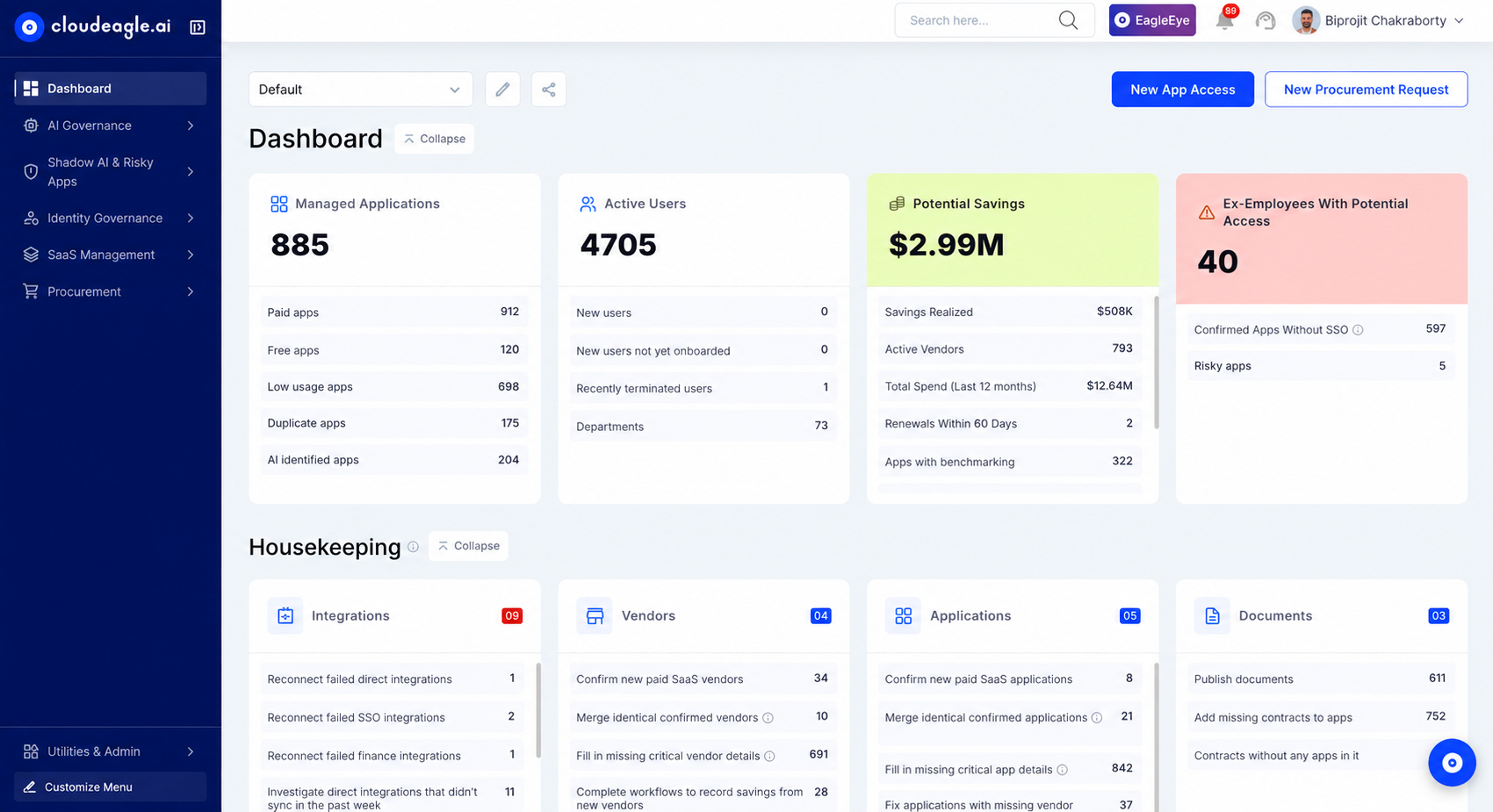
CloudEagle.ai is an AI governance platform that helps enterprises discover AI applications, control employee usage, enforce policies, manage AI agents, an d track AI spending.
Unlike specialist AI observability platforms that focus on tracing LLM calls, debugging workflows, and evaluating model outputs, CloudEagle.ai focuses on how AI is adopted and managed across an organization.
It helps IT, security, and finance teams identify unapproved tools, protect sensitive data, govern AI access, and understand usage across employees and departments.
CloudEagle.ai also helps organizations connect AI usage with cost accountability. In a customer case study, Domo found that 34% of its AI licenses had no activity in 90 days.
This highlights how usage visibility can help enterprises identify underused licenses and make more informed spending decisions.
Key features:
- Shadow AI Discovery: Identifies approved and unapproved AI applications by correlating browser, SSO, finance, and security signals. Its centralized inventory helps teams find tools operating outside approved IT processes and assess potential risks through shadow AI and IT discovery.
- AI Usage Control and Token Tracking: Tracks AI consumption across supported tools, including ChatGPT, Claude, Cursor, and Gemini. Through AI usage control, teams can review token consumption and costs by user, team, model, API key, and cost center. This helps organizations understand usage patterns, identify underused licenses, and improve accountability for AI consumption.
- AI Policy Enforcement: Helps organizations apply AI usage policies where employees access AI tools. Browser-based controls can warn employees when they open unapproved applications, redirect them to approved alternatives, and block sensitive information from being submitted to unmanaged AI tools through AI policy enforcement.
- AI Spend Limits and Budgeting: Provides visibility into AI consumption and costs across teams, models, and departments. Teams can use spending insights and available thresholds or alerts to identify potential overages and plan budgets more effectively. The AI token cost management guide offers further context on managing token-related expenses.
- AI Chargeback Reporting: Connects AI usage and costs with the teams, departments, and cost centers responsible for consumption. This helps finance teams understand where AI spending originates, improve budget accountability, and make more informed decisions about AI investments. Explore CloudEagle.ai’s finance capabilities for related spending visibility.
- AI Agent Management: Extends governance to AI agents, MCP servers, service accounts, and API keys. CloudEagle.ai’s AI agent security platform helps organizations manage agent access and security risks. Its non-human identity management capabilities support identity discovery, permission reviews, credential management, and access revocation.
Pros:
- Combines AI discovery, employee usage visibility, and policy enforcement in one platform.
- Provides visibility into token consumption and AI spending across teams and models.
- Helps protect company data through browser-level AI governance controls.
- Extends identity and access governance to AI agents and other non-human identities.
- Supports better AI spending decisions through usage and cost visibility.
Pricing: CloudEagle.ai offers five modules for different enterprise requirements. Schedule a demo and the experts will provide you with a customized plan according to your needs.
Don't Just Monitor AI. Govern It.


B. Langfuse
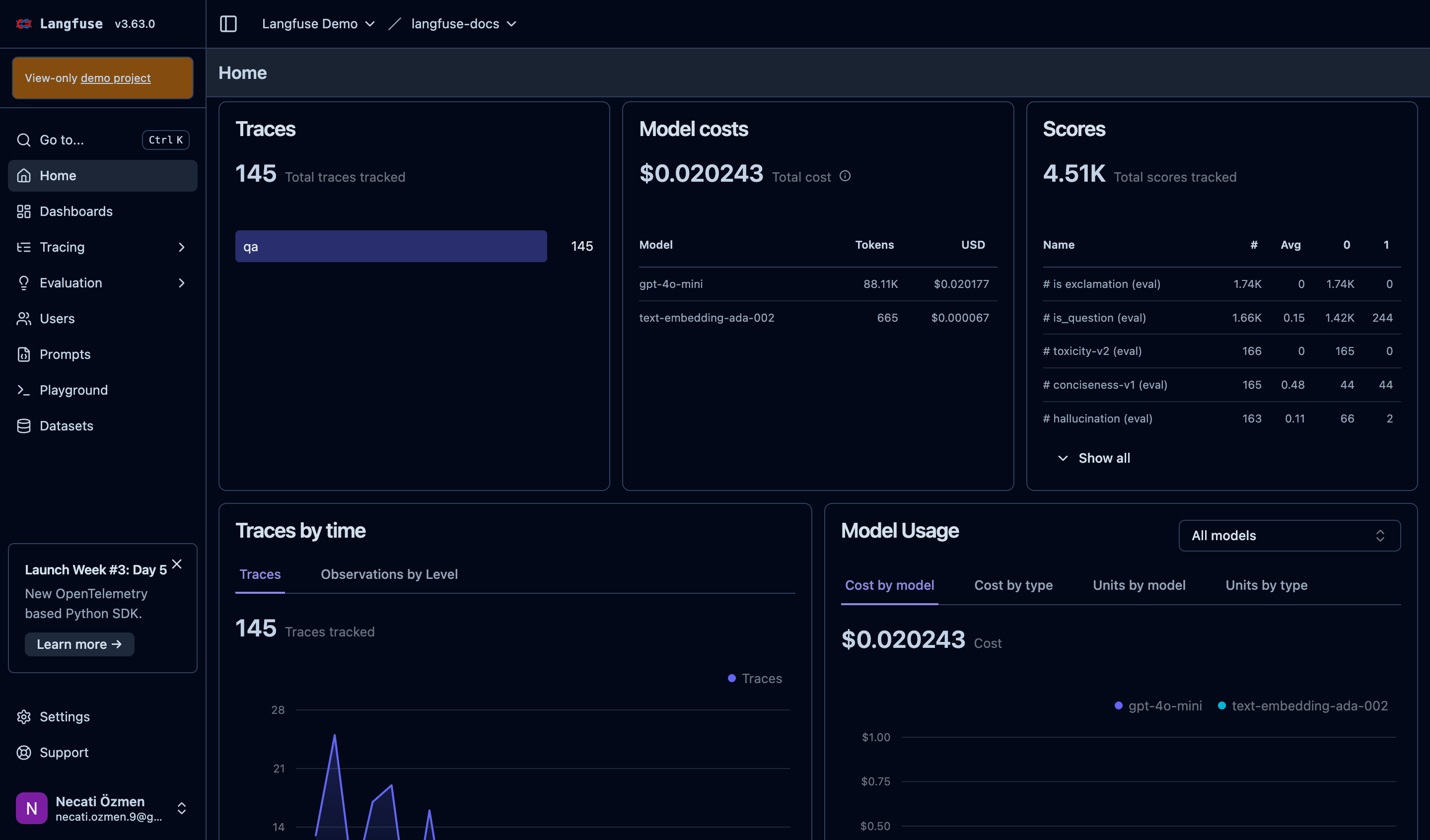
Best for: Open-source LLM observability and prompt evaluation
Langfuse is an open-source observability platform for teams building LLM applications. It combines tracing, prompt management, evaluations, and usage analytics, helping developers investigate failures and measure how application changes affect quality, latency, and cost.
Key features
- LLM tracing: Captures model calls and application execution details so developers can investigate unexpected outputs and slow requests.
- Prompt version management: Connects prompt versions to traces and metrics, helping teams compare changes before deploying them.
- Automated evaluations: Supports LLM-as-a-judge, code-based scoring, human feedback, and custom evaluation pipelines.
- Datasets and experiments: Lets teams test prompts and models against reusable examples before releasing changes.
- Cost and latency analytics: Tracks usage and performance metrics to identify expensive workflows and quality regressions.
Pricing: Langfuse offers a free Hobby plan, Core at $29/month, and Pro at $199/month. Usage limits and additional charges vary by plan.
C. LangSmith
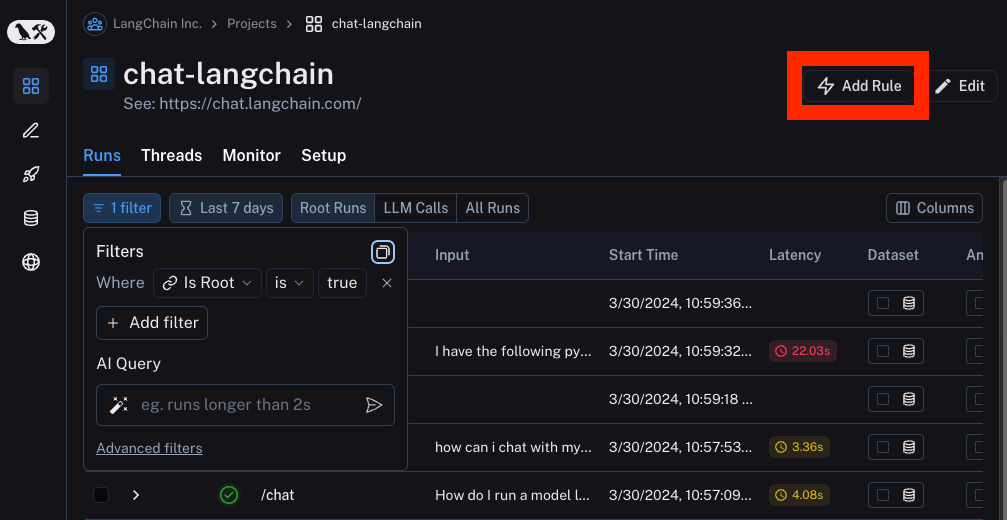
Best for: LLM and AI agent debugging
LangSmith helps developers understand how LLM applications and AI agents execute, where their workflows fail, and how to improve their behaviour.
Its tracing, evaluation, and prompt experimentation capabilities make it useful for teams developing production AI applications, particularly within the LangChain ecosystem.
Key features
- Execution tracing: Breaks application runs into individual steps to help isolate problems in model calls, tools, and other workflow components.
- Agent debugging: Exposes intermediate operations and tool calls so developers can investigate why an agent selected an action or produced an unexpected result.
- Online and offline evaluations: Measures production responses and test datasets to identify quality regressions.
- Prompt experimentation: Supports prompt testing and iteration so teams can compare approaches before rollout.
- Dataset management: Lets teams collect examples, annotate responses, and turn production failures into reusable evaluation cases.
Pricing: The Developer plan is free for one seat and includes up to 5,000 base traces/month. Plus starts at $39/seat/month and includes up to 10,000 base traces/month, with additional usage charges. Enterprise pricing is custom.
D. Arize Phoenix
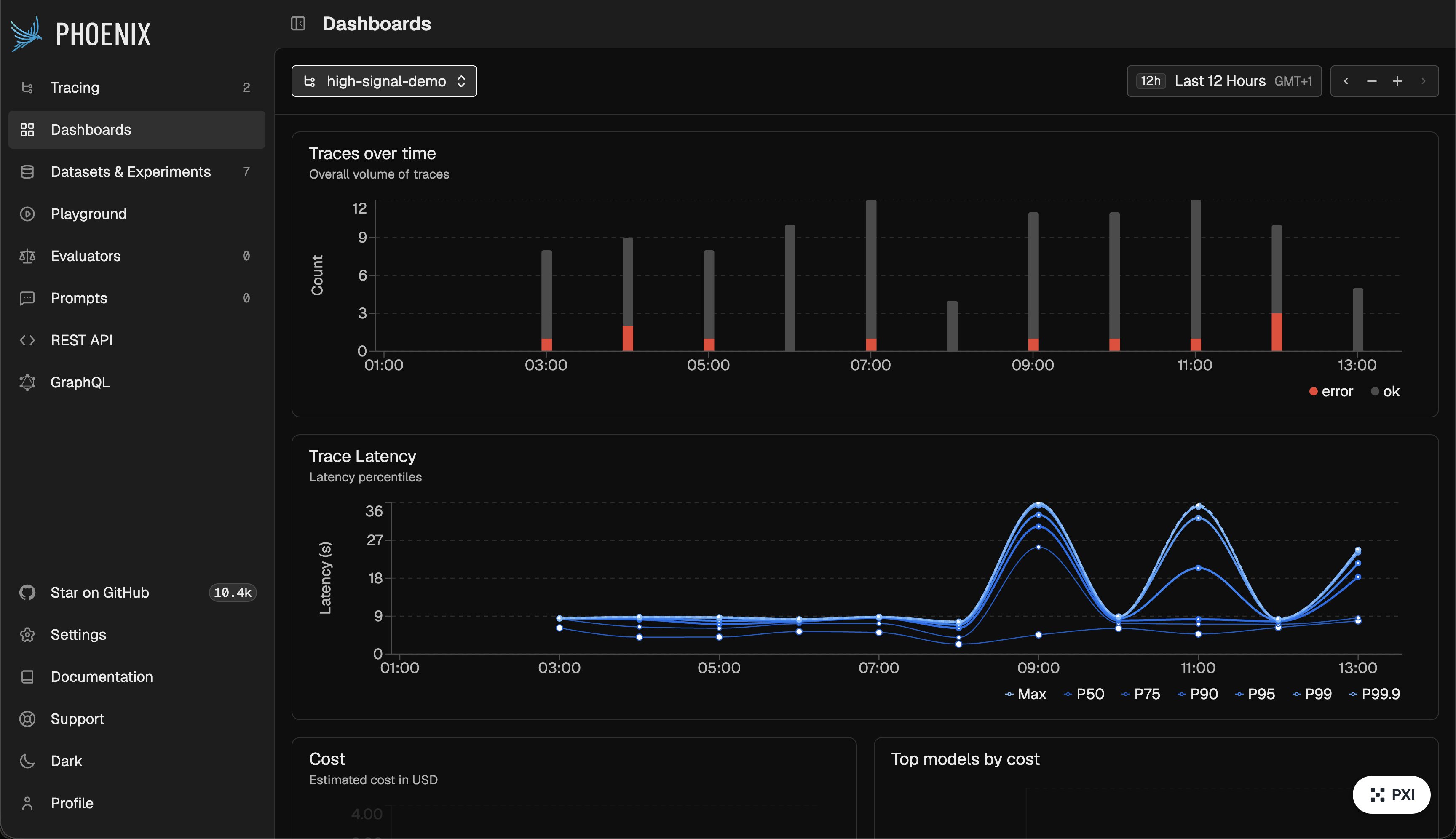
Best for: Open-source tracing, RAG debugging, and LLM evaluation
Arize Phoenix is an open-source observability platform designed to help teams inspect and evaluate LLM applications. Its tracing and instrumentation capabilities help developers examine retrieval, model interactions, and other execution steps without committing entirely to a proprietary observability stack.
Key features
- OpenTelemetry-based tracing: Collects execution data from supported frameworks and instrumentation, helping teams inspect application behaviour.
- RAG debugging: Exposes retrieval and model interactions to help identify problems such as irrelevant context or poor grounding.
- LLM evaluations: Supports evaluators for assessing qualities such as relevance, correctness, and faithfulness.
- Datasets and experiments: Helps developers reuse test cases and compare application changes against consistent evaluation criteria.
- Prompt experimentation: Supports testing prompt and model configurations to understand their effect on outputs.
Pricing: Phoenix is free and open source, with self-hosting available. Arize also offers separate commercial observability products.
E. Fiddler AI
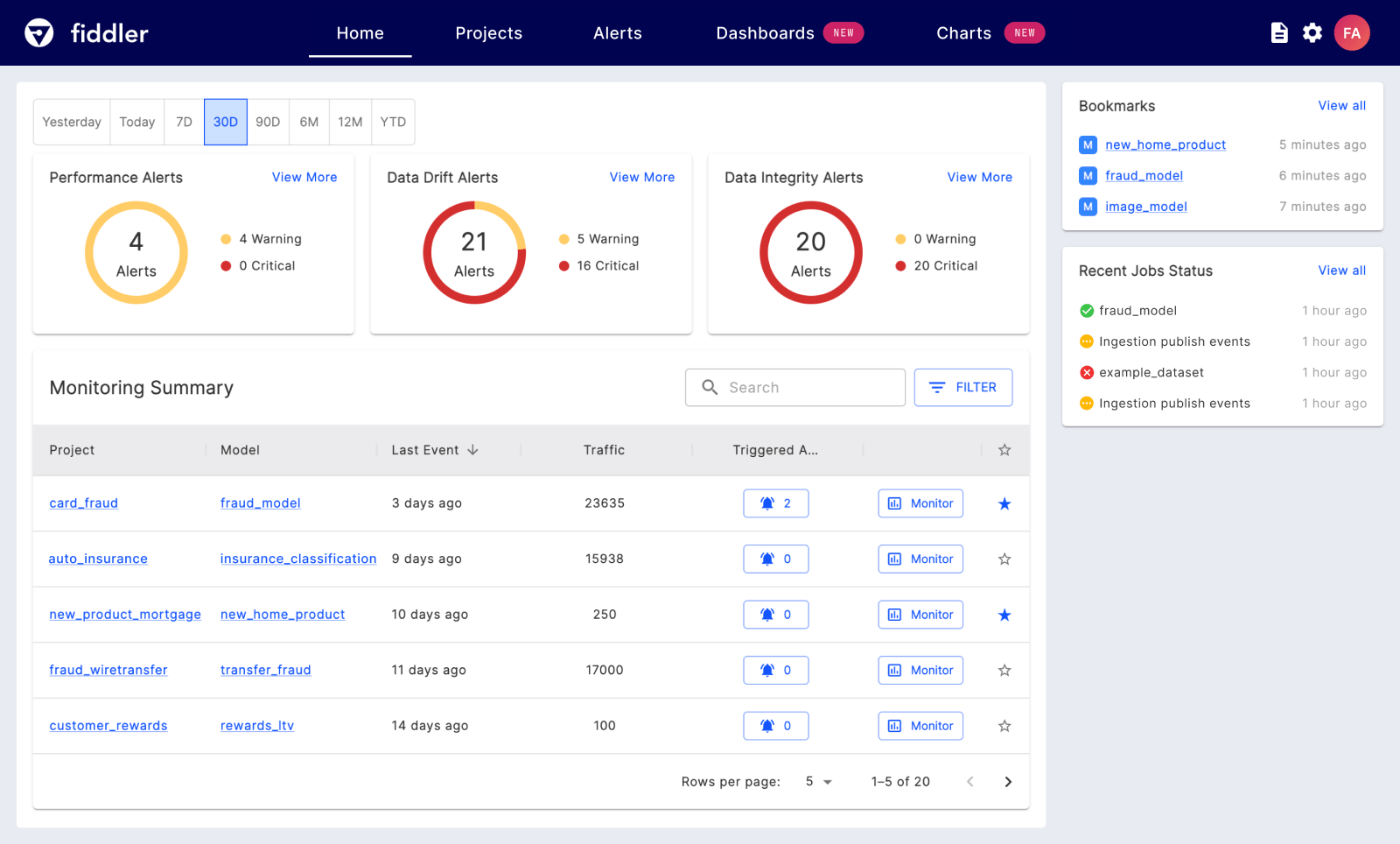
Best for: Enterprise AI observability, evaluation, and security guardrails
Fiddler AI combines observability with diagnostics and safety controls for LLM applications, AI agents, and predictive models. It is particularly relevant to organizations that need to investigate production issues while monitoring for risks such as hallucinations, sensitive-data exposure, and prompt injection.
Key features
- Agent tracing: Helps teams inspect execution across agents, traces, and spans to investigate failures in multi-step workflows.
- Quality and safety checks: Supports detection of issues such as hallucinations, toxicity, PII exposure, prompt injection, and jailbreak attempts.
- Custom evaluations: Allows teams to configure evaluators and use their own evaluation models to assess application quality.
- Production monitoring: Helps teams identify changes in application performance and behaviour.
- Flexible deployment: Enterprise options include SaaS, virtual private cloud, and on-premises deployment.
Pricing: Fiddler offers a free plan for guardrails and a Developer plan priced at $0.002 per trace. Enterprise pricing is custom.
F. Braintrust
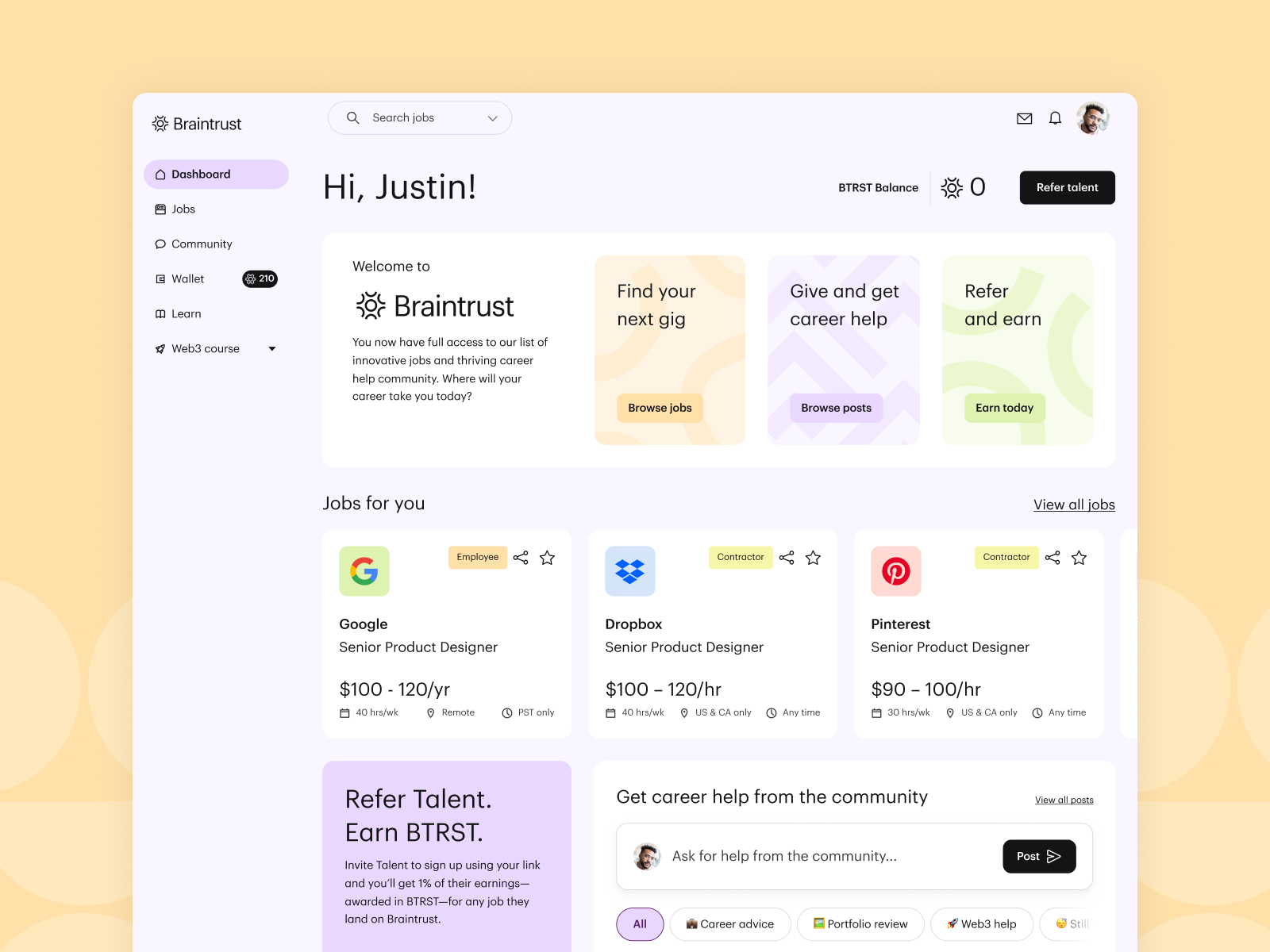
Best for: LLM evaluation and regression testing
Braintrust connects production tracing with repeatable evaluation workflows. Instead of simply showing where an AI application failed, it helps teams turn real failures into test cases and compare prompts, models, or application changes against consistent quality criteria.
Key features
- Production trace logging: Stores application runs for inspection and troubleshooting.
- Versioned evaluation datasets: Converts production examples and curated test cases into reusable datasets.
- Evaluation experiments: Runs scorers against datasets to measure qualities such as correctness and relevance.
- Prompt and model comparisons: Tests alternative configurations against the same examples to measure quality differences.
- Quality analysis: Centralizes evaluation results and trace data to help identify recurring failure patterns.
Pricing: Braintrust has a free Starter plan and a Pro plan at $249/month. Usage-based charges may apply for processed data, scores, and model usage. Enterprise pricing is custom.
G. Datadog LLM Observability
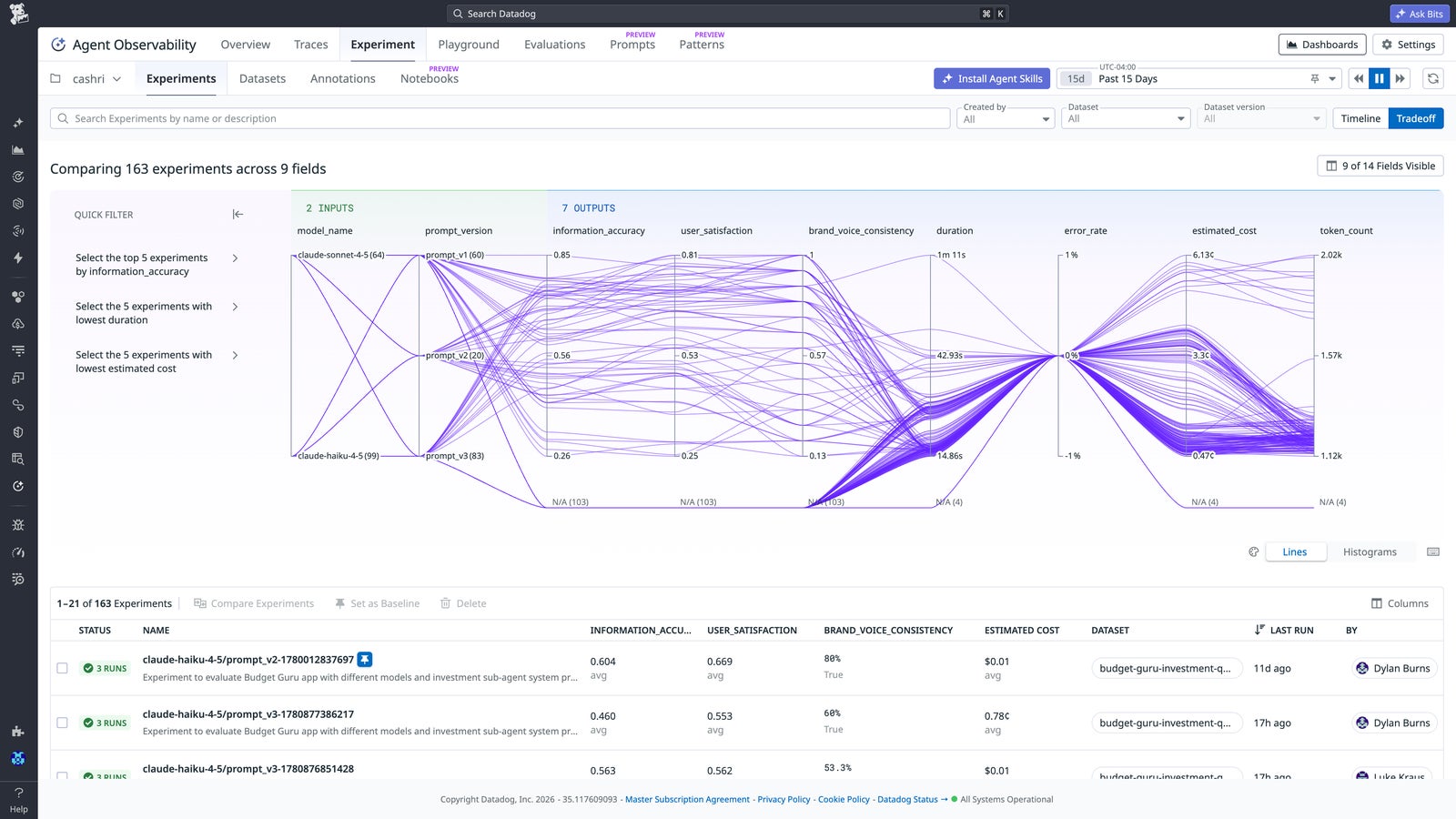
Best for: Production AI monitoring within an existing observability stack
Datadog LLM Observability is suited to teams that already use Datadog for application performance monitoring, logs, and infrastructure visibility. It brings AI application traces into that environment, helping teams investigate LLM latency, errors, and costs alongside broader service performance.
Key features
- End-to-end LLM traces: Captures nested execution spans across model calls, retrieval, and tools to help isolate failures.
- Latency and error tracking: Helps identify slow requests and failures that affect application reliability.
- Token and cost monitoring: Tracks model usage and associated costs to help identify expensive requests.
- Evaluations: Supports evaluation workflows for checking AI application quality before and during production use.
- Production dashboards and alerts: Helps teams monitor AI behaviour alongside existing application and infrastructure telemetry.
Pricing: The current Agent Observability pricing includes a free plan with up to 40,000 LLM spans/month and a Pro plan at $160/month with up to 100,000 spans/month. Additional usage and retention options may affect cost.
H. Helicone
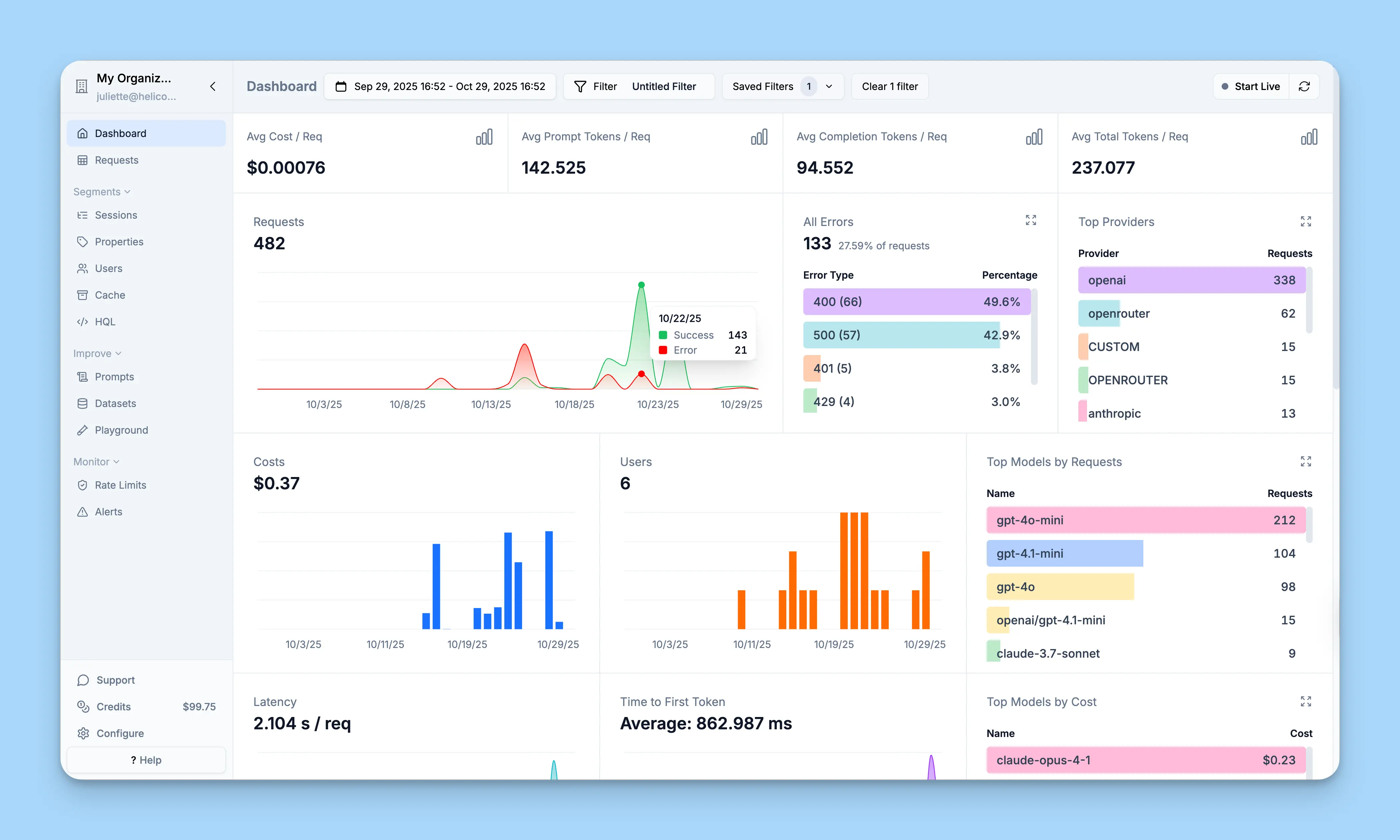
Best for: Lightweight LLM request monitoring and usage tracking
Helicone helps developers add observability to LLM requests without building a monitoring system from scratch. Its logging and AI gateway capabilities support multiple model providers, while usage data helps teams investigate slow responses and manage consumption.
Key features
- Request logging: Records LLM requests and responses so developers can inspect model interactions.
- Multi-provider gateway: Provides a common gateway interface to supported models and providers.
- Latency monitoring: Captures request performance metrics to help identify slow responses.
- Cost and token tracking: Monitors usage and associated spending to help teams understand consumption patterns.
- Alerts and reports: Helps teams review usage patterns and configure alerts around supported monitoring metrics.
Pricing: Helicone offers a free Hobby plan with 10,000 requests/month, Pro at $79/month, and Team at $799/month. Usage-based charges may apply; Enterprise pricing is custom.
I. W&B Weave
Best for: AI experimentation, tracing, and continuous evaluation
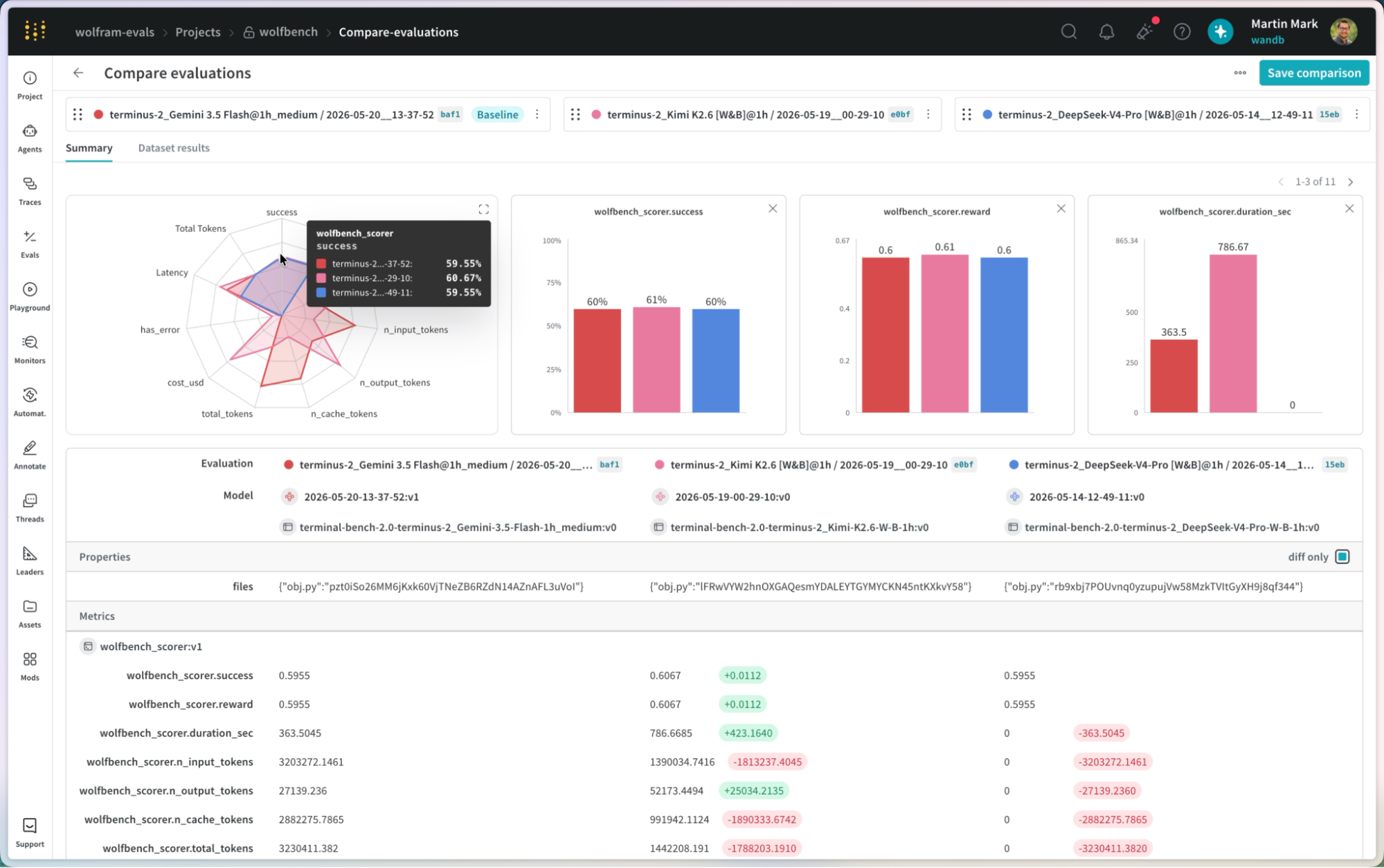
W&B Weave supports teams building and refining LLM applications by combining tracing, evaluation datasets, scorers, and experiment tracking. It helps developers compare different prompts and models, investigate failures, and assess whether changes improve application quality.
Key features
- Application tracing: Records AI application inputs, outputs, and execution metadata to help developers inspect behaviour.
- Evaluation datasets: Lets teams create test cases and reusable datasets for consistent quality checks.
- Custom scorers: Supports custom and model-based evaluation methods to measure application-specific requirements.
- Experiment comparisons: Compares prompts, models, and configurations across datasets to evaluate changes.
- Production monitoring: Helps teams examine quality, latency, and token usage across application runs.
Pricing: W&B offers a free plan and a Pro plan starting at $60/month, billed monthly. Enterprise pricing depends on security, hosting, and collaboration requirements.
J. Galileo
Best for: AI evaluation, RAG quality, and production guardrails
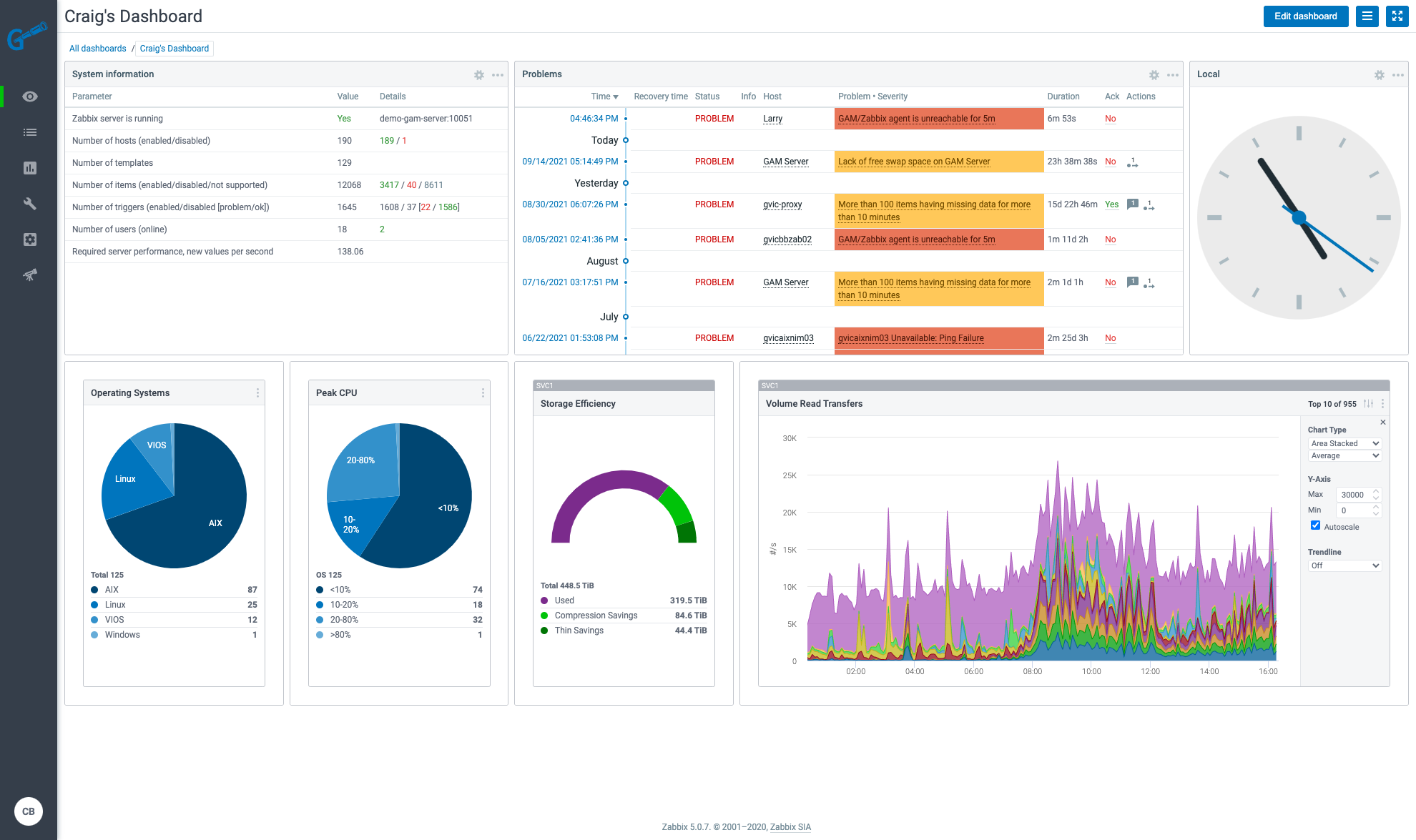
Galileo focuses on evaluating the reliability of LLM applications, RAG systems, and AI agents. It helps teams define measurable quality checks, investigate problematic outputs, and use evaluation results to inform guardrails for deployed applications.
Key features
- Built-in evaluation metrics: Provides evaluators for common RAG, agent, safety, and security concerns.
- Evaluation datasets: Supports building datasets from development and production examples for repeatable assessments.
- Custom evaluators: Lets teams define checks that reflect their application's domain and expected behaviour.
- Production guardrails: Supports runtime guardrails in enterprise offerings to help address selected output risks.
- Trace and quality analysis: Helps teams inspect AI interactions and investigate recurring quality or safety issues.
Pricing: Galileo offers a free plan with 5,000 traces/month and a Pro plan starting at $100/month when billed yearly, including 50,000 traces/month. Enterprise pricing is custom.
5. Which Holistic AI Alternative Should You Choose?
The right platform depends on the problem your team needs to solve:
- For shadow AI discovery and usage governance: CloudEagle.ai helps identify unapproved tools, understand employee usage, and enforce access policies.
- For LLM tracing and debugging: Langfuse, LangSmith, and Arize Phoenix are useful starting points for examining execution and troubleshooting failures.
- For evaluation and regression testing: Braintrust and W&B Weave help teams compare outputs and test changes against consistent criteria.
- For enterprise monitoring and safety: Fiddler AI and Datadog are worth evaluating for production observability, while Galileo is relevant for evaluation and guardrails.
- For lightweight, multi-provider monitoring: Helicone offers request logging and usage visibility through its gateway.
Before choosing, compare tracing depth, evaluation methods, production monitoring, data-retention requirements, integrations, and total cost. CloudEagle.ai addresses a different but related need, enterprise AI discovery and usage governance, so organizations may need it alongside an observability tool rather than as a direct substitute.
6. Holistic AI vs. AI Observability Platforms: What's the Difference?
Holistic AI focuses on enterprise AI governance, including risk assessments, security testing, and compliance, and ongoing oversight. Specialist AI observability platforms typically focus on tracing LLM workflows, debugging application failures, evaluating outputs, and monitoring production performance.
However, Holistic AI also offers monitoring capabilities, so the key difference is the depth and purpose of each platform's features.
Which approach should you choose?
Choose a governance-focused platform when your priority is enterprise-wide AI risk assessment, policy enforcement, and compliance evidence. Choose a specialist observability tool when developers need to trace failed responses, investigate retrieval errors, compare prompt versions, or diagnose production performance issues.
When evaluating Holistic AI alternatives, identify these requirements separately. Organizations managing both regulatory obligations and complex AI applications may benefit from combining governance software with a dedicated observability platform.
7. Which Holistic AI Alternative Is Right for Your Team?
The best Holistic AI alternative depends on whether you need deeper debugging, better output quality, production monitoring, or enterprise AI governance.
- For LLM tracing and debugging: Langfuse offers open-source observability, LangSmith supports detailed execution tracing, and Arize Phoenix is useful for tracing and RAG troubleshooting.
- For evaluation and quality testing: Braintrust and W&B Weave help compare prompts and models against test datasets, while Galileo adds AI quality checks and production guardrails.
- For enterprise monitoring and safety: Fiddler AI combines observability with quality and safety checks, while Datadog integrates AI monitoring with application and infrastructure telemetry.
- For cost and usage monitoring: Helicone provides request-level logging, multi-provider access, and AI usage tracking.
- For employee AI governance: CloudEagle.ai helps discover shadow AI, monitor employee usage, enforce access policies, and track AI spending.
Before choosing among Holistic AI competitors, test your priority workflows and compare tracing depth, evaluation capabilities, integrations, and deployment requirements. The best fit is the platform that solves your team's specific challenges without adding unnecessary complexity.
8. Find the Right Fit for Your AI Observability Needs
The best Holistic AI alternative depends on whether your team needs deeper LLM tracing, reliable output evaluations, or production monitoring. Langfuse, LangSmith, and Arize Phoenix support application-level debugging, while Braintrust and Galileo focus on evaluation and quality improvement.
For organizations managing shadow AI and employee usage, CloudEagle.ai complements observability tools with AI discovery, access controls, and usage governance. Compare platforms against your workflows, integration requirements, and budget before making a decision.
9. FAQs
1. How is LLM observability different from traditional application monitoring?
Traditional application monitoring tracks service health, errors, latency, and infrastructure performance. LLM observability adds AI-specific details, such as prompts, model responses, retrieved context, tool calls, token usage, and evaluation scores, helping teams understand why an AI application produces an unexpected result.
2. How often should teams evaluate LLM output quality?
Teams should run evaluations whenever they change prompts, models, retrieval pipelines, or agent logic. Production evaluations can also reveal quality regressions that controlled testing misses. The frequency should reflect the application's risk, traffic volume, and the potential impact of incorrect responses.
3. Can open-source AI observability tools support enterprise workloads?
Yes, provided the deployment meets enterprise requirements. Before choosing a self-hosted tool, assess scalability, role-based access controls, data retention, audit logging, alerting, and maintenance requirements. Open-source availability can reduce licensing constraints, but the organization remains responsible for operating and securing the deployment.
4. Does AI observability prevent hallucinations?
No. AI observability helps teams detect and investigate hallucinations through trace analysis, retrieval inspection, and evaluations for grounding or factual consistency. Reducing them requires corrective measures such as improving retrieval quality, validating sources, adjusting prompts, adding guardrails, and introducing human review where appropriate.
5. How can teams protect sensitive data in AI observability logs?
Teams should minimize the sensitive data collected in traces, redact personal information and credentials where possible, and apply role-based access and retention controls. Capture enough context to debug failures without retaining unnecessary raw prompts, responses, or confidential business data.
Stop Managing AI Risks With Disconnected Tools.