
%201.svg)


HIPAA Compliance Checklist for 2025

Your last audit went fine. Your next one might not.
Not because your team isn't trying, but because compliance isn't a moment anymore. It's a moving target. Regulations change. Employees join and leave. Shadow AI tools get adopted on a Tuesday.
Access that was fine six months ago is a violation today. And somewhere in that gap between your last review and right now, something slipped.
That's the problem with periodic compliance. It only tells you where you stood, not where you stand.
The best tools for continuous compliance monitoring in 2026 don't just help you pass audits. They make sure you're not ready for one. This guide compares 10 platforms enterprises are actually using, what they do, who they're for, and what they cost.
TL;DR
- Choose tools that offer real-time continuous compliance monitoring, not periodic checks.
- Look for automated evidence collection and multi-framework support (SOC 2, ISO 27001, HIPAA).
- Ensure the platform can detect shadow IT and AI tools that create hidden compliance gaps.
- Prioritize solutions that monitor access governance and user permissions continuously.
- Select a tool that generates audit-ready evidence automatically to simplify audits.
1. Why Continuous Compliance Monitoring Is Now a Board-Level Priority?
A few years ago, compliance was an annual exercise. Run the audit, collect the evidence, pass the review, move on. That model is broken, and executives are starting to feel it.
Here's why 2026 changed the stakes:
- Regulations multiplied: GDPR, CCPA, HIPAA, SOC 2, ISO 27001, the EU AI Act. Enterprises are managing overlapping frameworks simultaneously, and auditors want continuous evidence, not snapshots.
- SaaS sprawl made compliance invisible: Employees are adopting tools that IT never approved. Every unsanctioned app is a potential compliance gap that nobody sees until it's flagged in an audit.
- Shadow AI introduced a new risk layer: Generative AI tools are being used across organizations with no governance, no data controls, and no audit trail. The exposure is real and growing.
- Buyers now demand compliance proof upfront: The majority of enterprise buyers require SOC 2 before signing. Your compliance posture is now a direct revenue lever.
The GRC software market is projected to reach $60.7 billion in 2026, driven by enterprises recognizing that reactive compliance is no longer viable. (Source: Grand View Research)
Worth a Read : Why SaaS Compliance Is Breaking Traditional IT Governance
2. How to Select the Best Tools for Continuous Compliance Monitoring?
Before you sign anything, run every candidate through these questions:
- Is it actually continuous? Ask for specifics. Weekly batch jobs do not have continuous monitoring. Real-time control testing is.
- Does it cover your full app environment? Most tools only see what's connected via integrations. Shadow IT and non-SSO apps stay invisible.
- How does it handle access governance? Access control is the foundation of SOC 2, ISO 27001, and HIPAA. If the tool doesn't govern access continuously, it's leaving a gap.
- Can it detect shadow AI? In 2026, AI tool adoption is outpacing governance everywhere. If the platform can't see it, it can't monitor it.
- What does implementation look like? Some platforms take 6 to 12 months to fully deploy. That matters when you have a renewal or audit on the calendar.
- Does it generate audit-ready evidence automatically? Or does someone still have to manually assemble it before every audit cycle?
- What frameworks does it cover? Make sure it handles every framework you're currently managing and the ones you'll need next year.
3. Key Capabilities Every Modern Compliance Monitoring Tool Should Have
Not every compliance monitoring tool is built for the same problem. Before you shortlist anything, here's what actually matters in 2026:
- Continuous monitoring: Real-time control testing, not quarterly point-in-time checks
- Automated evidence collection: Pulling access logs, permission changes, and audit trails automatically without manual exports
- Multi-framework support: Mapping controls across SOC 2, ISO 27001, HIPAA, GDPR, and others simultaneously
- Access governance integration: Knowing who has access to what, continuously, is the foundation of any compliance program
- Shadow IT and AI visibility: You can't govern what you can't see, and most tools still can't see everything
- Audit-ready reporting: Organized, timestamped evidence that's ready to share with auditors on demand, not assembled the week before
If a platform doesn't do all of these, it's covering only part of your compliance surface.

You Might Also Like: SaaS Compliance Checklist for Security and IT Leaders
4. 10 Best Compliance Monitoring Software Enterprises Are Using in 2026
1. CloudEagle.ai
Best for: Enterprises that need continuous SaaS access governance, shadow IT compliance, and automated audit-ready evidence as part of their compliance program
CloudEagle.ai is a SaaS management and identity governance platform that tackles compliance from the root: unmanaged access, shadow IT, and incomplete visibility across the SaaS stack.
While most automated Compliance Monitoring Software focuses on framework certifications, CloudEagle focuses on the underlying access and governance problems that cause compliance failures in the first place.
SaaS Security and Compliance
Your compliance posture is only as strong as your visibility into what's actually running in your environment.
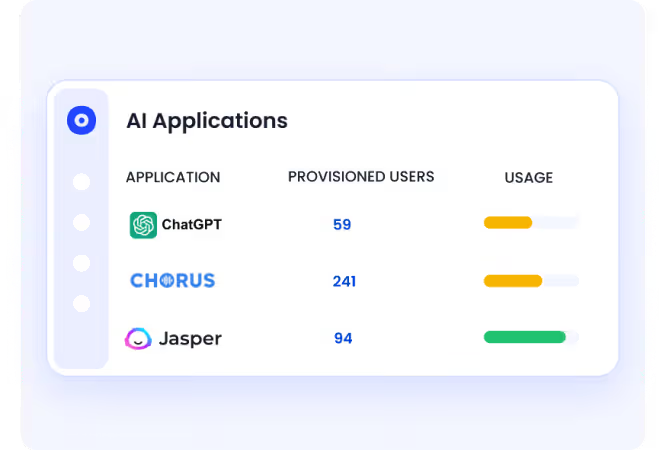
- Continuously monitors app risk, access misalignment, and policy violations across the entire SaaS portfolio
- Flags risky apps, misconfigured tools, and non-compliant access in real time
- Replaces reactive compliance checks with always-on SaaS security and compliance monitoring
Automated User Access Reviews
Quarterly reviews leave months of exposure. CloudEagle runs them continuously, so you're never caught off guard.
- AI-powered access reviews that run automatically across all apps
- Flags ex-employees, over-privileged users, and stale permissions instantly
- Completes SOC 2 access reviews up to 80% faster with one-click remediation
Shadow IT and AI Governance
You can't monitor compliance for apps you don't know exist.
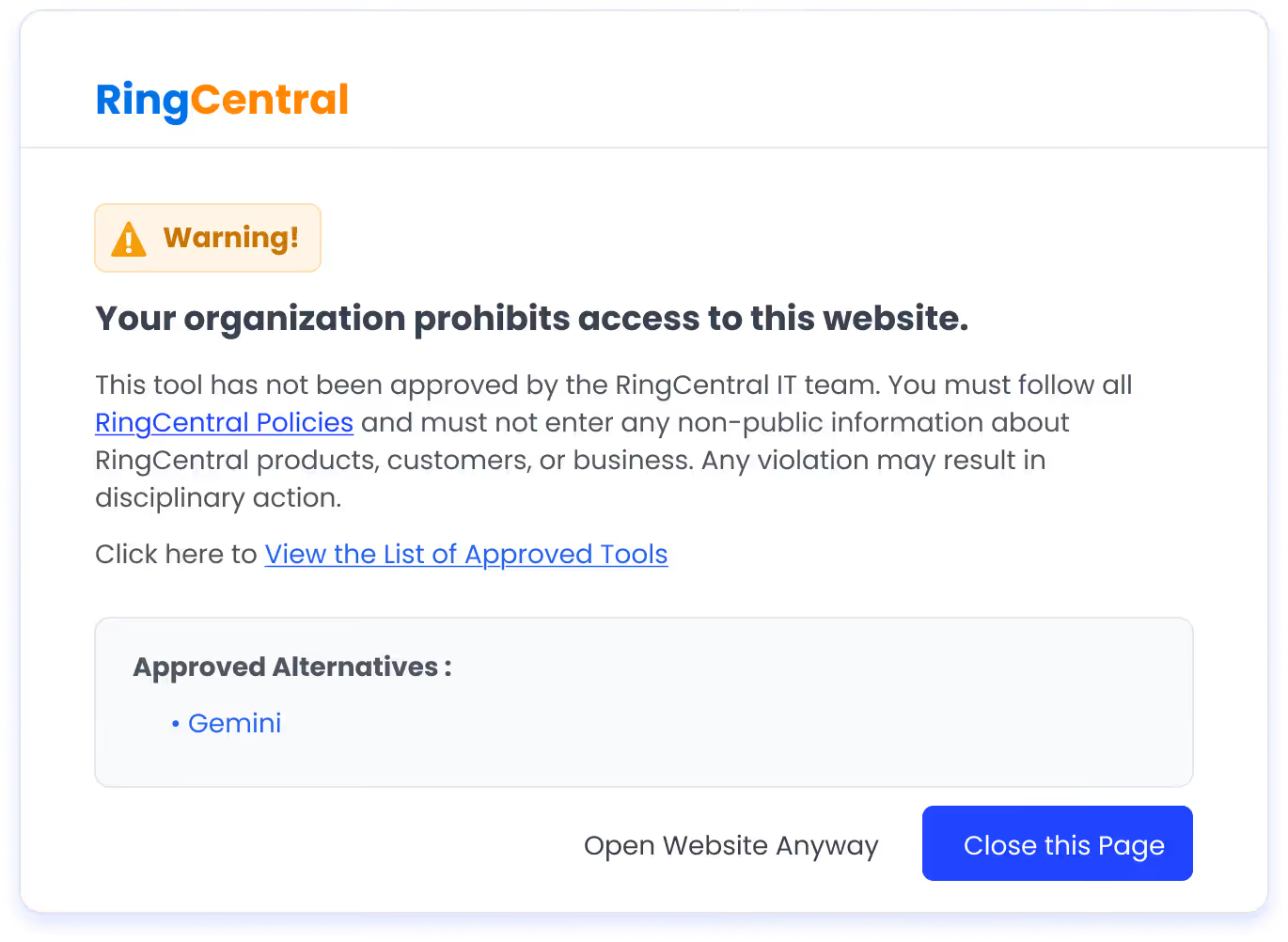
- Surfaces every unsanctioned SaaS and AI tool employees are using, including those outside SSO
- Risk-scores each tool and triggers automated workflows to block, approve, or redirect
- Full shadow IT and AI governance with a complete audit trail
Excessive Privileged User Detection
Privilege creep is one of the most common compliance failures. CloudEagle catches it continuously.
- Surfaces users with unnecessary admin roles or elevated permissions across all apps
- Highlights privilege mismatches based on role, department, or policy
- Guides remediation with automated deprovisioning paths for excessive privileged users
Zero-Touch Offboarding
Incomplete offboarding is a compliance violation waiting to happen.

- Triggers instant, automated deprovisioning the moment an HRIS or ITSM exit signal fires
- Covers SSO apps, non-SSO apps, and shadow tools in a single workflow
- Eliminates 48% of lingering access identified in the CloudEagle IGA Report via automated offboarding
Pros:
- The only platform that governs both SSO and non-SSO apps for complete compliance coverage
- Continuous monitoring replaces periodic reviews, always audit-ready, never scrambling
- Generates audit-ready evidence for SOC 2 and ISO 27001 automatically, timestamped, and organized
- Recognized in the 2025 Gartner Magic Quadrant for SaaS Management Platforms
"We lacked confidence in our access certifications. CloudEagle brought structure and accountability to user access reviews without reviewer fatigue." — Michal Lipinski, Director of IT & Security, ICEYE
Case Study: ICEYE cut manual access review work by 90% and saved 1,500+ hours/year, with audit-ready certifications available by default. Read the full case study →
Pricing: Available on request.
Compliance monitoring is no longer just an IT problem. It's a business risk conversation that reaches the C-suite.
Kevin Lee, Account Executive at CloudEagle, covered exactly this in the webinar "Managing SaaS Risk and Compliance", walking through how enterprises are rethinking their compliance posture in a world where 60% of SaaS and AI apps operate outside IT visibility.
If you're building or refreshing your compliance monitoring program, this is worth your time.
Watch here: Managing SaaS Risk and Compliance
Compliant Last Quarter Doesn't Mean Compliant Right Now.


2. Drata
Drata is one of the strongest continuous compliance monitoring software platforms for enterprise teams managing multiple frameworks simultaneously. It goes deep into automation and is built for mature compliance programs.
Features:
- Supports 16+ frameworks simultaneously with continuous control monitoring
- Automates evidence collection from cloud providers, MDM tools, and SaaS apps
- Real-time compliance health scoring and risk quantification
- Cross-framework mapping eliminates duplicate control work
- Security training, automation, and policy management built in
Best for: Multi-framework compliance for enterprise teams needing depth and breadth simultaneously.
Pricing: Starts around $10,000/year. Enterprise plans on request.
3. Vanta
Vanta pioneered the continuous compliance model and remains one of the most recognized names in regulatory compliance monitoring. The go-to for teams that need to get certified fast without deep internal compliance expertise.
Features:
- Connects to 300+ integrations to pull evidence automatically
- Maps controls across SOC 2, ISO 27001, HIPAA, GDPR, and PCI DSS simultaneously
- Automates employee security training and policy acknowledgment tracking
- Real-time compliance dashboards and risk scoring
- Vendor risk management and questionnaire automation
Best for: Fast SOC 2 and ISO 27001 certification for growing SaaS companies.
Pricing: Starts at approximately $5,000 to $7,000/year for startups. Enterprise pricing on request.
4. Secureframe
Secureframe combines solid automated compliance monitoring with a notably hands-on customer success experience. For teams without dedicated compliance staff, the support model consistently outranks competitors.
Features:
- Automated evidence collection across AWS, GCP, Azure, and 200+ SaaS integrations
- Covers SOC 2, ISO 27001, HIPAA, PCI DSS, GDPR, and FedRAMP
- Continuous control testing with real-time failure alerts
- Vendor security assessment workflows built in
- Pen test and security training integrations included
Best for: Teams that want strong automation and even stronger support.
Pricing: Starts around $6,000 to $8,000/year. Custom pricing for enterprise.
5. Sprinto
Sprinto is built specifically for high-growth SaaS startups, faster to deploy, more affordable, and designed to get you certified without a heavy internal lift.
Features:
- Automated evidence collection from cloud and SaaS tools
- Covers SOC 2, ISO 27001, HIPAA, GDPR, and SOC 1
- Security training and policy management included
- Real-time compliance monitoring and health dashboards
- Audit partner network for end-to-end certification support
Best for: Fast-growing startups that need compliance without the enterprise price tag.
Pricing: Starts around $6,000 to $8,000/year. Scales with company size.
6. Hyperproof
Hyperproof is purpose-built for the operational side of compliance, the strongest compliance monitoring tool for teams where evidence collection involves coordinating across 10+ internal stakeholders.
Features:
- Centralized evidence collection and control management across frameworks
- Cross-framework compliance mapping to eliminate duplicate work
- Task assignment and workflow management for audit coordination
- Risk register and compliance program tracking
- Integrates with JIRA, Slack, and 70+ SaaS tools
Best for: Compliance operations teams juggling multiple frameworks and lots of stakeholders.
Pricing: Starts around $12,000/year. Enterprise plans on request.
Read this too: Top 10 Compliance Standards in 2026: What IT and Security Leaders Must Know
7. Thoropass
Thoropass differentiates itself by combining compliance software with built-in auditor access, so you're not just preparing for an audit; you're completing it within the same platform.
Features:
- Integrated audit workflows with in-house auditors for SOC 2 and ISO 27001
- Continuous control monitoring with automated evidence collection
- Policy and vendor management built in
- Compliance readiness scoring with gap analysis
- Supports HIPAA, PCI DSS, and GDPR alongside SOC 2 and ISO
Best for: Teams that want compliance software and audit services under one roof.
Pricing: Pricing on request. Bundled audit and software packages available.
8. Scrut Automation
Scrut is a strong option for lean security teams that need fast, multi-framework compliance coverage without the complexity of larger enterprise platforms.
Features:
- Automated evidence collection across cloud and SaaS environments
- Supports SOC 2, ISO 27001, HIPAA, GDPR, and PCI DSS
- Real-time risk monitoring with automated alerts
- Policy management and vendor risk assessment workflows
- Audit management with collaboration tools for internal teams
Best for: Lean security teams needing fast multi-framework compliance coverage.
Pricing: Starts around $7,000 to $10,000/year. Enterprise pricing on request.
9. AuditBoard
AuditBoard covers the full compliance spectrum, one of the few regulatory compliance monitoring platforms that seriously addresses internal audit, SOX, and ESG. Built for public companies with formal audit committee requirements.
Features:
- Internal audit management and scheduling
- SOX compliance and financial controls testing
- Risk management with heat maps and quantification
- ESG and sustainability reporting
- Board-level compliance reporting built in
Best for: Public companies that need internal audit, SOX, and enterprise risk in one place.
Pricing: Enterprise pricing only. Typically starting around $50,000+/year, depending on modules.
10. LogicGate
LogicGate takes a workflow-first approach, giving teams a highly configurable drag-and-drop builder to create the GRC processes that match their specific needs. Built for teams whose compliance requirements are genuinely non-standard.
Features:
- Drag-and-drop workflow builder for fully custom compliance processes
- Risk management with quantification and scenario modeling
- Audit management and evidence tracking
- Third-party and vendor risk workflows
- Regulatory change management is built in
Best for: Complex, custom GRC workflows that don't fit off-the-shelf templates.
Pricing: Starts around $20,000/year. Enterprise pricing on request.
Conclusion
Continuous compliance monitoring isn't a nice-to-have in 2026. It's the difference between being audit-ready on any given Tuesday and scrambling the week before every review.
Drata and Vanta lead on multi-framework certification speed. Secureframe and Sprinto lead on support and startup accessibility. Hyperproof leads on compliance operations at scale. Thoropass brings auditors into the platform itself. Scrut serves lean teams well. AuditBoard and LogicGate serve the most complex enterprise and GRC needs.
And CloudEagle.ai leads on the compliance problem most of them don't fully solve: governing the access, shadow IT, and unsanctioned AI tools that sit completely outside the visibility of every other tool on this list. Because you can't monitor compliance for apps you don't know exist.
Start with where your biggest compliance gap actually lives. Then pick the tool built for that gap.
FAQs
- What are the best tools for continuous compliance monitoring in 2026?
The top platforms include CloudEagle.ai, Drata, Vanta, Secureframe, Sprinto, Hyperproof, Thoropass, Scrut Automation, AuditBoard, and LogicGate, each built for different aspects of continuous compliance monitoring across enterprise environments.
- What is continuous compliance monitoring?
Continuous compliance monitoring is the practice of automatically and continuously tracking controls, access, and evidence across your environment so you're always audit-ready, not just prepared for scheduled reviews.
- How is continuous compliance monitoring different from traditional compliance?
Traditional compliance happens periodically, with quarterly reviews, annual audits, and point-in-time snapshots. Continuous compliance monitoring runs in real time, flagging gaps, collecting evidence, and maintaining a constant state of readiness across all frameworks.
- What should enterprises look for in a compliance monitoring tool?
Real-time control monitoring, automated evidence collection, multi-framework support, access governance integration, shadow IT visibility, and audit-ready reporting without manual effort.
- How much do Compliance Monitoring Software cost?
Pricing varies significantly. Startup-focused platforms like Vanta and Sprinto start around $5,000 to $8,000/year. Mid-market platforms like Hyperproof range from $10,000 to $20,000/year. Enterprise platforms like AuditBoard start at $50,000+.
Compliant Last Quarter Doesn't Mean Compliant Right Now.


.avif)


.avif)
.avif)



.png)




.png)

.avif)
.avif)
.avif)


