AI Governance

Why Your AI Contracts Don't Match Your AI Usage

Share via:
Written by:
CloudEagle.ai Team
Reviewed by
Nidhi Jain
Last Updated:
November 25, 2026
blog-cms-banner-bg
Little-Known Negotiation Hacks to Get the Best Deal on Slack
cta-bg-blogDownload Your Copy

HIPAA Compliance Checklist for 2025

Download PDF

‍

Your company signed an AI contract for 100 users. Six months later, three departments are using different AI tools and employees have activated features IT never reviewed. 

The contract still reflects what the company originally purchased. Actual usage tells a different story.

This gap is becoming harder for IT teams to manage. AI pricing changes with consumption and existing vendors introduce new AI capabilities through product updates.

AI contracts and actual usage drift apart because contracts define fixed seats, terms, and pricing, while AI adoption changes continuously across teams, applications, and consumption patterns. IT often discovers the mismatch only after unexpected invoices, renewal discussions, or usage reviews.

Here are five common gaps IT teams should understand and how they can regain control.

‍

1. Why Do AI Contracts and AI Usage Drift Apart?

AI contracts describe what an organization agreed to purchase. They don't necessarily reflect how employees use AI throughout the contract term. Three changes make this mismatch particularly common.

A. Why Do AI Contracts Stay Fixed While Usage Changes Weekly?

Most software contracts establish a pricing tier, committed quantity, and contract duration at signing. AI usage, however, changes as employees adopt new tools and vendors introduce new capabilities.

For example, an organization might purchase 50 licenses for an AI assistant. A few months later, its engineering team starts using the assistant for code generation, while marketing adopts it for content research.

The original contract hasn't changed, but the number of workflows and intensity of usage have.

IT often gets involved midway through the contract when Finance questions an unexpected invoice or a department requests additional capacity.

By then, understanding the difference between contracted usage and actual consumption becomes difficult.

‍

Contracted vs. Actual AI Spend. See the Gap

Check how far your real usage has drifted
Calculate My AI Spend

‍

B. Why Does AI Spending Scale With Consumption Instead of Seats?

Traditional SaaS pricing often revolves around named users or subscriptions. AI pricing increasingly includes tokens, credits, API calls, and completed tasks.

These models make spending harder to predict.

For example, an AI-powered workflow might process a document, generate a summary, and retry an operation when the output doesn't meet its requirements. Each step can trigger additional model calls and AI consumption.

A fixed subscription price won't necessarily reflect that activity.

According to InfoTech, citing USM Systems, 65% of IT leaders report unexpected charges from consumption-based AI pricing. These charges can be 30%–50% higher than budgeted because of token overages, API charges, and unpredictable usage.

IT needs visibility into consumption alongside contracted commitments to understand where costs are increasing.

C. Why Does AI Show Up Without a Contract at All?

Employees don't always wait for formal approval before adopting AI applications.

They can register using personal email addresses, activate free accounts, or purchase subscriptions using departmental cards.

These applications may never enter IT's software inventory or contract repository.

CloudEagle.ai's survey of 1,000 enterprise CIOs and CISOs found that 60% of enterprise SaaS and AI applications operate outside IT's visibility.

This creates a significant blind spot. IT may be responsible for managing application access and data usage without knowing which vendors employees have introduced.

In some cases, there is no centrally accessible contract, documented owner, or renewal date for IT to review.

‍

2. What Are the Five Gaps Between Your AI Contracts and Actual Usage?

The mismatch isn't limited to application counts or subscription costs. It appears across pricing, product updates, data terms, and billing.

A. Why Don't Contract Pricing Metrics Match Actual AI Consumption?

An AI contract might specify 100 seats or a fixed annual commitment. However, the vendor's billing portal may report usage in tokens, credits, or tool calls. These are different measurement units.

For example, IT might know how many employees have access to an AI assistant but have no clear view of how much each department consumes. The result is a gap between contracted capacity and actual spending.

IT should map every pricing model to its corresponding usage metric.

‍

Contract pricing Actual usage to monitor
Per-seat subscription Assigned and active users
Token-based pricing Input and output tokens
Credit-based pricing Credits consumed and remaining
API-based pricing Calls, models, and request volume
Task-based pricing Completed tasks and execution volume

‍

This makes it easier to compare vendor commitments against actual consumption.

B. How Do Embedded AI Features Change Existing Contracts?

AI capabilities increasingly arrive through software updates rather than separate application purchases. 

An existing CRM might introduce AI-generated summaries. A collaboration platform might add meeting assistants. A development platform might introduce AI coding capabilities.

Employees can start using these features within applications IT has already approved. However, the update may introduce new data flows, additional charges, or different access requirements. IT should review vendor updates for:

  • Newly activated AI capabilities.
  • Changes to subscription tiers or pricing.
  • Additional data access requirements.
  • New usage or consumption limits.
  • Changes to data processing terms.

An application approval should not automatically mean every future AI feature is approved.

C. Why Does Shadow AI Have No Contract for IT to Review?

Shadow AI creates a different problem: the application may have no centrally managed contract at all.

An employee might purchase an AI writing assistant through a personal account or sign up for a free AI research platform.

IT may discover the application through browser activity or employee reports, long after adoption begins.

Without a centrally accessible agreement, IT may not know:

  • Which vendor processes company information.
  • Whether a data processing agreement exists.
  • Who owns the account or subscription.
  • When the subscription renews.
  • What contractual terms govern data retention and usage.

IT should identify the business owner and determine whether the application needs formal evaluation, an approved enterprise agreement, or access restrictions.

‍

Who Owns That AI Subscription?

Learn how to stop shadow AI before it starts
Get the Guide

‍

D. Why Are AI Data Training and Usage Clauses Difficult to Track?

AI vendor agreements don't always explain data handling in the same level of detail.

One provider might offer contractual commitments that customer inputs won't train its models. Another might apply different terms depending on the subscription tier or configuration.

IT needs to understand these differences before approving applications for business use.

Pay particular attention to:

  • Whether customer prompts and uploaded files are used for model training.
  • How long submitted information is retained.
  • Whether data is shared with third-party model providers.
  • Whether the terms differ between consumer and enterprise plans.
  • What happens to stored information when the contract ends.

These details matter because an employee using a personal account may not receive the same contractual protections as someone using an organization-managed subscription.

E. Why Don't AI Vendor Billing Cycles Line Up?

Organizations rarely purchase every AI application from one vendor. One platform might bill monthly, another annually, and a third based on API consumption. 

Even applications from the same vendor may have separate SKUs and billing arrangements.

This makes consolidated cost tracking difficult. IT teams often end up collecting invoices, exporting usage reports, and reconciling everything manually in spreadsheets.

A centralized view should connect:

  • Vendor and application names.
  • Contracted pricing and commitments.
  • Actual consumption.
  • Billing periods and renewal dates.
  • Department-level spending.

Without this information, IT cannot reliably explain whether AI spending matches the organization's agreements.

‍

3. What Does the Mismatch Between AI Contracts and Usage Cost Your Organization?

The consequences extend beyond inaccurate software inventories.

Unexpected overage invoices: Consumption grows beyond contracted expectations, leaving IT to explain charges it couldn't forecast.

Automatic renewals at higher tiers: Without historical usage data, IT has limited evidence to challenge unnecessary upgrades or negotiate better terms.

Security and compliance exposure: Employees use applications to process company information under contractual terms IT may never have reviewed.

IT is held responsible for managing all three outcomes, but it often controls only part of the underlying data.

‍

4. How Does CloudEagle.ai Help IT Teams Control AI Usage?
‍

‍

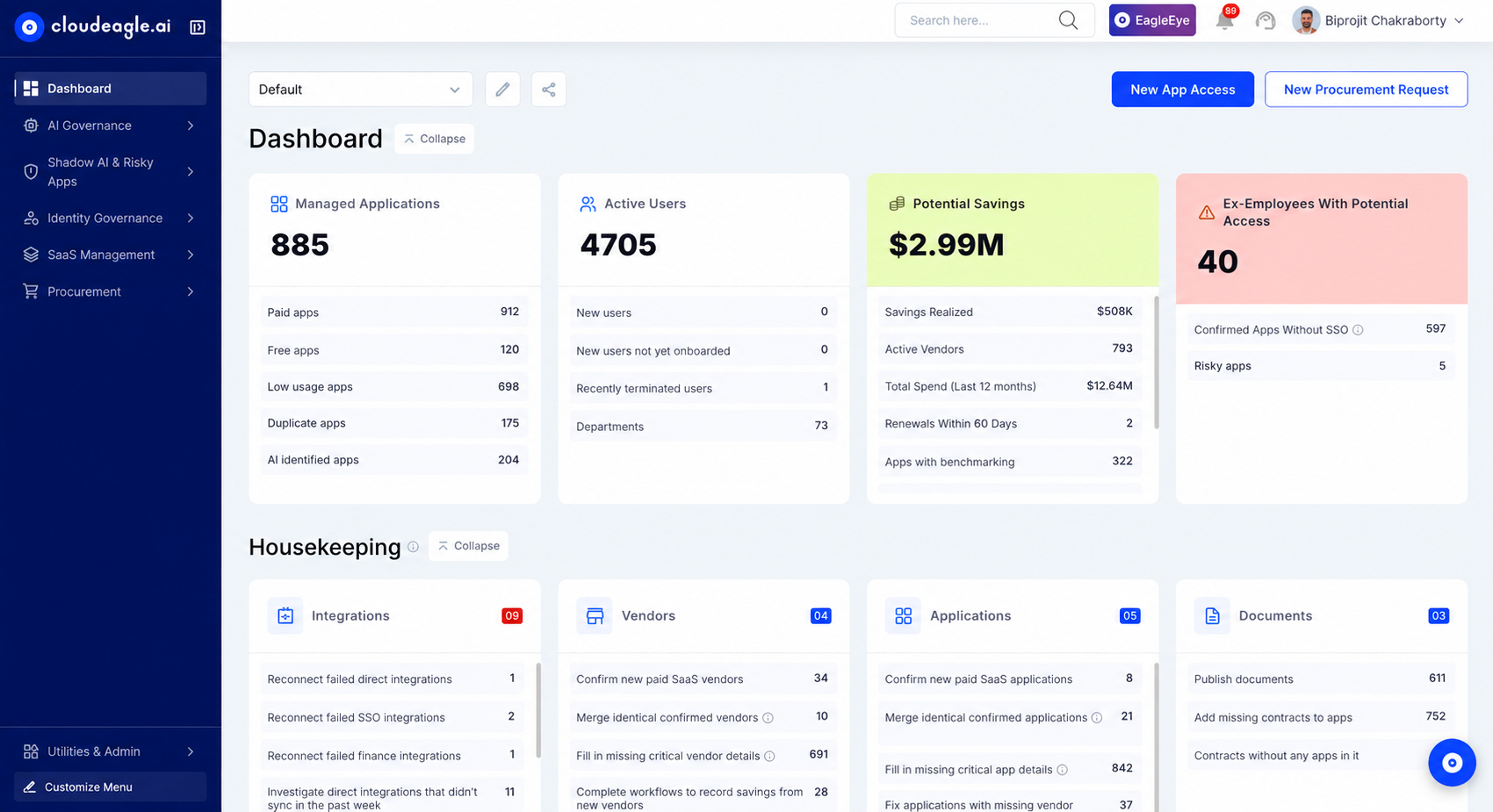
Employees are adopting AI tools across departments, but IT teams often can’t see who uses them or how much they consume. 

CloudEagle.ai gives IT control through consumption tracking, spending limits, policy enforcement, and data protection across supported AI tools.

  • Consumption tracking: Track token usage and spend across Claude, ChatGPT, Cursor, Gemini, and GitHub Copilot, by user, team, department, model, and API key.
  • Spending limits: Set department budgets and user or team limits, with alerts before thresholds are crossed and approval workflows for extra capacity.
  • Policy enforcement: Apply usage rules by role, user, department, and application, redirect employees to sanctioned tools, and block specific models like Opus.
  • Data protection: Inspect prompts before they reach the AI model to stop PII, PHI, financial data, and source code from being shared.
  • Spend attribution: Link AI costs to teams and cost centers, and reconcile invoices against tracked usage.
  • License optimization: Identify unused AI licenses and reclaim them through license harvesting workflows.

‍

‍

5. Conclusion

AI contracts are only useful when organizations understand how their employees actually use the applications covered by those agreements. For IT teams, that means looking beyond signed contracts and subscription counts.

They need visibility into application adoption, consumption, embedded AI features, and actual spending.

Connecting this information helps IT identify mismatches before they become unexpected invoices, renewal problems, or unmanaged application usage.

The goal isn't simply to keep contracts updated. It's to ensure that what the organization pays for, what employees use, and what IT manages remain aligned.

‍

6. FAQs

1. Why don't AI contracts match actual usage?

AI contracts define agreed pricing, seats, and terms, while employee adoption and consumption change throughout the contract period.

2. How can IT track AI usage against contracts?

IT should compare contracted seats, credits, tokens, and commitments against actual application usage, consumption reports, and vendor invoices.

3. What causes unexpected AI spending?

Unexpected costs often come from token overages, API calls, additional model usage, automated retries, and consumption beyond contracted limits.

4. How does Shadow AI affect contract management?

Shadow AI introduces applications without centralized contracts, documented ownership, renewal dates, or reviewed data handling terms.

5. What should IT review in an AI vendor contract?

IT should review pricing metrics, consumption limits, data retention, model training terms, third-party data sharing, access controls, and renewal conditions.

‍

Advertisement for a SaaS Subscription Tracking Template with a call-to-action button to download and a partial graphic of a tablet showing charts.Banner promoting a SaaS Agreement Checklist to streamline SaaS management and avoid budget waste with a call-to-action button labeled Download checklist.Blue banner with text 'The Ultimate Employee Offboarding Checklist!' and a black button labeled 'Download checklist' alongside partial views of checklist documents from cloudeagle.ai.Digital ad for download checklist titled 'The Ultimate Checklist for IT Leaders to Optimize SaaS Operations' by cloudeagle.ai, showing checklist pages.Slack Buyer's Guide offer with text 'Unlock insider insights to get the best deal on Slack!' and a button labeled 'Get Your Copy', accompanied by a preview of the guide featuring Slack's logo.Monday Pricing Guide by cloudeagle.ai offering exclusive pricing secrets to maximize investment with a call-to-action button labeled Get Your Copy and an image of the guide's cover.Blue banner for Canva Pricing Guide by cloudeagle.ai offering a guide to Canva costs, features, and alternatives with a call-to-action button saying Get Your Copy.Blue banner with white text reading 'Little-Known Negotiation Hacks to Get the Best Deal on Slack' and a white button labeled 'Get Your Copy'.Blue banner with text 'Little-Known Negotiation Hacks to Get the Best Deal on Monday.com' and a white button labeled 'Get Your Copy'.Blue banner with text 'Little-Known Negotiation Hacks to Get the Best Deal on Canva' and a white button labeled 'Get Your Copy'.Banner with text 'Slack Buyer's Guide' and a 'Download Now' button next to images of a guide titled 'Slack Buyer’s Guide: Features, Pricing & Best Practices'.Digital cover of Monday Pricing Guide with a button labeled Get Your Copy on a blue background.Canva Pricing Guide cover with a button labeled Get Your Copy on a blue gradient background.

Enter your email to
unlock the report

Oops! Something went wrong while submitting the form.
License Count
Benchmark
Per User/Per Year

Enter your email to
unlock the report

Oops! Something went wrong while submitting the form.
License Count
Benchmark
Per User/Per Year

Enter your email to
unlock the report

Oops! Something went wrong while submitting the form.
Notion Plus
License Count
Benchmark
Per User/Per Year
100-500
$67.20 - $78.72
500-1000
$59.52 - $72.00
1000+
$51.84 - $57.60
Canva Pro
License Count
Benchmark
Per User/Per Year
100-500
$74.33-$88.71
500-1000
$64.74-$80.32
1000+
$55.14-$62.34

Enter your email to
unlock the report

Oops! Something went wrong while submitting the form.

Enter your email to
unlock the report

Oops! Something went wrong while submitting the form.
Zoom Business
License Count
Benchmark
Per User/Per Year
100-500
$216.00 - $264.00
500-1000
$180.00 - $216.00
1000+
$156.00 - $180.00

Enter your email to
unlock the report

Oops! Something went wrong while submitting the form.

Get the Right Security Platform To Secure Your Cloud Infrastructure

Please enter a business email
Thank you!
The 2023 SaaS report has been sent to your email. Check your promotional or spam folder.
Oops! Something went wrong while submitting the form.

Access full report

Please enter a business email
Thank you!
The 2023 SaaS report has been sent to your email. Check your promotional or spam folder.
Oops! Something went wrong while submitting the form.

TL;DR

  • AI contracts define fixed seats, pricing, and terms, while employee adoption, consumption, and spending change continuously.
  • Consumption-based pricing, embedded AI features, and Shadow AI create gaps between contracted commitments and actual usage.
  • Five common gaps involve pricing metrics, newly introduced AI features, uncontracted applications, data-use clauses, and mismatched billing cycles.
  • These gaps lead to unexpected invoices, unnecessary renewals, and security exposure from applications operating under unreviewed terms.‍
  • CloudEagle.ai helps IT teams align AI usage with contracts through token tracking, spending limits, policy enforcement, prompt-level DLP, spend attribution, and license optimization.

‍

‍

Your company signed an AI contract for 100 users. Six months later, three departments are using different AI tools and employees have activated features IT never reviewed. 

The contract still reflects what the company originally purchased. Actual usage tells a different story.

This gap is becoming harder for IT teams to manage. AI pricing changes with consumption and existing vendors introduce new AI capabilities through product updates.

AI contracts and actual usage drift apart because contracts define fixed seats, terms, and pricing, while AI adoption changes continuously across teams, applications, and consumption patterns. IT often discovers the mismatch only after unexpected invoices, renewal discussions, or usage reviews.

Here are five common gaps IT teams should understand and how they can regain control.

‍

1. Why Do AI Contracts and AI Usage Drift Apart?

AI contracts describe what an organization agreed to purchase. They don't necessarily reflect how employees use AI throughout the contract term. Three changes make this mismatch particularly common.

A. Why Do AI Contracts Stay Fixed While Usage Changes Weekly?

Most software contracts establish a pricing tier, committed quantity, and contract duration at signing. AI usage, however, changes as employees adopt new tools and vendors introduce new capabilities.

For example, an organization might purchase 50 licenses for an AI assistant. A few months later, its engineering team starts using the assistant for code generation, while marketing adopts it for content research.

The original contract hasn't changed, but the number of workflows and intensity of usage have.

IT often gets involved midway through the contract when Finance questions an unexpected invoice or a department requests additional capacity.

By then, understanding the difference between contracted usage and actual consumption becomes difficult.

‍

Contracted vs. Actual AI Spend. See the Gap

Check how far your real usage has drifted
Calculate My AI Spend

‍

B. Why Does AI Spending Scale With Consumption Instead of Seats?

Traditional SaaS pricing often revolves around named users or subscriptions. AI pricing increasingly includes tokens, credits, API calls, and completed tasks.

These models make spending harder to predict.

For example, an AI-powered workflow might process a document, generate a summary, and retry an operation when the output doesn't meet its requirements. Each step can trigger additional model calls and AI consumption.

A fixed subscription price won't necessarily reflect that activity.

According to InfoTech, citing USM Systems, 65% of IT leaders report unexpected charges from consumption-based AI pricing. These charges can be 30%–50% higher than budgeted because of token overages, API charges, and unpredictable usage.

IT needs visibility into consumption alongside contracted commitments to understand where costs are increasing.

C. Why Does AI Show Up Without a Contract at All?

Employees don't always wait for formal approval before adopting AI applications.

They can register using personal email addresses, activate free accounts, or purchase subscriptions using departmental cards.

These applications may never enter IT's software inventory or contract repository.

CloudEagle.ai's survey of 1,000 enterprise CIOs and CISOs found that 60% of enterprise SaaS and AI applications operate outside IT's visibility.

This creates a significant blind spot. IT may be responsible for managing application access and data usage without knowing which vendors employees have introduced.

In some cases, there is no centrally accessible contract, documented owner, or renewal date for IT to review.

‍

2. What Are the Five Gaps Between Your AI Contracts and Actual Usage?

The mismatch isn't limited to application counts or subscription costs. It appears across pricing, product updates, data terms, and billing.

A. Why Don't Contract Pricing Metrics Match Actual AI Consumption?

An AI contract might specify 100 seats or a fixed annual commitment. However, the vendor's billing portal may report usage in tokens, credits, or tool calls. These are different measurement units.

For example, IT might know how many employees have access to an AI assistant but have no clear view of how much each department consumes. The result is a gap between contracted capacity and actual spending.

IT should map every pricing model to its corresponding usage metric.

‍

Contract pricing Actual usage to monitor
Per-seat subscription Assigned and active users
Token-based pricing Input and output tokens
Credit-based pricing Credits consumed and remaining
API-based pricing Calls, models, and request volume
Task-based pricing Completed tasks and execution volume

‍

This makes it easier to compare vendor commitments against actual consumption.

B. How Do Embedded AI Features Change Existing Contracts?

AI capabilities increasingly arrive through software updates rather than separate application purchases. 

An existing CRM might introduce AI-generated summaries. A collaboration platform might add meeting assistants. A development platform might introduce AI coding capabilities.

Employees can start using these features within applications IT has already approved. However, the update may introduce new data flows, additional charges, or different access requirements. IT should review vendor updates for:

  • Newly activated AI capabilities.
  • Changes to subscription tiers or pricing.
  • Additional data access requirements.
  • New usage or consumption limits.
  • Changes to data processing terms.

An application approval should not automatically mean every future AI feature is approved.

C. Why Does Shadow AI Have No Contract for IT to Review?

Shadow AI creates a different problem: the application may have no centrally managed contract at all.

An employee might purchase an AI writing assistant through a personal account or sign up for a free AI research platform.

IT may discover the application through browser activity or employee reports, long after adoption begins.

Without a centrally accessible agreement, IT may not know:

  • Which vendor processes company information.
  • Whether a data processing agreement exists.
  • Who owns the account or subscription.
  • When the subscription renews.
  • What contractual terms govern data retention and usage.

IT should identify the business owner and determine whether the application needs formal evaluation, an approved enterprise agreement, or access restrictions.

‍

Who Owns That AI Subscription?

Learn how to stop shadow AI before it starts
Get the Guide

‍

D. Why Are AI Data Training and Usage Clauses Difficult to Track?

AI vendor agreements don't always explain data handling in the same level of detail.

One provider might offer contractual commitments that customer inputs won't train its models. Another might apply different terms depending on the subscription tier or configuration.

IT needs to understand these differences before approving applications for business use.

Pay particular attention to:

  • Whether customer prompts and uploaded files are used for model training.
  • How long submitted information is retained.
  • Whether data is shared with third-party model providers.
  • Whether the terms differ between consumer and enterprise plans.
  • What happens to stored information when the contract ends.

These details matter because an employee using a personal account may not receive the same contractual protections as someone using an organization-managed subscription.

E. Why Don't AI Vendor Billing Cycles Line Up?

Organizations rarely purchase every AI application from one vendor. One platform might bill monthly, another annually, and a third based on API consumption. 

Even applications from the same vendor may have separate SKUs and billing arrangements.

This makes consolidated cost tracking difficult. IT teams often end up collecting invoices, exporting usage reports, and reconciling everything manually in spreadsheets.

A centralized view should connect:

  • Vendor and application names.
  • Contracted pricing and commitments.
  • Actual consumption.
  • Billing periods and renewal dates.
  • Department-level spending.

Without this information, IT cannot reliably explain whether AI spending matches the organization's agreements.

‍

3. What Does the Mismatch Between AI Contracts and Usage Cost Your Organization?

The consequences extend beyond inaccurate software inventories.

Unexpected overage invoices: Consumption grows beyond contracted expectations, leaving IT to explain charges it couldn't forecast.

Automatic renewals at higher tiers: Without historical usage data, IT has limited evidence to challenge unnecessary upgrades or negotiate better terms.

Security and compliance exposure: Employees use applications to process company information under contractual terms IT may never have reviewed.

IT is held responsible for managing all three outcomes, but it often controls only part of the underlying data.

‍

4. How Does CloudEagle.ai Help IT Teams Control AI Usage?

‍

‍

Employees are adopting AI tools across departments, but IT teams often can’t see who uses them or how much they consume. 

CloudEagle.ai gives IT control through consumption tracking, spending limits, policy enforcement, and data protection across supported AI tools.

  • Consumption tracking: Track token usage and spend across Claude, ChatGPT, Cursor, Gemini, and GitHub Copilot, by user, team, department, model, and API key.
  • Spending limits: Set department budgets and user or team limits, with alerts before thresholds are crossed and approval workflows for extra capacity.
  • Policy enforcement: Apply usage rules by role, user, department, and application, redirect employees to sanctioned tools, and block specific models like Opus.
  • Data protection: Inspect prompts before they reach the AI model to stop PII, PHI, financial data, and source code from being shared.
  • Spend attribution: Link AI costs to teams and cost centers, and reconcile invoices against tracked usage.
  • License optimization: Identify unused AI licenses and reclaim them through license harvesting workflows.

‍

‍

5. Conclusion

AI contracts are only useful when organizations understand how their employees actually use the applications covered by those agreements. For IT teams, that means looking beyond signed contracts and subscription counts.

They need visibility into application adoption, consumption, embedded AI features, and actual spending.

Connecting this information helps IT identify mismatches before they become unexpected invoices, renewal problems, or unmanaged application usage.

The goal isn't simply to keep contracts updated. It's to ensure that what the organization pays for, what employees use, and what IT manages remain aligned.

‍

6. FAQs

1. Why don't AI contracts match actual usage?

AI contracts define agreed pricing, seats, and terms, while employee adoption and consumption change throughout the contract period.

2. How can IT track AI usage against contracts?

IT should compare contracted seats, credits, tokens, and commitments against actual application usage, consumption reports, and vendor invoices.

3. What causes unexpected AI spending?

Unexpected costs often come from token overages, API calls, additional model usage, automated retries, and consumption beyond contracted limits.

4. How does Shadow AI affect contract management?

Shadow AI introduces applications without centralized contracts, documented ownership, renewal dates, or reviewed data handling terms.

5. What should IT review in an AI vendor contract?

IT should review pricing metrics, consumption limits, data retention, model training terms, third-party data sharing, access controls, and renewal conditions.

‍

CloudEagle.ai recognized in the 2025 Gartner® Magic Quadrant™ for SaaS Management Platforms
Download now
gartner chart
5x
Faster employee
onboarding
80%
Reduction in time for
user access reviews
30k
Workflows
automated
$15Bn
Analyzed in
contract spend
$2Bn
Saved in
SaaS spend

Streamline SaaS governance and save 10-30%

Book a Demo with Expert
CTA image