HIPAA Compliance Checklist for 2025

Cisco's AI Readiness Index found only 24% of organizations have sufficient controls and guardrails for AI agents. The other 76% are running agents they can't fully see or stop.
Shadow agents fill that gap, and shadow agent discovery tools are how you find them. Employees build agents in low-code tools, switch them on inside SaaS apps, and run them on their own credentials, all without IT review.
This guide compares 9 tools on two questions. Can they find agents nobody registered? And can they contain a rogue one?
1. What Are the 9 Best Shadow Agent Discovery Tools in 2026?
The best shadow agent discovery tools in 2026 are CloudEagle.ai, Nudge Security, Reco, Cisco + Astrix Security, Zenity, Noma Security, Microsoft Entra Agent ID, Okta, and CrowdStrike Falcon.
They differ most in where they look for agents and whether they can stop one.
We left out shadow AI app-detection tools like Netskope and Zscaler. They find AI apps and prompts, not agents running on their own credentials.
2. How Did We Evaluate the 9 Best Shadow Agent Discovery Tools?
We scored each tool on two things: coverage of unregistered agents, and response to rogue ones.
- Unregistered-agent coverage: does it find agents nobody told IT about, across low-code, SaaS, browser, endpoint, and MCP?
- Ownership mapping: does it tie each agent to a person, its credentials, and its data access?
- Containment: can it revoke, rotate, deactivate, or block a rogue agent, or only flag it?
- Review fit: does it feed findings into your access reviews?
We used vendor announcements, product pages, and documentation, not paid rankings.

3. Which Shadow Agent Discovery Tools Find and Contain Rogue Agents Best?
The tools that find and contain rogue agents best connect discovery to action. They show where an agent came from, who owns it, and what it can reach. Then they let you stop it from the same place.
Most tools on this list lead on one side and are lighter on the other.
1. CloudEagle.ai
CloudEagle.ai is an AI Governance, SaaS Security, and Identity Governance platform that helps enterprises discover, govern, and secure SaaS applications, AI agents, and non-human identities. Its AI agent security platform provides visibility into the identities agents use, the permissions they hold, and the systems they can access.
AI agents often operate through service accounts, API tokens, and other non-human identities. When these identities aren't tracked, agents can retain access to business applications and sensitive data without clear ownership or regular reviews.
CloudEagle.ai approaches agent governance through identity management, helping organizations discover unmanaged agents, identify excessive permissions, and take action on risky identities.
"As our identity environment expanded, governing non-human identities became just as important as managing human access. CloudEagle.ai gave us visibility into service accounts, API tokens, and AI agents, helping increase NHI visibility, remediate unmanaged identities, and reduce overprivileges, helping us govern NHI, the same way we did for people."
Karthik Swarnam, Chief Security and Trust Officer, Armorcode
Surface Agents Nobody Registered
CloudEagle.ai helps identify AI agents through the non-human identities and connected applications they rely on.
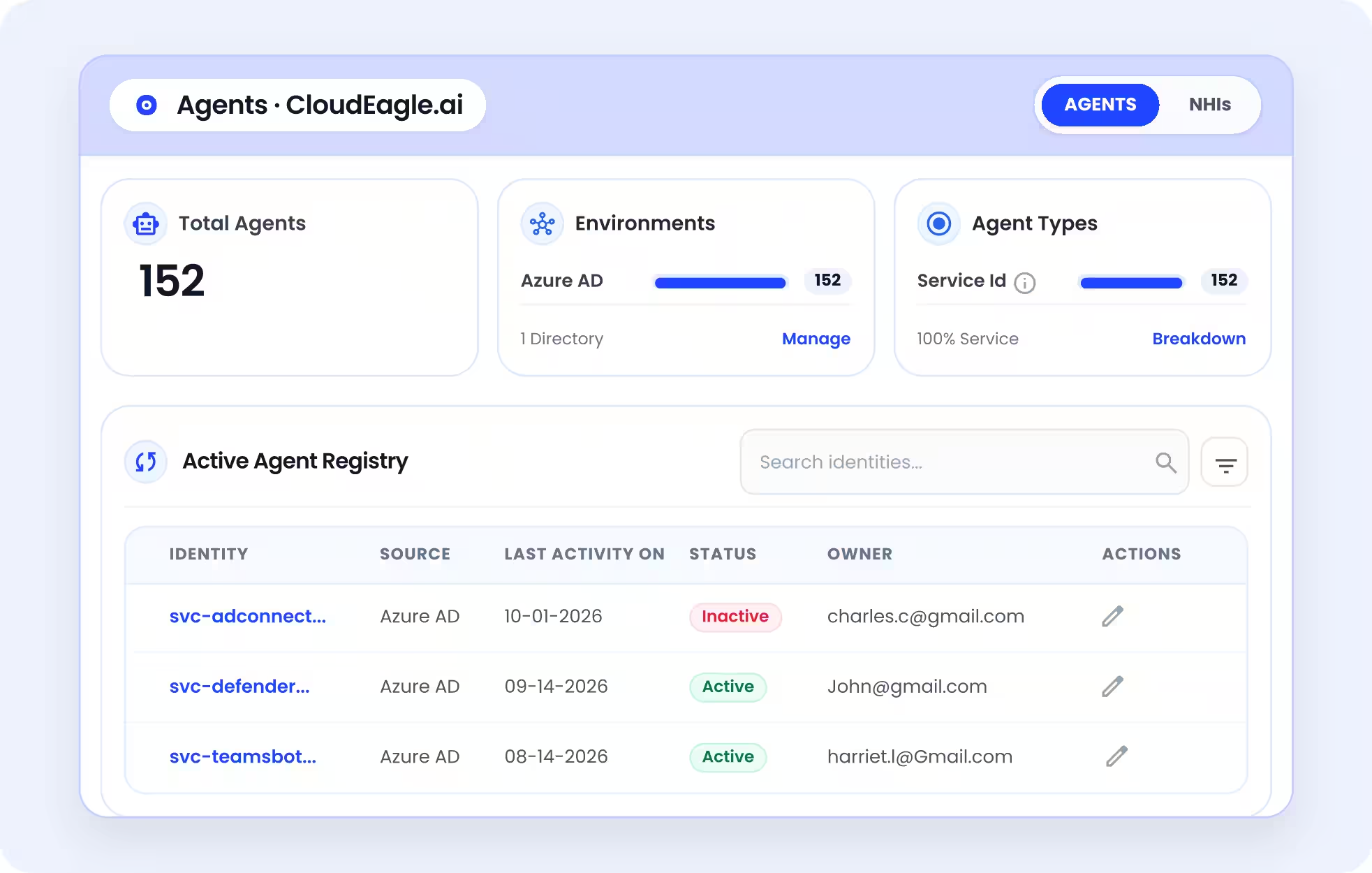
- Discover machine identities through Microsoft Entra ID, Okta, and connected applications.
- Identify agents even when they haven't been formally registered with IT.
- Maintain a centralized inventory of agents, their status, credentials, and data sources.
- View service accounts and API tokens alongside the agents that use them.
Spot the Agents Turning Rogue
Unowned, inactive, or overprivileged identities can leave agents with access they no longer need.
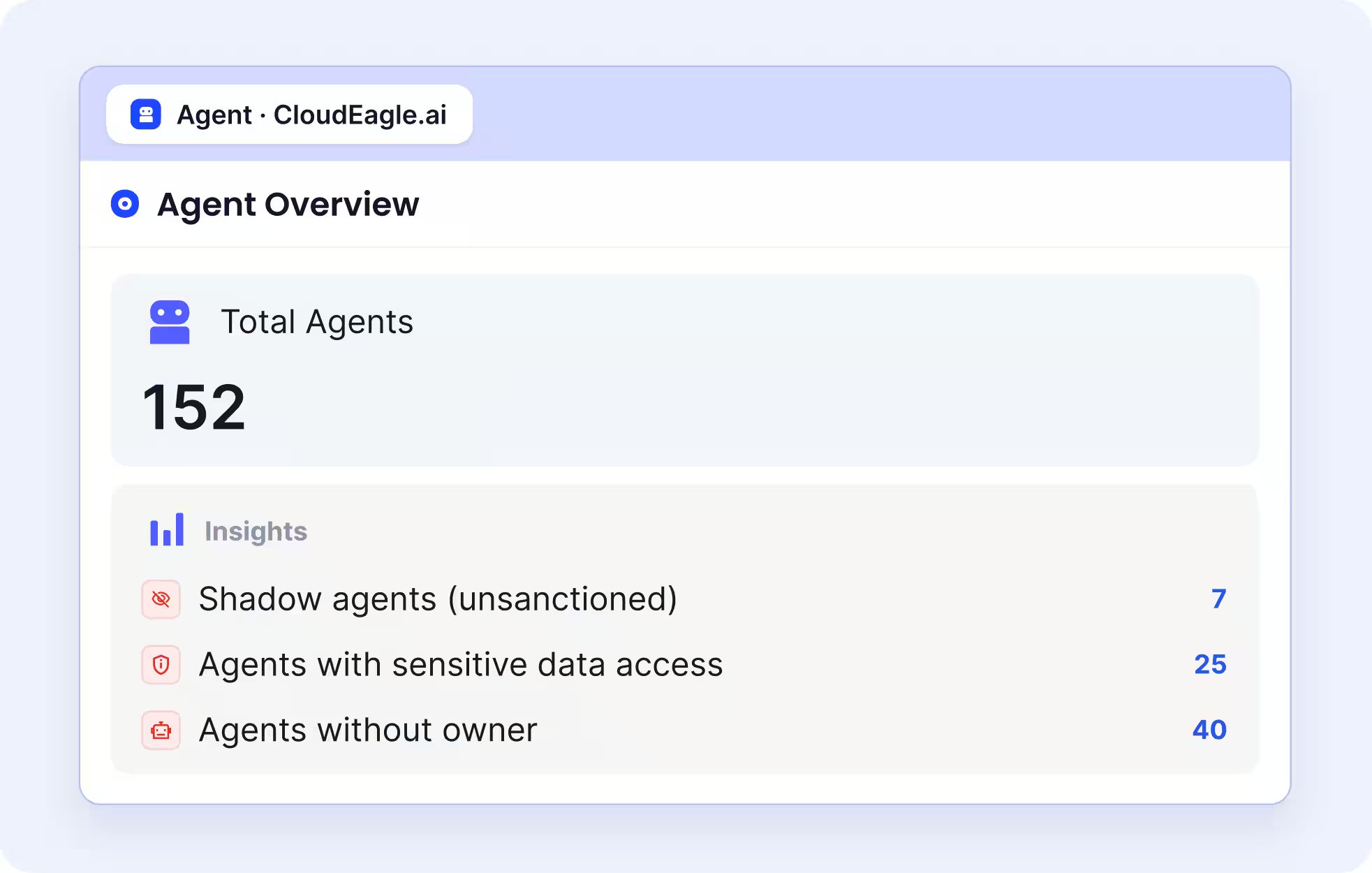
- Flag agents with no assigned owner, administrative permissions, or 90+ days of inactivity.
- Identify agents that remain active after their owners leave the organization.
- Review activity logs to understand what each agent accessed, changed, or interacted with.
Contain a Rogue Agent in One Step
Once a risky agent is identified, security teams need a way to address its access without lengthy manual investigations.
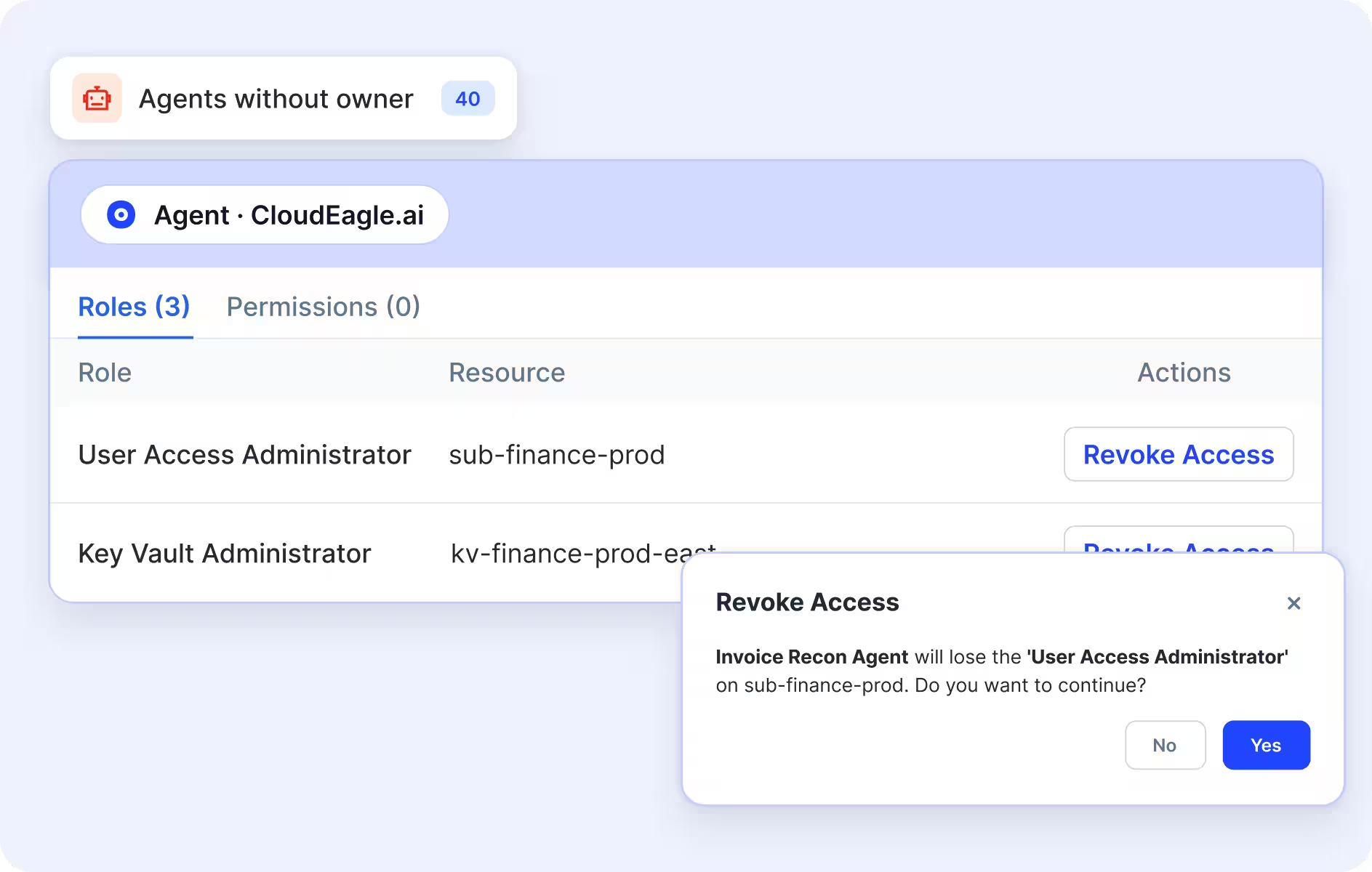
- Revoke roles, rotate secrets, or deactivate an agent's identity from the same view.
- Keep administrators in control of remediation actions, with every action recorded in audit-ready logs.
- Combine identity-based agent governance with Shadow AI discovery to identify the tools and environments where agents are created.
Find and Govern Every Shadow Agent


2. Nudge Security: Best for Browser- and API-Based Shadow Agent Discovery
Nudge Security discovers AI agents through two channels: API integrations with agent-building platforms and browser-based discovery. The API integrations provide information about agent configurations, permissions, and connected applications, while its browser extension identifies agents on platforms that don't expose public APIs.
The platform supports discovery across 23 agentic platforms, combining both methods. It also identifies agent creators, connected resources, permissions, and potential risks, helping security teams establish ownership and follow up on unmanaged agents.
Key capabilities
- Two-channel discovery: Combines API integrations with browser-based discovery across 23 supported agent platforms.
- MCP and shadow AI discovery: Identifies MCP server connections and other AI applications operating outside approved processes.
- Creator identification: Maps agents to their creators and helps security teams understand their purpose through direct follow-up.
- Risk identification: Flags publicly accessible agents, hardcoded credentials, unauthenticated MCP connections, and agents whose creators have left.
Limitations
- Browser-based discovery depends on the Nudge browser extension being deployed.
- Discovery coverage and available agent details vary by platform and integration.
Pricing: Free trial available; enterprise pricing requires a custom quote.
Best for: Enterprises that want browser- and API-based discovery across multiple agent-building platforms.
3. Reco: Best for Agents Living Inside SaaS Apps Like Slack and Salesforce
Reco focuses on AI agents and automated identities operating inside enterprise SaaS applications. Many organizations already use applications such as Microsoft 365, Salesforce, and Google Workspace, where AI capabilities and connected agents can be enabled without a separate agent registration process.
Its approach also extends to remediation. Reco helps organizations identify stale tokens and orphaned access, making it easier to remove permissions associated with agents that are no longer required.
Key capabilities
- SaaS-native discovery: Identifies agents embedded in applications such as Microsoft 365, Salesforce, and Google Workspace.
- Permission visibility: Shows the permissions and OAuth scopes associated with connected agents across its SaaS integrations.
- Identity mapping: Connects agents with their applications, permissions, and associated identities.
- Shadow agent offboarding: Helps revoke stale tokens and remove orphaned access associated with unmanaged agents.
Limitations
- Its discovery approach is primarily focused on SaaS applications.
- Agents running on employee endpoints, within local development environments, or in custom code may require additional discovery tools.
Pricing: Custom quote; not publicly listed.
Best for: Enterprises where AI agents primarily operate inside existing SaaS applications and security teams need visibility into their permissions and connected resources.
4. Cisco + Astrix Security: Best for Agent and NHI Security in the Cisco Stack
Cisco's Astrix Security acquisition brings together agent security and non-human identity management. Astrix focuses on discovering AI agents, API keys, OAuth tokens, service accounts, and other machine identities across SaaS, cloud, and development environments.
Cisco announced its intent to acquire Astrix Security in May 2026, with plans to integrate its capabilities into Cisco's broader identity and zero-trust portfolio.
Key capabilities
- Non-human identity discovery: Identifies API keys, OAuth tokens, service accounts, and other machine identities.
- Agent security: Extends identity security practices to AI agents and the credentials they use.
- Threat detection: Helps identify compromised credentials and agent activity that falls outside expected behavior.
- Security ecosystem integration: Cisco plans to incorporate Astrix capabilities into its broader identity and access portfolio.
Limitations
- The acquisition and product integration may affect future packaging, licensing, and deployment options.
- Buyers should confirm which capabilities are currently available independently and which depend on Cisco's planned integrations.
Pricing: Custom quote; not publicly listed.
Best for: Enterprises looking to govern AI agents and non-human identities across SaaS, cloud, and development environments, particularly those already invested in Cisco security.
5. Zenity: Best for Low-Code Agents in Copilot Studio and Power Platform
Zenity specializes in securing AI agents created through low-code and no-code development environments.
These platforms make it easier for business users to build agents without traditional software development, but they can also introduce governance challenges when agents are deployed without sufficient security review.
Key capabilities
- Low-code agent discovery: Identifies agents created across platforms such as Copilot Studio and Power Platform.
- Development-time security: Detects risky configurations before agents are deployed.
- Runtime protection: Provides inline runtime prevention capabilities within supported environments.
- Agent governance: Helps security teams establish oversight over agents built by business users and citizen developers.
Limitations
- Its strongest coverage is around low-code agent development environments.
- Organizations looking for broader human identity governance, employee lifecycle management, and enterprise-wide access reviews may need complementary IAM tools.
Pricing: Custom quote; not publicly listed.
Best for: Enterprises with significant adoption of Copilot Studio and Power Platform, particularly those where business teams create and deploy agents independently.
6. Noma Security: Best for Agent Inventory Plus Runtime Protection
Noma Security takes a security-first approach to AI agent discovery and protection. Rather than treating agent discovery as an isolated inventory exercise, it combines AI security posture management with runtime protection to help organizations understand and manage risks throughout the AI development lifecycle.
Key capabilities
- Cross-environment discovery: Inventories AI agents across cloud environments, code repositories, and development platforms.
- AI security posture management: Helps identify security risks across AI assets and development workflows.
- Runtime protection: Extends security monitoring and protection to agents after deployment.
- Development lifecycle coverage: Connects security oversight across the AI build pipeline and deployed environments.
Limitations
- Its approach is primarily security-focused rather than identity-governance-led.
- Agent ownership, employee lifecycle management, and access revocation may require integration with existing identity management tools.
Pricing: Custom quote; not publicly listed.
Best for: Security teams that need agent discovery alongside broader AI security posture management and runtime protection.
7. Microsoft Entra Agent ID: Best for Microsoft-Native Agent Registries
Microsoft Entra Agent ID extends Microsoft's identity infrastructure to AI agents by assigning them individual identities. This allows organizations to manage agents as distinct entities instead of treating them as extensions of the employees who created them.
This approach is particularly useful for Microsoft-first enterprises that build agents through Copilot Studio and Microsoft Foundry.
Key capabilities
- Dedicated agent identities: Assigns individual Entra Agent IDs to agents built within supported Microsoft environments.
- Centralized agent management: Uses Microsoft Agent 365 to manage and govern agents.
- Conditional Access: Applies access policies to help prevent risky or unauthorized agent activity.
- Identity protection: Extends identity security controls to supported agent identities.
Limitations
- Coverage is strongest for agents built within Microsoft's ecosystem.
- Agents created through third-party platforms, custom frameworks, or other cloud environments may require additional discovery and governance tools.
Pricing: Agent 365 standalone pricing is $15 per user/month. It is also included in Microsoft 365 E7. Confirm current licensing and eligibility before publishing.
Best for: Microsoft-centric enterprises building agents through Copilot Studio and Foundry that want to manage agent identities through their existing Entra infrastructure.
8. Okta: Best for Agent Identity Governance in Okta Environments
Okta extends its identity security capabilities to AI agents through Okta for AI Agents and Identity Security Posture Management (ISPM). Its approach focuses on identifying agents connected to enterprise applications and bringing legitimate agents into the organization's existing identity directory.
Key capabilities
- Shadow agent discovery: Identifies agents connected to enterprise applications through Okta ISPM.
- Agent identity registration: Registers legitimate agents as identities in Universal Directory.
- Centralized revocation: Uses Universal Logout to revoke an agent's tokens when access needs to be terminated.
- Existing identity integration: Extends agent governance into an organization's established Okta identity security environment.
Limitations
- Endpoint-based agent discovery depends on a CrowdStrike integration that is still in early access.
- Organizations using multiple identity providers or extensive custom agent environments should validate discovery coverage across those systems.
Pricing: Agent discovery is included with ISPM. Okta for AI Agents is available through a custom quote.
Best for: Okta-centric enterprises that want to identify shadow agents, register approved agents as identities, and manage their access through existing identity infrastructure.
9. CrowdStrike Falcon: Best for Endpoint Discovery of Local Agents and MCP Servers
CrowdStrike Falcon approaches shadow agent discovery from the endpoint security layer. This is important because not every AI agent runs inside a centrally managed SaaS platform. Developers can install local agents, connect MCP servers, and use AI extensions within their IDEs, often through personal or locally stored credentials.
Falcon Shield further extends discovery to agents operating inside enterprise platforms such as Copilot, Agentforce, and ChatGPT Enterprise.
Key capabilities
- Endpoint-based discovery: Identifies local AI agents, applications, LLM runtimes, MCP servers, and IDE extensions.
- Developer environment visibility: Helps identify agents operating with credentials on employee devices.
- Enterprise agent discovery: Falcon Shield extends coverage to supported agents in platforms such as Copilot, Agentforce, and ChatGPT Enterprise.
- Security detection and response: Extends endpoint security capabilities to desktop AI applications and related activity.
Limitations
- Its approach is primarily endpoint- and security-focused.
- Organizations may need additional tools for agent ownership mapping, identity lifecycle management, and recurring access reviews.
Pricing: Custom quote, depending on the Falcon modules selected.
Best for: Enterprises already using CrowdStrike Falcon that need visibility into local AI agents, developer environments, MCP servers, and endpoint-based AI activity.
4. What Makes an AI Agent Rogue?
An AI agent turns rogue when it holds access nobody is accountable for.
Most rogue agents aren't malicious. They're ownerless, overprivileged, or exposed to people who shouldn't reach them.
Picture this. A marketing analyst builds an agent that reads the CRM and drafts weekly emails. She leaves in April. By September, the agent is still running on her connection, and nobody can say who approved it.
Ownerless, Overprivileged, and Externally Exposed Agents
5. How Do You Choose a Shadow Agent Discovery Tool?
Choose by where your shadow agents are most likely to hide. Identity-led tools find agents with credentials. SaaS tools find embedded agents. Endpoint tools find local agents.
Then check whether the tool can contain what it finds.
Worth a Read: Top 10 Best AI Agent Discovery Tools in 2026
Coverage Across Low-Code, SaaS, Endpoint, and MCP
No single discovery channel sees everything. Map your creation channels first, then pick the tool, or pair of tools, that covers them.
- Low-code builders: Zenity, Nudge, and identity-led tools.
- Agents inside SaaS apps: Reco, Nudge, and CloudEagle.ai.
- Local agents and MCP servers: CrowdStrike and Okta's endpoint integration.
- Microsoft-built agents: Microsoft Entra Agent ID.
Owner, Credential, and Data Access Mapping
An agent without an owner and access map is just a name in a list. Every finding should show:
- Who owns it.
- What credentials it holds.
- What data it can reach.
- When it last did anything.
Containment, Not Just Flags
A flag adds a ticket. Containment fixes the problem. Look for these actions in the same view where the agent was found:
- Revoke a role or token.
- Rotate a secret.
- Deactivate the agent's identity.
- Log every action for auditors.
Fit With Your Access Review Process
Shadow agents you find should flow into the same reviews as your employees. Read how identity governance now fits into SaaS management.
Find and Contain Shadow Agents With CloudEagle.ai
The best shadow agent discovery tools don't stop at a list. They show who owns each agent, what it can reach, and give you a way to stop a rogue agent before it does damage.
CloudEagle.ai brings AI, SaaS, and identity governance into one control plane, with 500+ direct integrations. We find shadow agents through Entra ID, Okta, and your connected apps, flag the ones turning rogue, and let your admins revoke, rotate, or deactivate them from one view, with audit-ready logs.
Don't let a rogue agent find your gaps first. Watch this webinar or book a demo.
Frequently Asked Questions
- Can One Tool Discover Every Shadow AI Agent Across an Enterprise?
Not necessarily. Agent discovery depends on where agents are built and deployed. Some tools specialize in SaaS platforms, while others focus on endpoints, cloud environments, or identity providers. Enterprises with agents spread across multiple environments may need to combine discovery sources.
- Can Shadow Agent Discovery Tools Find Agents Built by Employees?
Yes, depending on the discovery method. Browser extensions can identify activity on agent-building platforms, while API integrations can surface agents registered within connected applications. Endpoint tools can also help identify locally installed agents and development environments.
- What Should You Do After Discovering an Unmanaged AI Agent?
Start by identifying its owner, credentials, permissions, and connected resources. Then determine whether the agent has a legitimate business purpose. Depending on the risk, security teams can assign an owner, reduce permissions, rotate credentials, or deactivate the agent.
- Can Identity Providers Alone Find Shadow Agents?
Not completely. Identity-based discovery finds agents with their own credentials and OAuth connections. Local agents running on a developer's own token look like the developer, so they need endpoint discovery too.
- What Should You Do After Discovering a Shadow Agent?
Assign it an owner or retire it. Then cut its access to its job, add it to your access reviews, and keep a kill switch ready. NHI management puts all of that in one place.
Find and Govern Every Shadow Agent