
%201.svg)


HIPAA Compliance Checklist for 2025

Most teams don’t look for Nudge Security alternatives randomly. They start looking when they realize something is already slipping through the cracks.
Maybe it’s a simple question that no one can answer clearly: Which AI tools are employees actually using, and what data are they putting into them?
A developer is using Claude to debug code. A sales rep is summarizing deal notes in ChatGPT.
All of this improves productivity. But it also creates a gap. You can’t easily answer:
- what data is being shared with AI
- which tools are being used across teams
- or how those outputs are being used in decisions
These gaps matter more when AI enters the picture. In this article, we’ll break down 7 Nudge Security competitors in 2026.
1. Why Should Enterprises Look for Nudge Security Alternatives?
Enterprises look for Nudge Security alternatives when they need visibility into deeper control, customization, and operational clarity.
Nudge already covers a lot, from SaaS discovery to AI monitoring and security nudges. The shift usually happens when teams try to operationalize that data.
- From Discovery To Actionable Control: Seeing AI tools and SaaS apps is useful, but teams need tighter control over how data is actually used.
- From Visibility To Clear Ownership: Knowing a tool exists is one thing. Knowing exactly who owns it and is accountable is another.
- From Alerts To Enforceable Policies: Security nudges highlight issues, but teams often need stronger enforcement mechanisms tied to workflows.
- From Tool-Level Insight To Workflow-Level Context: AI usage isn’t isolated. It spans tools like Google Workspace, Slack, and internal systems.
This is where the experience starts to feel different in practice. This is usually the point where teams start asking, “Okay but how do we actually control this?”
- Access And Ownership Can Become Hard To Interpret At Scale: As environments grow, mapping users, permissions, and ownership becomes less straightforward.
- AI Usage Needs More Granular Context: Monitoring conversations is useful, but teams also need to understand data sensitivity and impact.
- Cross-System Visibility Becomes Critical: Data doesn’t stay in one tool. It moves across integrations, workflows, and AI interactions.
At this stage, the requirement changes.
It’s no longer just about discovering tools or flagging risks. It’s about connecting usage, access, data, and ownership into a system that can be controlled and audited consistently.

2. What Are the Top 7 Nudge Security Alternatives in 2026?
This list focuses on Nudge Security alternatives that address different parts of that problem, from AI usage monitoring to identity governance and SaaS control. To keep this useful and objective:
- The list is unbiased and not ranked by preference or sponsorship
- Tools are organized in alphabetical order to avoid bias
The sections below break down each Nudge Security alternative so you can understand where it fits and how it compares based on your specific needs.
A. CloudEagle.ai
CloudEagle.ai is an AI governance platform and the only alternative on this list that combines AI governance and non-human identity management with SaaS spend and procurement in one platform.
Most tools on this list, Nudge Security included, are built to answer one question: what SaaS and AI tools are people using.
CloudEagle.ai answers a second question most of them don't touch: who owns every service account, API token, and AI agent quietly running in the background, and is anyone still checking on it.
How is CloudEagle.ai different from Nudge Security?
- Discovery: Nudge Security surfaces new SaaS and AI signups as they happen. That's where its job ends.
- Ownership: CloudEagle.ai takes that same discovery and assigns an owner to every tool, account, or agent found, so nothing sits unclaimed.
- Review: Each of those identities gets pulled into recurring access reviews, not a one-time check when it's first spotted.
- Expiration: Credentials that shouldn't live forever get an expiration date set automatically, so standing access doesn't quietly accumulate.
- The real difference: Nudge Security answers "what's out there." CloudEagle.ai answers "who's accountable for it, and when does it get checked again."
What has CloudEagle.ai's AI governance delivered for real customers?
Before CloudEagle.ai, Armorcode could only account for 40% of its non-human identities. Old service accounts, forgotten API tokens, all invisible. After deployment: 95% visibility, 480 orphaned identities cleaned up, 220+ over-privileged accounts scoped back down.
"As our identity environment expanded, governing non-human identities became just as important as managing human access. CloudEagle.ai gave us visibility into service accounts, API tokens, and AI agents, helping increase NHI visibility, remediate unmanaged identities, and reduce overprivileges, helping us govern NHI, the same way we did for people."
— Karthik Swarnam, Chief Security and Trust Officer, Armorcode
This is the platform for security teams who've already got SaaS and AI discovery covered somewhere, and need what comes after it: ownership, review cycles, and expiration policies applied consistently across every identity type.
Key Features:
- Non-Human Identity Management: Assigns an owner to every service account, API key, and AI agent, sets expiration dates at creation, and pulls each one into the same review cadence used for employee access.
- AI Usage Control: Cross-references SSO logs, browser activity, network traffic, and finance records to build a live map of every AI tool in use, catching duplicate subscriptions and dormant seats before the next renewal.
- AI Policy Enforcement: Intercepts attempts to paste sensitive data into an unapproved AI tool in real time and reroutes the user to a sanctioned option, instead of generating an alert someone reviews next week.
- AI Token Consumption Tracking: Tracks token usage by user and by model across Claude, Cursor, ChatGPT, and Gemini, with forecasting to flag which teams are on pace to blow past budget.
- Shadow AI and Shadow IT Discovery: Correlates browser, network, endpoint, and finance data to catch unsanctioned shadow AI, including personal AI accounts opened under a company email.
- GenAI Risk Scores: Scores every AI vendor through Netskope's Cloud Confidence Index on data residency, training data practices, and overall security posture.
- Continuous Security Posture Management: Checks application configurations against frameworks like NIST 800 continuously, pulling live MFA and SSO data from Okta and Entra instead of relying on a periodic manual audit.
- Continuous Access Reviews: Assigns the right reviewer automatically, flags high-risk and departed users first, and generates audit evidence without anyone compiling it by hand, human and non-human identities alike.
- SaaS Spend Intelligence and Procurement Workflows: Extracts contract terms, tracks renewal timelines, and benchmarks pricing, capability Nudge Security's platform doesn't include at all.
- CloudEagle MCP Server: Lets a security or IT admin pull SaaS, AI, and identity data through natural language from inside Claude or any MCP-compatible tool.
Strengths:
Rated 4.7/5 on G2. Reviewers point to the breadth of what it covers and how much of the manual review work gets automated. Best fit on this list for teams that need human and machine identities governed under one roof instead of two separate systems.
Limitations:
The range of features takes real time to configure properly at first. Sized for mid-market and enterprise environments running 50+ applications rather than smaller teams.
Pricing:
Licensing is modular, not a flat per-seat cost. AI Governance, Security & Compliance, Identity Governance, Optimization, and Procurement can each be bought on their own or bundled, based on company size.
For a team weighing this against Nudge Security specifically, that means the AI Governance and Security & Compliance modules alone can be enough to start, without paying for spend or procurement tooling that Nudge Security doesn't offer to begin with.
Nudges Don’t Stop Risk.


B. Grip Security
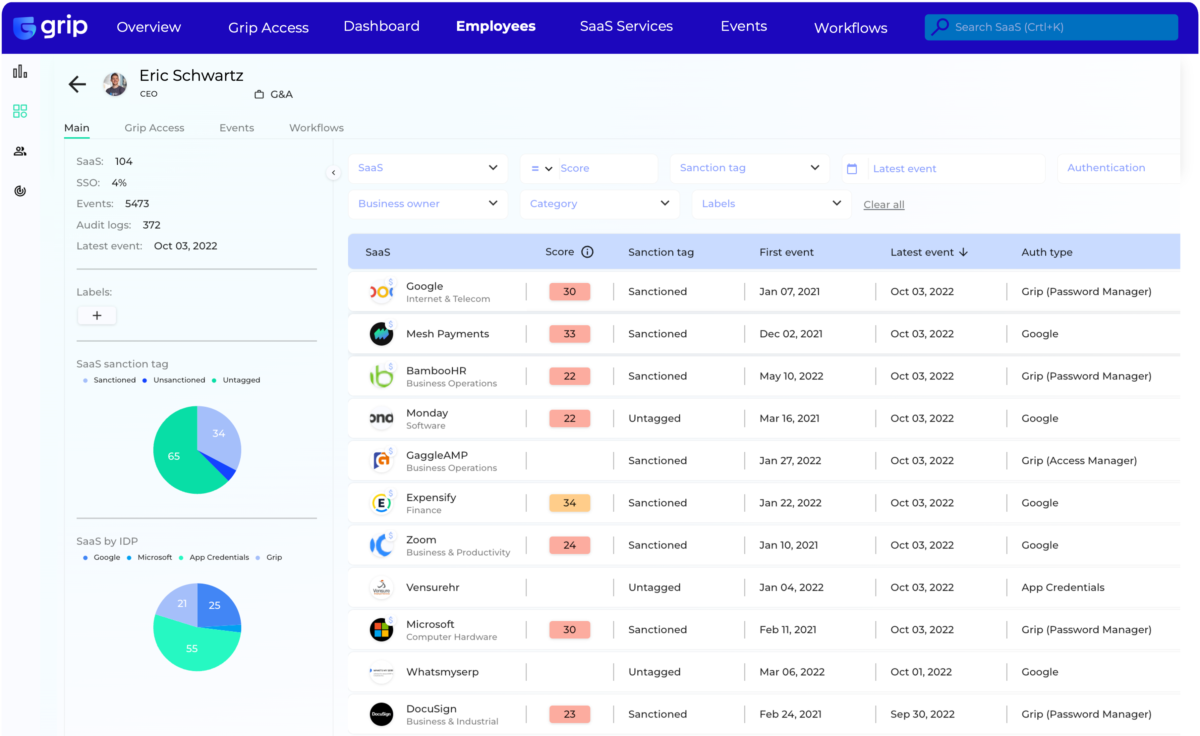
Grip Security is a SaaS security platform that discovers and secures shadow SaaS and AI usage. Grip nudge security alternative focuses on identifying unmanaged applications, risky access patterns, and identity-related risks.
The platform uses an identity-centric approach to monitor sanctioned and unsanctioned apps. It also helps security teams automate remediation workflows and reduce SaaS-related security exposure.
Key features:
- Shadow SaaS and AI discovery across enterprise environments
- SaaS Security Posture Management (SSPM) capabilities
- Identity risk analysis and OAuth permission monitoring
- Automated workflows for access governance and remediation
- Continuous monitoring for SaaS configuration drift and threats
Strengths:
Deep shadow SaaS visibility, identity-focused risk detection, strong SaaS posture management capabilities, and automated security workflows.
Limitations:
Primarily security-focused, with less emphasis on broader SaaS lifecycle management, procurement workflows, and software spend optimization.
Pricing:
Custom pricing based on number of users and selected capabilities. Pricing follows an annual per-user model.
C. Obsidian Security
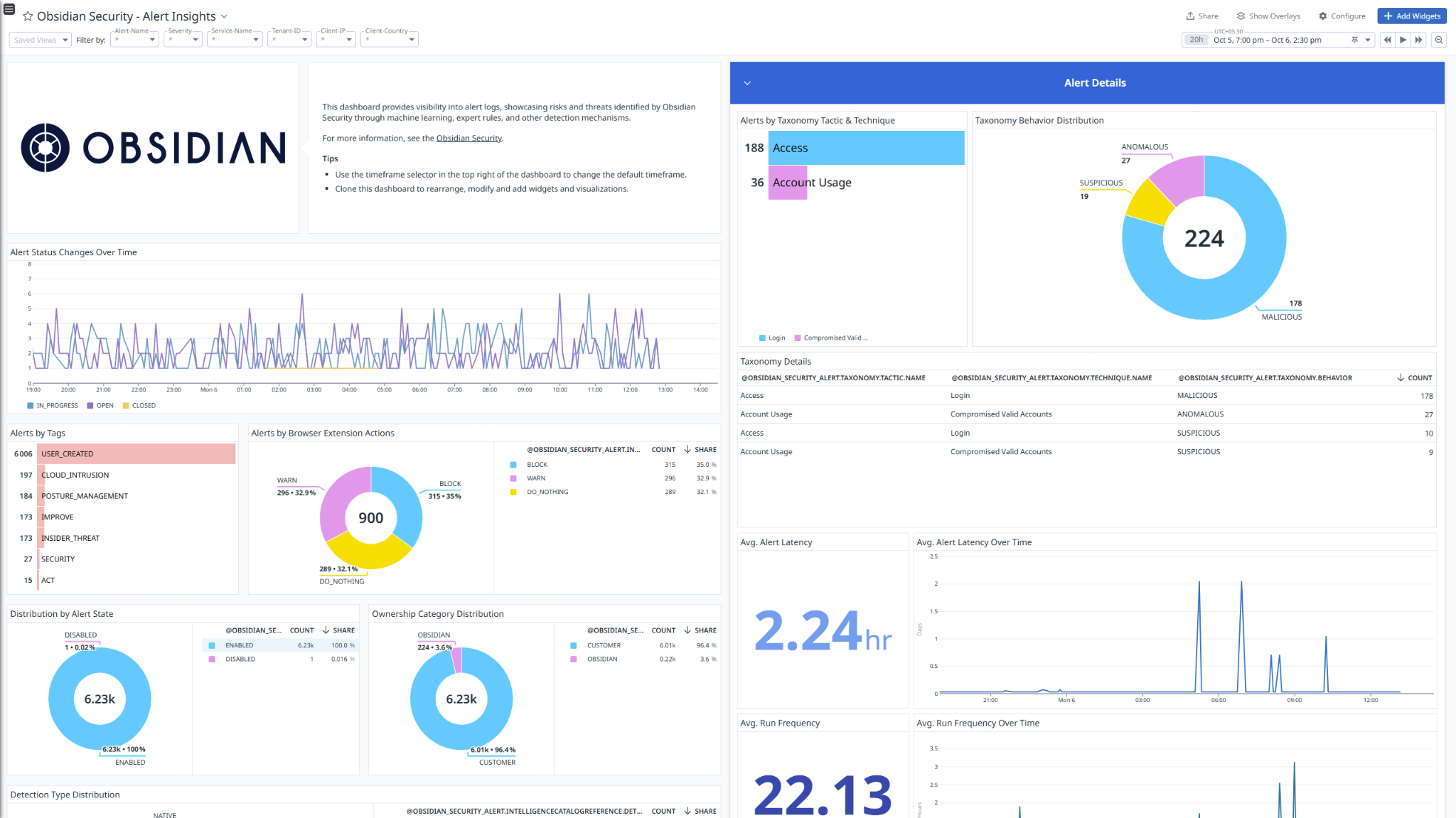
Obsidian Security focuses on protecting enterprise applications from identity, configuration, and account-related risks. This helps security teams identify misconfigurations, risky integrations, and suspicious activity.
This nudge security alternative combines SaaS Security Posture Management (SSPM) with threat detection and continuous monitoring to reduce exposure across sanctioned applications.
Key features:
- SaaS Security Posture Management (SSPM)
- Continuous configuration monitoring and posture hardening
- Risk analysis for third-party integrations and OAuth access
- Threat detection and anomaly monitoring
- Compliance monitoring and reporting workflows
Strengths:
Strong SaaS posture management capabilities, deep threat visibility, and automated compliance monitoring.
Limitations:
Focuses primarily on securing managed SaaS environments and may offer less visibility into broader SaaS lifecycle and operational workflows.
Pricing:
Besides a free plan, Obsidian Security provides two paid plans. Contact their sales team to get a customized quote.
D. Push Security

Push Security is a browser-based security platform designed to protect organizations against identity and SaaS attacks. It focuses on detecting compromised accounts, phishing activity, and risky user behaviors.
The nudge security alternative deploys through a browser extension and provides visibility into user interactions, shadow SaaS activity, and identity risks. Its browser-level approach helps security teams detect threats.
Features:
- Browser-based identity attack detection
- Shadow SaaS and AI visibility
- Phishing and session hijacking protection
- Identity attack surface monitoring
- Real-time browser security controls
Strengths:
Strong browser-level visibility, identity-focused threat detection, and protection against account takeover attacks.
Limitations:
Primarily focuses on browser and identity security, with less emphasis on broader SaaS governance and lifecycle management.
Pricing:
The standard plan is $5/user/month (yearly) for up to 500 employees. For 500+ employees, contact the sales team.
E. Valence Security

Valence Security is a SaaS and AI security platform to discover and reduce SaaS risks. It focuses on securing SaaS environments by identifying shadow applications, identity risks, and misconfigurations.
The nudge security alternative combines SaaS discovery, SaaS Security Posture Management (SSPM), identity threat detection, and AI governance capabilities. It helps security teams monitor risky activity and automate remediation workflows.
Key features:
- Shadow SaaS and AI application discovery
- SaaS Security Posture Management (SSPM)
- Identity Threat Detection and Response (ITDR)
- Third-party app and OAuth risk analysis
- Automated remediation workflows
Strengths:
Strong identity relationship mapping, deeper visibility into SaaS-to-SaaS connections, and AI security capabilities alongside SSPM.
Limitations:
Primarily focused on SaaS security workflows with less emphasis on broader SaaS operations and lifecycle management.
Pricing:
Schedule a demo and the sales team will provide you with a customized quote.
F. Waldo Security
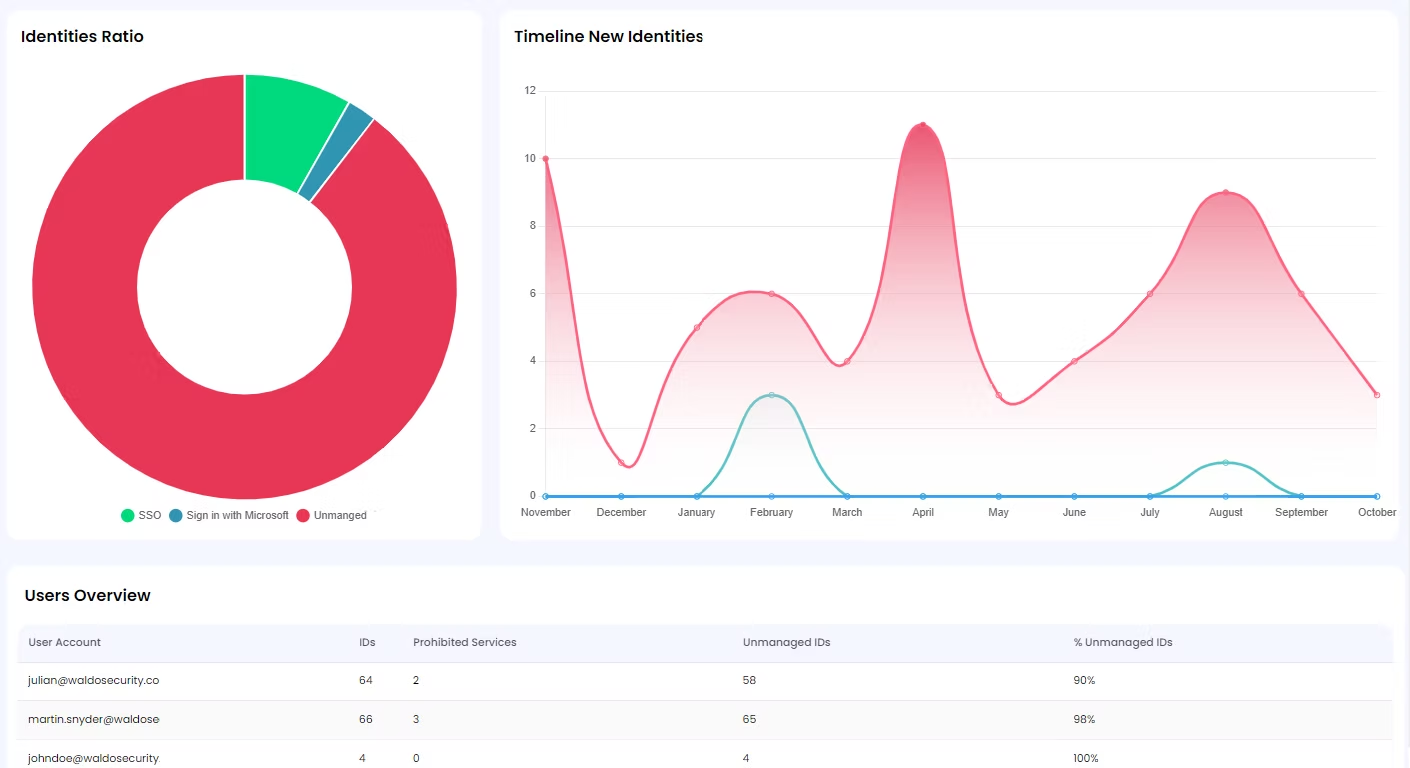
Waldo Security is a SaaS security platform focused on uncovering shadow SaaS and AI usage. This nudge security alternative helps teams identify unmanaged applications, unknown accounts, and identity risks.
The platform follows a discovery-first approach, giving teams visibility into SaaS accounts, OAuth connections, and user activity without requiring browser extensions or endpoint agents.
Key features:
- Shadow SaaS and AI discovery
- Detection of unmanaged accounts and identities
- OAuth access monitoring and risk visibility
- Automated SaaS offboarding workflows
- Compliance monitoring and reporting automation
Strengths:
Agentless deployment, strong discovery capabilities, and identity-focused visibility across unmanaged SaaS environments.
Limitations:
Primarily focused on SaaS discovery and governance, with less emphasis on broader lifecycle management and operational workflows.
Pricing:
You can opt in for a free trial or schedule a personalized demo with the sales team.
G. Wing Security
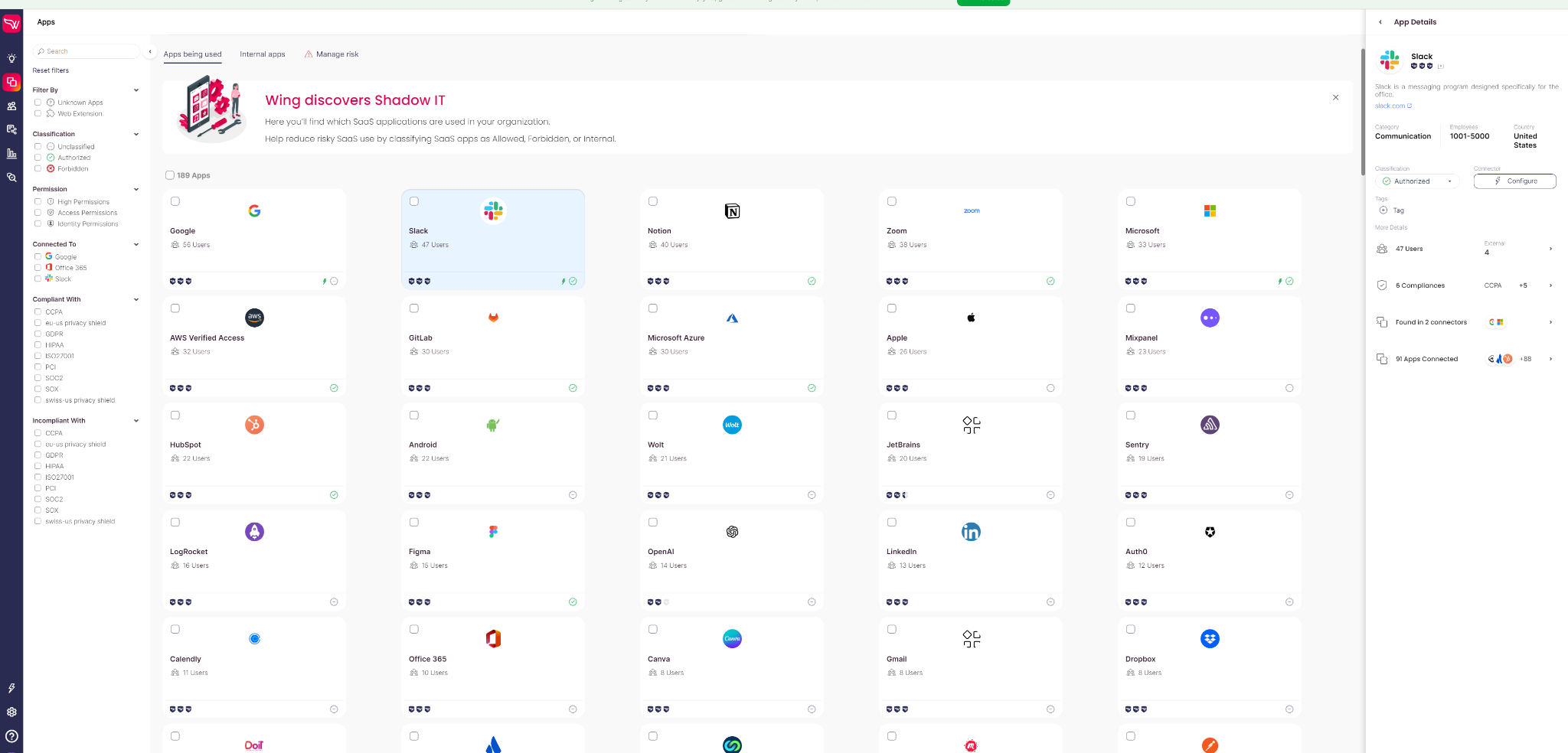
Wing Security is a SaaS security platform that helps organizations discover, monitor, and secure shadow activity. It focuses on reducing risks related to identities, integrations, permissions, and unmanaged applications.
The nudge security alternative combines SaaS Security Posture Management (SSPM) with Identity Threat Detection and Response (ITDR) to continuously identify risky configurations and security threats.
Key features:
- Shadow SaaS and AI application discovery
- SaaS Security Posture Management (SSPM)
- Identity Threat Detection and Response (ITDR)
- OAuth and app-to-app connection monitoring
- Automated remediation workflows and policy enforcement
Strengths:
Strong identity-based threat detection, risk prioritization with MITRE context, and agentless deployment with deep app relationship visibility.
Limitations:
Primarily centered on SaaS security operations and posture management, with less focus on broader SaaS lifecycle workflows.
Pricing:
Request a personalized demo with the sales team.
3. Conclusion
Most teams don’t look for nudge security alternatives because it fails. They move on when visibility stops being enough and control becomes the real need.
As AI usage grows, the focus shifts from: seeing which tools are used, to understanding what data is flowing through them, and who is accountable for that usage.
That’s where alternatives come in. Each tool in this list solves a different part of that problem. The right choice depends on whether you need better visibility, stronger access control, or deeper AI governance.
4. FAQs
1. Isn't Nudge Security's discovery enough to govern shadow AI?
CloudEagle.ai picks up where discovery ends. It assigns an owner to every tool, account, and AI agent it finds, and pulls each one into recurring access reviews. It also sets credential expiration dates automatically, so standing access doesn't quietly build up after the first alert.
2. Don't security nudges already stop employees from sharing sensitive data with AI tools?
CloudEagle.ai goes further than nudges by enforcing policy in real time. When someone tries to paste sensitive data into an unapproved AI tool, AI Policy Enforcement intercepts the attempt and redirects them to a sanctioned option. That replaces an alert someone might not review until next week.
3. Can't service accounts, API tokens, and AI agents slip past a SaaS discovery tool?
CloudEagle.ai brings non-human identities under the same governance as employee access. It gives every service account, API key, and AI agent an owner, an expiration date, and a review schedule. Armorcode used it to raise non-human identity visibility from 40% to 95% and clean up 480 orphaned identities.
4. Won't switching from Nudge Security mean paying for features we don't need?
CloudEagle.ai uses modular licensing, so you pay only for what you use. AI Governance, Security & Compliance, Identity Governance, Optimization, and Procurement can each be bought separately. Many teams moving from Nudge Security start with just the AI Governance and Security & Compliance modules.
5. Isn't it hard to track AI usage and spend across Claude, ChatGPT, Cursor, and Gemini?
CloudEagle.ai tracks token consumption by user and by model across Claude, Cursor, ChatGPT, and Gemini in one view. Its forecasting shows which teams are on pace to go over budget. It also catches duplicate subscriptions and dormant seats before the next renewal.


.avif)


.avif)
.avif)




.png)




_.png)

.avif)
.avif)
.avif)


