You need to enable JavaScript in order to use the AI chatbot tool powered by ChatBot

Shadow AI After an Acquisition: Why Unmanaged AI Tools Multiply Post-Close and How to Recover Visibility

Share via:
blog-cms-banner-bg
Little-Known Negotiation Hacks to Get the Best Deal on Slack
cta-bg-blogDownload Your Copy

HIPAA Compliance Checklist for 2025

Download PDF

When a company is acquired, its AI governance pauses. Employees keep using the tools they know, sign up for new ones, and no one from the acquiring company has visibility into any of it. 

That's why unmanaged AI tools multiply post-close: not because of negligence, but because the acquisition created a window where no single team owns the acquired company's AI stack.

Recovering visibility requires going beyond SSO logs. Browser activity, finance systems, endpoint data, and network telemetry are the signals that surface what's actually running.

This blog covers the specific risks that make post-acquisition shadow AI different, and how to build a complete AI inventory across both environments before your integration timeline forces the issue.

TL;DR

  • Shadow AI multiplies during acquisitions because there's no governance handover, only a gap between two IT teams
  • Acquired employees continue using AI tools that IT never approved, and those tools now have access to the shared infrastructure
  • The three risks that make post-acquisition shadow AI different: data commingling, orphaned identities from restructured employees, and duplicate AI vendors running in parallel
  • CloudEagle.ai surfaces every AI tool across both environments using browser, finance, endpoint, and network signals
  • The result: a unified, audit-ready AI inventory across both companies before the integration project gives you the luxury of time

1. Why Acquisitions Are Shadow AI's Favorite Entry Point

During due diligence and the early integration period, the acquired company's IT governance effectively pauses. Their IT team knows a transition is coming. Employees know it too. 

And in that gap, normal behavior continues: people keep using the tools they know, sign up for new ones when they need them, and nobody from the acquiring company has visibility into any of it.

Here's what makes acquisitions structurally different from a standard shadow AI problem:

  • Two IT environments, one attack surface: The average large enterprise runs over 1,400 SaaS applications, with IT managing only 10-15% of them. In an M&A context, that's two companies' ungoverned stacks merging into one, before either side has taken stock of the other.
  • Purchasing happens outside your visibility: Acquired employees buy AI tools on personal or corporate cards that the acquiring company's finance team cannot see. Those transactions don't appear in your expense systems.
  • SSO logs on either side don't capture it: Browser-based copilots, locally installed coding assistants, and API-key-connected models don't generate login events in your identity provider, or theirs.
  • The governance gap is structural: Employees aren't doing anything unusual. The acquisition created a window where no one is accountable for the acquired company's AI stack, and tools filled that window.

The integration project starts with the assumption that you know what you're integrating, what you actually have is ungoverned AI sprawl on two sides of a deal, merging into one environment before anyone has taken stock of either.

You Just Acquired Their Shadow AI Too. Find It First.

Use this checklist to surface every ungoverned AI tool before it touches your data.
Download Checklist

2. The Three Shadow AI Risks That Compound During Integration

M&A creates three shadow AI risk scenarios that don't exist in a single-company environment, and each one gets worse the longer the integration takes.

Risk 1: Data Commingling Before Security Reviews Are Complete

This is the scenario that should concern your CISO most.

When the integration project begins, infrastructure starts to merge shared drives, email systems, project management platforms, and cloud environments.

The acquired company's employees bring their existing AI tool habits into that shared infrastructure. Tools that were originally scoped to access only their company's data now have access to yours.

Why this compounds quickly:

  • An acquired employee's AI assistant that reads email and connected drives doesn't get re-scoped when their account migrates to shared infrastructure
  • The migration typically happens before the security review is complete; that's the default in early integration
  • That AI tool's data access scope expands silently alongside the employee's account
According to IBM's Cost of Data Breach Report, shadow AI incidents now add approximately $670,000 to the average breach cost. In an M&A context, that exposure arrives before your security team has had a chance to inventory what it's dealing with.

Risk 2: Orphaned Identities From Restructured Employees

Acquisitions restructure workforces. Employees leave, roles consolidate, and offboarding runs across two companies simultaneously, often with different processes, different systems, and different timelines.

The acquiring company's offboarding workflow only covers accounts it knows about. It can't see the acquired company's shadow AI tools.

What gets left behind when an acquired employee exits:

What persists Why it’s a problem
Active API tokens Continue authenticating to AI tools and connected data sources with no accountable owner
Browser extension sessions Remain active on shared or reassigned devices
AI tool accounts tied to corporate email Don't auto-expire when offboarding runs in a different system
OAuth grants to shared infrastructure Persist until explicitly revoked, which requires knowing they exist

A single orphaned service account in the acquired tenant can give an attacker a direct entry point into the merged environment. In a post-acquisition context, these aren't edge cases; they're the default output of two offboarding pipelines that were never designed to talk to each other.

Risk 3: Duplicate AI Vendors Running in Parallel

Both companies have GitHub Copilot contract. Both likely have some version of an AI writing assistant, a coding copilot, and a data analysis tool. Post-close, the merged entity is paying for overlapping subscriptions that neither of the IT teams fully knows about.

Consider what duplicate AI vendors actually create:

  • Double the compliance surface: two sets of vendor DPAs to review, two data processing agreements to audit, two sets of model provider terms to assess
  • Usage-based billing no one is tracking: both contracts accumulate consumption charges independently, with no one monitoring the combined spend
  • Fragmented governance: two AI stacks means two sets of usage patterns, two sets of data access grants, and no unified view of what employees across the merged entity are actually using

Two AI Stacks. Double the Compliance Surface. One Checklist.

Audit every AI vendor before the integration clock runs out.
Download Checklist

3. How CloudEagle.ai Recovers AI Visibility Across Both Environments Post-Close

The first objection in every M&A conversation is predictable: "We have too much going on to deploy another tool right now."

CloudEagle.ai onboards in 30 minutes. You can deploy it into the acquired company's environment immediately post-close, before the integration project formally begins, before the first steering committee meeting, or before the first workstream charter is signed.

Here's how CloudEagle.ai surfaces shadow AI across both environments simultaneously:

Discovery Layer What it catches Why it matters in M&A
Browser plugin via MDM Every AI tool accessed in a browser at first visit, cross-referenced against SaaSMap Flags tools employees signed up for during the acquisition transition window: the exact period when no one was watching
Finance and ERP integration AI tools purchased on corporate cards that never went through IT Usually, the first time the acquiring company sees the acquired company's full AI spend picture
Endpoint data via CrowdStrike Locally installed AI tools: Cursor, Claude Code, GitHub Copilot desktop Invisible to SSO on either side; don't appear in browser logs or any software asset management system
Network telemetry via Zscaler API-key-based model calls that bypass both companies' identity providers Developers making direct API calls to model providers don't show up in any SaaS discovery tool that relies on login events

The output: a unified AI app inventory showing every tool across both environments, with discovery source, approval status, risk classification, and which company's employees are using each tool.
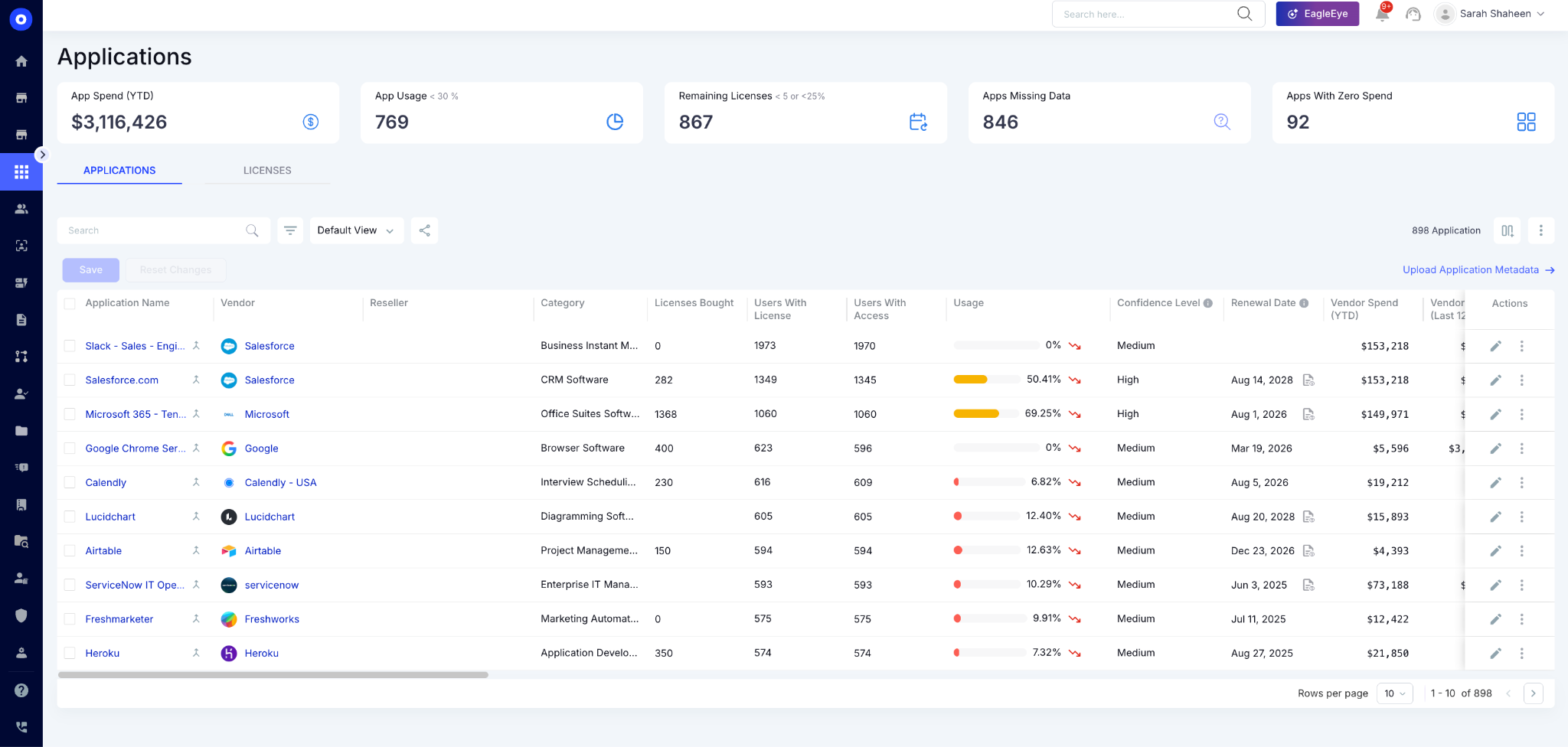
Applications Dashboard showing SaaS inventory, spend, usage, and renewal management across the organization. The interface provides visibility into application usage, license allocation, vendor spend, confidence scores, renewal dates, and duplicate applications to help IT teams optimize SaaS portfolios and reduce software costs.

That's the inventory your integration project needs on day one.

If you're building the case for why shadow AI governance can't wait for the integration timeline: The Shadow AI Governance Gap: Why 63% of Enterprises Have No Shadow AI Policy

4. What a Unified Post-Acquisition AI Inventory Actually Needs to Include

Most acquirers arrive at day 31 with a partial list from the target company's IT team and whatever SSO logs they can pull. That's not an inventory. It's a starting point for one.

A post-acquisition AI inventory is only usable for both security and integration planning if it captures these five fields:

Field Why It’s Non-Negotiable
Tool name Baseline, you need to know what you're governing
Which company's employees are using it Distinguishes tools that arrived with the acquisition from tools already sanctioned in your environment
Approval status in the acquiring company's policy framework Determines what needs immediate action vs. what's already cleared
Data access scope Without this, you can't prioritize remediation, and not every unsanctioned tool carries the same risk
Accountable owner or team Without an owner, you can't enforce. This is where governance actually starts.

CloudEagle.ai automatically detects AI and SaaS applications by analyzing SSO, finance, and browser data, delivering a single dashboard showing all apps, their usage, spend, and approval status, and identifying duplicate and underutilized applications across both environments simultaneously.

For a deeper look at what shadow AI detection tools should actually surface: 10 Best Shadow AI Discovery Solutions

5. From Inventory to Integration: Using AI Visibility to De-Risk the First 90 Days

The first 90 days post-close are when most M&A security incidents occur. Employees from both companies are sharing infrastructure before governance is unified. Shadow AI is already running.

Once the inventory exists, three actions become possible immediately:

1. Revoke access to unsanctioned tools: 

With a complete, discovery-source-tagged AI inventory, your security team can immediately identify tools that don't meet the acquiring company's policy standards and revoke access before those tools accumulate more data exposure in the shared environment.

2. Consolidate duplicate AI vendors: 

With both companies' AI spend visible in one dashboard, procurement can identify overlapping contracts, consolidate to preferred vendors, and eliminate the duplicate compliance surface. 

Two Copilot contracts become one. Usage-based billing gets tracked centrally.

3. Enforce your AI acceptable use policy across the acquired workforce from day one:

CloudEagle.ai monitors and blocks sensitive content shared with AI tools, and deploys a flash page redirecting employees to approved alternatives when they try to access an unsanctioned tool. Your AI policy reaches the acquired company's workforce immediately.

The integration clock starts on day one. And so does the shadow AI risk. The only question is whether your team has visibility before or after the exposure happens.

6. FAQs

1. What is the problem with shadow AI?

Shadow AI is an AI tool usage that happens outside of IT visibility. Employees share sensitive data with tools IT hasn't reviewed, creating data leakage, compliance exposure, and ungoverned access that security teams can't detect or contain.

2. How to mitigate shadow AI?

Mitigating shadow AI requires discovery across browser, finance, endpoint, and network signals. Once tools are inventoried, enforce policy with approved alternatives, behavioral redirects, and automated access controls tied to your identity governance workflow.

3. Why is shadow AI harder to detect during an acquisition than in a normal environment?

During an acquisition, two separate IT environments merge without a unified discovery process. Tools from the acquired company don't appear in the acquiring company's SSO, finance, or endpoint systems, making standard discovery methods blind to half the environment.

4. What types of AI tools typically go undetected post-acquisition?

Browser-based copilots, locally installed coding assistants like Cursor or GitHub Copilot desktop, and tools accessed via personal API keys are the most commonly missed. None of these generate login events in either company's identity provider.

5. How quickly should an acquiring company audit the acquired company's AI tools?

Immediately post-close, before infrastructure begins to merge. Once shared drives, email systems, and cloud environments connect, unsanctioned AI tools from the acquired company gain access to the acquiring company's data, and the remediation window closes fast.

Advertisement for a SaaS Subscription Tracking Template with a call-to-action button to download and a partial graphic of a tablet showing charts.Banner promoting a SaaS Agreement Checklist to streamline SaaS management and avoid budget waste with a call-to-action button labeled Download checklist.Blue banner with text 'The Ultimate Employee Offboarding Checklist!' and a black button labeled 'Download checklist' alongside partial views of checklist documents from cloudeagle.ai.Digital ad for download checklist titled 'The Ultimate Checklist for IT Leaders to Optimize SaaS Operations' by cloudeagle.ai, showing checklist pages.Slack Buyer's Guide offer with text 'Unlock insider insights to get the best deal on Slack!' and a button labeled 'Get Your Copy', accompanied by a preview of the guide featuring Slack's logo.Monday Pricing Guide by cloudeagle.ai offering exclusive pricing secrets to maximize investment with a call-to-action button labeled Get Your Copy and an image of the guide's cover.Blue banner for Canva Pricing Guide by cloudeagle.ai offering a guide to Canva costs, features, and alternatives with a call-to-action button saying Get Your Copy.Blue banner with white text reading 'Little-Known Negotiation Hacks to Get the Best Deal on Slack' and a white button labeled 'Get Your Copy'.Blue banner with text 'Little-Known Negotiation Hacks to Get the Best Deal on Monday.com' and a white button labeled 'Get Your Copy'.Blue banner with text 'Little-Known Negotiation Hacks to Get the Best Deal on Canva' and a white button labeled 'Get Your Copy'.Banner with text 'Slack Buyer's Guide' and a 'Download Now' button next to images of a guide titled 'Slack Buyer’s Guide: Features, Pricing & Best Practices'.Digital cover of Monday Pricing Guide with a button labeled Get Your Copy on a blue background.Canva Pricing Guide cover with a button labeled Get Your Copy on a blue gradient background.

Enter your email to
unlock the report

Oops! Something went wrong while submitting the form.
License Count
Benchmark
Per User/Per Year

Enter your email to
unlock the report

Oops! Something went wrong while submitting the form.
License Count
Benchmark
Per User/Per Year

Enter your email to
unlock the report

Oops! Something went wrong while submitting the form.
Notion Plus
License Count
Benchmark
Per User/Per Year
100-500
$67.20 - $78.72
500-1000
$59.52 - $72.00
1000+
$51.84 - $57.60
Canva Pro
License Count
Benchmark
Per User/Per Year
100-500
$74.33-$88.71
500-1000
$64.74-$80.32
1000+
$55.14-$62.34

Enter your email to
unlock the report

Oops! Something went wrong while submitting the form.

Enter your email to
unlock the report

Oops! Something went wrong while submitting the form.
Zoom Business
License Count
Benchmark
Per User/Per Year
100-500
$216.00 - $264.00
500-1000
$180.00 - $216.00
1000+
$156.00 - $180.00

Enter your email to
unlock the report

Oops! Something went wrong while submitting the form.

Get the Right Security Platform To Secure Your Cloud Infrastructure

Please enter a business email
Thank you!
The 2023 SaaS report has been sent to your email. Check your promotional or spam folder.
Oops! Something went wrong while submitting the form.

Access full report

Please enter a business email
Thank you!
The 2023 SaaS report has been sent to your email. Check your promotional or spam folder.
Oops! Something went wrong while submitting the form.

When a company is acquired, its AI governance pauses. Employees keep using the tools they know, sign up for new ones, and no one from the acquiring company has visibility into any of it. 

That's why unmanaged AI tools multiply post-close: not because of negligence, but because the acquisition created a window where no single team owns the acquired company's AI stack.

Recovering visibility requires going beyond SSO logs. Browser activity, finance systems, endpoint data, and network telemetry are the signals that surface what's actually running.

This blog covers the specific risks that make post-acquisition shadow AI different, and how to build a complete AI inventory across both environments before your integration timeline forces the issue.

TL;DR

  • Shadow AI multiplies during acquisitions because there's no governance handover, only a gap between two IT teams
  • Acquired employees continue using AI tools that IT never approved, and those tools now have access to the shared infrastructure
  • The three risks that make post-acquisition shadow AI different: data commingling, orphaned identities from restructured employees, and duplicate AI vendors running in parallel
  • CloudEagle.ai surfaces every AI tool across both environments using browser, finance, endpoint, and network signals
  • The result: a unified, audit-ready AI inventory across both companies before the integration project gives you the luxury of time

1. Why Acquisitions Are Shadow AI's Favorite Entry Point

During due diligence and the early integration period, the acquired company's IT governance effectively pauses. Their IT team knows a transition is coming. Employees know it too. 

And in that gap, normal behavior continues: people keep using the tools they know, sign up for new ones when they need them, and nobody from the acquiring company has visibility into any of it.

Here's what makes acquisitions structurally different from a standard shadow AI problem:

  • Two IT environments, one attack surface: The average large enterprise runs over 1,400 SaaS applications, with IT managing only 10-15% of them. In an M&A context, that's two companies' ungoverned stacks merging into one, before either side has taken stock of the other.
  • Purchasing happens outside your visibility: Acquired employees buy AI tools on personal or corporate cards that the acquiring company's finance team cannot see. Those transactions don't appear in your expense systems.
  • SSO logs on either side don't capture it: Browser-based copilots, locally installed coding assistants, and API-key-connected models don't generate login events in your identity provider, or theirs.
  • The governance gap is structural: Employees aren't doing anything unusual. The acquisition created a window where no one is accountable for the acquired company's AI stack, and tools filled that window.

The integration project starts with the assumption that you know what you're integrating, what you actually have is ungoverned AI sprawl on two sides of a deal, merging into one environment before anyone has taken stock of either.

You Just Acquired Their Shadow AI Too. Find It First.

Use this checklist to surface every ungoverned AI tool before it touches your data.
Download Checklist

2. The Three Shadow AI Risks That Compound During Integration

M&A creates three shadow AI risk scenarios that don't exist in a single-company environment, and each one gets worse the longer the integration takes.

Risk 1: Data Commingling Before Security Reviews Are Complete

This is the scenario that should concern your CISO most.

When the integration project begins, infrastructure starts to merge shared drives, email systems, project management platforms, and cloud environments.

The acquired company's employees bring their existing AI tool habits into that shared infrastructure. Tools that were originally scoped to access only their company's data now have access to yours.

Why this compounds quickly:

  • An acquired employee's AI assistant that reads email and connected drives doesn't get re-scoped when their account migrates to shared infrastructure
  • The migration typically happens before the security review is complete; that's the default in early integration
  • That AI tool's data access scope expands silently alongside the employee's account
According to IBM's Cost of Data Breach Report, shadow AI incidents now add approximately $670,000 to the average breach cost. In an M&A context, that exposure arrives before your security team has had a chance to inventory what it's dealing with.

Risk 2: Orphaned Identities From Restructured Employees

Acquisitions restructure workforces. Employees leave, roles consolidate, and offboarding runs across two companies simultaneously, often with different processes, different systems, and different timelines.

The acquiring company's offboarding workflow only covers accounts it knows about. It can't see the acquired company's shadow AI tools.

What gets left behind when an acquired employee exits:

What persists Why it’s a problem
Active API tokens Continue authenticating to AI tools and connected data sources with no accountable owner
Browser extension sessions Remain active on shared or reassigned devices
AI tool accounts tied to corporate email Don't auto-expire when offboarding runs in a different system
OAuth grants to shared infrastructure Persist until explicitly revoked, which requires knowing they exist

A single orphaned service account in the acquired tenant can give an attacker a direct entry point into the merged environment. In a post-acquisition context, these aren't edge cases; they're the default output of two offboarding pipelines that were never designed to talk to each other.

Risk 3: Duplicate AI Vendors Running in Parallel

Both companies have GitHub Copilot contract. Both likely have some version of an AI writing assistant, a coding copilot, and a data analysis tool. Post-close, the merged entity is paying for overlapping subscriptions that neither of the IT teams fully knows about.

Consider what duplicate AI vendors actually create:

  • Double the compliance surface: two sets of vendor DPAs to review, two data processing agreements to audit, two sets of model provider terms to assess
  • Usage-based billing no one is tracking: both contracts accumulate consumption charges independently, with no one monitoring the combined spend
  • Fragmented governance: two AI stacks means two sets of usage patterns, two sets of data access grants, and no unified view of what employees across the merged entity are actually using

Two AI Stacks. Double the Compliance Surface. One Checklist.

Audit every AI vendor before the integration clock runs out.
Download Checklist

3. How CloudEagle.ai Recovers AI Visibility Across Both Environments Post-Close

The first objection in every M&A conversation is predictable: "We have too much going on to deploy another tool right now."

CloudEagle.ai onboards in 30 minutes. You can deploy it into the acquired company's environment immediately post-close, before the integration project formally begins, before the first steering committee meeting, or before the first workstream charter is signed.

Here's how CloudEagle.ai surfaces shadow AI across both environments simultaneously:

Discovery Layer What it catches Why it matters in M&A
Browser plugin via MDM Every AI tool accessed in a browser at first visit, cross-referenced against SaaSMap Flags tools employees signed up for during the acquisition transition window: the exact period when no one was watching
Finance and ERP integration AI tools purchased on corporate cards that never went through IT Usually, the first time the acquiring company sees the acquired company's full AI spend picture
Endpoint data via CrowdStrike Locally installed AI tools: Cursor, Claude Code, GitHub Copilot desktop Invisible to SSO on either side; don't appear in browser logs or any software asset management system
Network telemetry via Zscaler API-key-based model calls that bypass both companies' identity providers Developers making direct API calls to model providers don't show up in any SaaS discovery tool that relies on login events

The output: a unified AI app inventory showing every tool across both environments, with discovery source, approval status, risk classification, and which company's employees are using each tool.

Applications Dashboard showing SaaS inventory, spend, usage, and renewal management across the organization. The interface provides visibility into application usage, license allocation, vendor spend, confidence scores, renewal dates, and duplicate applications to help IT teams optimize SaaS portfolios and reduce software costs.

That's the inventory your integration project needs on day one.

If you're building the case for why shadow AI governance can't wait for the integration timeline: The Shadow AI Governance Gap: Why 63% of Enterprises Have No Shadow AI Policy

4. What a Unified Post-Acquisition AI Inventory Actually Needs to Include

Most acquirers arrive at day 31 with a partial list from the target company's IT team and whatever SSO logs they can pull. That's not an inventory. It's a starting point for one.

A post-acquisition AI inventory is only usable for both security and integration planning if it captures these five fields:

Field Why It’s Non-Negotiable
Tool name Baseline, you need to know what you're governing
Which company's employees are using it Distinguishes tools that arrived with the acquisition from tools already sanctioned in your environment
Approval status in the acquiring company's policy framework Determines what needs immediate action vs. what's already cleared
Data access scope Without this, you can't prioritize remediation, and not every unsanctioned tool carries the same risk
Accountable owner or team Without an owner, you can't enforce. This is where governance actually starts.

CloudEagle.ai automatically detects AI and SaaS applications by analyzing SSO, finance, and browser data, delivering a single dashboard showing all apps, their usage, spend, and approval status, and identifying duplicate and underutilized applications across both environments simultaneously.

For a deeper look at what shadow AI detection tools should actually surface: 10 Best Shadow AI Discovery Solutions

5. From Inventory to Integration: Using AI Visibility to De-Risk the First 90 Days

The first 90 days post-close are when most M&A security incidents occur. Employees from both companies are sharing infrastructure before governance is unified. Shadow AI is already running.

Once the inventory exists, three actions become possible immediately:

1. Revoke access to unsanctioned tools: 

With a complete, discovery-source-tagged AI inventory, your security team can immediately identify tools that don't meet the acquiring company's policy standards and revoke access before those tools accumulate more data exposure in the shared environment.

2. Consolidate duplicate AI vendors: 

With both companies' AI spend visible in one dashboard, procurement can identify overlapping contracts, consolidate to preferred vendors, and eliminate the duplicate compliance surface. 

Two Copilot contracts become one. Usage-based billing gets tracked centrally.

3. Enforce your AI acceptable use policy across the acquired workforce from day one:

CloudEagle.ai monitors and blocks sensitive content shared with AI tools, and deploys a flash page redirecting employees to approved alternatives when they try to access an unsanctioned tool. Your AI policy reaches the acquired company's workforce immediately.

The integration clock starts on day one. And so does the shadow AI risk. The only question is whether your team has visibility before or after the exposure happens.

6. FAQs

1. What is the problem with shadow AI?

Shadow AI is an AI tool usage that happens outside of IT visibility. Employees share sensitive data with tools IT hasn't reviewed, creating data leakage, compliance exposure, and ungoverned access that security teams can't detect or contain.

2. How to mitigate shadow AI?

Mitigating shadow AI requires discovery across browser, finance, endpoint, and network signals. Once tools are inventoried, enforce policy with approved alternatives, behavioral redirects, and automated access controls tied to your identity governance workflow.

3. Why is shadow AI harder to detect during an acquisition than in a normal environment?

During an acquisition, two separate IT environments merge without a unified discovery process. Tools from the acquired company don't appear in the acquiring company's SSO, finance, or endpoint systems, making standard discovery methods blind to half the environment.

4. What types of AI tools typically go undetected post-acquisition?

Browser-based copilots, locally installed coding assistants like Cursor or GitHub Copilot desktop, and tools accessed via personal API keys are the most commonly missed. None of these generate login events in either company's identity provider.

5. How quickly should an acquiring company audit the acquired company's AI tools?

Immediately post-close, before infrastructure begins to merge. Once shared drives, email systems, and cloud environments connect, unsanctioned AI tools from the acquired company gain access to the acquiring company's data, and the remediation window closes fast.

CloudEagle.ai recognized in the 2025 Gartner® Magic Quadrant™ for SaaS Management Platforms
Download now
gartner chart
5x
Faster employee
onboarding
80%
Reduction in time for
user access reviews
30k
Workflows
automated
$15Bn
Analyzed in
contract spend
$2Bn
Saved in
SaaS spend

Streamline SaaS governance and save 10-30%

Book a Demo with Expert
CTA image