AI Governance

What CIOs Should Tell the Board About AI in 2026

Share via:
Written by:
CloudEagle.ai Team
Reviewed by
Nidhi Jain
Last Updated:
November 25, 2026
blog-cms-banner-bg
Little-Known Negotiation Hacks to Get the Best Deal on Slack
cta-bg-blogDownload Your Copy

HIPAA Compliance Checklist for 2025

Download PDF

‍

"How much are we spending on AI, what are we getting in return, and how do we know it's under control?"

That's the board conversation every CIO should be prepared for.

Knowing which AI initiatives are running isn't enough. The challenge is that AI usage and risk often sit across disconnected systems. IT sees applications and individual departments see their own AI initiatives.

CIOs need to bring these pieces together. Here are five messages every CIO should communicate, along with the evidence the board should expect.

‍

1. What Should CIOs Tell the Board About AI: The 5 Core Messages?

A useful board update should answer five questions: what's being used, what it costs, where the risks are, who owns governance, and how progress is measured.

A. How Much AI Is Really in Use, Including Shadow AI?

The first number CIOs should present is the actual number of AI applications employees use, not just the number IT has approved.

An approved application inventory rarely captures the entire picture. Employees can access AI through personal accounts, browser extensions, IDE plugins, and features embedded in existing software.

Consider Plex. The company believed it had 30 sanctioned AI tools. CloudEagle.ai discovered another 73 shadow AI tools across its environment. Read the Plex case study. 

CIOs should report:

  • Total AI applications discovered.
  • Number of approved and unapproved applications.
  • Departments with the highest AI adoption.
  • Applications requiring further evaluation.

This gives the board a realistic view of AI adoption across the organization.

‍

Your AI Inventory Is Probably Wrong

Here's how to catch the AI tools IT never approved.
Get The Guide

‍

B. What Is AI Costing Us by License and by Token?

AI spending isn't simply a matter of counting licenses. Some applications charge per user or seat. Others use consumption-based pricing, where costs depend on token usage, model selection, and workload intensity.

A team using the same number of AI licenses can generate significantly higher costs as usage increases. CIOs should separate AI spending into two categories:

‍

Cost category What to report
License spending Purchased seats, assigned users, unused licenses, and subscription costs
Token consumption Tokens consumed, API usage, and spend by user, team, and model

‍

The board should also see which departments drive spending and whether consumption is increasing faster than expected.

For example, an engineering team's token consumption might increase because developers are using AI coding assistants more frequently. IT should identify that change before it becomes an unexpected budget overrun.

C. Where Does AI Risk Sit Across Data, Access, and Agents?

CIOs should give the board a clear picture of three areas of exposure:

  • Sensitive data: Employees may enter customer information, proprietary documents, or source code into AI applications without understanding how that information is handled.
  • Ungoverned access: Employees may retain access to AI applications, API credentials, and integrations without clear ownership or periodic reviews.
  • Autonomous agents: AI agents may access business systems, use service accounts, or execute actions without adequate ownership and oversight.

Rather than presenting every AI application as equally risky, CIOs should explain which applications require attention and what controls address those risks.

The board needs to know where exposure exists, who is addressing it, and whether remediation is progressing.

‍

61% of AI Agents Can Access Customer Data

See where AI risk really sits, with data from the 2026 report.
Get the Report

‍

D. Who Owns AI Governance and Who Is Accountable?

AI governance often involves multiple teams, but responsibilities shouldn't become ambiguous.

A 2026 Schellman study found that 42% of surveyed organizations place AI purchasing and adoption authority with the CIO or head of IT. Another 37% identify the CIO or head of IT as ultimately accountable when AI-related risks emerge.

This makes ownership an important part of the board conversation.

A practical operating model separates responsibilities:

‍

Function Responsibility
IT AI discovery, application inventory, and usage monitoring
Security Risk scoring, data protection, and access controls
Finance AI spend attribution, budgets, and cost tracking
CIO AI strategy, executive oversight, and board accountability

‍

The CIO doesn't need to personally manage every application or risk assessment. However, the CIO should ensure that every responsibility has an owner and measurable outcomes.

E. What Should the Board Expect to See Every Quarter?

AI governance shouldn't appear in board meetings only when something goes wrong. CIOs should establish a quarterly reporting cadence with a consistent set of metrics.

‍

Board metric What it reveals
AI applications in use Actual adoption across the organization
Applications under policy Progress toward governed AI usage
AI spend against budget Whether spending is within expected limits
Open AI incidents Unresolved issues and remediation progress

‍

Each update should explain significant changes since the previous quarter.

For example, if AI spending increased, explain which teams drove the increase and whether their workflows produced measurable benefits.

CIOs should also tell the board what support they need. This could include approval for an AI budget, executive sponsorship, or agreement on acceptable risk boundaries.

‍

2. How Should CIOs Frame AI for the Board Around Revenue, Cost, and Risk?

The five messages establish what the board needs to know. The next step is presenting that information in business terms.

A. Revenue: Which Workflows Are Changing

Start with the business processes AI improves, not the number of employees using AI.

For example, consider a customer support team using AI to classify incoming tickets, summarize customer conversations, and suggest responses.

The board should understand:

  • Which support workflows now use AI?
  • Has average ticket resolution time changed?
  • Can the team handle more requests with existing resources?
  • Has customer satisfaction improved?

These questions connect AI adoption to operational performance.

CIOs should distinguish measured improvements from expected benefits. If a workflow is still being piloted, present it as an opportunity rather than a proven financial return.

B. Cost: Seats, Tokens, and Duplicate Subscriptions

A consolidated AI spending figure rarely tells the whole story.

CIOs should separate fixed subscription costs from variable consumption costs. They should also identify duplicate subscriptions across departments.

A useful board presentation includes:

  • Total AI license expenditure.
  • Token and API consumption costs.
  • Spend by department and business use case.
  • Duplicate or underutilized subscriptions.
  • Monthly or quarterly spending trends.

A trend line helps the board understand whether consumption is stable, accelerating, or declining.

C. Risk: Shadow AI, Sensitive Data, and Autonomous Agents

Avoid presenting AI risk as a reason to stop adoption.

Instead, show the board how applications are classified and what employees can do with each category.

‍

Risk tier AI usage Management approach
Low Approved tools handling public information Allow usage under standard policies
Medium Tools processing internal business information Apply usage restrictions and monitoring
High Tools handling sensitive data or privileged access Require additional review or restrict access

‍

This approach demonstrates that IT can distinguish acceptable AI usage from applications requiring intervention.

The board gets a clearer understanding of exposure without receiving a blanket recommendation to block AI.

‍

3. What Common Mistakes Should CIOs Avoid in Board AI Updates?

Even well-prepared CIOs can lose the board's attention by presenting too much technical detail without connecting it to business outcomes.

Avoid these common mistakes:

  • Reporting pilots instead of outcomes: The number of AI projects doesn't explain whether they deliver measurable improvements.
  • Reporting licenses instead of consumption: Seat counts miss the variable costs associated with token-based applications.
  • Ignoring Shadow AI: Approved application inventories don't necessarily reflect actual employee usage.
  • Treating governance as a policy document: Policies need clear owners, operational controls, and regular reviews.
  • Presenting risks without actions: Every significant exposure should have an owner, remediation plan, and reporting timeline.

A good board update should make decisions easier, not introduce another layer of technical complexity.

‍

4. How Does CloudEagle.ai Help Enterprises with AI Governance?
‍

‍

Employees adopt AI tools faster than IT can review them, through free assistants, personal accounts, browser tools, and AI features built into existing apps. 

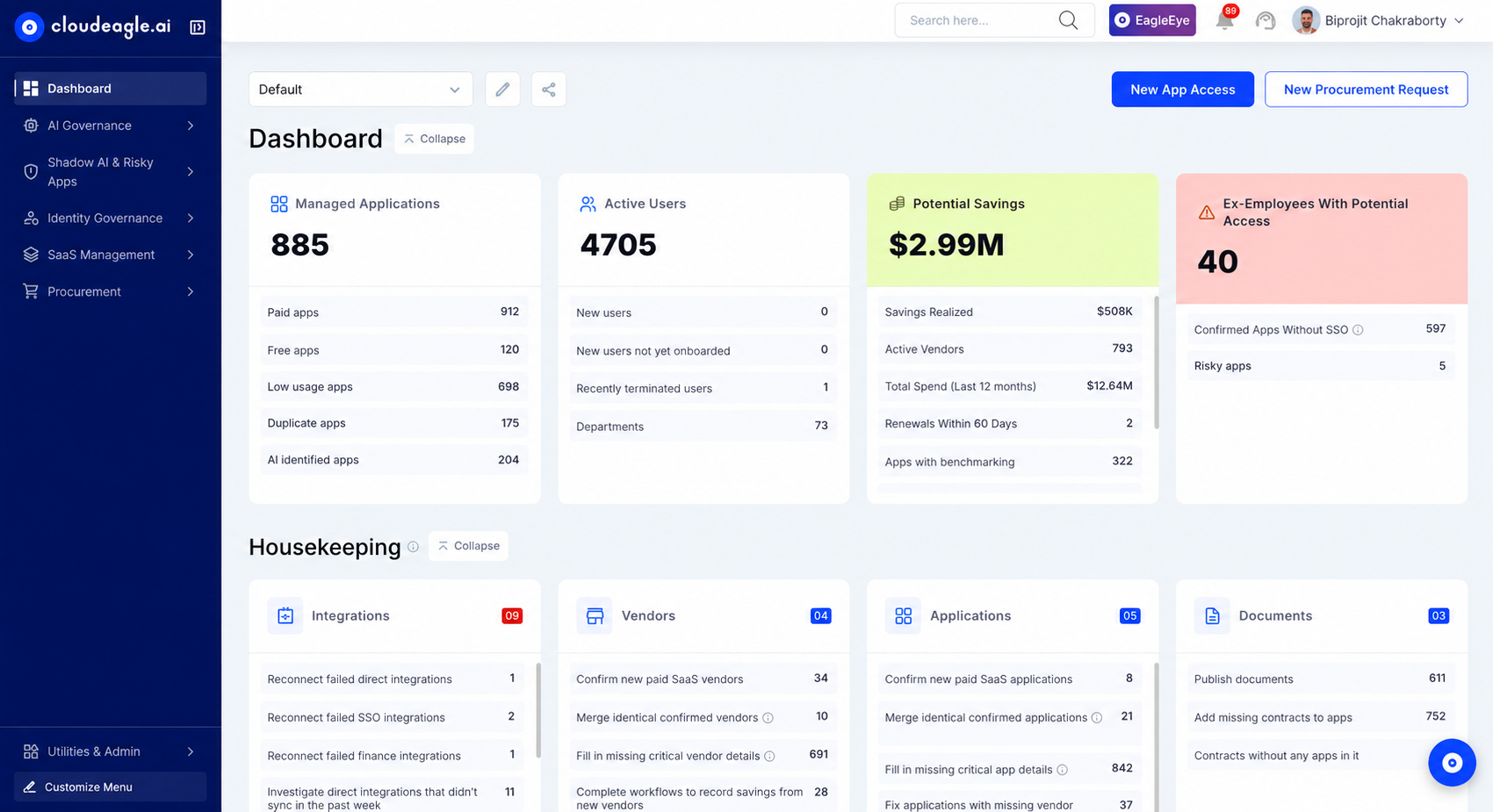
CloudEagle.ai, a unified platform for AI governance, SaaS security, identity governance, and SaaS spend, helps IT teams stay in control without blocking the people who want to use AI.

  • See everything: Seven layers of discovery combine signals from SSO, browser activity, finance systems, and security tools, so you find AI tools that SSO alone misses.
  • Focus on real risk: Risk scores based on security posture, data residency, training data use, and compliance alignment show which tools need approval, restrictions, or blocking.
  • Redirect, don’t just block: Secure Browsing sends employees from unapproved tools to an approved alternative, and logs each redirect for audit.
  • Protect sensitive data: DLP checks prompts for PII, PHI, financial data, and source code before they reach the AI model.
  • Keep AI spend in check: Track usage by user, department, and model, set budgets with alerts, and spot unused AI licenses.
  • Govern AI agents: Inventory supported AI agents and non-human identities, then review their owners and permissions.

The result: employees keep using approved AI tools, while IT keeps visibility into risk, data exposure, access, and cost.

‍

‍

5. Conclusion

CIOs don't need to convince boards that AI matters. They need to demonstrate that the organization understands its AI adoption and can manage it responsibly.

That means knowing which tools employees use, what those tools cost, where exposure exists, and who owns each decision.

A consistent quarterly reporting process turns scattered AI activity into information the board can evaluate.

‍

6. FAQs

1. What should a CIO report to the board about AI?

CIOs should report AI adoption, application inventory, spending, business outcomes, governance ownership, and major risks with their remediation status.

2. How often should CIOs report AI governance to the board?

Quarterly reporting provides a consistent view of AI adoption, spending, risks, and governance progress. Significant incidents should be escalated immediately.

3. Who is responsible for AI governance in an organization?

The CIO typically oversees AI strategy and board accountability. IT manages discovery, Security evaluates risks, and Finance tracks spending.

4. How should organizations measure AI ROI?

Organizations should connect AI spending to measurable workflow outcomes, such as reduced processing time, increased throughput, lower operating costs, and improved customer experiences.

5. Why should CIOs track Shadow AI?

Shadow AI discovery reveals applications employees use outside approved IT inventories. This helps CIOs understand actual adoption, identify exposure, and establish appropriate controls.

‍

Advertisement for a SaaS Subscription Tracking Template with a call-to-action button to download and a partial graphic of a tablet showing charts.Banner promoting a SaaS Agreement Checklist to streamline SaaS management and avoid budget waste with a call-to-action button labeled Download checklist.Blue banner with text 'The Ultimate Employee Offboarding Checklist!' and a black button labeled 'Download checklist' alongside partial views of checklist documents from cloudeagle.ai.Digital ad for download checklist titled 'The Ultimate Checklist for IT Leaders to Optimize SaaS Operations' by cloudeagle.ai, showing checklist pages.Slack Buyer's Guide offer with text 'Unlock insider insights to get the best deal on Slack!' and a button labeled 'Get Your Copy', accompanied by a preview of the guide featuring Slack's logo.Monday Pricing Guide by cloudeagle.ai offering exclusive pricing secrets to maximize investment with a call-to-action button labeled Get Your Copy and an image of the guide's cover.Blue banner for Canva Pricing Guide by cloudeagle.ai offering a guide to Canva costs, features, and alternatives with a call-to-action button saying Get Your Copy.Blue banner with white text reading 'Little-Known Negotiation Hacks to Get the Best Deal on Slack' and a white button labeled 'Get Your Copy'.Blue banner with text 'Little-Known Negotiation Hacks to Get the Best Deal on Monday.com' and a white button labeled 'Get Your Copy'.Blue banner with text 'Little-Known Negotiation Hacks to Get the Best Deal on Canva' and a white button labeled 'Get Your Copy'.Banner with text 'Slack Buyer's Guide' and a 'Download Now' button next to images of a guide titled 'Slack Buyer’s Guide: Features, Pricing & Best Practices'.Digital cover of Monday Pricing Guide with a button labeled Get Your Copy on a blue background.Canva Pricing Guide cover with a button labeled Get Your Copy on a blue gradient background.

Enter your email to
unlock the report

Oops! Something went wrong while submitting the form.
License Count
Benchmark
Per User/Per Year

Enter your email to
unlock the report

Oops! Something went wrong while submitting the form.
License Count
Benchmark
Per User/Per Year

Enter your email to
unlock the report

Oops! Something went wrong while submitting the form.
Notion Plus
License Count
Benchmark
Per User/Per Year
100-500
$67.20 - $78.72
500-1000
$59.52 - $72.00
1000+
$51.84 - $57.60
Canva Pro
License Count
Benchmark
Per User/Per Year
100-500
$74.33-$88.71
500-1000
$64.74-$80.32
1000+
$55.14-$62.34

Enter your email to
unlock the report

Oops! Something went wrong while submitting the form.

Enter your email to
unlock the report

Oops! Something went wrong while submitting the form.
Zoom Business
License Count
Benchmark
Per User/Per Year
100-500
$216.00 - $264.00
500-1000
$180.00 - $216.00
1000+
$156.00 - $180.00

Enter your email to
unlock the report

Oops! Something went wrong while submitting the form.

Get the Right Security Platform To Secure Your Cloud Infrastructure

Please enter a business email
Thank you!
The 2023 SaaS report has been sent to your email. Check your promotional or spam folder.
Oops! Something went wrong while submitting the form.

Access full report

Please enter a business email
Thank you!
The 2023 SaaS report has been sent to your email. Check your promotional or spam folder.
Oops! Something went wrong while submitting the form.

TL;DR

  • CIOs must give the board a clear picture of AI adoption, spending, risks, governance ownership, and measurable progress.
  • AI reporting should cover approved and shadow AI tools, license and token costs, sensitive data exposure, access risks, and autonomous agents.
  • Connect AI investments to business outcomes, including productivity gains, reduced processing time, lower costs, and improved customer experiences.
  • Establish quarterly reporting with clear ownership, measurable metrics, and remediation plans. Avoid reporting pilots, licenses, or risks without showing business impact.‍
  • CloudEagle.ai helps IT teams govern AI through seven-layer discovery, risk scoring, browser-level redirection, prompt-level DLP, AI spend tracking, and AI agent governance.

‍

"How much are we spending on AI, what are we getting in return, and how do we know it's under control?"

That's the board conversation every CIO should be prepared for.

Knowing which AI initiatives are running isn't enough. The challenge is that AI usage and risk often sit across disconnected systems. IT sees applications and individual departments see their own AI initiatives.

CIOs need to bring these pieces together. Here are five messages every CIO should communicate, along with the evidence the board should expect.

‍

1. What Should CIOs Tell the Board About AI: The 5 Core Messages?

A useful board update should answer five questions: what's being used, what it costs, where the risks are, who owns governance, and how progress is measured.

A. How Much AI Is Really in Use, Including Shadow AI?

The first number CIOs should present is the actual number of AI applications employees use, not just the number IT has approved.

An approved application inventory rarely captures the entire picture. Employees can access AI through personal accounts, browser extensions, IDE plugins, and features embedded in existing software.

Consider Plex. The company believed it had 30 sanctioned AI tools. CloudEagle.ai discovered another 73 shadow AI tools across its environment. Read the Plex case study. 

CIOs should report:

  • Total AI applications discovered.
  • Number of approved and unapproved applications.
  • Departments with the highest AI adoption.
  • Applications requiring further evaluation.

This gives the board a realistic view of AI adoption across the organization.

‍

Your AI Inventory Is Probably Wrong

Here's how to catch the AI tools IT never approved.
Get The Guide

‍

B. What Is AI Costing Us by License and by Token?

AI spending isn't simply a matter of counting licenses. Some applications charge per user or seat. Others use consumption-based pricing, where costs depend on token usage, model selection, and workload intensity.

A team using the same number of AI licenses can generate significantly higher costs as usage increases. CIOs should separate AI spending into two categories:

‍

Cost category What to report
License spending Purchased seats, assigned users, unused licenses, and subscription costs
Token consumption Tokens consumed, API usage, and spend by user, team, and model

‍

The board should also see which departments drive spending and whether consumption is increasing faster than expected.

For example, an engineering team's token consumption might increase because developers are using AI coding assistants more frequently. IT should identify that change before it becomes an unexpected budget overrun.

C. Where Does AI Risk Sit Across Data, Access, and Agents?

CIOs should give the board a clear picture of three areas of exposure:

  • Sensitive data: Employees may enter customer information, proprietary documents, or source code into AI applications without understanding how that information is handled.
  • Ungoverned access: Employees may retain access to AI applications, API credentials, and integrations without clear ownership or periodic reviews.
  • Autonomous agents: AI agents may access business systems, use service accounts, or execute actions without adequate ownership and oversight.

Rather than presenting every AI application as equally risky, CIOs should explain which applications require attention and what controls address those risks.

The board needs to know where exposure exists, who is addressing it, and whether remediation is progressing.

‍

61% of AI Agents Can Access Customer Data

See where AI risk really sits, with data from the 2026 report.
Get the Report

‍

D. Who Owns AI Governance and Who Is Accountable?

AI governance often involves multiple teams, but responsibilities shouldn't become ambiguous.

A 2026 Schellman study found that 42% of surveyed organizations place AI purchasing and adoption authority with the CIO or head of IT. Another 37% identify the CIO or head of IT as ultimately accountable when AI-related risks emerge.

This makes ownership an important part of the board conversation.

A practical operating model separates responsibilities:

‍

Function Responsibility
IT AI discovery, application inventory, and usage monitoring
Security Risk scoring, data protection, and access controls
Finance AI spend attribution, budgets, and cost tracking
CIO AI strategy, executive oversight, and board accountability

‍

The CIO doesn't need to personally manage every application or risk assessment. However, the CIO should ensure that every responsibility has an owner and measurable outcomes.

E. What Should the Board Expect to See Every Quarter?

AI governance shouldn't appear in board meetings only when something goes wrong. CIOs should establish a quarterly reporting cadence with a consistent set of metrics.

‍

Board metric What it reveals
AI applications in use Actual adoption across the organization
Applications under policy Progress toward governed AI usage
AI spend against budget Whether spending is within expected limits
Open AI incidents Unresolved issues and remediation progress

‍

Each update should explain significant changes since the previous quarter.

For example, if AI spending increased, explain which teams drove the increase and whether their workflows produced measurable benefits.

CIOs should also tell the board what support they need. This could include approval for an AI budget, executive sponsorship, or agreement on acceptable risk boundaries.

‍

2. How Should CIOs Frame AI for the Board Around Revenue, Cost, and Risk?

The five messages establish what the board needs to know. The next step is presenting that information in business terms.

A. Revenue: Which Workflows Are Changing

Start with the business processes AI improves, not the number of employees using AI.

For example, consider a customer support team using AI to classify incoming tickets, summarize customer conversations, and suggest responses.

The board should understand:

  • Which support workflows now use AI?
  • Has average ticket resolution time changed?
  • Can the team handle more requests with existing resources?
  • Has customer satisfaction improved?

These questions connect AI adoption to operational performance.

CIOs should distinguish measured improvements from expected benefits. If a workflow is still being piloted, present it as an opportunity rather than a proven financial return.

B. Cost: Seats, Tokens, and Duplicate Subscriptions

A consolidated AI spending figure rarely tells the whole story.

CIOs should separate fixed subscription costs from variable consumption costs. They should also identify duplicate subscriptions across departments.

A useful board presentation includes:

  • Total AI license expenditure.
  • Token and API consumption costs.
  • Spend by department and business use case.
  • Duplicate or underutilized subscriptions.
  • Monthly or quarterly spending trends.

A trend line helps the board understand whether consumption is stable, accelerating, or declining.

C. Risk: Shadow AI, Sensitive Data, and Autonomous Agents

Avoid presenting AI risk as a reason to stop adoption.

Instead, show the board how applications are classified and what employees can do with each category.

‍

Risk tier AI usage Management approach
Low Approved tools handling public information Allow usage under standard policies
Medium Tools processing internal business information Apply usage restrictions and monitoring
High Tools handling sensitive data or privileged access Require additional review or restrict access

‍

This approach demonstrates that IT can distinguish acceptable AI usage from applications requiring intervention.

The board gets a clearer understanding of exposure without receiving a blanket recommendation to block AI.

‍

3. What Common Mistakes Should CIOs Avoid in Board AI Updates?

Even well-prepared CIOs can lose the board's attention by presenting too much technical detail without connecting it to business outcomes.

Avoid these common mistakes:

  • Reporting pilots instead of outcomes: The number of AI projects doesn't explain whether they deliver measurable improvements.
  • Reporting licenses instead of consumption: Seat counts miss the variable costs associated with token-based applications.
  • Ignoring Shadow AI: Approved application inventories don't necessarily reflect actual employee usage.
  • Treating governance as a policy document: Policies need clear owners, operational controls, and regular reviews.
  • Presenting risks without actions: Every significant exposure should have an owner, remediation plan, and reporting timeline.

A good board update should make decisions easier, not introduce another layer of technical complexity.

‍

4. How Does CloudEagle.ai Help Enterprises with AI Governance?

‍

‍

Employees adopt AI tools faster than IT can review them, through free assistants, personal accounts, browser tools, and AI features built into existing apps. 

CloudEagle.ai, a unified platform for AI governance, SaaS security, identity governance, and SaaS spend, helps IT teams stay in control without blocking the people who want to use AI.

  • See everything: Seven layers of discovery combine signals from SSO, browser activity, finance systems, and security tools, so you find AI tools that SSO alone misses.
  • Focus on real risk: Risk scores based on security posture, data residency, training data use, and compliance alignment show which tools need approval, restrictions, or blocking.
  • Redirect, don’t just block: Secure Browsing sends employees from unapproved tools to an approved alternative, and logs each redirect for audit.
  • Protect sensitive data: DLP checks prompts for PII, PHI, financial data, and source code before they reach the AI model.
  • Keep AI spend in check: Track usage by user, department, and model, set budgets with alerts, and spot unused AI licenses.
  • Govern AI agents: Inventory supported AI agents and non-human identities, then review their owners and permissions.

The result: employees keep using approved AI tools, while IT keeps visibility into risk, data exposure, access, and cost.

‍

‍

5. Conclusion

CIOs don't need to convince boards that AI matters. They need to demonstrate that the organization understands its AI adoption and can manage it responsibly.

That means knowing which tools employees use, what those tools cost, where exposure exists, and who owns each decision.

A consistent quarterly reporting process turns scattered AI activity into information the board can evaluate.

‍

6. FAQs

1. What should a CIO report to the board about AI?

CIOs should report AI adoption, application inventory, spending, business outcomes, governance ownership, and major risks with their remediation status.

2. How often should CIOs report AI governance to the board?

Quarterly reporting provides a consistent view of AI adoption, spending, risks, and governance progress. Significant incidents should be escalated immediately.

3. Who is responsible for AI governance in an organization?

The CIO typically oversees AI strategy and board accountability. IT manages discovery, Security evaluates risks, and Finance tracks spending.

4. How should organizations measure AI ROI?

Organizations should connect AI spending to measurable workflow outcomes, such as reduced processing time, increased throughput, lower operating costs, and improved customer experiences.

5. Why should CIOs track Shadow AI?

Shadow AI discovery reveals applications employees use outside approved IT inventories. This helps CIOs understand actual adoption, identify exposure, and establish appropriate controls.

‍

CloudEagle.ai recognized in the 2025 Gartner® Magic Quadrant™ for SaaS Management Platforms
Download now
gartner chart
5x
Faster employee
onboarding
80%
Reduction in time for
user access reviews
30k
Workflows
automated
$15Bn
Analyzed in
contract spend
$2Bn
Saved in
SaaS spend

Streamline SaaS governance and save 10-30%

Book a Demo with Expert
CTA image