HIPAA Compliance Checklist for 2025

AI governance budget planning for 2027 is the work of sizing, funding, and defending the money your organization spends to discover, control, and audit AI tools, agents, and usage next year.
The short answer: ask for a dedicated operating line sized to your AI estate, fund discovery first, and justify the request as the gate that releases AI spend.
Three things make 2027 different from this year:
- The EU AI Act's stand-alone high-risk obligations now apply from 2 December 2027
- Gartner expects the average Fortune 500 company to go from fewer than 15 AI agents in 2025 to more than 150,000 by 2028
- Forrester predicted enterprises would push a quarter of planned AI spend into 2027
Your governance budget sits underneath all three.
Why Does 2027 Need Its Own AI Governance Budget Line?
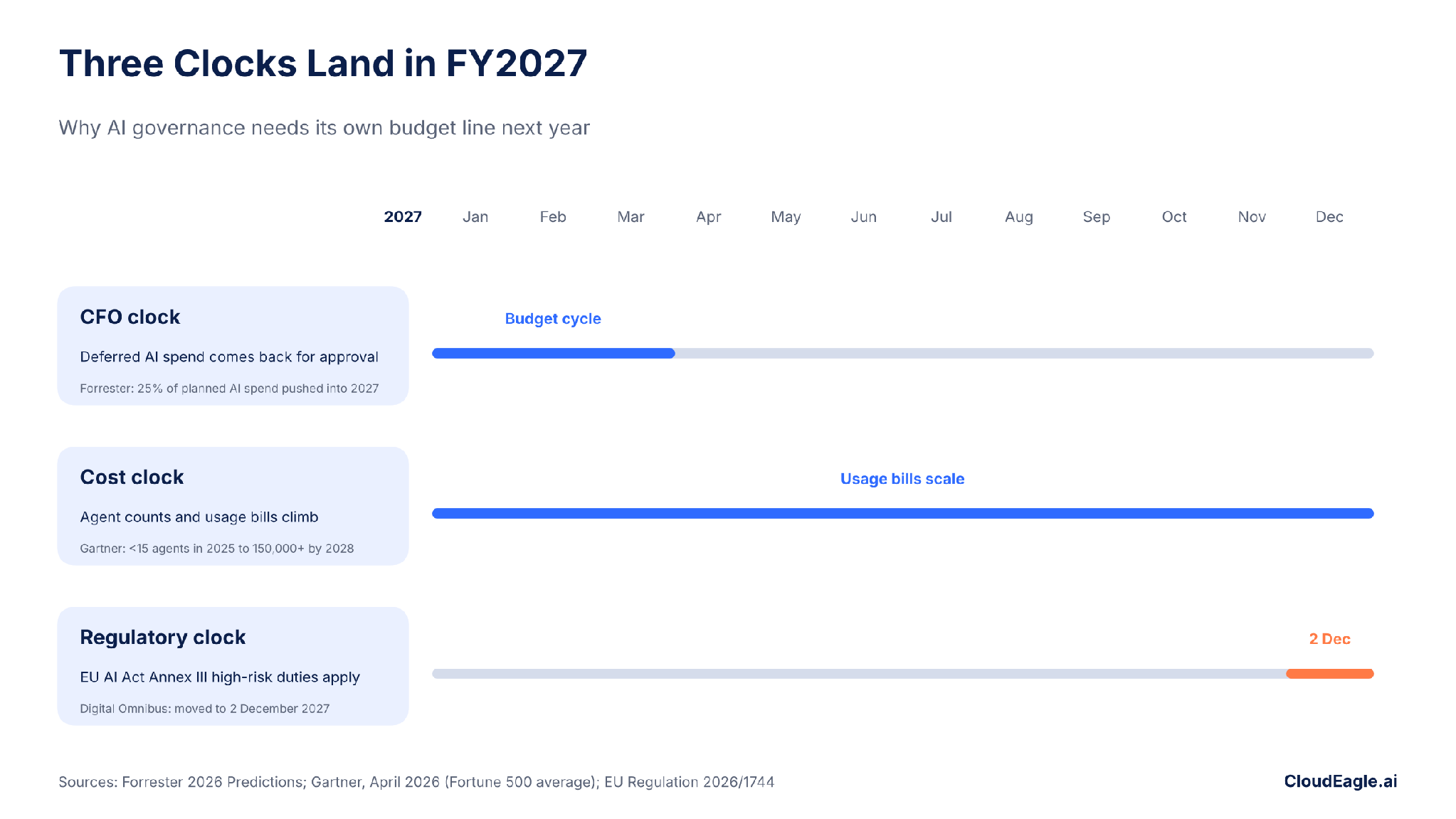
Because three clocks run out in the same fiscal year, and each one turns AI governance from a policy exercise into a spending decision.
The Regulatory Clock Moved, But It Didn't Stop
The EU's Digital Omnibus on AI entered into force on 27 July 2026 and moved Annex III high-risk obligations, covering hiring, credit, education and critical infrastructure, from August 2026 to 2 December 2027.
The substantive requirements did not change. General-purpose AI and most transparency obligations kept their original dates, and the AI Office gained powers to inspect and fine directly.
Our take: a one-year delay helps only if the money lands in the year the work happens. Teams that read "delayed" as "deferred" will be funding audit evidence in late 2027 with no inventory to pull it from.
The Cost Model Moves from Seats to Meters
Gartner forecasts that the average Fortune 500 company will run more than 150,000 AI agents by 2028, up from fewer than 15 in 2025. Agents are billed by usage, and usage bills don't follow annual plans.
Uber found that out early. It reportedly used up its 2026 AI coding budget in about four months, with engineers running $500 to $2,000 a month each, and its COO now says the spend is getting harder to justify.
Our take: in 2027, part of AI governance is a FinOps job. If no budget line pays for token visibility by team, nobody owns an overrun until finance finds it.
The CFO Clock Is Already Running
Forrester predicted that enterprises would defer 25% of planned AI spend into 2027 as finance teams gated AI deals on proven returns. That deferred money comes back for approval next year.
Before releasing it, a CFO can fairly ask: can we see and control the AI we already run?
Our take: position governance as the release valve for deferred AI spend, not a brake on it.

How Much Should You Budget for AI Governance in 2027?
Build the number from your own inventory. Published benchmarks for AI governance spend exist, but the ones we checked don't disclose how they were measured, so they make a weak anchor for a CFO conversation.
The one well-sourced market figure is Gartner's: spending on AI governance platforms will reach $492 million in 2026 and pass $1 billion by 2030. That tells you the category is real, not what your share of it should be.
Size the Ask from Three Inputs
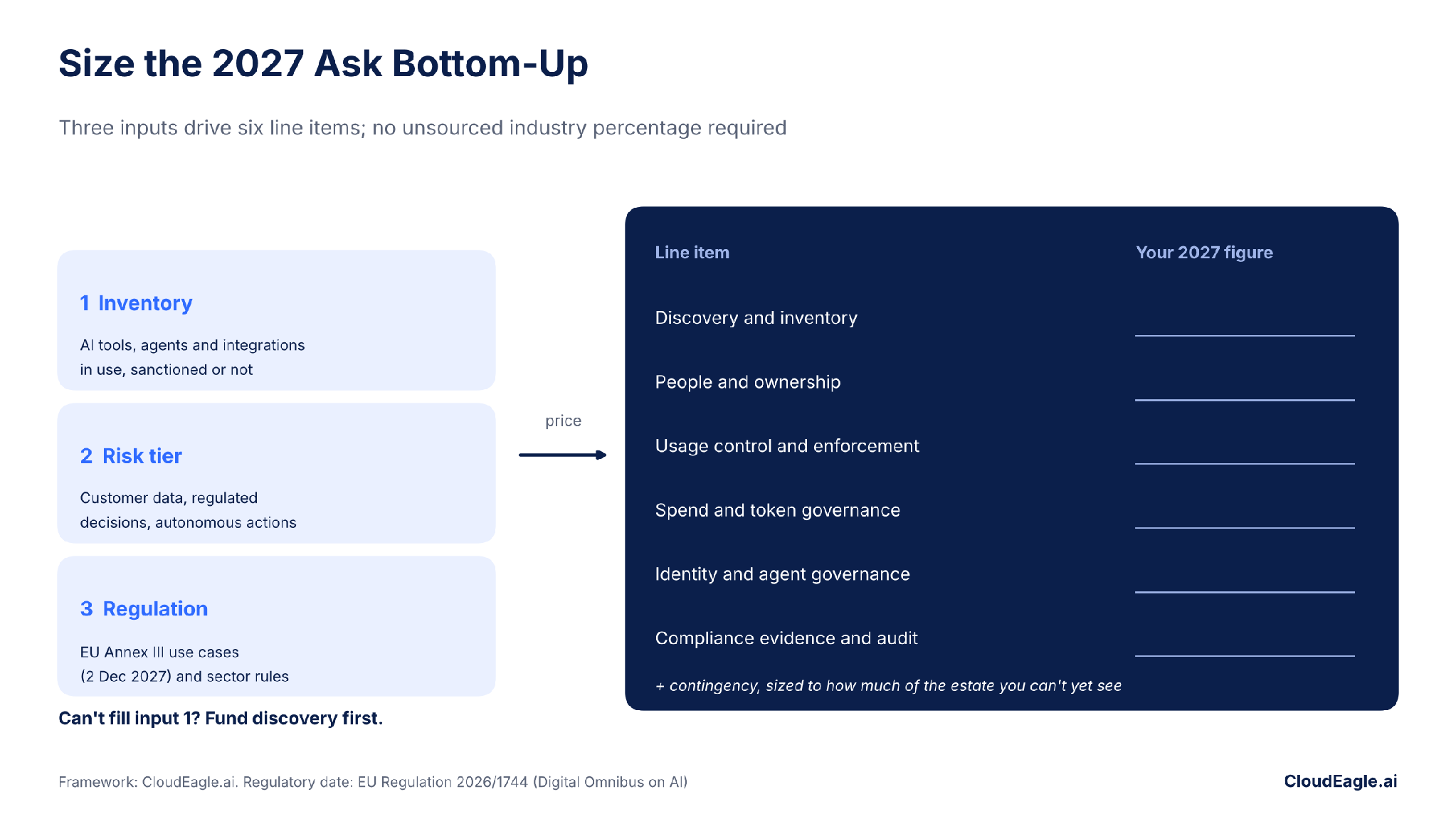
A defensible number comes from three inputs, each priced against the line items in the next section:
- How many AI tools, agents and integrations are in use, sanctioned or not
- The risk tier of each, based on customer data, regulated decisions and autonomous actions
- Your regulatory exposure, especially EU Annex III use cases and sector rules
If you can't produce the first number, that is your budget answer: fund discovery before anything else. A funded 90-day discovery line is a stronger ask than a confident percentage built on a partial inventory.
What Should a 2027 AI Governance Budget Include?
Six lines, most of them recurring, with discovery funded first because every other line depends on knowing what exists.
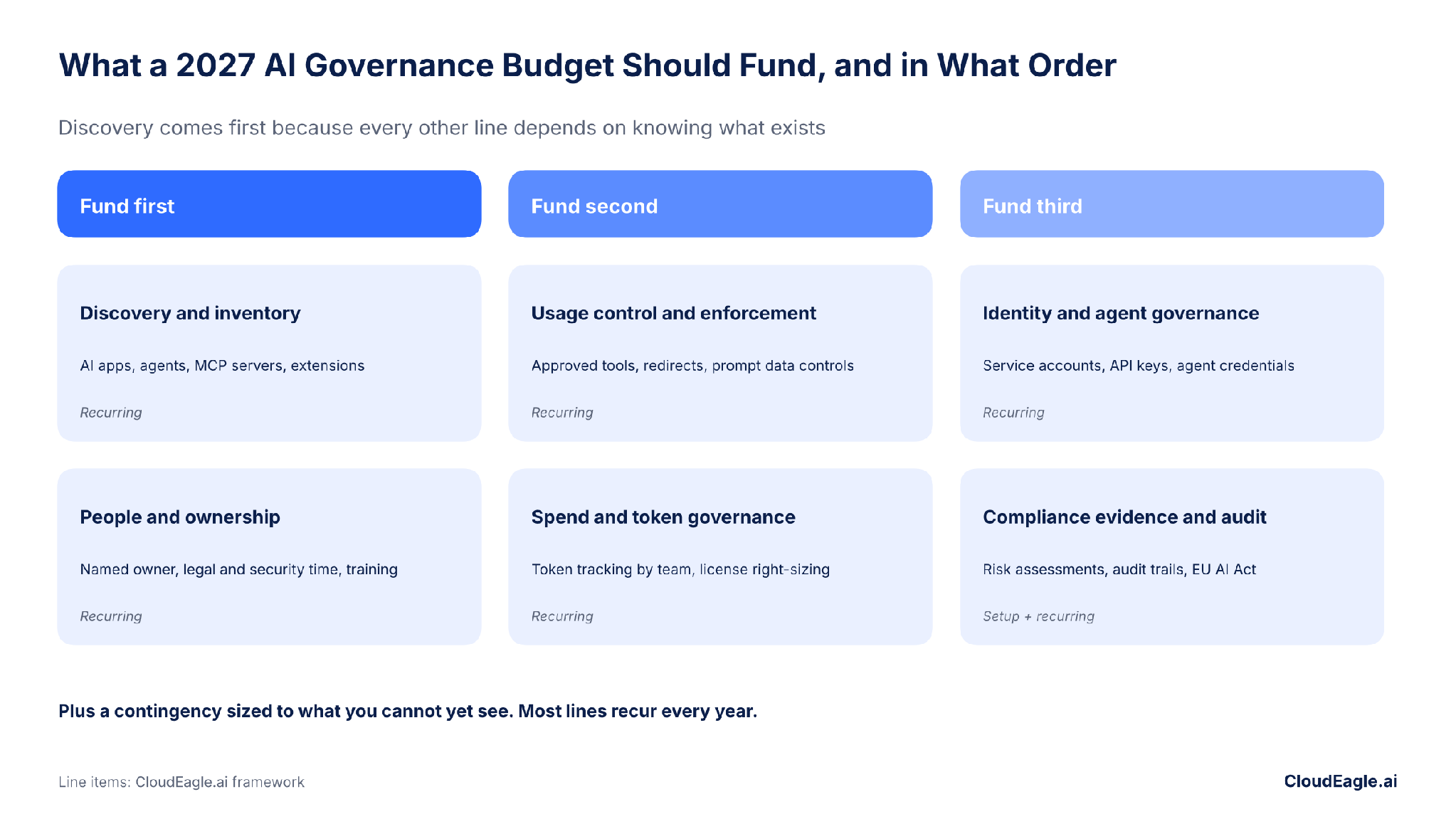
Hold a contingency on top, sized to how incomplete your inventory is. The less you can see today, the more of next year's spend is still unknown.
The ownership line is the one most often missing. Forrester expected 60% of the Fortune 100 to appoint a head of AI governance during 2026; if your organization hasn't named one, the budget should pay for that role before it pays for more tooling.
Our take: by year two, recurring lines will outweigh setup costs. A governance budget that ends at launch is a project plan; ask for an operating line.
Whose Budget Should AI Governance Come From?
Not the security budget alone. Forrester's 2026 advice to CISOs is to move AI security costs into enterprise AI investments, so funding follows risk ownership and doesn't eat into core defenses.
In practice, the strongest 2027 requests blend three sources:
- a fixed governance allocation inside every approved AI initiative, so new projects carry their own oversight cost
- spend recovered from unused, duplicate and over-tiered AI and SaaS licenses
- a smaller central line for shared discovery, audit and identity tooling
The second source is the most persuasive and the least used. Zylo's 2026 index found that organizations leave 36% of SaaS licenses unused, while AI-native app spend rose 108% in a year, and 393% at companies with more than 10,000 employees.
Our take: the waste that ungoverned AI creates can pay for the governance that controls it. That reframes the ask from new money to redirected money, which is an easier conversation in any budget cycle.
How Do You Justify an AI Governance Budget to the CFO and Board?
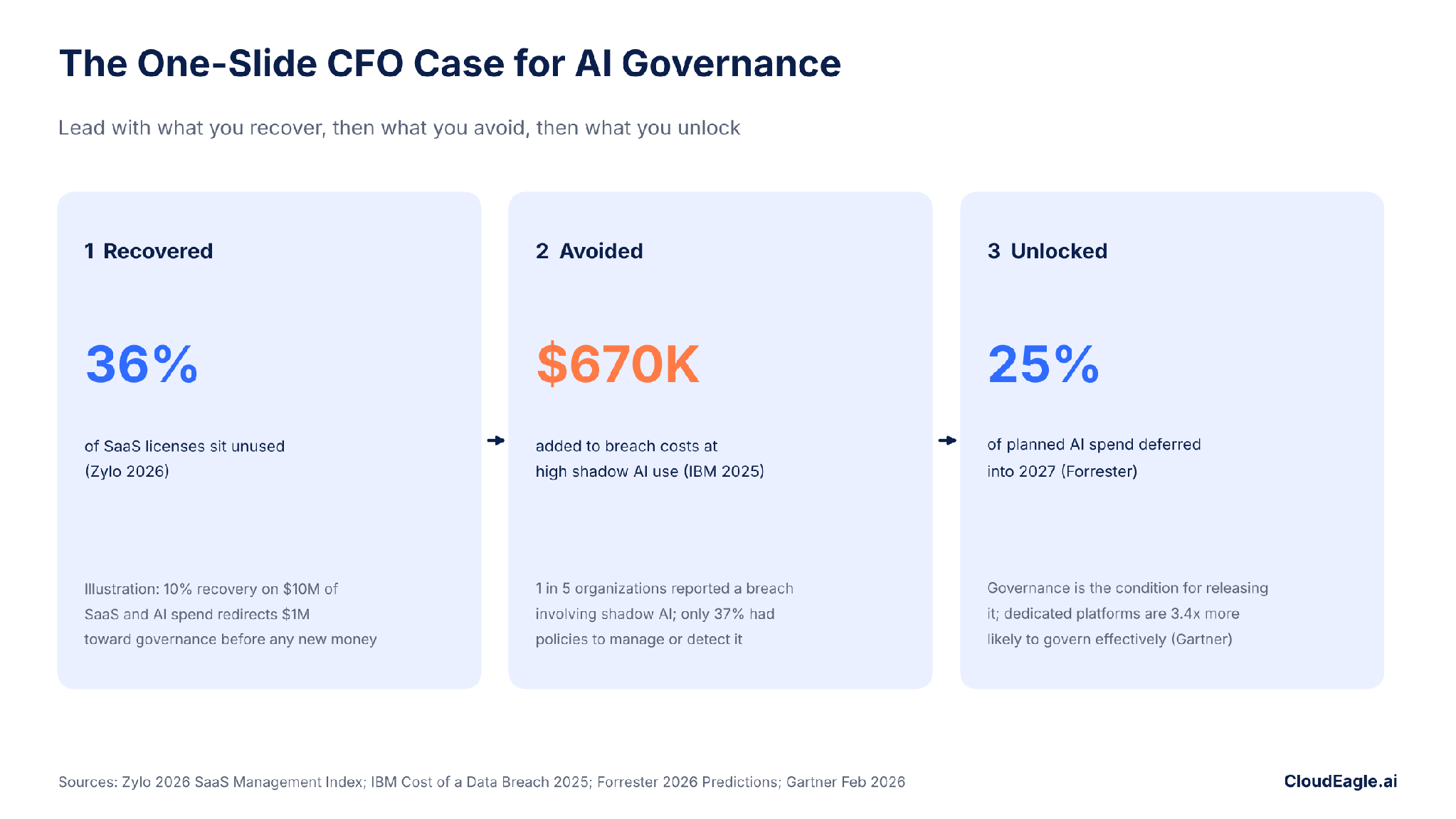
Lead with money recovered, then risk avoided, then the AI spend that governance unlocks. Finance funds certainty first, so the order matters.
Start with Spend You Can Recover
Take an illustrative enterprise with $10M in annual SaaS and AI spend. If license harvesting and tool consolidation recover even 10%, that is $1M redirected toward governance before anyone approves new money.
Your own numbers will differ. The CloudEagle.ai SaaS and AI spend calculator estimates recoverable spend for your stack in about four minutes, which gives the request a real first line.
Price the Risk in Breach Terms
IBM's 2025 breach research found that one in five organizations reported a breach involving shadow AI, high shadow AI use added about $670,000 to average breach costs, and only 37% had policies to manage or detect it.
Boards respond to exposure stated in their own terms: what an undetected AI tool costs us, and how much faster we'll find the next one.
Show That Governance Releases Deferred Spend
Connect the request to the AI projects finance paused this year. If governance is the condition for releasing them, its cost belongs in the business case of every project it unblocks.
Gartner adds an effectiveness argument: organizations using dedicated AI governance platforms were 3.4 times more likely to achieve high governance effectiveness than those that weren't.
Our take: don't lead with EU fines. A CFO discounts a regulatory risk dated December 2027; recovered spend shows up this quarter.
What Objections Will You Hear, and How Should You Answer Them?
Expect four objections in a budget review. Three have clean answers; one deserves a concession.
The last objection is the one to take seriously. Governance that runs on tickets and blanket bans pushes employees back to personal accounts, which recreates the shadow AI problem you budgeted to solve.
Our take: the budget should buy controls that work at the moment of use, so teams keep moving and IT keeps seeing.
How Does CloudEagle.ai Help You Build and Defend the 2027 Budget?
CloudEagle.ai is an AI governance and SaaS management platform that helps enterprises discover, govern and optimize their SaaS and AI stack, including AI agents and non-human identities, from one command center. For a 2027 budget, it maps onto the line items above and supplies the numbers that defend them.
- It finds sanctioned and shadow AI tools, agents and MCP servers by correlating SSO, finance, browser and network data, then risk-scores each one
- It tracks token consumption and API spend for Claude, ChatGPT, Cursor, Gemini and GitHub Copilot by user, team and department, and harvests unused licenses automatically
- It redirects users from unsanctioned AI tools to approved ones, and monitors or blocks sensitive data shared with AI vendors
- It inventories service accounts, API keys and AI agents with their owners and permissions
- It forecasts next year's app spend from licenses bought, provisioned users and current spend, so the request starts from real data
The AI spend side already has a track record.
At Printify, team-level spend limits warned 8 teams before they crossed their ceiling, caught $30K in overspend before it happened, and flagged 14 department budget overruns while the quarter was still open. Treasure Data now traces 2.8M tokens a month to a specific user, project or model, verifies $20K+ in monthly token costs against usage before finance pays the vendor, and found 34% of its licenses had sat inactive for 90+ days.
Its CIO and CISO, Aysha Khan, put the budget payoff plainly: the team can now “give leadership a number we can stand behind.” Printify Catches AI Overspend Before the Invoice Does Preventing Budget Overruns +2
The strongest case for a 2027 AI governance budget rests on money already in motion: into agents, into tokens, into projects waiting for approval. Fund visibility first, and the rest of the request defends itself.
Book a CloudEagle.ai demo to see your AI estate, token spend and recoverable licenses in one view. Take those numbers into your budget meeting instead of estimates. Your 2027 governance ask will arrive with its own funding plan.
Frequently Asked Questions
How much should a company budget for AI governance in 2027?
Build the figure bottom-up rather than from an industry percentage. Count the AI tools, agents and integrations in use, tier each by risk, add your regulatory exposure, then price six line items: discovery, ownership, usage control, spend and token governance, identity, and compliance evidence. If you can't count your AI estate yet, fund discovery first.
Should AI governance be funded from the security budget?
Only in part. Forrester recommends moving AI security costs into enterprise AI investments so funding follows risk ownership. A workable model combines a governance allocation inside each AI project, spend recovered from unused AI and SaaS licenses, and a small central line for shared discovery and audit tooling.
Can CloudEagle.ai track AI token spend for budget planning?
Yes. CloudEagle.ai tracks token consumption and API spend for Claude, ChatGPT, Cursor, Gemini and GitHub Copilot by user, team and department. It also forecasts next year's app spend from license and usage data, which gives a 2027 governance request a measured baseline instead of an estimate.
Fund Visibility First. The Rest Defends Itself.