AI Governance

The AI Governance Confidence Gap: 90% of Security Leaders Think They Have Visibility, 59% Are Wrong

Share via:
Written by:
CloudEagle.ai Team
Reviewed by
Nidhi Jain
Last Updated:
October 9, 2026
blog-cms-banner-bg
Little-Known Negotiation Hacks to Get the Best Deal on Slack
cta-bg-blogDownload Your Copy

HIPAA Compliance Checklist for 2025

Download PDF

Ninety percent of enterprise security leaders say they have visibility into their AI footprint. Fifty-nine percent confirm or suspect shadow AI inside their environment.

Both numbers come from the Purple Book Community's State of AI Risk Management 2026, a survey of 650+ CISOs, VPs and security directors, and the sharper finding sits one layer down: 57% of organizations that claim a complete AI inventory also admit shadow AI is present.

That is not a contradiction respondents missed. It is what visibility looks like when it is measured against the list you already have. An inventory always reports itself complete, because the apps it can't see never enter the count. The confidence is sincere; the denominator is wrong.

This piece argues the confidence gap is a measurement problem before it is a security problem. It maps the three places AI hides from the sensors most enterprises trust, and gives you five questions to size your own gap before an auditor or an attacker does.

‍

1. What Is the AI Governance Confidence Gap?

The AI governance confidence gap is the distance between how much of its AI footprint a security team believes it can see and control, and what outcomes in its environment show. The Purple Book Community named it after finding the same pattern across every dimension it measured.
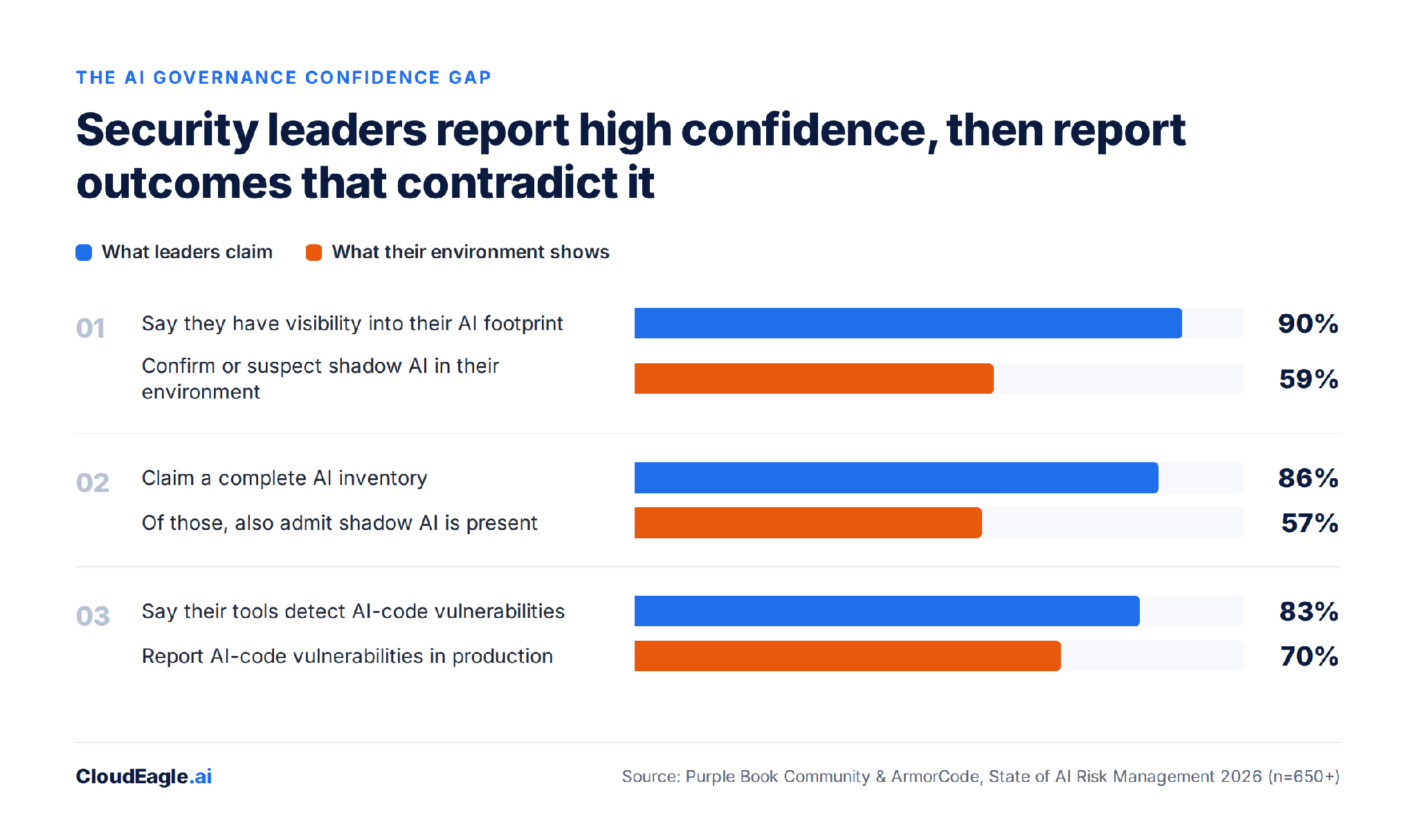
Claim vs. reality: three paired findings from the State of AI Risk Management 2026

‍

The detection pair is the one to sit with. Among organizations with confirmed AI-code vulnerabilities in production, 92% say their security tools effectively detect those vulnerabilities. If the tools caught everything, the vulnerabilities would not be in production.

Nobody in that sample is lying. Each respondent is accurately reporting how a tool performs on the scope it was given. The failure is in the scope, and scope is exactly what a confidence survey can't capture.

Our take: The confidence gap isn't overconfidence in the psychological sense, so you can't coach a CISO out of it. It's a reporting system working as designed on an incomplete scope. Fixing it means changing what gets counted, not how leaders feel about the count.

‍

The Tools IT Doesn't Know About

They're already in your stack
Find Them

‍

2. Why Do Security Leaders Overestimate Their AI Visibility?

Three structural habits turn partial visibility into full confidence.

A. Visibility Gets Measured Against the Identity Provider

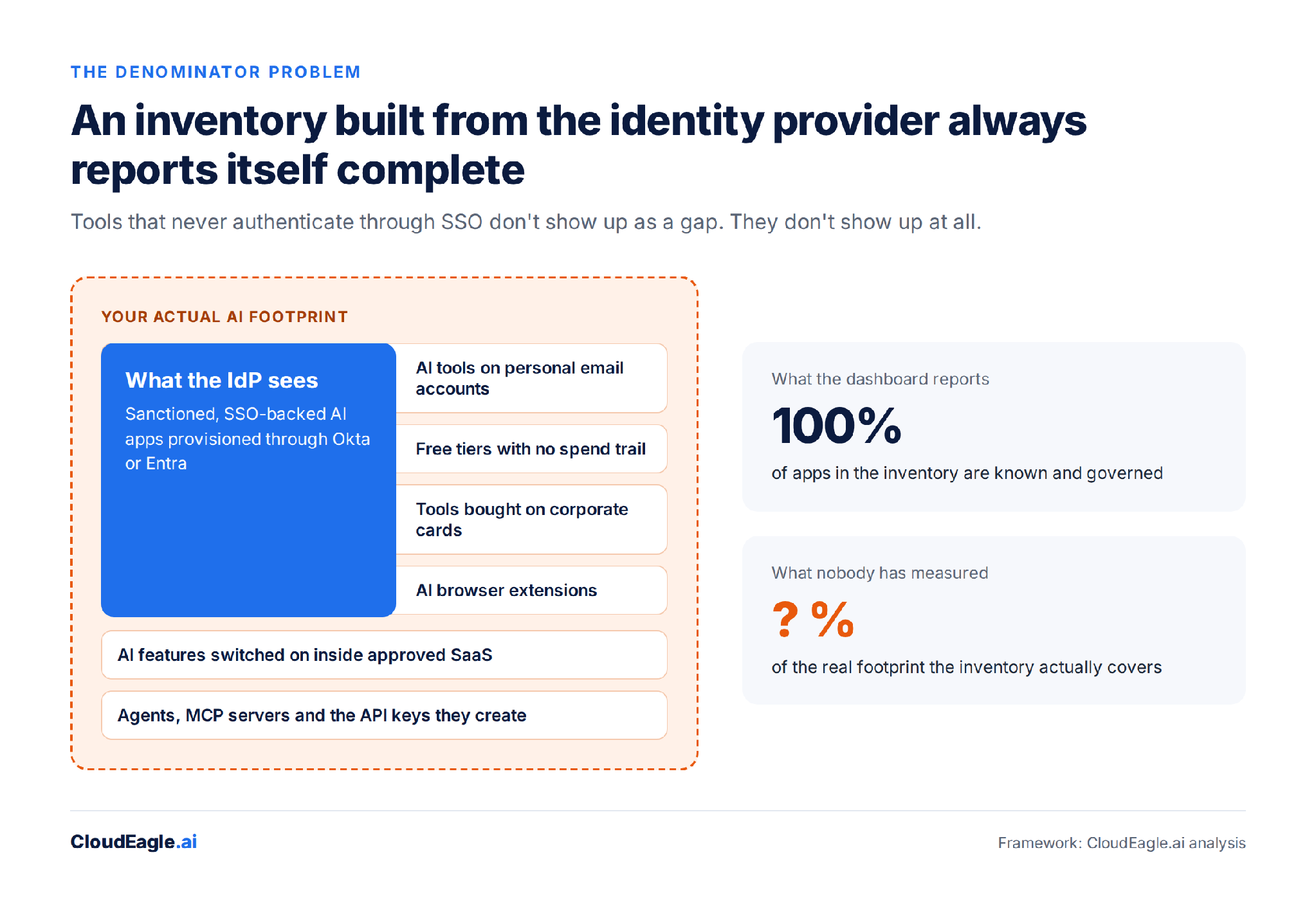
Most AI inventories start at Okta or Entra, the federated list. That list is accurate for what it contains. It says nothing about a ChatGPT account created with a personal email, a Perplexity subscription on a corporate card, or a browser extension with read access to every tab.

None of those authenticate through the IdP, so none show up as a gap. They show up as nothing.
‍

The denominator problem: what the IdP sees vs. the full AI footprint

‍

B. Dashboards Produce Confidence Faster Than Coverage

Gravitee's State of AI Agent Security 2026 tracked 750 technology leaders across two waves. Between December 2025 and April 2026, agent fleets roughly doubled and confidence in agent security rose; mean monitoring coverage moved from about 47% to 52%. The unmonitored share barely shifted while the unmonitored count grew.

The Purple Book data shows the same mechanism from the tooling side: 51% of enterprises run 11 or more security scanning tools, and 82% say that sprawl hurts their ability to fix what matters. Each tool reports green on its own slice, and eleven green slices read like a green whole.

‍

C. Nobody Owns the Denominator

IT owns the IdP. Security owns the CASB and firewall. Finance owns card spend. Engineering owns API keys. Each holds a partial list, and reconciling them is nobody's job. ArmorCode's Karthik Swarnam put it plainly at the report launch: "Signals are coming from everywhere, and without clear ownership and action, things slip through."

Our take: If four teams each hold 70% of the AI list, the organization doesn't have 70% visibility. It has an unknown number, because nobody has measured the overlap.

‍

3. Where Does AI Hide From Enterprise Inventories?

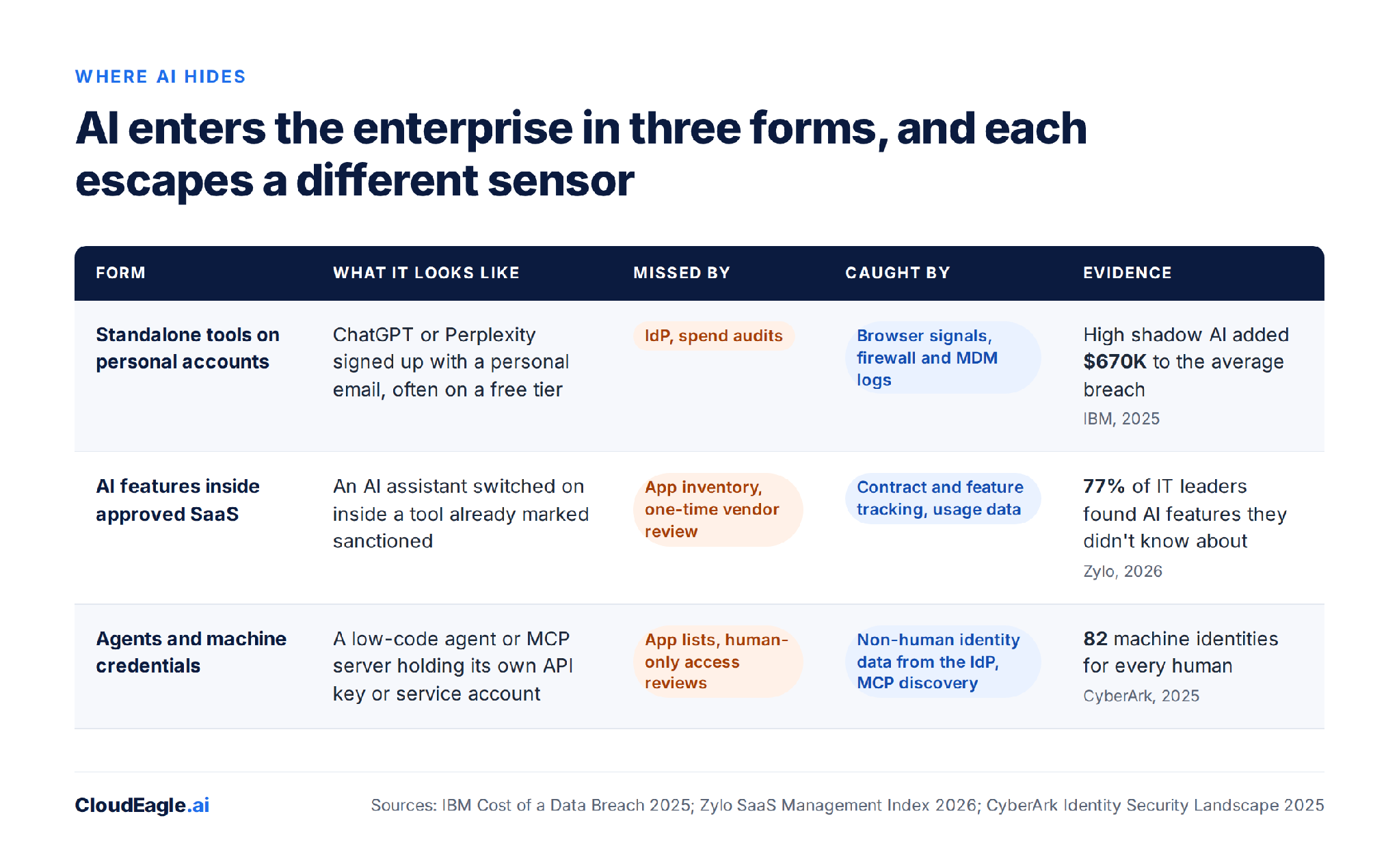
AI now enters the enterprise in three forms, and each escapes a different sensor.
‍

Three forms of hidden AI and the sensors each one escapes

‍

A. Standalone Tools on Personal Accounts

Browser-based, free-tier, signed up with a personal email. The IdP never sees them; the firewall sees them only on the corporate network. IBM's 2025 Cost of a Data Breach Report found that high levels of shadow AI added $670,000 to the average breach, and those incidents exposed customer PII 65% of the time against a 53% baseline.

B. AI Features Switched On Inside Approved SaaS

This is the category inventories miss most confidently. According to Zylo's 2026 SaaS Management Index, 77% of IT leaders have found AI features or apps running in their stack without IT's knowledge. The vendor is approved; the new data processing is not. Your inventory still reads "Notion, sanctioned," which is correct and useless.

C. Agents, MCP Servers and the Credentials They Mint

78% of Purple Book respondents are piloting or deploying agentic AI. Every agent connection creates a token, a service account or an OAuth grant, and none go through onboarding or offboarding. CyberArk's 2025 Identity Security Landscape puts machine identities at 82 for every human, with 88% of organizations still defining only human identities as privileged users.

Our take: The next confidence gap is already forming in agents. Human shadow AI at least leaves a browser trail. An agent built in a low-code tool leaves an API key, and API keys don't appear in anyone's app list.

If you're still building the policy layer underneath this, our breakdown of the shadow AI gap covers where most programs stall.

‍

AI Is Slipping Past IT

Catch it before it spreads
Find It

‍

4. Why Is the AI Visibility Gap Harder to Close Than Shadow IT Was?

Security teams have closed a visibility gap before. Shadow IT in the 2010s looked similar on the surface: employees routing around procurement to Dropbox and personal Slack workspaces. The playbook that worked then was spend discovery plus SSO consolidation. It works less well now, for three reasons.

‍

Shadow IT (2010s) Shadow AI (2026)
Cost to adopt A card charge finance could find Often zero; free tiers leave no spend trail
Where it arrives As a new vendor As a new vendor, or as a feature inside one you already approved
What it does with access Stores files Reads, writes and acts, including through agents with their own credentials
Discovery that worked Spend audit plus SSO rollout Browser, network, identity and spend signals, correlated together

‍

The consequence is that any one source now undercounts by design. Spend misses free tiers, SSO misses personal accounts, and both miss the AI feature that shipped inside an approved tool last Tuesday.

Our take: Teams that closed their shadow IT gap are, if anything, more exposed to the AI confidence gap, because they trust a playbook built for a different shape of problem.

‍

5. What Does the AI Confidence Gap Actually Cost?

The breach math is well documented. In IBM's data, 97% of organizations that reported an AI-related breach lacked proper AI access controls, and 63% of breached organizations had no AI governance policy or were still writing one.

The cost that lands first is quieter. A CISO who reports full AI visibility to the board has set the risk budget on the wrong number, and every downstream decision inherits the error:

  • Which AI tools get approved, and which get blocked
  • Where DLP gets deployed, and where it doesn't
  • What the auditor is told about AI access, and what evidence backs it

Our take: The real price of the gap is borrowed credibility. When an incident traces back to a tool the board was told didn't exist, the conversation stops being about the tool.

‍

6. How Can You Measure Your Organization's AI Confidence Gap?

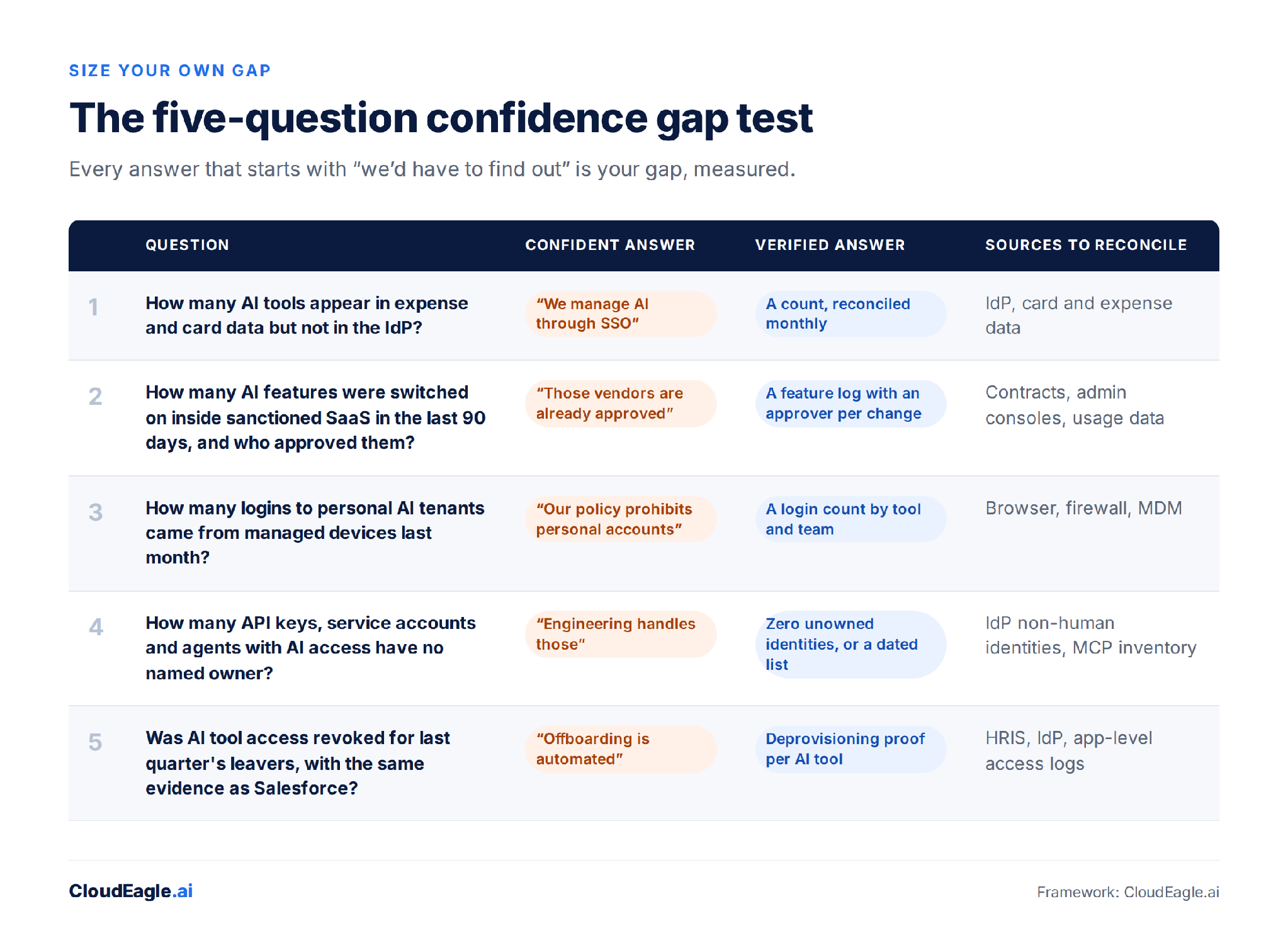
Don't ask "do we have visibility into AI?" Every team will say yes, and every team will be right about its own slice. Ask questions whose answers force you to reconcile sources.
‍

The five-question confidence gap test

‍

  • How many AI tools appear in expense and card data that don't appear in the IdP?
  • How many AI features were switched on inside sanctioned SaaS in the last 90 days, and who approved them?
  • How many logins to personal, non-corporate AI tenants came from managed devices last month?
  • How many API keys, service accounts and agents with AI access have no named human owner?
  • When someone left last quarter, was their AI tool access revoked with the same evidence as their Salesforce access?

Score it simply. Every answer that starts with "we'd have to find out" is your gap, measured.

Our take: Stop reporting AI visibility as a percentage. Report it as a reconciliation: sources checked, discrepancies found, discrepancies closed. That number can't be inflated by a confident dashboard.

‍

7. How Do You Move From AI Visibility to AI Control?

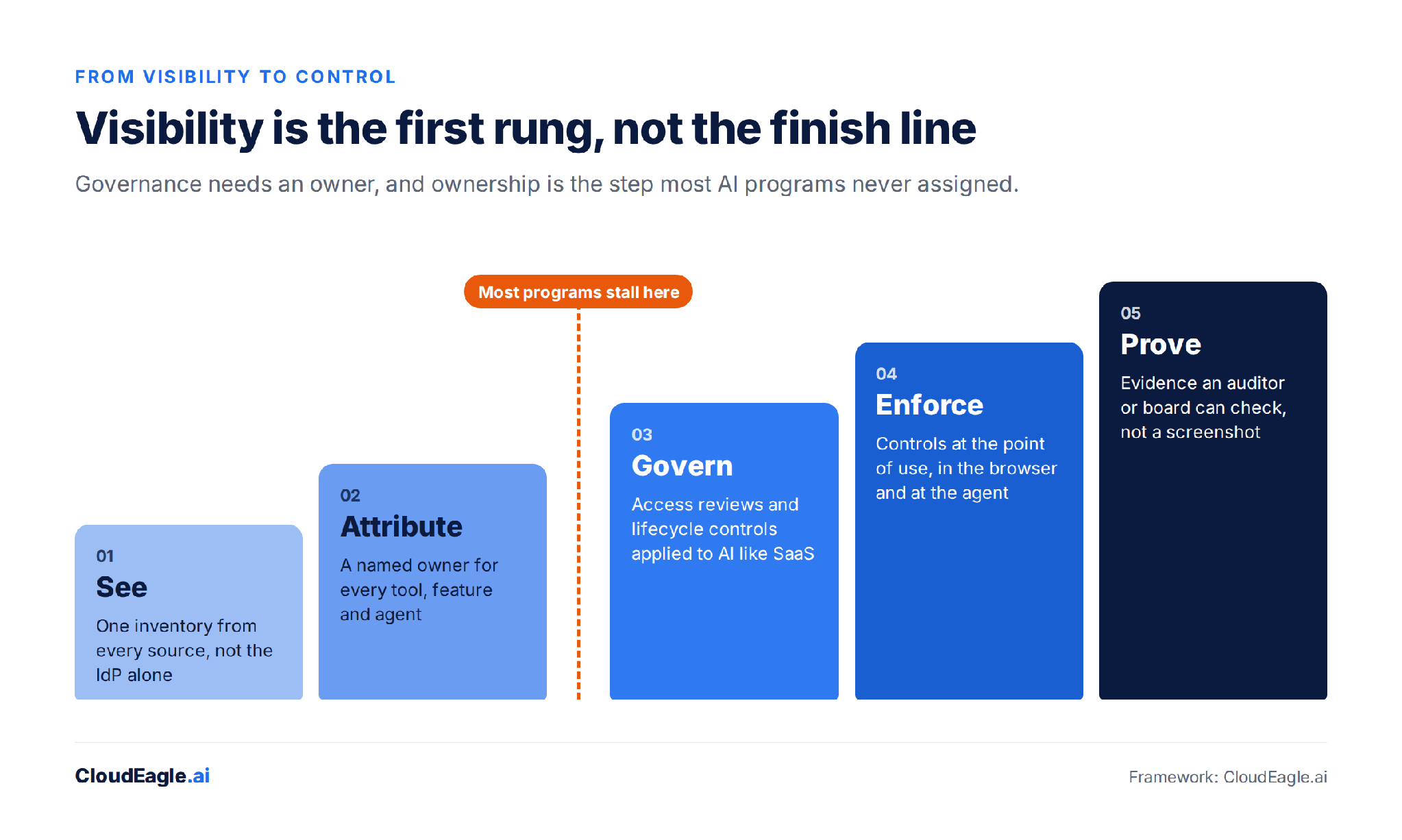
The Purple Book report's own conclusion is that leaders "aren't lacking awareness. They're lacking the ability to convert that awareness into governed action at the pace AI demands." Visibility is the first rung, not the finish line.
‍

The visibility-to-control ladder

‍

Most programs stall between Attribute and Govern, because governance needs an owner and ownership was never assigned.

‍

8. How CloudEagle.ai Closes the Confidence Gap

CloudEagle.ai was built around the denominator problem: one inventory, many sources, and controls that run where AI use actually happens.

A. One Inventory Built From Seven Sources

EagleIQ, CloudEagle.ai's discovery engine, correlates seven shadow AI signals: the IdP, contract metadata, firewall logs and MDM, approved purchases, social-login signups, shadow purchases and browser-extension sessions. Tools that never touched Okta still land in the count, and each gets a risk score so security can triage instead of treating every discovery as equal.

B. Enforcement at the Moment of Use

A policy in Confluence doesn't reach a browser tab. CloudEagle.ai's AI policy enforcement redirects an employee opening an unapproved AI tool to the sanctioned one, flags logins to personal AI tenants, and monitors or blocks sensitive data headed to AI apps.

C. Agents and Non-Human Identities, Governed Like Employees

CloudEagle.ai surfaces MCP servers and non-human identities from Okta, Entra and connected systems, with owner, status and permissions for each. Orphaned keys and service accounts get revoked, and machine identities enter the same access reviews as people.

D. Evidence the Board Can Check

Access reviews cover AI tools alongside SaaS, and deprovisioning proof attaches automatically. The answer to "do we have AI visibility?" becomes a report, not an opinion.

The confidence gap closes when your count includes what you couldn't see yesterday. See how CloudEagle.ai builds that count across your AI governance stack. Book a demo and we'll map your five-question score in 30 minutes.

‍

‍

9. Conclusion

The AI confidence gap isn't a lack of visibility. It's the difference between what security teams believe they can see and what their evidence actually confirms.

Closing it requires more than another discovery tool. Organizations need to reconcile AI usage across identity, spend, devices, browsers, and embedded SaaS features. They also need controls that enforce policies, assign ownership, and produce auditable evidence.

CloudEagle.ai brings these signals into one inventory and connects discovery with enforcement and access governance. The result is a clearer picture of AI exposure and a more defensible basis for security decisions.

‍

10. FAQs

1. What is the AI confidence gap?

The AI confidence gap is the difference between an organization's perceived AI visibility and its verified ability to discover, assess, and govern actual AI usage.

2. How is the AI confidence gap different from shadow AI?

Shadow AI refers to unauthorized or unmonitored AI usage. The AI confidence gap measures how far an organization's understanding of its AI exposure differs from reality.

3. Why do traditional security tools miss AI usage?

Traditional tools track separate signals, such as SSO logins, software purchases, and network activity. They can miss personal accounts, free AI tools, and AI features embedded in approved SaaS applications.

4. How can organizations measure their AI confidence gap?

Compare AI discoveries across identity, finance, browser, device, and network data. Track unmatched tools, unowned AI identities, unapproved access, and unresolved discrepancies between sources.

5. How can organizations close the AI confidence gap?

Organizations need a unified AI inventory, risk-based enforcement, named ownership for AI agents and service accounts, and access reviews backed by auditable evidence.

6. How does CloudEagle.ai help close the AI confidence gap?

CloudEagle.ai correlates AI discovery signals, assigns risk scores, enforces AI usage policies, governs non-human identities, and supports access reviews with auditable evidence.

‍

Advertisement for a SaaS Subscription Tracking Template with a call-to-action button to download and a partial graphic of a tablet showing charts.Banner promoting a SaaS Agreement Checklist to streamline SaaS management and avoid budget waste with a call-to-action button labeled Download checklist.Blue banner with text 'The Ultimate Employee Offboarding Checklist!' and a black button labeled 'Download checklist' alongside partial views of checklist documents from cloudeagle.ai.Digital ad for download checklist titled 'The Ultimate Checklist for IT Leaders to Optimize SaaS Operations' by cloudeagle.ai, showing checklist pages.Slack Buyer's Guide offer with text 'Unlock insider insights to get the best deal on Slack!' and a button labeled 'Get Your Copy', accompanied by a preview of the guide featuring Slack's logo.Monday Pricing Guide by cloudeagle.ai offering exclusive pricing secrets to maximize investment with a call-to-action button labeled Get Your Copy and an image of the guide's cover.Blue banner for Canva Pricing Guide by cloudeagle.ai offering a guide to Canva costs, features, and alternatives with a call-to-action button saying Get Your Copy.Blue banner with white text reading 'Little-Known Negotiation Hacks to Get the Best Deal on Slack' and a white button labeled 'Get Your Copy'.Blue banner with text 'Little-Known Negotiation Hacks to Get the Best Deal on Monday.com' and a white button labeled 'Get Your Copy'.Blue banner with text 'Little-Known Negotiation Hacks to Get the Best Deal on Canva' and a white button labeled 'Get Your Copy'.Banner with text 'Slack Buyer's Guide' and a 'Download Now' button next to images of a guide titled 'Slack Buyer’s Guide: Features, Pricing & Best Practices'.Digital cover of Monday Pricing Guide with a button labeled Get Your Copy on a blue background.Canva Pricing Guide cover with a button labeled Get Your Copy on a blue gradient background.

Enter your email to
unlock the report

Oops! Something went wrong while submitting the form.
License Count
Benchmark
Per User/Per Year

Enter your email to
unlock the report

Oops! Something went wrong while submitting the form.
License Count
Benchmark
Per User/Per Year

Enter your email to
unlock the report

Oops! Something went wrong while submitting the form.
Notion Plus
License Count
Benchmark
Per User/Per Year
100-500
$67.20 - $78.72
500-1000
$59.52 - $72.00
1000+
$51.84 - $57.60
Canva Pro
License Count
Benchmark
Per User/Per Year
100-500
$74.33-$88.71
500-1000
$64.74-$80.32
1000+
$55.14-$62.34

Enter your email to
unlock the report

Oops! Something went wrong while submitting the form.

Enter your email to
unlock the report

Oops! Something went wrong while submitting the form.
Zoom Business
License Count
Benchmark
Per User/Per Year
100-500
$216.00 - $264.00
500-1000
$180.00 - $216.00
1000+
$156.00 - $180.00

Enter your email to
unlock the report

Oops! Something went wrong while submitting the form.

Get the Right Security Platform To Secure Your Cloud Infrastructure

Please enter a business email
Thank you!
The 2023 SaaS report has been sent to your email. Check your promotional or spam folder.
Oops! Something went wrong while submitting the form.

Access full report

Please enter a business email
Thank you!
The 2023 SaaS report has been sent to your email. Check your promotional or spam folder.
Oops! Something went wrong while submitting the form.
  • The AI governance confidence gap occurs when organizations believe they have complete AI visibility but miss tools, features, and agents outside their existing inventories.
  • Traditional discovery methods miss personal AI accounts, AI features inside approved SaaS, and agents operating through API keys or service accounts.
  • Closing the gap requires correlating identity, browser, firewall, finance, contract, and device signals instead of relying on a single inventory source.
  • Organizations should measure visibility by reconciling sources, identifying discrepancies, assigning ownership, enforcing AI policies, and verifying access revocation.
  • CloudEagle.ai closes the confidence gap with unified AI discovery, risk scoring, real-time policy enforcement, non-human identity governance, and auditable access reviews

Ninety percent of enterprise security leaders say they have visibility into their AI footprint. Fifty-nine percent confirm or suspect shadow AI inside their environment.

Both numbers come from the Purple Book Community's State of AI Risk Management 2026, a survey of 650+ CISOs, VPs and security directors, and the sharper finding sits one layer down: 57% of organizations that claim a complete AI inventory also admit shadow AI is present.

That is not a contradiction respondents missed. It is what visibility looks like when it is measured against the list you already have. An inventory always reports itself complete, because the apps it can't see never enter the count. The confidence is sincere; the denominator is wrong.

This piece argues the confidence gap is a measurement problem before it is a security problem. It maps the three places AI hides from the sensors most enterprises trust, and gives you five questions to size your own gap before an auditor or an attacker does.

‍

1. What Is the AI Governance Confidence Gap?

The AI governance confidence gap is the distance between how much of its AI footprint a security team believes it can see and control, and what outcomes in its environment show. The Purple Book Community named it after finding the same pattern across every dimension it measured.

Claim vs. reality: three paired findings from the State of AI Risk Management 2026

‍

The detection pair is the one to sit with. Among organizations with confirmed AI-code vulnerabilities in production, 92% say their security tools effectively detect those vulnerabilities. If the tools caught everything, the vulnerabilities would not be in production.

Nobody in that sample is lying. Each respondent is accurately reporting how a tool performs on the scope it was given. The failure is in the scope, and scope is exactly what a confidence survey can't capture.

Our take: The confidence gap isn't overconfidence in the psychological sense, so you can't coach a CISO out of it. It's a reporting system working as designed on an incomplete scope. Fixing it means changing what gets counted, not how leaders feel about the count.

‍

The Tools IT Doesn't Know About

They're already in your stack
Find Them

‍

2. Why Do Security Leaders Overestimate Their AI Visibility?

Three structural habits turn partial visibility into full confidence.

A. Visibility Gets Measured Against the Identity Provider

Most AI inventories start at Okta or Entra, the federated list. That list is accurate for what it contains. It says nothing about a ChatGPT account created with a personal email, a Perplexity subscription on a corporate card, or a browser extension with read access to every tab.

None of those authenticate through the IdP, so none show up as a gap. They show up as nothing.

‍

The denominator problem: what the IdP sees vs. the full AI footprint

‍

B. Dashboards Produce Confidence Faster Than Coverage

Gravitee's State of AI Agent Security 2026 tracked 750 technology leaders across two waves. Between December 2025 and April 2026, agent fleets roughly doubled and confidence in agent security rose; mean monitoring coverage moved from about 47% to 52%. The unmonitored share barely shifted while the unmonitored count grew.

The Purple Book data shows the same mechanism from the tooling side: 51% of enterprises run 11 or more security scanning tools, and 82% say that sprawl hurts their ability to fix what matters. Each tool reports green on its own slice, and eleven green slices read like a green whole.

‍

C. Nobody Owns the Denominator

IT owns the IdP. Security owns the CASB and firewall. Finance owns card spend. Engineering owns API keys. Each holds a partial list, and reconciling them is nobody's job. ArmorCode's Karthik Swarnam put it plainly at the report launch: "Signals are coming from everywhere, and without clear ownership and action, things slip through."

Our take: If four teams each hold 70% of the AI list, the organization doesn't have 70% visibility. It has an unknown number, because nobody has measured the overlap.

‍

3. Where Does AI Hide From Enterprise Inventories?

AI now enters the enterprise in three forms, and each escapes a different sensor.

‍

Three forms of hidden AI and the sensors each one escapes

‍

A. Standalone Tools on Personal Accounts

Browser-based, free-tier, signed up with a personal email. The IdP never sees them; the firewall sees them only on the corporate network. IBM's 2025 Cost of a Data Breach Report found that high levels of shadow AI added $670,000 to the average breach, and those incidents exposed customer PII 65% of the time against a 53% baseline.

B. AI Features Switched On Inside Approved SaaS

This is the category inventories miss most confidently. According to Zylo's 2026 SaaS Management Index, 77% of IT leaders have found AI features or apps running in their stack without IT's knowledge. The vendor is approved; the new data processing is not. Your inventory still reads "Notion, sanctioned," which is correct and useless.

C. Agents, MCP Servers and the Credentials They Mint

78% of Purple Book respondents are piloting or deploying agentic AI. Every agent connection creates a token, a service account or an OAuth grant, and none go through onboarding or offboarding. CyberArk's 2025 Identity Security Landscape puts machine identities at 82 for every human, with 88% of organizations still defining only human identities as privileged users.

Our take: The next confidence gap is already forming in agents. Human shadow AI at least leaves a browser trail. An agent built in a low-code tool leaves an API key, and API keys don't appear in anyone's app list.

If you're still building the policy layer underneath this, our breakdown of the shadow AI gap covers where most programs stall.

‍

AI Is Slipping Past IT

Catch it before it spreads
Find It

‍

4. Why Is the AI Visibility Gap Harder to Close Than Shadow IT Was?

Security teams have closed a visibility gap before. Shadow IT in the 2010s looked similar on the surface: employees routing around procurement to Dropbox and personal Slack workspaces. The playbook that worked then was spend discovery plus SSO consolidation. It works less well now, for three reasons.

‍

Shadow IT (2010s) Shadow AI (2026)
Cost to adopt A card charge finance could find Often zero; free tiers leave no spend trail
Where it arrives As a new vendor As a new vendor, or as a feature inside one you already approved
What it does with access Stores files Reads, writes and acts, including through agents with their own credentials
Discovery that worked Spend audit plus SSO rollout Browser, network, identity and spend signals, correlated together

‍

The consequence is that any one source now undercounts by design. Spend misses free tiers, SSO misses personal accounts, and both miss the AI feature that shipped inside an approved tool last Tuesday.

Our take: Teams that closed their shadow IT gap are, if anything, more exposed to the AI confidence gap, because they trust a playbook built for a different shape of problem.

‍

5. What Does the AI Confidence Gap Actually Cost?

The breach math is well documented. In IBM's data, 97% of organizations that reported an AI-related breach lacked proper AI access controls, and 63% of breached organizations had no AI governance policy or were still writing one.

The cost that lands first is quieter. A CISO who reports full AI visibility to the board has set the risk budget on the wrong number, and every downstream decision inherits the error:

  • Which AI tools get approved, and which get blocked
  • Where DLP gets deployed, and where it doesn't
  • What the auditor is told about AI access, and what evidence backs it

Our take: The real price of the gap is borrowed credibility. When an incident traces back to a tool the board was told didn't exist, the conversation stops being about the tool.

‍

6. How Can You Measure Your Organization's AI Confidence Gap?

Don't ask "do we have visibility into AI?" Every team will say yes, and every team will be right about its own slice. Ask questions whose answers force you to reconcile sources.

‍

The five-question confidence gap test

‍

  • How many AI tools appear in expense and card data that don't appear in the IdP?
  • How many AI features were switched on inside sanctioned SaaS in the last 90 days, and who approved them?
  • How many logins to personal, non-corporate AI tenants came from managed devices last month?
  • How many API keys, service accounts and agents with AI access have no named human owner?
  • When someone left last quarter, was their AI tool access revoked with the same evidence as their Salesforce access?

Score it simply. Every answer that starts with "we'd have to find out" is your gap, measured.

Our take: Stop reporting AI visibility as a percentage. Report it as a reconciliation: sources checked, discrepancies found, discrepancies closed. That number can't be inflated by a confident dashboard.

‍

7. How Do You Move From AI Visibility to AI Control?

The Purple Book report's own conclusion is that leaders "aren't lacking awareness. They're lacking the ability to convert that awareness into governed action at the pace AI demands." Visibility is the first rung, not the finish line.

‍

The visibility-to-control ladder

‍

Most programs stall between Attribute and Govern, because governance needs an owner and ownership was never assigned.

‍

8. How CloudEagle.ai Closes the Confidence Gap

CloudEagle.ai was built around the denominator problem: one inventory, many sources, and controls that run where AI use actually happens.

A. One Inventory Built From Seven Sources

EagleIQ, CloudEagle.ai's discovery engine, correlates seven shadow AI signals: the IdP, contract metadata, firewall logs and MDM, approved purchases, social-login signups, shadow purchases and browser-extension sessions. Tools that never touched Okta still land in the count, and each gets a risk score so security can triage instead of treating every discovery as equal.

B. Enforcement at the Moment of Use

A policy in Confluence doesn't reach a browser tab. CloudEagle.ai's AI policy enforcement redirects an employee opening an unapproved AI tool to the sanctioned one, flags logins to personal AI tenants, and monitors or blocks sensitive data headed to AI apps.

C. Agents and Non-Human Identities, Governed Like Employees

CloudEagle.ai surfaces MCP servers and non-human identities from Okta, Entra and connected systems, with owner, status and permissions for each. Orphaned keys and service accounts get revoked, and machine identities enter the same access reviews as people.

D. Evidence the Board Can Check

Access reviews cover AI tools alongside SaaS, and deprovisioning proof attaches automatically. The answer to "do we have AI visibility?" becomes a report, not an opinion.

The confidence gap closes when your count includes what you couldn't see yesterday. See how CloudEagle.ai builds that count across your AI governance stack. Book a demo and we'll map your five-question score in 30 minutes.

‍

‍

9. Conclusion

The AI confidence gap isn't a lack of visibility. It's the difference between what security teams believe they can see and what their evidence actually confirms.

Closing it requires more than another discovery tool. Organizations need to reconcile AI usage across identity, spend, devices, browsers, and embedded SaaS features. They also need controls that enforce policies, assign ownership, and produce auditable evidence.

CloudEagle.ai brings these signals into one inventory and connects discovery with enforcement and access governance. The result is a clearer picture of AI exposure and a more defensible basis for security decisions.

‍

10. FAQs

1. What is the AI confidence gap?

The AI confidence gap is the difference between an organization's perceived AI visibility and its verified ability to discover, assess, and govern actual AI usage.

2. How is the AI confidence gap different from shadow AI?

Shadow AI refers to unauthorized or unmonitored AI usage. The AI confidence gap measures how far an organization's understanding of its AI exposure differs from reality.

3. Why do traditional security tools miss AI usage?

Traditional tools track separate signals, such as SSO logins, software purchases, and network activity. They can miss personal accounts, free AI tools, and AI features embedded in approved SaaS applications.

4. How can organizations measure their AI confidence gap?

Compare AI discoveries across identity, finance, browser, device, and network data. Track unmatched tools, unowned AI identities, unapproved access, and unresolved discrepancies between sources.

5. How can organizations close the AI confidence gap?

Organizations need a unified AI inventory, risk-based enforcement, named ownership for AI agents and service accounts, and access reviews backed by auditable evidence.

6. How does CloudEagle.ai help close the AI confidence gap?

CloudEagle.ai correlates AI discovery signals, assigns risk scores, enforces AI usage policies, governs non-human identities, and supports access reviews with auditable evidence.

‍

CloudEagle.ai recognized in the 2025 Gartner® Magic Quadrant™ for SaaS Management Platforms
Download now
gartner chart
5x
Faster employee
onboarding
80%
Reduction in time for
user access reviews
30k
Workflows
automated
$15Bn
Analyzed in
contract spend
$2Bn
Saved in
SaaS spend

Streamline SaaS governance and save 10-30%

Book a Demo with Expert
CTA image