HIPAA Compliance Checklist for 2025

Shadow agents are already running in your company. Gravitee's State of AI Agent Security 2026 report found 80.9% of technical teams have moved AI agents into testing or production.
Only 14.4% of organizations say all their agents went live with full security and IT approval. That means more than 8 in 10 organizations have at least one agent that went live without it.
These agents don't just answer prompts. They act. This guide explains what shadow agents are, where they come from, and how to find and govern them without slowing your teams down.
1. What Are Shadow Agents?
Shadow agents, also called shadow AI agents, are AI agents that run inside an organization without IT or security approval.
They hold real access to apps and data through credentials, connections, or tokens. They take actions on their own, with no owner on record and no review of what they can reach.
A typical shadow agent has:
- No owner on record: nobody is named as responsible for it.
- Standing access: a token, API key, or connection that stays active.
- No review: nobody has checked what it can read, change, or send.
- No exit plan: nothing retires it when the builder moves on.
Shadow AI vs. Shadow Agents: From Answering Prompts to Taking Action
Shadow AI is an employee using an unapproved AI tool. The risk is what they paste in.
A shadow agent goes further. It reads files, updates records, calls APIs, and sends messages, often while nobody is watching.
The question changes from "what data left?" to "what did this agent do, and who let it?"
2. Where Do Shadow Agents Come From?
Shadow agents come from four channels that skip IT review: low-code builders, AI features inside SaaS apps, coding agents on developer credentials, and MCP servers or OAuth grants approved by one user.
Low-Code Agents Built by Business Teams
Tools like Microsoft Copilot Studio and Power Automate let anyone build an agent in an afternoon. No ticket, no security review, no owner on file.
Picture this. A sales ops manager builds an agent that pulls pipeline data from Salesforce into a weekly Slack summary. It runs on her connections.
She moves to another team in March. In June, it's still reading every deal in the pipeline.
AI Features Switched On Inside SaaS Apps
Vendors are adding agents to apps you already approved, and some arrive switched on. Because the app is sanctioned, the agent inherits that trust without its own review.
What to look for:
- AI assistants or "agent" features added in a recent app update.
- New permissions or data-sharing settings turned on by default.
- Vendor terms that changed without a security review.
That's how shadow AI ends up hiding inside sanctioned apps.
Coding Agents and Scripts Running on Developer Credentials
Coding agents like Claude Code, Cursor, and GitHub Copilot run in developer environments with access to repositories, terminals, and tokens. To your identity provider, they look like the developer.
Our guide to Claude Code security covers why these need usage monitoring, not just identity checks.
MCP Servers and OAuth Grants Nobody Reviewed
MCP servers and OAuth grants connect agents to your systems with a single click. One user approves the connection, and nobody looks at it again.
That's why MCP servers are becoming an ungoverned access surface.
Worth a Read: Why Most of Your Non-Human Identities Are Now AI Agents and Not Service Accounts
3. Why Are Shadow Agents Riskier Than Shadow AI?
Shadow agents are riskier than shadow AI because they don't wait for a person. They hold credentials, chain actions across systems, and keep running after their builder is gone.
A shadow AI tool leaks what someone pastes into it. A shadow agent can act on everything it can reach.
They Hold Their Own Credentials
A shadow AI tool uses whatever an employee types into it. A shadow agent holds standing access through a token, API key, or connection, often broader than its job needs.
That access doesn't expire when the browser tab closes. Common problems:
- Tokens that never expire.
- Admin-level roles granted "just to get it working."
- Access to data sources the agent's job never needs.
They Chain Actions Across Systems Without Human Review
An agent can read a CRM record, draft an email, update a ticket, and post to Slack in one run. No human approves each step.
One bad instruction or misconfigured permission travels across every system the agent touches.
They Outlive the People Who Built Them
When the builder changes roles or leaves, their agents keep running with everything they had. Offboarding removes the person's accounts, not the agents running on their connections.
This is where shadow agents turn into orphaned agents, and where the real cost of shadow AI starts to compound.

4. Why Do SSO, CASB, and DLP Miss Shadow Agents?
SSO, CASB, and DLP miss shadow agents because they watch logins, traffic, and data, not identities that act on their own.
Agents don't log in through SSO. Their API calls rarely look unusual to a CASB. And DLP sees data, not who sent it.
Our breakdown of blind spots covers the same gap for shadow AI tools.
5. How Do You Find and Govern Shadow Agents?
You find shadow agents through identity, then govern them like any other identity. Give each one an owner or retire it, cut its access to its job, and watch what it does.
Keep a way to stop it. Then make the approved path faster, so new agents don't go dark. The full framework covers each step in depth.
Here is how CloudEagle.ai, the control plane for enterprise AI, handles each step.
Discover Agents Through Identity, Not Just Network Traffic
Every agent connects through an identity. If you only watch network traffic, you only see the agents that happen to generate noise.
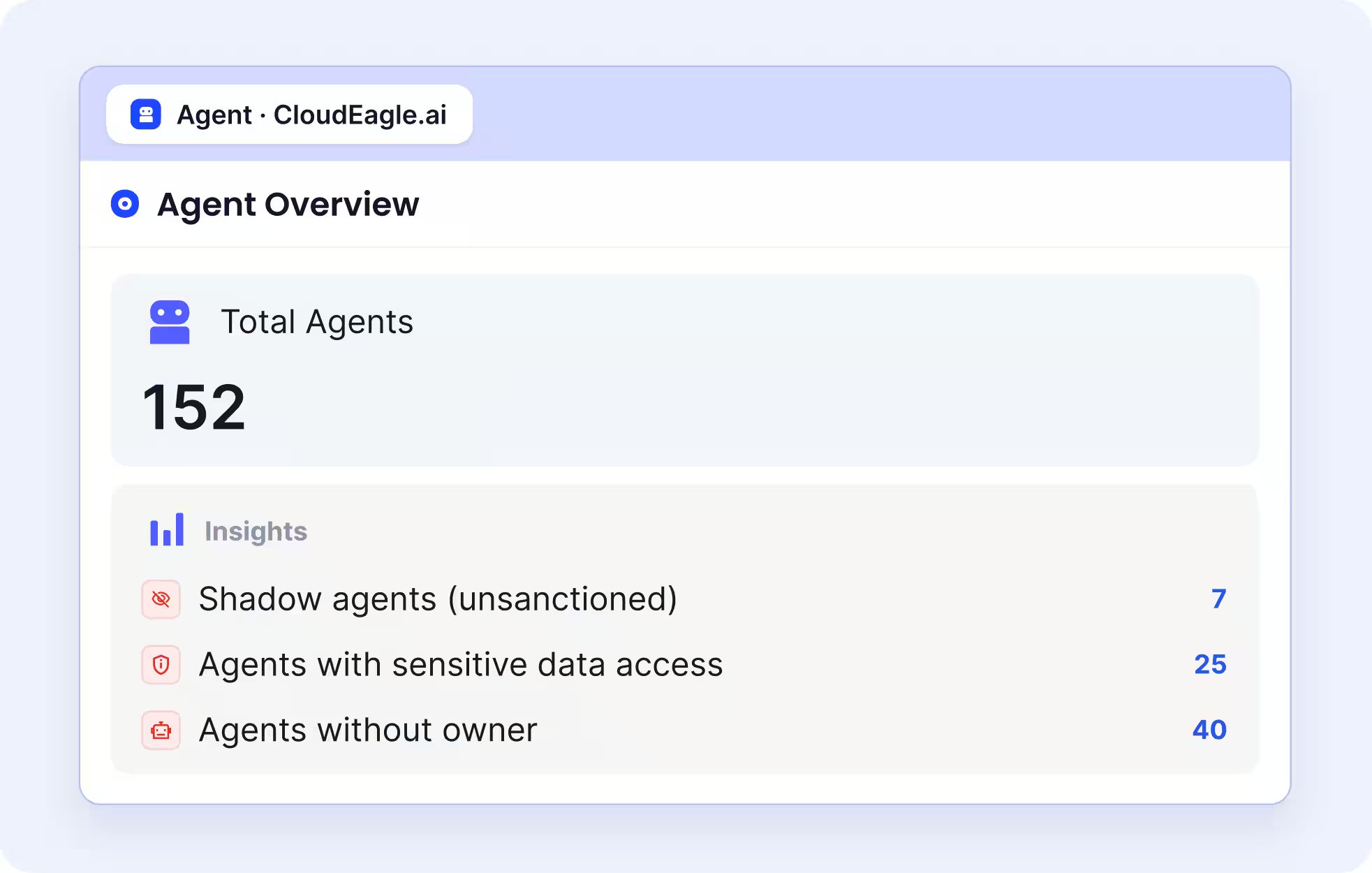
CloudEagle.ai reads non-human identities (NHIs) directly from the sources where agents get their access:
- Microsoft Entra ID and Okta: service principals, app registrations, and tokens, so agents appear whether or not anyone registered them.
- Connected apps: agents and integrations created inside the apps you already run, through 500+ direct integrations.
- One inventory: each agent shown with its status, credentials, and owner.
Assign an Owner or Retire the Agent
Every shadow agent you find gets one of two outcomes: a named owner, or retirement. "The data team" is not an owner. A name is.
Ask one question: if this agent sends the wrong data to the wrong person tomorrow, who gets the call? If you can't name that person, the agent has no owner.
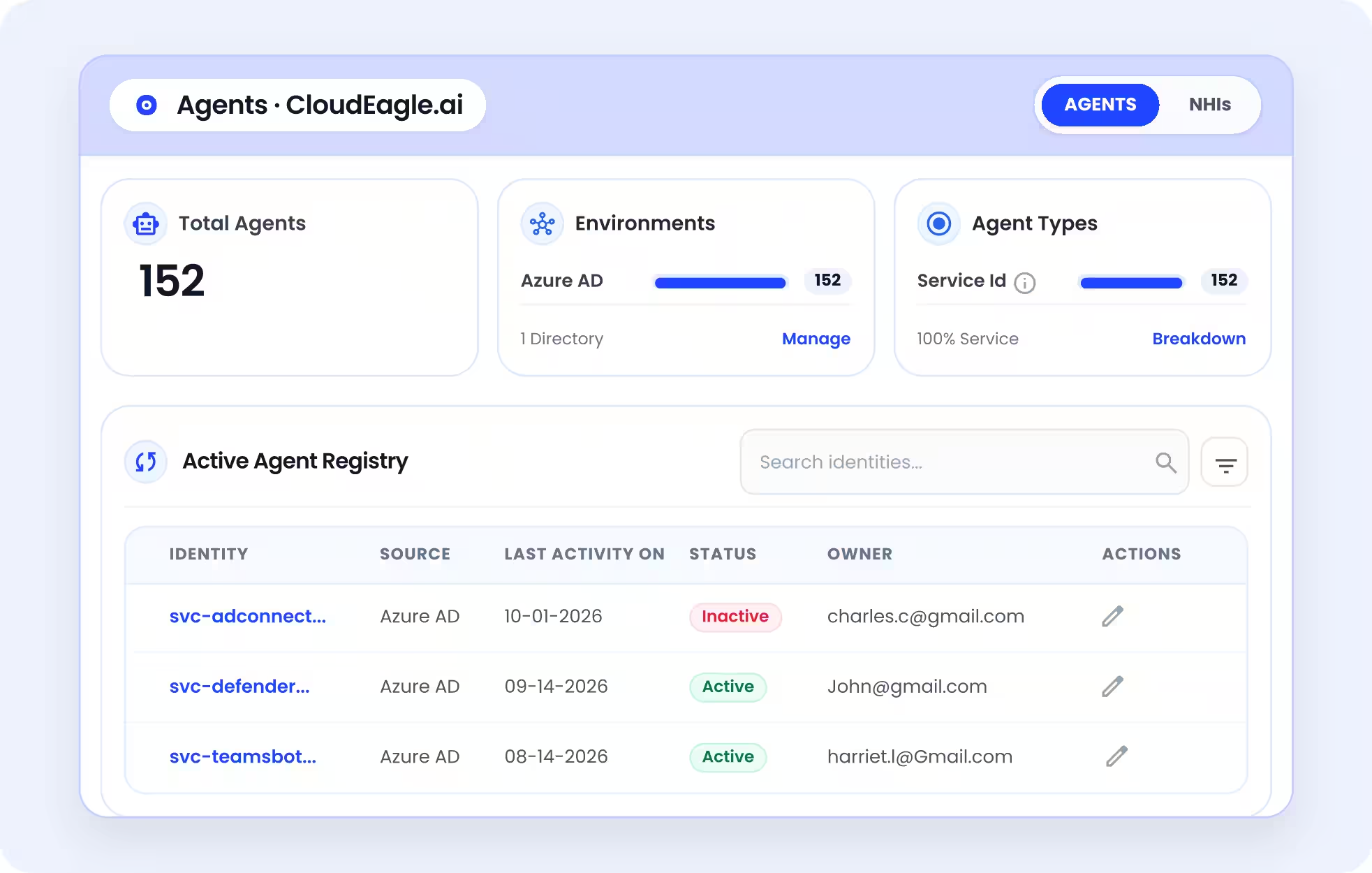
CloudEagle.ai puts ownership into the inventory itself:
- Ownerless agents flagged: agents with no owner, admin permissions, or 90+ days of inactivity rise to the top of the list.
- Orphaned accounts and active API tokens surfaced: agents still holding access after their builder has left.
- A clear decision per agent: assign an owner, reassign it, or retire it.
Right-Size Permissions to the Agent's Actual Job
Shadow agents usually inherit their builder's access. List every role and data source each agent holds, then remove anything its job doesn't need.
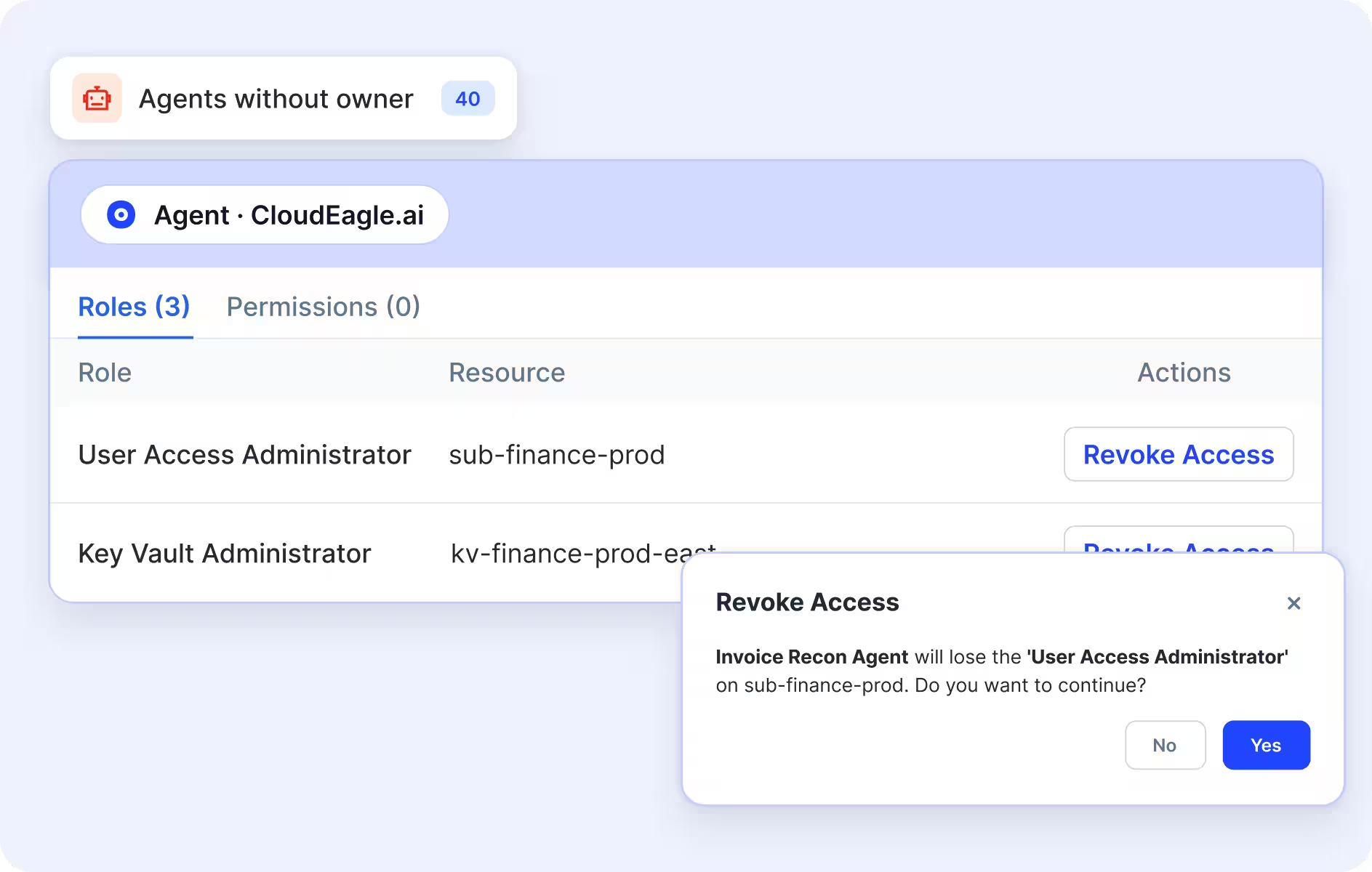
CloudEagle.ai helps you move each agent toward least privilege:
- Full access view: every app and data source an agent connects to, down to the role it holds.
- Unused access exposed: roles the agent has never used can be revoked.
- Role-based provisioning: new agents start with only what their job requires.
Monitor What Agents Do, Not Just Where They Exist
An inventory tells you an agent exists. A useful activity log answers four questions for every action: what the agent read or changed, in which system, when, and under whose credentials.
If you can't answer those, you can't investigate an incident. A list of agents is not evidence of control. Logs are.
CloudEagle.ai keeps the record auditors ask for:
- Activity logs: what each agent did, changed, and touched, traced back to its owner.
- Audit-ready logs: every admin action on an agent is recorded for audit and GRC review.
- Defensible AI governance: evidence you can hand over, not a dashboard screenshot.
Keep a Kill Switch Within Reach
You need one place to revoke an agent's roles, rotate its secrets, or deactivate its identity.
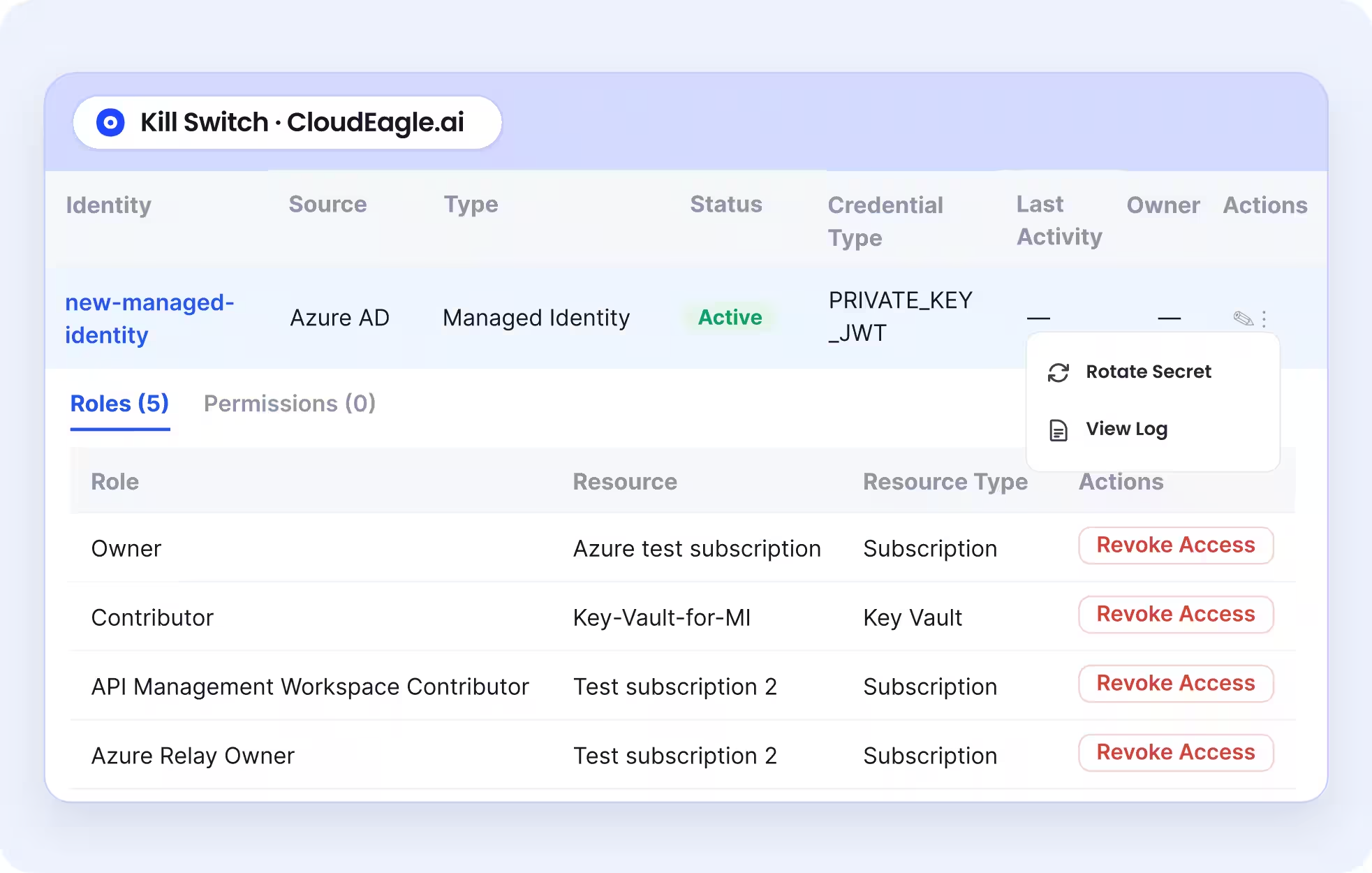
Check its owner and access first, because disabling the wrong identity can break a business process. CloudEagle.ai shows that context before an admin acts:
- One view: the agent, its owner, its access, and what it touches.
- Admin-run actions: revoke a role or deactivate the identity from the same screen.
- Secret rotation: available where the underlying platform supports it.
- Every action logged: nothing happens off the record.
Govern the Identity Behind Every Agent


Find Every Shadow Agent With CloudEagle.ai
Shadow agents are shadow AI that acts. They hold credentials, chain actions, and outlive their builders, so finding shadow AI agents starts with identity, not traffic.
CloudEagle.ai is the control plane for enterprise AI. With 500+ direct integrations, we read agent identities from Entra ID, Okta, and your connected apps, tie each agent to an owner, and let your admins revoke, rotate, or deactivate it from one view. NHI management governs agents alongside your people, service accounts, and SaaS access. See it in action in our agent governance walkthrough.
Govern Every SaaS and AI Identity. Don't let a shadow agent find your gaps first. Watch this webinar or book a demo.
Frequently Asked Questions
- Are Shadow Agents Always Malicious?
No. Most are built by employees trying to work faster. The risk from shadow agents comes from what they can reach with no owner and no review, not from intent.
- How Are Shadow Agents Different From Shadow IT?
Shadow IT is unapproved software that people use. Shadow agents are unapproved AI that acts on its own, with standing credentials, across several systems. Shadow IT exposes data. Shadow agents can change it.
- Can SSO or CASB Tools Detect Shadow Agents?
Not reliably. Agents use tokens and API connections that skip SSO, and their calls to approved apps look like normal traffic to a CASB. Finding shadow AI agents takes identity-based discovery.
- Should You Block Shadow Agents or Govern Them?
Govern most of them. Blocking pushes builders toward channels you can't see. Assign owners, cut access to the job, and retire what nobody will own. Block only the agents that touch data they never should.
- Do Shadow Agents Fall Under the EU AI Act?
They can. The Act doesn't care whether IT approved an agent. Transparency duties apply from August 2, 2026, and a shadow agent used in a high-risk area, such as hiring, faces high-risk rules from December 2, 2027.
Govern the Identity Behind Every Agent