AI Tools

Claude Code vs Cursor: Which Is Easier to Govern? 

Share via:
Written by:
CloudEagle.ai Team
Reviewed by
Nidhi Jain
Last Updated:
September 3, 2026
blog-cms-banner-bg
Little-Known Negotiation Hacks to Get the Best Deal on Slack
cta-bg-blogDownload Your Copy

HIPAA Compliance Checklist for 2025

Download PDF

TL;DR

  • Cursor has the deeper native admin console: SSO, SCIM, RBAC, audit logs, and MCP and model allowlisting all built into one place
  • Claude Code has the simpler data story: everything routes to Anthropic only, while Cursor's multi-model routing can send code to three different LLM vendors depending on settings
  • Claude Code has more shadow provisioning paths: enterprise seat, personal account, and Bedrock or Vertex deployment, each invisible to the others
  • Claude Code's Compliance and Analytics APIs give deeper programmatic audit access than Cursor's native logging
  • Neither tool's own console shows IT or Finance a combined, chargeback-ready view of both tools side by side
  • CloudEagle's AI governance module closes that gap by correlating identity, spend, and MCP servers across both tools from one place

Claude Code vs Cursor governance is not a question with one winner.

Most IT teams already know both tools do good work. What is unresolved is which one is actually easier to see, control, and audit once it is live across an engineering org.

The honest answer depends on which kind of governance you mean: console-native or cross-tool. And most IT teams end up needing both.

1. What Does "Easier to Govern" Actually Mean for These Two Tools?

"Easier to govern" collapses two different questions into one.

The first question: How much control does the vendor's own console give you?

The second question: How much can your existing IT stack see without relying on that console?

Claude Code and Cursor split those two questions in opposite directions. That is why most head-to-head comparisons pick a winner that only holds for one definition.

The six-axis comparison below keeps those two questions separate, because collapsing them is where most evaluations go wrong.

2. How Do Claude Code and Cursor Differ on Governance, Axis by Axis?

Native Admin Console Depth

Verdict: Cursor is easier here.

Cursor ships its own admin console with:

  • SSO and SCIM provisioning
  • Role-based access controls
  • Privacy mode for sensitive codebases
  • Native allowlisting for repos, models, and MCP servers

Claude Code has no separate console of its own. A developer running it is authenticated against, and governed by, the Claude Enterprise org's settings. That is a meaningful difference for IT teams who want a single pane of glass inside the vendor's own product.

Data Routing and Vendor Exposure

Verdict: Claude Code is easier here.

Every Claude Code session routes to Anthropic only. One vendor. One data agreement. One security review.

Cursor supports multi-model routing. Depending on which model a developer selects, code can be sent to OpenAI, Anthropic, or Google. That multiplies the number of vendor data agreements a security review has to cover.

For organizations with strict data residency or vendor approval requirements, Claude Code's single-vendor architecture is a meaningful simplification.

MCP Server Governance

Verdict: Roughly tied.

Cursor allowlists MCP servers natively per project. Claude Code manages them through permission configuration rather than a dedicated console.

Both approaches share the same underlying problem: neither vendor's own console answers the governance question that actually matters.

  • Who owns this MCP server?
  • What data can it reach?
  • When was it last reviewed?

Those questions live outside both consoles. Governing MCP servers requires a layer that sits above either tool's native controls.

Provisioning Path Sprawl

Verdict: Cursor is easier here.

Cursor is a single SaaS application, typically SSO-gated like any other app in the stack. IT provisions it once. One provisioning path.

Claude Code can enter through three separate doors:

  • An enterprise seat purchased through Anthropic's sales process
  • A personal account authenticated via CLI credentials
  • A cloud-platform deployment like AWS Bedrock or Google Vertex, with its own billing

Each of these is invisible to the others. Customers connecting both Claude and Cursor to CloudEagle routinely discover multiple Claude Code instances running simultaneously, where only one went through IT.

Audit and Compliance Evidence Depth

Verdict: Claude Code is easier here.

Claude Code's Compliance API and Analytics API give security teams programmatic, exportable usage data. That matters for regulated industries where audit evidence needs to be pulled, reviewed, and produced on demand.

Third-party enterprise reviewers have noted that Cursor's documentation is less specific on audit logging for compliance-heavy reviews.

Worth flagging: this reflects third-party published assessments, not CloudEagle's own testing. Verify against each vendor's current documentation before treating it as a final verdict for your own review.

Spend and License Visibility From Outside the Tool

Governance Axis Cursor Claude Code Verdict
Native Admin Console Depth Dedicated admin console with SSO, SCIM, RBAC, privacy mode, and native allowlisting for repos, models, and MCP servers. No separate admin console; governed through Claude Enterprise organization settings. Cursor
Data Routing and Vendor Exposure Supports multiple model providers, including OpenAI, Anthropic, and Google, increasing the number of vendor relationships to review. Sessions route to Anthropic, providing a simpler single-vendor data and security model. Claude Code
MCP Server Governance Native MCP server allowlisting per project. MCP servers managed through permission configuration rather than a dedicated console. Roughly tied
Provisioning Path Sprawl Typically deployed as a single SaaS application with one primary SSO provisioning path. Can enter through enterprise seats, personal CLI accounts, or cloud deployments such as AWS Bedrock and Google Vertex. Cursor
Audit and Compliance Evidence Depth Less specific published documentation around audit logging for compliance-heavy reviews. Compliance and Analytics APIs provide programmatic, exportable usage data. Claude Code
Spend and License Visibility From Inside the Tool Does not provide a combined, chargeback-ready view across Cursor and other AI tools. Does not provide a combined, chargeback-ready view across Claude Code and other AI tools. Tied

Customers connecting both Claude and Cursor to CloudEagle for unified spend reporting describe this as the first thing they solve: not which tool to use, but how to see both in the same place. The cost-tracking ground is covered in detail in a separate post, so this piece will not re-litigate it.

👉 How Enterprises Can Track Claude, Cursor, and Gemini Spend in One Place

3. Why Neither Tool Is Actually Easier to Govern From the Outside

Here is the summary of the six axes:

Axis Easier Tool
Native admin console depth Cursor
Data routing and vendor exposure Claude Code
MCP server governance Tied
Provisioning path sprawl Cursor
Audit and compliance evidence Claude Code
Spend and license visibility Tied

Three axes favor Cursor. Two favor Claude Code. Two are tied.

That split is the finding.

Whichever tool you pick, half of your governance surface still lives outside its own console. Console-native governance and cross-tool governance are different jobs. No vendor does both. That is not a criticism of either product. It is the architectural reality that applies to every AI coding tool, not just these two.

📖 Worth a Read 👉 Claude Code Security Risks IT Teams Should Know in 2026

4. How Should IT Teams Govern AI Coding Assistants Like Claude Code and Cursor?

Correlate Identity and Spend Across Both Tools

The governance gap that exists outside both consoles requires a layer that sits above them.

For identity, that means SSO and SCIM sync that surfaces which seats are provisioned for each tool, cross-referenced against actual usage signals.
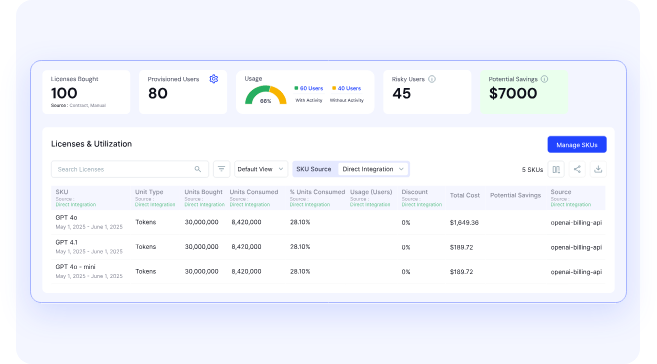
For spend, that means finance-system correlation that covers:

  • Enterprise seat billing for both Cursor and Claude Code
  • AWS Bedrock and GCP Vertex charges for Claude Code deployed through cloud platforms
  • Personal account usage that never touched either vendor's enterprise billing

CloudEagle's AI governance module correlates all three into a single inventory, giving IT and Finance the chargeback-ready view that neither vendor's console provides.

Bring Every MCP Server Under One Review Process

An MCP server that was created in Cursor is still an MCP server that needs governance. An MCP server created in Claude Code is still an MCP server that needs governance.

Which tool created it is less important than:

  • Who owns it?
  • What can it reach?
  • When was it last reviewed?

CloudEagle's MCP server governance capability tracks ownership, permissions, and connected workflows centrally. The review process does not depend on which tool's console happens to log the server. Both tools' MCP servers sit under the same governance layer.

Set the Boundary Honestly

One scope limit deserves an explicit statement.

CloudEagle.ai covers identity, spend, and MCP visibility across both tools. It does not replace either vendor's own in-session controls.

These remain owned inside each tool's native settings:

  • Sandboxing and permission configuration
  • Prompt-level content review
  • Model behavior and output controls
  • Network policy for tool access

Both layers matter. Neither substitutes for the other. A governance platform that tells you who is using which tool and what it costs does not replace the vendor-side controls that determine what the tool can do inside a session.

For a broader view of how teams are approaching shadow AI and hidden access across their full AI footprint, this webinar covers exactly the visibility gap that applies to AI coding tools:

🎙️ Webinar 60% Invisible: Shadow AI and Hidden Access Crisis in SaaS and AI Environments. 👉 Watch now

Get Started

Claude Code vs Cursor governance is not a one-time decision. Both tools are already live in most engineering organizations, often through provisioning paths IT did not initiate.

CloudEagle's AI governance module gives you identity, spend, and MCP visibility across both tools in one place, the combined view neither vendor's own console provides.

Book a demo with CloudEagle.ai to see what your Claude Code and Cursor footprint actually looks like from outside both consoles.

Frequently Asked Questions

1. Can Cursor and Claude Code be used together safely?

Yes. Many engineering teams use both for different task types. The key governance question is whether both are visible through the same identity, usage, spend, and security controls rather than managed separately through each vendor's console.

2. Which tool is better for regulated industries?

Claude Code has an advantage for audit-heavy environments through its Compliance and Analytics APIs. This is most useful when teams need programmatic access to usage and compliance data for recurring reviews and audit evidence.

3. Does standardizing on one tool simplify governance?

It simplifies vendor management, but not governance. Teams still need visibility into users, provisioning paths, spend, permissions, and connected MCP servers whether they use one coding assistant or several.

4. Which is easier to govern across enterprise environments?

The easier tool to govern is the one that provides clear identity, usage, permissions, and audit data across every deployment path. Vendor-native controls help, but enterprises still need centralized visibility when developers use personal accounts, cloud deployments, or multiple coding assistants.

5. What should enterprises review before approving Cursor or Claude Code?

Review how each tool handles identity, permissions, MCP connections, data access, usage monitoring, and audit logging. Also determine whether the organization can detect personal accounts and unmanaged cloud deployments before approving widespread use.

Advertisement for a SaaS Subscription Tracking Template with a call-to-action button to download and a partial graphic of a tablet showing charts.Banner promoting a SaaS Agreement Checklist to streamline SaaS management and avoid budget waste with a call-to-action button labeled Download checklist.Blue banner with text 'The Ultimate Employee Offboarding Checklist!' and a black button labeled 'Download checklist' alongside partial views of checklist documents from cloudeagle.ai.Digital ad for download checklist titled 'The Ultimate Checklist for IT Leaders to Optimize SaaS Operations' by cloudeagle.ai, showing checklist pages.Slack Buyer's Guide offer with text 'Unlock insider insights to get the best deal on Slack!' and a button labeled 'Get Your Copy', accompanied by a preview of the guide featuring Slack's logo.Monday Pricing Guide by cloudeagle.ai offering exclusive pricing secrets to maximize investment with a call-to-action button labeled Get Your Copy and an image of the guide's cover.Blue banner for Canva Pricing Guide by cloudeagle.ai offering a guide to Canva costs, features, and alternatives with a call-to-action button saying Get Your Copy.Blue banner with white text reading 'Little-Known Negotiation Hacks to Get the Best Deal on Slack' and a white button labeled 'Get Your Copy'.Blue banner with text 'Little-Known Negotiation Hacks to Get the Best Deal on Monday.com' and a white button labeled 'Get Your Copy'.Blue banner with text 'Little-Known Negotiation Hacks to Get the Best Deal on Canva' and a white button labeled 'Get Your Copy'.Banner with text 'Slack Buyer's Guide' and a 'Download Now' button next to images of a guide titled 'Slack Buyer’s Guide: Features, Pricing & Best Practices'.Digital cover of Monday Pricing Guide with a button labeled Get Your Copy on a blue background.Canva Pricing Guide cover with a button labeled Get Your Copy on a blue gradient background.

Enter your email to
unlock the report

Oops! Something went wrong while submitting the form.
License Count
Benchmark
Per User/Per Year

Enter your email to
unlock the report

Oops! Something went wrong while submitting the form.
License Count
Benchmark
Per User/Per Year

Enter your email to
unlock the report

Oops! Something went wrong while submitting the form.
Notion Plus
License Count
Benchmark
Per User/Per Year
100-500
$67.20 - $78.72
500-1000
$59.52 - $72.00
1000+
$51.84 - $57.60
Canva Pro
License Count
Benchmark
Per User/Per Year
100-500
$74.33-$88.71
500-1000
$64.74-$80.32
1000+
$55.14-$62.34

Enter your email to
unlock the report

Oops! Something went wrong while submitting the form.

Enter your email to
unlock the report

Oops! Something went wrong while submitting the form.
Zoom Business
License Count
Benchmark
Per User/Per Year
100-500
$216.00 - $264.00
500-1000
$180.00 - $216.00
1000+
$156.00 - $180.00

Enter your email to
unlock the report

Oops! Something went wrong while submitting the form.

Get the Right Security Platform To Secure Your Cloud Infrastructure

Please enter a business email
Thank you!
The 2023 SaaS report has been sent to your email. Check your promotional or spam folder.
Oops! Something went wrong while submitting the form.

Access full report

Please enter a business email
Thank you!
The 2023 SaaS report has been sent to your email. Check your promotional or spam folder.
Oops! Something went wrong while submitting the form.

TL;DR

  • Cursor has the deeper native admin console: SSO, SCIM, RBAC, audit logs, and MCP and model allowlisting all built into one place
  • Claude Code has the simpler data story: everything routes to Anthropic only, while Cursor's multi-model routing can send code to three different LLM vendors depending on settings
  • Claude Code has more shadow provisioning paths: enterprise seat, personal account, and Bedrock or Vertex deployment, each invisible to the others
  • Claude Code's Compliance and Analytics APIs give deeper programmatic audit access than Cursor's native logging
  • Neither tool's own console shows IT or Finance a combined, chargeback-ready view of both tools side by side
  • CloudEagle's AI governance module closes that gap by correlating identity, spend, and MCP servers across both tools from one place

Claude Code vs Cursor governance is not a question with one winner.

Most IT teams already know both tools do good work. What is unresolved is which one is actually easier to see, control, and audit once it is live across an engineering org.

The honest answer depends on which kind of governance you mean: console-native or cross-tool. And most IT teams end up needing both.

1. What Does "Easier to Govern" Actually Mean for These Two Tools?

"Easier to govern" collapses two different questions into one.

The first question: How much control does the vendor's own console give you?

The second question: How much can your existing IT stack see without relying on that console?

Claude Code and Cursor split those two questions in opposite directions. That is why most head-to-head comparisons pick a winner that only holds for one definition.

The six-axis comparison below keeps those two questions separate, because collapsing them is where most evaluations go wrong.

2. How Do Claude Code and Cursor Differ on Governance, Axis by Axis?

Native Admin Console Depth

Verdict: Cursor is easier here.

Cursor ships its own admin console with:

  • SSO and SCIM provisioning
  • Role-based access controls
  • Privacy mode for sensitive codebases
  • Native allowlisting for repos, models, and MCP servers

Claude Code has no separate console of its own. A developer running it is authenticated against, and governed by, the Claude Enterprise org's settings. That is a meaningful difference for IT teams who want a single pane of glass inside the vendor's own product.

Data Routing and Vendor Exposure

Verdict: Claude Code is easier here.

Every Claude Code session routes to Anthropic only. One vendor. One data agreement. One security review.

Cursor supports multi-model routing. Depending on which model a developer selects, code can be sent to OpenAI, Anthropic, or Google. That multiplies the number of vendor data agreements a security review has to cover.

For organizations with strict data residency or vendor approval requirements, Claude Code's single-vendor architecture is a meaningful simplification.

MCP Server Governance

Verdict: Roughly tied.

Cursor allowlists MCP servers natively per project. Claude Code manages them through permission configuration rather than a dedicated console.

Both approaches share the same underlying problem: neither vendor's own console answers the governance question that actually matters.

  • Who owns this MCP server?
  • What data can it reach?
  • When was it last reviewed?

Those questions live outside both consoles. Governing MCP servers requires a layer that sits above either tool's native controls.

Provisioning Path Sprawl

Verdict: Cursor is easier here.

Cursor is a single SaaS application, typically SSO-gated like any other app in the stack. IT provisions it once. One provisioning path.

Claude Code can enter through three separate doors:

  • An enterprise seat purchased through Anthropic's sales process
  • A personal account authenticated via CLI credentials
  • A cloud-platform deployment like AWS Bedrock or Google Vertex, with its own billing

Each of these is invisible to the others. Customers connecting both Claude and Cursor to CloudEagle routinely discover multiple Claude Code instances running simultaneously, where only one went through IT.

Audit and Compliance Evidence Depth

Verdict: Claude Code is easier here.

Claude Code's Compliance API and Analytics API give security teams programmatic, exportable usage data. That matters for regulated industries where audit evidence needs to be pulled, reviewed, and produced on demand.

Third-party enterprise reviewers have noted that Cursor's documentation is less specific on audit logging for compliance-heavy reviews.

Worth flagging: this reflects third-party published assessments, not CloudEagle's own testing. Verify against each vendor's current documentation before treating it as a final verdict for your own review.

Spend and License Visibility From Outside the Tool

Governance Axis Cursor Claude Code Verdict
Native Admin Console Depth Dedicated admin console with SSO, SCIM, RBAC, privacy mode, and native allowlisting for repos, models, and MCP servers. No separate admin console; governed through Claude Enterprise organization settings. Cursor
Data Routing and Vendor Exposure Supports multiple model providers, including OpenAI, Anthropic, and Google, increasing the number of vendor relationships to review. Sessions route to Anthropic, providing a simpler single-vendor data and security model. Claude Code
MCP Server Governance Native MCP server allowlisting per project. MCP servers managed through permission configuration rather than a dedicated console. Roughly tied
Provisioning Path Sprawl Typically deployed as a single SaaS application with one primary SSO provisioning path. Can enter through enterprise seats, personal CLI accounts, or cloud deployments such as AWS Bedrock and Google Vertex. Cursor
Audit and Compliance Evidence Depth Less specific published documentation around audit logging for compliance-heavy reviews. Compliance and Analytics APIs provide programmatic, exportable usage data. Claude Code
Spend and License Visibility From Inside the Tool Does not provide a combined, chargeback-ready view across Cursor and other AI tools. Does not provide a combined, chargeback-ready view across Claude Code and other AI tools. Tied

Customers connecting both Claude and Cursor to CloudEagle for unified spend reporting describe this as the first thing they solve: not which tool to use, but how to see both in the same place. The cost-tracking ground is covered in detail in a separate post, so this piece will not re-litigate it.

👉 How Enterprises Can Track Claude, Cursor, and Gemini Spend in One Place

3. Why Neither Tool Is Actually Easier to Govern From the Outside

Here is the summary of the six axes:

Axis Easier Tool
Native admin console depth Cursor
Data routing and vendor exposure Claude Code
MCP server governance Tied
Provisioning path sprawl Cursor
Audit and compliance evidence Claude Code
Spend and license visibility Tied

Three axes favor Cursor. Two favor Claude Code. Two are tied.

That split is the finding.

Whichever tool you pick, half of your governance surface still lives outside its own console. Console-native governance and cross-tool governance are different jobs. No vendor does both. That is not a criticism of either product. It is the architectural reality that applies to every AI coding tool, not just these two.

📖 Worth a Read 👉 Claude Code Security Risks IT Teams Should Know in 2026

4. How Should IT Teams Govern AI Coding Assistants Like Claude Code and Cursor?

Correlate Identity and Spend Across Both Tools

The governance gap that exists outside both consoles requires a layer that sits above them.

For identity, that means SSO and SCIM sync that surfaces which seats are provisioned for each tool, cross-referenced against actual usage signals.

For spend, that means finance-system correlation that covers:

  • Enterprise seat billing for both Cursor and Claude Code
  • AWS Bedrock and GCP Vertex charges for Claude Code deployed through cloud platforms
  • Personal account usage that never touched either vendor's enterprise billing

CloudEagle's AI governance module correlates all three into a single inventory, giving IT and Finance the chargeback-ready view that neither vendor's console provides.

Bring Every MCP Server Under One Review Process

An MCP server that was created in Cursor is still an MCP server that needs governance. An MCP server created in Claude Code is still an MCP server that needs governance.

Which tool created it is less important than:

  • Who owns it?
  • What can it reach?
  • When was it last reviewed?

CloudEagle's MCP server governance capability tracks ownership, permissions, and connected workflows centrally. The review process does not depend on which tool's console happens to log the server. Both tools' MCP servers sit under the same governance layer.

Set the Boundary Honestly

One scope limit deserves an explicit statement.

CloudEagle.ai covers identity, spend, and MCP visibility across both tools. It does not replace either vendor's own in-session controls.

These remain owned inside each tool's native settings:

  • Sandboxing and permission configuration
  • Prompt-level content review
  • Model behavior and output controls
  • Network policy for tool access

Both layers matter. Neither substitutes for the other. A governance platform that tells you who is using which tool and what it costs does not replace the vendor-side controls that determine what the tool can do inside a session.

For a broader view of how teams are approaching shadow AI and hidden access across their full AI footprint, this webinar covers exactly the visibility gap that applies to AI coding tools:

🎙️ Webinar 60% Invisible: Shadow AI and Hidden Access Crisis in SaaS and AI Environments. 👉 Watch now

Get Started

Claude Code vs Cursor governance is not a one-time decision. Both tools are already live in most engineering organizations, often through provisioning paths IT did not initiate.

CloudEagle's AI governance module gives you identity, spend, and MCP visibility across both tools in one place, the combined view neither vendor's own console provides.

Book a demo with CloudEagle.ai to see what your Claude Code and Cursor footprint actually looks like from outside both consoles.

Frequently Asked Questions

1. Can Cursor and Claude Code be used together safely?

Yes. Many engineering teams use both for different task types. The key governance question is whether both are visible through the same identity, usage, spend, and security controls rather than managed separately through each vendor's console.

2. Which tool is better for regulated industries?

Claude Code has an advantage for audit-heavy environments through its Compliance and Analytics APIs. This is most useful when teams need programmatic access to usage and compliance data for recurring reviews and audit evidence.

3. Does standardizing on one tool simplify governance?

It simplifies vendor management, but not governance. Teams still need visibility into users, provisioning paths, spend, permissions, and connected MCP servers whether they use one coding assistant or several.

4. Which is easier to govern across enterprise environments?

The easier tool to govern is the one that provides clear identity, usage, permissions, and audit data across every deployment path. Vendor-native controls help, but enterprises still need centralized visibility when developers use personal accounts, cloud deployments, or multiple coding assistants.

5. What should enterprises review before approving Cursor or Claude Code?

Review how each tool handles identity, permissions, MCP connections, data access, usage monitoring, and audit logging. Also determine whether the organization can detect personal accounts and unmanaged cloud deployments before approving widespread use.

CloudEagle.ai recognized in the 2025 Gartner® Magic Quadrant™ for SaaS Management Platforms
Download now
gartner chart
5x
Faster employee
onboarding
80%
Reduction in time for
user access reviews
30k
Workflows
automated
$15Bn
Analyzed in
contract spend
$2Bn
Saved in
SaaS spend

Streamline SaaS governance and save 10-30%

Book a Demo with Expert
CTA image