You need to enable JavaScript in order to use the AI chatbot tool powered by ChatBot

How to Mitigate SaaS compliance risks?

Share via:
blog-cms-banner-bg
Little-Known Negotiation Hacks to Get the Best Deal on Slack
cta-bg-blogDownload Your Copy

HIPAA Compliance Checklist for 2025

Download PDF

Managing SaaS compliance risks is one of the biggest challenges IT and security teams face today. As organizations adopt more cloud applications, the complexity of maintaining compliance across hundreds of tools continues to grow exponentially.

According to Gartner, global SaaS spending is expected to exceed $195 billion in 2023. With that massive adoption comes equally massive SaaS compliance challenges that require immediate attention and structured approaches to SaaS governance.

Whether you're dealing with GDPR, SOC 2, HIPAA, or industry-specific regulations, understanding SaaS compliance risks and implementing effective risk management strategies is critical for protecting your organization from regulatory penalties and data breaches.

TL;DR

  • Shadow IT creates blind spots exposing organizations to unauthorized data sharing and regulatory violations through unapproved applications
  • Data residency issues arise when SaaS vendors store information in regions conflicting with compliance and sovereignty requirements
  • Third-party vulnerabilities mean your security posture is only as strong as your weakest vendor integration point
  • Access control sprawl happens when employees retain permissions long after needed, creating security and audit nightmares
  • Fragmented governance leaves compliance monitoring scattered across departments with no centralized oversight or accountability

Risk 1 : How Does Shadow IT Create Compliance Vulnerabilities?

Shadow IT happens when employees adopt SaaS applications without official approval. Your marketing team signs up for a social media scheduling tool, your sales team tries a new prospecting platform, or engineers experiment with development tools, all storing company data outside IT's visibility.

A Cisco study revealed organizations use 10 times more cloud services than IT departments know about. Most IT teams believe they manage 30-40 applications when the actual number exceeds 300-400.

Shadow IT compliance challenges include:

  • Unknown data flows you can't protect or monitor
  • Unvetted security practices creating vulnerability gaps
  • Audit failures when examiners discover undocumented applications
  • Regulatory violations from storing sensitive data in non-compliant systems
  • Lack of vendor management oversight and contract controls

This creates massive SaaS governance risks because you can't enforce compliance policies on applications you don't know exist.

Risk 2: Data Residency and Sovereignty Risk

Where your data physically resides matters significantly for SaaS data compliance. If you're subject to GDPR and your vendor stores EU customer data on US servers without proper safeguards, you've violated regulations.

Many SaaS vendors operate multi-tenant environments where customer data shares infrastructure. They might replicate information across regions for redundancy without explicit consent or notification to clients.

Critical data residency concerns:

  • Cross-border transfers triggering different regulatory requirements
  • Vendor transparency gaps about storage and processing locations
  • Dynamic infrastructure shifting workloads between data centers
  • Conflicting regulations between jurisdictions
  • Data sovereignty requirements varying by industry and region

According to IDC research, 80% of organizations will face penalties for non-compliance with data sovereignty regulations by 2024 without proper data governance controls.

Risk 3. Third-Party and Integration Risk

Your SaaS applications operate within complex ecosystems. They integrate with other tools, connect to APIs, and share data across your entire tech stack. Each integration point represents a potential SaaS governance risk.

Consider this: Your CRM integrates with an email platform, which connects to a data enrichment service, which pulls from public databases. That's four vendors touching customer data, all requiring compliance verification.

Third-party compliance risks include:

  • Shared responsibility confusion when data breaches occur during transfers
  • Integration vulnerabilities through APIs and webhooks
  • Vendor risk extending through supply chains
  • Outdated security certifications needing continuous verification
  • Lack of standardized security assessments across vendors

Maintaining a comprehensive vendor registry with current compliance documentation helps manage these interconnected risks effectively.

Risk 4. Access Control Sprawl

Employee turnover creates access control nightmares. When someone leaves, their SaaS access often remains active. That former employee from six months ago might still access your project management tool, shared drives, and customer databases.

Research from Varonis shows 58% of companies have over 500 employees with inappropriate access to sensitive files. That's not just security risk, it's a compliance violation waiting to surface during audits.

Access control challenges:

  • Orphaned accounts remaining active after employee departures
  • Excessive permissions beyond role requirements
  • No systematic access reviews or recertification processes
  • Shared credentials preventing individual accountability tracking
  • Missing automated offboarding workflows to revoke access

Implementing proper identity management and access governance prevents these issues from escalating into major compliance violations.

Risk 5. Fragmented Governance and Ownership Gaps

Most organizations manage SaaS risk management reactively across silos. IT handles security, finance tracks spending, departments approve tools independently. Nobody maintains complete visibility into the entire SaaS portfolio.

This fragmented approach creates dangerous blind spots:

  • No single source of truth for approved applications
  • Inconsistent vetting processes across departments
  • Duplicate tools wasting budget on similar capabilities
  • Compliance gaps as requirements fall between departments
  • Audit chaos when documentation is scattered

A Deloitte survey found 68% of executives believe their organizations face more compliance risk today than five years ago, primarily from cloud services complexity.

Establishing centralized SaaS management with cross-functional oversight addresses these governance challenges systematically.

Risk 6. Audit Readiness Risk

When auditors request documentation about your SaaS environment, can you provide it immediately? Most organizations scramble to compile information about applications, vendors, data flows, and access controls because they lack centralized documentation.

Audit readiness challenges include:

  • Missing vendor contracts and data processing agreements
  • Incomplete security questionnaires and compliance certifications
  • No documented approval workflows or risk assessments
  • Scattered evidence across departments and systems
  • Inability to demonstrate continuous monitoring and controls

Without proper audit preparation, organizations face extended audit timelines, qualification letters, and potential compliance failures that damage reputation and customer trust.

Risk 7. Data Leakage and Misconfiguration Risk

SaaS applications offer powerful sharing and collaboration features, but these same capabilities create data leakage risks. Employees accidentally share sensitive files publicly, misconfigure permissions, or sync data to personal devices.

Common data leakage scenarios:

  • Public link sharing for documents containing sensitive information
  • Overly permissive default sharing settings in collaboration tools
  • Data synchronization to unmanaged personal devices
  • Lack of data classification preventing appropriate handling
  • Missing data loss prevention controls in cloud applications

These misconfigurations often go undetected until a breach occurs, making proactive monitoring and controls essential for SaaS security compliance.

How to Mitigate SaaS Compliance Risks

a. Improve SaaS Visibility
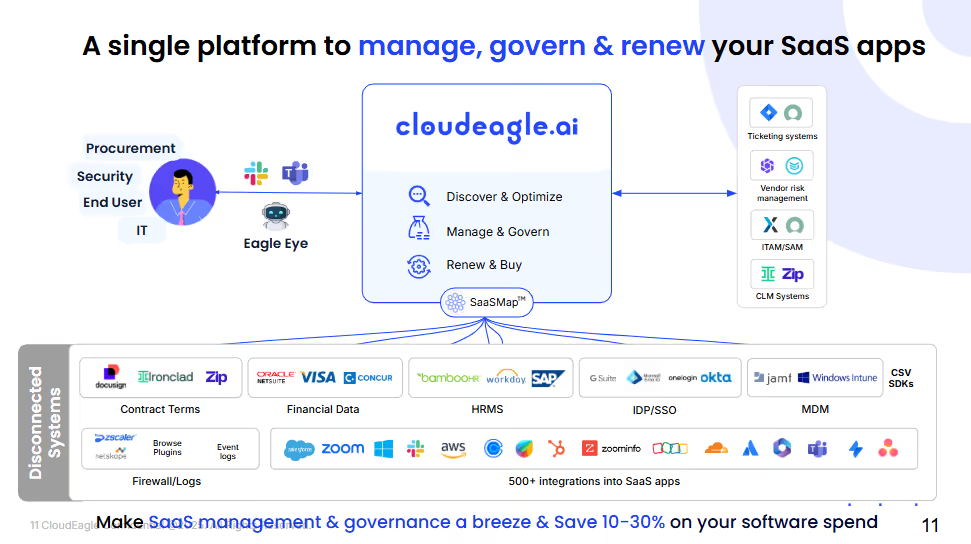
You can't manage SaaS compliance risks you can't see. CloudEagle's automated SaaS discovery continuously scans your environment by analyzing SSO logs, browser extensions, expense reports, and network traffic to surface every application in use including unauthorized ones. 

Instead of relying on manual surveys or guesswork, you get a real-time, comprehensive inventory with compliance status for each tool, giving your team the visibility needed to make informed decisions fast.

b. Visibility strategies:
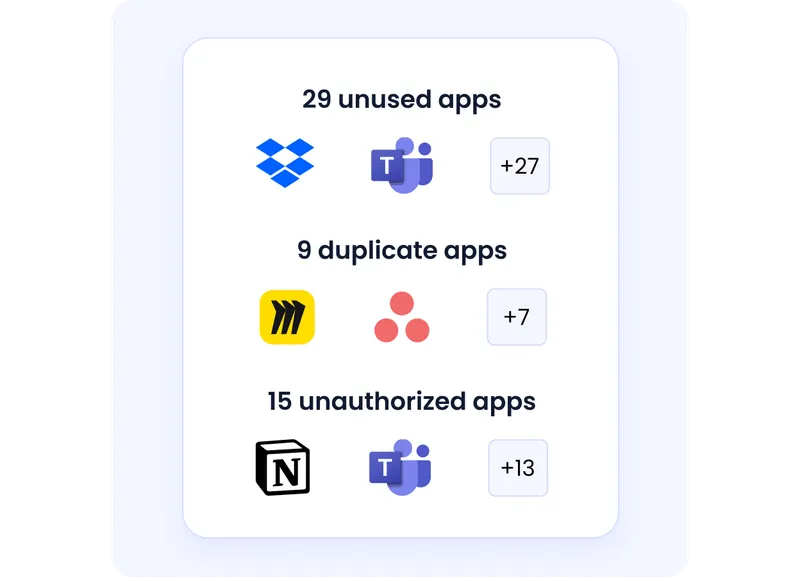
Fragmented approval processes are an open invitation for shadow IT. CloudEagle's procurement and governance workflows let you build tiered approval processes based on risk level, lightweight for low-risk tools, and rigorous for applications touching sensitive data. 

All contracts, security questionnaires, and compliance certifications are stored in a centralized repository that becomes your single source of truth, making audits faster and eliminating the chaos of documentation scattered across departments.

c. Centralize Governance and Ownership

Compliance only works when everyone knows their role. CloudEagle supports cross-functional governance by giving each stakeholder CISO, SaaS Ops, IT, Legal, Finance, and department managers, role-appropriate visibility and controls within a single platform. 

Rather than siloed tools and email threads, every team works from the same data, with clear accountability built into workflows from day one.

d. Automate Access Management

Manual access management simply doesn't scale. CloudEagle automates the entire access lifecycle, provisioning the right permissions during onboarding, instantly revoking access when employees leave, and automatically adjusting permissions during role changes. 
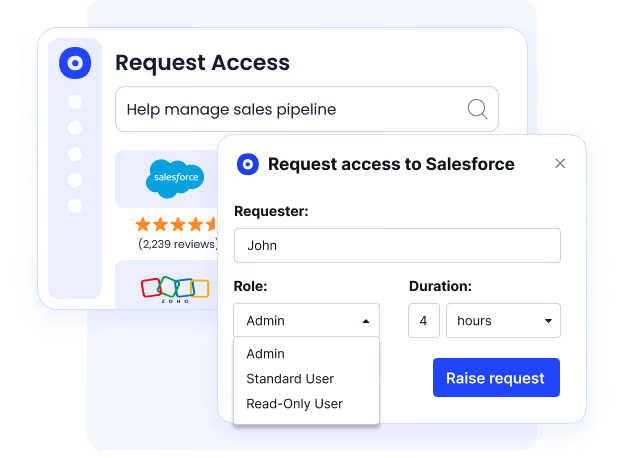
Combined with SSO integration, it enforces consistent access policies across your entire SaaS stack while triggering periodic access certification campaigns so managers regularly review who has access to what.

e. Strengthen Vendor Risk Management

Your compliance posture is only as strong as your weakest vendor. CloudEagle's vendor risk management module keeps you ahead of expiring certifications and shifting vendor practices with structured review cadences, quarterly compliance checks, annual risk assessments, monthly access audits, and bi-annual integration reviews. 
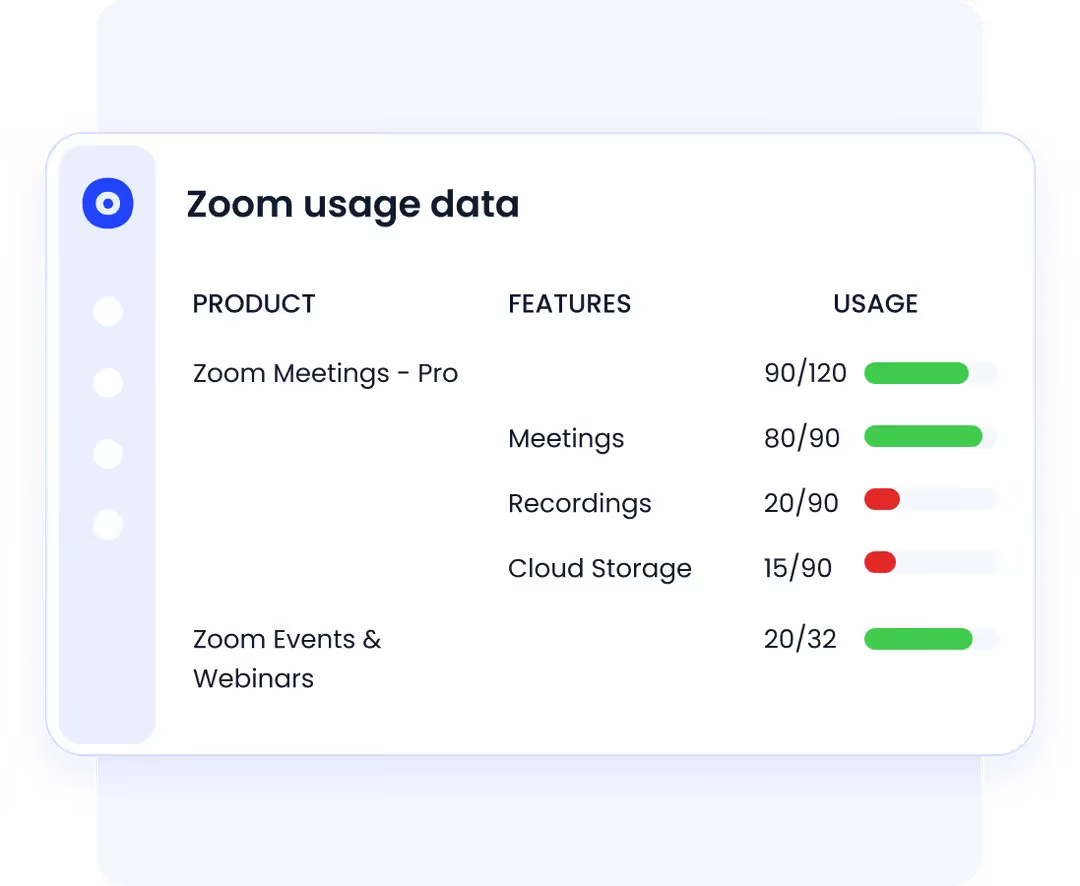
A built-in vendor scoring system helps you prioritize which applications need immediate attention based on data sensitivity, user base size, and integration depth.

f. Implement Cloud-Native Data Protection

Traditional perimeter-based DLP tools weren't built for SaaS. CloudEagle provides cloud-native data protection with content inspection, sensitive data classification, policy enforcement, and geographic transfer restrictions, all operating within your cloud applications and in transit. This means accidental public sharing, overly permissive defaults, and unauthorized data movement get flagged before they become breaches, not after.

Conclusion

Organizations that handle SaaS compliance best treat it as a business enabler, not a blocker. They build lightweight processes that give teams the tools they need while maintaining appropriate controls. 

Your SaaS stack will grow more complex and compliance requirements will get stricter, getting ahead of these risks now means building on solid ground instead of scrambling to fix problems later.

CloudEagle gives you the visibility, automation, and governance controls to stay ahead. 

Start your compliance journey today

Frequently Asked Questions

  1. What are the biggest SaaS compliance risks today?

Shadow IT, data residency issues, third-party security gaps, access sprawl, and fragmented governance create the most significant compliance exposures for modern organizations managing cloud applications.

  1. How do you mitigate SaaS security risks?

Implement discovery tools for visibility, establish governance policies, automate access controls, conduct regular vendor audits, and build centralized compliance documentation.

  1. Who should manage SaaS compliance programs?

A dedicated SaaS Operations team should coordinate between CISO, IT, security, legal, finance, and department managers with clear ownership and shared accountability.

  1. What tools help with SaaS compliance management?

SaaS discovery platforms, identity management systems, automated provisioning tools, compliance documentation hubs, and vendor risk assessment solutions streamline compliance workflows.

  1. How often should organizations review SaaS vendors?

Conduct quarterly certification checks, annual risk assessments, monthly access audits, and bi-annual integration reviews based on the application's risk level and data sensitivity.

Advertisement for a SaaS Subscription Tracking Template with a call-to-action button to download and a partial graphic of a tablet showing charts.Banner promoting a SaaS Agreement Checklist to streamline SaaS management and avoid budget waste with a call-to-action button labeled Download checklist.Blue banner with text 'The Ultimate Employee Offboarding Checklist!' and a black button labeled 'Download checklist' alongside partial views of checklist documents from cloudeagle.ai.Digital ad for download checklist titled 'The Ultimate Checklist for IT Leaders to Optimize SaaS Operations' by cloudeagle.ai, showing checklist pages.Slack Buyer's Guide offer with text 'Unlock insider insights to get the best deal on Slack!' and a button labeled 'Get Your Copy', accompanied by a preview of the guide featuring Slack's logo.Monday Pricing Guide by cloudeagle.ai offering exclusive pricing secrets to maximize investment with a call-to-action button labeled Get Your Copy and an image of the guide's cover.Blue banner for Canva Pricing Guide by cloudeagle.ai offering a guide to Canva costs, features, and alternatives with a call-to-action button saying Get Your Copy.Blue banner with white text reading 'Little-Known Negotiation Hacks to Get the Best Deal on Slack' and a white button labeled 'Get Your Copy'.Blue banner with text 'Little-Known Negotiation Hacks to Get the Best Deal on Monday.com' and a white button labeled 'Get Your Copy'.Blue banner with text 'Little-Known Negotiation Hacks to Get the Best Deal on Canva' and a white button labeled 'Get Your Copy'.Banner with text 'Slack Buyer's Guide' and a 'Download Now' button next to images of a guide titled 'Slack Buyer’s Guide: Features, Pricing & Best Practices'.Digital cover of Monday Pricing Guide with a button labeled Get Your Copy on a blue background.Canva Pricing Guide cover with a button labeled Get Your Copy on a blue gradient background.

Enter your email to
unlock the report

Oops! Something went wrong while submitting the form.
License Count
Benchmark
Per User/Per Year

Enter your email to
unlock the report

Oops! Something went wrong while submitting the form.
License Count
Benchmark
Per User/Per Year

Enter your email to
unlock the report

Oops! Something went wrong while submitting the form.
Notion Plus
License Count
Benchmark
Per User/Per Year
100-500
$67.20 - $78.72
500-1000
$59.52 - $72.00
1000+
$51.84 - $57.60
Canva Pro
License Count
Benchmark
Per User/Per Year
100-500
$74.33-$88.71
500-1000
$64.74-$80.32
1000+
$55.14-$62.34

Enter your email to
unlock the report

Oops! Something went wrong while submitting the form.

Enter your email to
unlock the report

Oops! Something went wrong while submitting the form.
Zoom Business
License Count
Benchmark
Per User/Per Year
100-500
$216.00 - $264.00
500-1000
$180.00 - $216.00
1000+
$156.00 - $180.00

Enter your email to
unlock the report

Oops! Something went wrong while submitting the form.

Get the Right Security Platform To Secure Your Cloud Infrastructure

Please enter a business email
Thank you!
The 2023 SaaS report has been sent to your email. Check your promotional or spam folder.
Oops! Something went wrong while submitting the form.

Access full report

Please enter a business email
Thank you!
The 2023 SaaS report has been sent to your email. Check your promotional or spam folder.
Oops! Something went wrong while submitting the form.

Managing SaaS compliance risks is one of the biggest challenges IT and security teams face today. As organizations adopt more cloud applications, the complexity of maintaining compliance across hundreds of tools continues to grow exponentially.

According to Gartner, global SaaS spending is expected to exceed $195 billion in 2023. With that massive adoption comes equally massive SaaS compliance challenges that require immediate attention and structured approaches to SaaS governance.

Whether you're dealing with GDPR, SOC 2, HIPAA, or industry-specific regulations, understanding SaaS compliance risks and implementing effective risk management strategies is critical for protecting your organization from regulatory penalties and data breaches.

TL;DR

  • Shadow IT creates blind spots exposing organizations to unauthorized data sharing and regulatory violations through unapproved applications
  • Data residency issues arise when SaaS vendors store information in regions conflicting with compliance and sovereignty requirements
  • Third-party vulnerabilities mean your security posture is only as strong as your weakest vendor integration point
  • Access control sprawl happens when employees retain permissions long after needed, creating security and audit nightmares
  • Fragmented governance leaves compliance monitoring scattered across departments with no centralized oversight or accountability

Risk 1 : How Does Shadow IT Create Compliance Vulnerabilities?

Shadow IT happens when employees adopt SaaS applications without official approval. Your marketing team signs up for a social media scheduling tool, your sales team tries a new prospecting platform, or engineers experiment with development tools, all storing company data outside IT's visibility.

A Cisco study revealed organizations use 10 times more cloud services than IT departments know about. Most IT teams believe they manage 30-40 applications when the actual number exceeds 300-400.

Shadow IT compliance challenges include:

  • Unknown data flows you can't protect or monitor
  • Unvetted security practices creating vulnerability gaps
  • Audit failures when examiners discover undocumented applications
  • Regulatory violations from storing sensitive data in non-compliant systems
  • Lack of vendor management oversight and contract controls

This creates massive SaaS governance risks because you can't enforce compliance policies on applications you don't know exist.

Risk 2: Data Residency and Sovereignty Risk

Where your data physically resides matters significantly for SaaS data compliance. If you're subject to GDPR and your vendor stores EU customer data on US servers without proper safeguards, you've violated regulations.

Many SaaS vendors operate multi-tenant environments where customer data shares infrastructure. They might replicate information across regions for redundancy without explicit consent or notification to clients.

Critical data residency concerns:

  • Cross-border transfers triggering different regulatory requirements
  • Vendor transparency gaps about storage and processing locations
  • Dynamic infrastructure shifting workloads between data centers
  • Conflicting regulations between jurisdictions
  • Data sovereignty requirements varying by industry and region

According to IDC research, 80% of organizations will face penalties for non-compliance with data sovereignty regulations by 2024 without proper data governance controls.

Risk 3. Third-Party and Integration Risk

Your SaaS applications operate within complex ecosystems. They integrate with other tools, connect to APIs, and share data across your entire tech stack. Each integration point represents a potential SaaS governance risk.

Consider this: Your CRM integrates with an email platform, which connects to a data enrichment service, which pulls from public databases. That's four vendors touching customer data, all requiring compliance verification.

Third-party compliance risks include:

  • Shared responsibility confusion when data breaches occur during transfers
  • Integration vulnerabilities through APIs and webhooks
  • Vendor risk extending through supply chains
  • Outdated security certifications needing continuous verification
  • Lack of standardized security assessments across vendors

Maintaining a comprehensive vendor registry with current compliance documentation helps manage these interconnected risks effectively.

Risk 4. Access Control Sprawl

Employee turnover creates access control nightmares. When someone leaves, their SaaS access often remains active. That former employee from six months ago might still access your project management tool, shared drives, and customer databases.

Research from Varonis shows 58% of companies have over 500 employees with inappropriate access to sensitive files. That's not just security risk, it's a compliance violation waiting to surface during audits.

Access control challenges:

  • Orphaned accounts remaining active after employee departures
  • Excessive permissions beyond role requirements
  • No systematic access reviews or recertification processes
  • Shared credentials preventing individual accountability tracking
  • Missing automated offboarding workflows to revoke access

Implementing proper identity management and access governance prevents these issues from escalating into major compliance violations.

Risk 5. Fragmented Governance and Ownership Gaps

Most organizations manage SaaS risk management reactively across silos. IT handles security, finance tracks spending, departments approve tools independently. Nobody maintains complete visibility into the entire SaaS portfolio.

This fragmented approach creates dangerous blind spots:

  • No single source of truth for approved applications
  • Inconsistent vetting processes across departments
  • Duplicate tools wasting budget on similar capabilities
  • Compliance gaps as requirements fall between departments
  • Audit chaos when documentation is scattered

A Deloitte survey found 68% of executives believe their organizations face more compliance risk today than five years ago, primarily from cloud services complexity.

Establishing centralized SaaS management with cross-functional oversight addresses these governance challenges systematically.

Risk 6. Audit Readiness Risk

When auditors request documentation about your SaaS environment, can you provide it immediately? Most organizations scramble to compile information about applications, vendors, data flows, and access controls because they lack centralized documentation.

Audit readiness challenges include:

  • Missing vendor contracts and data processing agreements
  • Incomplete security questionnaires and compliance certifications
  • No documented approval workflows or risk assessments
  • Scattered evidence across departments and systems
  • Inability to demonstrate continuous monitoring and controls

Without proper audit preparation, organizations face extended audit timelines, qualification letters, and potential compliance failures that damage reputation and customer trust.

Risk 7. Data Leakage and Misconfiguration Risk

SaaS applications offer powerful sharing and collaboration features, but these same capabilities create data leakage risks. Employees accidentally share sensitive files publicly, misconfigure permissions, or sync data to personal devices.

Common data leakage scenarios:

  • Public link sharing for documents containing sensitive information
  • Overly permissive default sharing settings in collaboration tools
  • Data synchronization to unmanaged personal devices
  • Lack of data classification preventing appropriate handling
  • Missing data loss prevention controls in cloud applications

These misconfigurations often go undetected until a breach occurs, making proactive monitoring and controls essential for SaaS security compliance.

How to Mitigate SaaS Compliance Risks

a. Improve SaaS Visibility

You can't manage SaaS compliance risks you can't see. CloudEagle's automated SaaS discovery continuously scans your environment by analyzing SSO logs, browser extensions, expense reports, and network traffic to surface every application in use including unauthorized ones. 

Instead of relying on manual surveys or guesswork, you get a real-time, comprehensive inventory with compliance status for each tool, giving your team the visibility needed to make informed decisions fast.

b. Visibility strategies:

Fragmented approval processes are an open invitation for shadow IT. CloudEagle's procurement and governance workflows let you build tiered approval processes based on risk level, lightweight for low-risk tools, and rigorous for applications touching sensitive data. 

All contracts, security questionnaires, and compliance certifications are stored in a centralized repository that becomes your single source of truth, making audits faster and eliminating the chaos of documentation scattered across departments.

c. Centralize Governance and Ownership

Compliance only works when everyone knows their role. CloudEagle supports cross-functional governance by giving each stakeholder CISO, SaaS Ops, IT, Legal, Finance, and department managers, role-appropriate visibility and controls within a single platform. 

Rather than siloed tools and email threads, every team works from the same data, with clear accountability built into workflows from day one.

d. Automate Access Management

Manual access management simply doesn't scale. CloudEagle automates the entire access lifecycle, provisioning the right permissions during onboarding, instantly revoking access when employees leave, and automatically adjusting permissions during role changes. 

Combined with SSO integration, it enforces consistent access policies across your entire SaaS stack while triggering periodic access certification campaigns so managers regularly review who has access to what.

e. Strengthen Vendor Risk Management

Your compliance posture is only as strong as your weakest vendor. CloudEagle's vendor risk management module keeps you ahead of expiring certifications and shifting vendor practices with structured review cadences, quarterly compliance checks, annual risk assessments, monthly access audits, and bi-annual integration reviews. 

A built-in vendor scoring system helps you prioritize which applications need immediate attention based on data sensitivity, user base size, and integration depth.

f. Implement Cloud-Native Data Protection

Traditional perimeter-based DLP tools weren't built for SaaS. CloudEagle provides cloud-native data protection with content inspection, sensitive data classification, policy enforcement, and geographic transfer restrictions, all operating within your cloud applications and in transit. This means accidental public sharing, overly permissive defaults, and unauthorized data movement get flagged before they become breaches, not after.

Conclusion

Organizations that handle SaaS compliance best treat it as a business enabler, not a blocker. They build lightweight processes that give teams the tools they need while maintaining appropriate controls. 

Your SaaS stack will grow more complex and compliance requirements will get stricter, getting ahead of these risks now means building on solid ground instead of scrambling to fix problems later.

CloudEagle gives you the visibility, automation, and governance controls to stay ahead. 

Start your compliance journey today

Frequently Asked Questions

  1. What are the biggest SaaS compliance risks today?

Shadow IT, data residency issues, third-party security gaps, access sprawl, and fragmented governance create the most significant compliance exposures for modern organizations managing cloud applications.

  1. How do you mitigate SaaS security risks?

Implement discovery tools for visibility, establish governance policies, automate access controls, conduct regular vendor audits, and build centralized compliance documentation.

  1. Who should manage SaaS compliance programs?

A dedicated SaaS Operations team should coordinate between CISO, IT, security, legal, finance, and department managers with clear ownership and shared accountability.

  1. What tools help with SaaS compliance management?

SaaS discovery platforms, identity management systems, automated provisioning tools, compliance documentation hubs, and vendor risk assessment solutions streamline compliance workflows.

  1. How often should organizations review SaaS vendors?

Conduct quarterly certification checks, annual risk assessments, monthly access audits, and bi-annual integration reviews based on the application's risk level and data sensitivity.

CloudEagle.ai recognized in the 2025 Gartner® Magic Quadrant™ for SaaS Management Platforms
Download now
gartner chart
5x
Faster employee
onboarding
80%
Reduction in time for
user access reviews
30k
Workflows
automated
$15Bn
Analyzed in
contract spend
$2Bn
Saved in
SaaS spend

Recognized as an Industry leader for our AI

CloudEagle.ai is Recognized in the 2024 Gartner® Magic Quadrant™ for SaaS Management Platforms

Recognition highlights CloudEagle’s innovation and leadership in the rapidly evolving SaaS management and procurement space.
Read More
Gartner Magic Quadrant for SaaS Management Platforms showing a chart divided into Challengers and Leaders quadrants with various companies plotted as dots.

CloudEagle.ai Recognized in the GigaOm Radar for SaaS Management Platforms

CloudEagle named a Leader and Outperformer in GigaOm Radar Report, validating its impact in the SaaS management platform landscape.
Read More
gigaom

Everest Group Positions CloudEagle.ai as a Trailblazer in SaaS Management Platforms

CloudEagle recognized as a Trailblazer by Everest Group, showcasing its rapid growth and innovation in SaaS spend and operations management.
Read More
qks

CloudEagle.ai is Recognized in the 2024 Gartner® Magic Quadrant™ for SaaS Management Platforms

Recognition highlights CloudEagle’s innovation and leadership in the rapidly evolving SaaS management and procurement space.
Read More
gartner

Streamline SaaS governance and save 10-30%

Book a Demo with Expert
CTA image
One platform to Manage
all SaaS Products
Learn More