AI Governance

Dynamic AI Risk Scoring: Why Static Risk Matrices Fall Short

Share via:
Written by:
CloudEagle.ai Team
Reviewed by
Nidhi Jain
Last Updated:
October 26, 2026
blog-cms-banner-bg
Little-Known Negotiation Hacks to Get the Best Deal on Slack
cta-bg-blogDownload Your Copy

HIPAA Compliance Checklist for 2025

Download PDF

‍

An AI system classified as low-risk today may become a serious security concern tomorrow as its data access, permissions, or integrations change. Static risk matrices often fail to capture these shifts, leaving organizations with risk assessments that no longer reflect actual exposure.

The 2026 Stanford AI Index Report reported that documented AI incidents rose from 233 in 2024 to 362 in 2025, highlighting the growing challenges of AI risk management.

Dynamic AI risk scoring helps organizations reassess risk as conditions change, using updated signals, business context, and control effectiveness.

This guide explains why static risk matrices fall short and how enterprises can build a more responsive AI risk assessment process.

‍

1. What Is Dynamic AI Risk Scoring?

Dynamic AI risk scoring is an approach to AI risk assessment that updates an AI system’s risk rating as its behavior, data access, permissions, integrations, or operating environment changes. 

Unlike static risk matrices, which typically capture risk at a specific point in time, dynamic scoring uses updated risk indicators and business context to identify emerging risks and prioritize appropriate responses.

A dynamic AI risk scoring model typically evaluates factors such as business impact, data sensitivity, system autonomy, access privileges, and the effectiveness of existing controls. When significant changes occur, predefined rules or monitoring signals can trigger reassessment, additional safeguards, or human review.

For enterprises, dynamic AI risk scoring helps security and governance teams move beyond periodic assessments toward more responsive risk management throughout the AI lifecycle.

‍

Hackers Only Need One Way In

Close the gaps they could exploit
Secure Your Stack

‍

2. Why Do Static AI Risk Matrices Fall Short?

Static risk matrices help organizations classify AI risks based on likelihood and impact. However, they often capture risk at a single point in time, making it difficult to keep assessments aligned with changing AI systems, permissions, and business use cases.

A. They Cannot Keep Pace With Changing AI Systems

An AI system's risk profile can change after deployment as models are updated, new use cases emerge, or integrations expand. A static assessment may retain its original rating even when the system's actual exposure has increased.

B. They Overlook Changes in Data Access and Permissions

An AI assistant with read-only access to internal documents presents a different level of exposure from one that can access sensitive records or modify business data. If its permissions change without a reassessment, the original risk score may no longer reflect its potential impact.

C. They Produce Inconsistent Risk Assessments

Risk matrices often depend on teams interpreting likelihood and impact using predefined rating scales. Without consistent criteria and supporting evidence, different teams may assign different scores to similar AI systems, making enterprise-wide risk prioritization less reliable.

D. They Delay Responses to Emerging Risks

Periodic assessments can leave gaps between reviews. Changes in vendor security, AI behavior, connected applications, or control effectiveness may go unnoticed until the next scheduled assessment, delaying necessary action.

E. They Do Not Explain What Action to Take Next

A risk rating identifies a potential problem but does not automatically explain why the risk changed or how to address it. Teams need supporting evidence, clear ownership, and defined response procedures to determine whether a system requires additional safeguards, a permission review, or escalation.

‍

3. How Does Dynamic AI Risk Scoring Work?

Dynamic AI risk scoring uses updated evidence and predefined assessment criteria to determine whether an AI system's exposure has changed. The process connects risk signals to reassessment, scoring, and appropriate governance actions.

A. Collect and Validate Risk Signals

Organizations gather evidence from AI inventories, access records, security monitoring, vendor assessments, and system change logs. Relevant signals include new data connections, expanded permissions, model updates, unusual behavior, and changes in security controls.

Not every change indicates higher risk. The objective is to identify changes that affect the likelihood or potential impact of harm, rather than treating every system update as a reason to escalate.

B. Evaluate Risk in Business Context

Risk signals must be assessed against the AI system's purpose, data sensitivity, autonomy, and potential business impact. For example, granting an AI assistant access to public documentation creates a different exposure from granting it permission to modify confidential financial records.

This contextual assessment helps organizations distinguish routine changes from those that warrant additional safeguards or approval.

C. Recalculate Inherent and Residual Risk

A scoring model evaluates relevant factors using defined criteria, weighted scores, or validated analytical methods. Inherent risk represents exposure before accounting for safeguards, while residual risk represents the remaining exposure after applicable controls are considered.

Organizations should document the evidence behind each score and avoid relying on a single aggregate rating that could conceal a critical weakness in one area.

D. Trigger Risk-Based Actions

Predefined thresholds and critical-event rules determine when action is required. A material increase in risk may trigger a reassessment, access review, additional testing, or escalation to a risk owner. Certain events, such as a serious control failure, may require immediate investigation regardless of the overall score.

E. Verify Outcomes and Update Assessments

After remediation, teams should verify whether the corrective action reduced exposure and update the residual risk assessment accordingly. Documenting the evidence, decision, owner, and outcome creates an audit trail and helps prevent unresolved risks from being overlooked in future reviews.

The result is a repeatable process in which changing AI exposure informs risk assessments, governance decisions, and follow-up actions.

‍

Your SaaS. Your Compliance Risk

Know what needs attention
Close The Gaps

‍

4. How to Build a Dynamic AI Risk Scoring Model

An effective dynamic AI risk scoring model needs clear criteria for measuring risk and deciding when action is required. The goal is to assess AI systems consistently while accounting for changes in their access, capabilities, and business impact.

A. Assess Business Impact

Identify what could go wrong if an AI system makes an incorrect decision, exposes sensitive information, or takes an unauthorized action. Consider financial losses, operational disruption, privacy risks, and regulatory consequences.

For example, an AI tool that summarizes meeting notes carries a different level of risk from an AI agent that can approve payments or modify customer records.

B. Evaluate Data Sensitivity and Access

Review the data an AI system can access, the applications it connects to, and the permissions it holds. Access to confidential records or additional business systems can increase exposure, particularly when safeguards are insufficient.

C. Measure Autonomy and Exposure

Consider how independently the AI operates and which actions it can perform without human approval. An assistant that recommends changes presents a different risk from an agent that executes them across business applications.

D. Identify Changes That Affect Risk

Define which changes warrant reassessment, such as new integrations, expanded permissions, model updates, or changes in business use. Focus on changes that affect actual exposure rather than treating every update as a new risk.

E. Check Whether Security Controls Work

Review safeguards such as access restrictions, human approvals, activity logging, and monitoring. Assess whether these controls work as intended before determining the remaining risk. If access restrictions fail or critical controls are missing, residual risk may increase and require immediate review.

F. Combine Risk Factors Into a Scoring Model

  • Score AI risk based on five factors: business impact, data sensitivity, access level, autonomy, and effectiveness of safeguards.
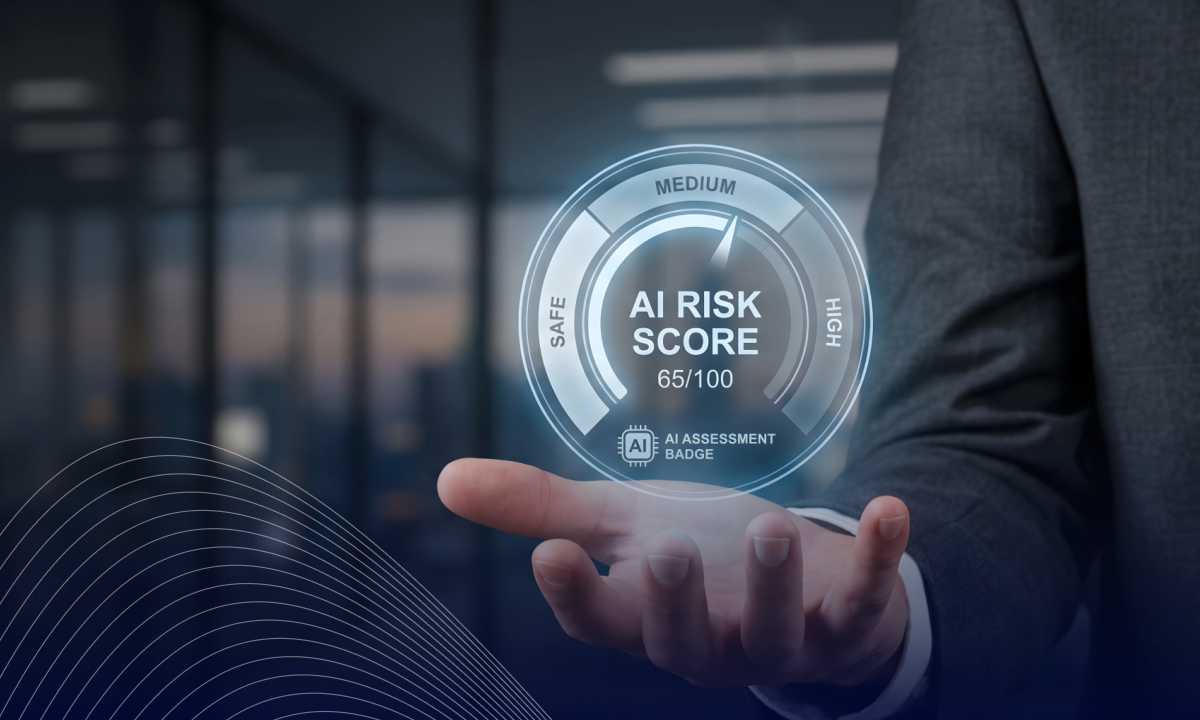
  • Rate each factor from 1 to 5 and apply weights to calculate a score out of 100. Example: An average rating of 3.5 out of 5 gives a risk score of 70/100.
  • Define risk levels and the actions required for each score.
  • Reassess risk when an AI tool gains access to sensitive data or permission to make changes.
  • Take immediate action if a critical security control fails, regardless of the overall score. 

‍

5. How to Implement Dynamic AI Risk Scoring Across the Enterprise

Implementing dynamic AI risk scoring requires more than choosing a scoring method. Organizations need visibility into AI usage, consistent assessment criteria, and clear processes for responding when risk changes.

A. Build a Centralized AI Inventory

Identify the AI applications and agents used across the organization, including unmanaged tools. Record each system's purpose, business owner, connected applications, data access, and permissions. Prioritize systems that handle sensitive information or support critical business operations.

B. Establish Initial Risk Assessments

Evaluate each system using consistent criteria for business impact, data sensitivity, autonomy, access, and control effectiveness. Document the initial score, supporting evidence, and existing safeguards to establish a baseline for future comparisons.

C. Define Reassessment Triggers

Specify which changes require a new assessment, such as expanded permissions, new data connections, significant model updates, or control failures. Routine changes may require a scheduled review, while critical events, such as unauthorized access to sensitive data, should trigger immediate investigation.

D. Assign Owners and Remediation Responsibilities

Assign an accountable owner to each material risk and define the actions required for different risk levels. Depending on the exposure, teams may need to restrict access, introduce additional approvals, strengthen safeguards, or escalate the issue to security leadership.

E. Track Risk Changes and Verify Outcomes

Record previous and current scores, the evidence behind each change, decisions made, and remediation results. After corrective actions, reassess residual risk to verify whether exposure has decreased to an acceptable level.

F. Combine Continuous Monitoring With Periodic Reviews

Use available monitoring signals to identify meaningful changes between scheduled assessments. Periodic reviews remain important for checking assumptions, identifying gaps, and confirming that safeguards remain effective. Review frequency should reflect each system's risk level and business importance.

By prioritizing high-impact AI systems, assigning clear ownership, and documenting review outcomes, organizations can turn dynamic AI risk scoring into a repeatable enterprise governance process.

‍

6. How CloudEagle.ai Supports AI Risk Governance

Dynamic AI risk scoring depends on accurate visibility into AI usage, application access, and potential exposure. CloudEagle.ai helps organizations manage their SaaS environments by bringing application discovery, usage, ownership, and access governance into focus.

CloudEagle.ai supports broader AI risk governance by helping teams:

  • Discover AI-enabled applications: Identify applications across the SaaS environment that may require additional governance review.
  • Review access and permissions: Identify potential access-related risks and opportunities to strengthen governance.
  • Establish application ownership: Improve accountability by identifying application owners and review responsibilities.
  • Prioritize governance gaps: Use application and access information to identify issues that warrant investigation and remediation.

CloudEagle.ai's Plex case study describes discovering 73 previously unseen AI tools and retiring 22. This illustrates how AI discovery can help organizations identify applications that may require additional governance review. The reported results are a vendor-published example, not independent validation of product performance.

These capabilities support the broader dynamic AI risk assessment process by improving visibility into enterprise AI usage and access. Specialized model testing, runtime monitoring, and technical AI risk scoring may still require dedicated tools or integrations.

By connecting SaaS visibility with access governance, CloudEagle.ai helps enterprises build a stronger foundation for managing AI-related exposure and making informed governance decisions.

‍

‍

7. Conclusion

Static risk matrices provide a starting point, but they cannot fully capture how AI exposure changes with new data access, permissions, and integrations. Dynamic AI risk scoring helps organizations reassess risks, prioritize safeguards, and respond to emerging threats.

By combining ongoing assessments with clear governance processes, enterprises can make more informed decisions. CloudEagle.ai supports this effort through SaaS visibility and access governance, helping teams identify potential exposure across their AI-enabled applications.

‍

8. FAQs

1. What Triggers a Reassessment of AI Risk?

An AI risk reassessment may be needed when an application gains access to sensitive data, receives new permissions, connects to additional systems, undergoes a significant model update, or experiences a security control failure. Organizations should define clear triggers and escalation rules based on the potential impact of each change.

2. Who Should Be Responsible for Updating AI Risk Scores?

Responsibility should be shared across AI system owners, security teams, risk and compliance teams, and relevant business stakeholders. System owners provide context about changes in use and capabilities, while security and governance teams evaluate exposure, validate controls, and determine whether remediation or escalation is required..

3. Which Factors Should an AI Risk Scoring Model Consider?

An AI risk scoring model should consider business impact, data sensitivity, access permissions, system autonomy, operational changes, and security control effectiveness. Organizations should weigh these factors according to their risk exposure and ensure that critical issues cannot be hidden by an aggregate score.

4. How Often Should AI Risk Scores Be Updated?

AI risk scores should be reassessed when meaningful changes occur, such as expanded permissions, new data connections, model updates, or security control failures. Organizations should also conduct periodic reviews based on the system's risk level, business importance, and applicable requirements. This approach aligns with the lifecycle-based risk management principles outlined in the NIST AI Risk Management Framework.

5. Can Dynamic AI Risk Scoring Help Organizations Meet AI Governance Requirements?

Dynamic AI risk scoring can support AI governance by helping organizations document assessments, track changing exposure, prioritize remediation, and maintain oversight. However, a risk score alone does not establish compliance. Organizations must also meet the applicable legal, regulatory, and framework-specific requirements for their AI systems.

‍

Advertisement for a SaaS Subscription Tracking Template with a call-to-action button to download and a partial graphic of a tablet showing charts.Banner promoting a SaaS Agreement Checklist to streamline SaaS management and avoid budget waste with a call-to-action button labeled Download checklist.Blue banner with text 'The Ultimate Employee Offboarding Checklist!' and a black button labeled 'Download checklist' alongside partial views of checklist documents from cloudeagle.ai.Digital ad for download checklist titled 'The Ultimate Checklist for IT Leaders to Optimize SaaS Operations' by cloudeagle.ai, showing checklist pages.Slack Buyer's Guide offer with text 'Unlock insider insights to get the best deal on Slack!' and a button labeled 'Get Your Copy', accompanied by a preview of the guide featuring Slack's logo.Monday Pricing Guide by cloudeagle.ai offering exclusive pricing secrets to maximize investment with a call-to-action button labeled Get Your Copy and an image of the guide's cover.Blue banner for Canva Pricing Guide by cloudeagle.ai offering a guide to Canva costs, features, and alternatives with a call-to-action button saying Get Your Copy.Blue banner with white text reading 'Little-Known Negotiation Hacks to Get the Best Deal on Slack' and a white button labeled 'Get Your Copy'.Blue banner with text 'Little-Known Negotiation Hacks to Get the Best Deal on Monday.com' and a white button labeled 'Get Your Copy'.Blue banner with text 'Little-Known Negotiation Hacks to Get the Best Deal on Canva' and a white button labeled 'Get Your Copy'.Banner with text 'Slack Buyer's Guide' and a 'Download Now' button next to images of a guide titled 'Slack Buyer’s Guide: Features, Pricing & Best Practices'.Digital cover of Monday Pricing Guide with a button labeled Get Your Copy on a blue background.Canva Pricing Guide cover with a button labeled Get Your Copy on a blue gradient background.

Enter your email to
unlock the report

Oops! Something went wrong while submitting the form.
License Count
Benchmark
Per User/Per Year

Enter your email to
unlock the report

Oops! Something went wrong while submitting the form.
License Count
Benchmark
Per User/Per Year

Enter your email to
unlock the report

Oops! Something went wrong while submitting the form.
Notion Plus
License Count
Benchmark
Per User/Per Year
100-500
$67.20 - $78.72
500-1000
$59.52 - $72.00
1000+
$51.84 - $57.60
Canva Pro
License Count
Benchmark
Per User/Per Year
100-500
$74.33-$88.71
500-1000
$64.74-$80.32
1000+
$55.14-$62.34

Enter your email to
unlock the report

Oops! Something went wrong while submitting the form.

Enter your email to
unlock the report

Oops! Something went wrong while submitting the form.
Zoom Business
License Count
Benchmark
Per User/Per Year
100-500
$216.00 - $264.00
500-1000
$180.00 - $216.00
1000+
$156.00 - $180.00

Enter your email to
unlock the report

Oops! Something went wrong while submitting the form.

Get the Right Security Platform To Secure Your Cloud Infrastructure

Please enter a business email
Thank you!
The 2023 SaaS report has been sent to your email. Check your promotional or spam folder.
Oops! Something went wrong while submitting the form.

Access full report

Please enter a business email
Thank you!
The 2023 SaaS report has been sent to your email. Check your promotional or spam folder.
Oops! Something went wrong while submitting the form.
  • Dynamic AI risk scoring updates risk assessments as AI systems, permissions, data access, and integrations change.
  • Effective risk scoring evaluates business impact, data sensitivity, system autonomy, access privileges, and control effectiveness.
  • Continuous monitoring and reassessment help organizations detect emerging risks, prioritize remediation, and verify control effectiveness.
  • CloudEagle.ai supports AI risk governance through AI application discovery, SaaS visibility, and access governance.

‍

An AI system classified as low-risk today may become a serious security concern tomorrow as its data access, permissions, or integrations change. Static risk matrices often fail to capture these shifts, leaving organizations with risk assessments that no longer reflect actual exposure.

The 2026 Stanford AI Index Report reported that documented AI incidents rose from 233 in 2024 to 362 in 2025, highlighting the growing challenges of AI risk management.

Dynamic AI risk scoring helps organizations reassess risk as conditions change, using updated signals, business context, and control effectiveness.

This guide explains why static risk matrices fall short and how enterprises can build a more responsive AI risk assessment process.

‍

1. What Is Dynamic AI Risk Scoring?

Dynamic AI risk scoring is an approach to AI risk assessment that updates an AI system’s risk rating as its behavior, data access, permissions, integrations, or operating environment changes. 

Unlike static risk matrices, which typically capture risk at a specific point in time, dynamic scoring uses updated risk indicators and business context to identify emerging risks and prioritize appropriate responses.

A dynamic AI risk scoring model typically evaluates factors such as business impact, data sensitivity, system autonomy, access privileges, and the effectiveness of existing controls. When significant changes occur, predefined rules or monitoring signals can trigger reassessment, additional safeguards, or human review.

For enterprises, dynamic AI risk scoring helps security and governance teams move beyond periodic assessments toward more responsive risk management throughout the AI lifecycle.

‍

Hackers Only Need One Way In

Close the gaps they could exploit
Secure Your Stack

‍

2. Why Do Static AI Risk Matrices Fall Short?

Static risk matrices help organizations classify AI risks based on likelihood and impact. However, they often capture risk at a single point in time, making it difficult to keep assessments aligned with changing AI systems, permissions, and business use cases.

A. They Cannot Keep Pace With Changing AI Systems

An AI system's risk profile can change after deployment as models are updated, new use cases emerge, or integrations expand. A static assessment may retain its original rating even when the system's actual exposure has increased.

B. They Overlook Changes in Data Access and Permissions

An AI assistant with read-only access to internal documents presents a different level of exposure from one that can access sensitive records or modify business data. If its permissions change without a reassessment, the original risk score may no longer reflect its potential impact.

C. They Produce Inconsistent Risk Assessments

Risk matrices often depend on teams interpreting likelihood and impact using predefined rating scales. Without consistent criteria and supporting evidence, different teams may assign different scores to similar AI systems, making enterprise-wide risk prioritization less reliable.

D. They Delay Responses to Emerging Risks

Periodic assessments can leave gaps between reviews. Changes in vendor security, AI behavior, connected applications, or control effectiveness may go unnoticed until the next scheduled assessment, delaying necessary action.

E. They Do Not Explain What Action to Take Next

A risk rating identifies a potential problem but does not automatically explain why the risk changed or how to address it. Teams need supporting evidence, clear ownership, and defined response procedures to determine whether a system requires additional safeguards, a permission review, or escalation.

‍

3. How Does Dynamic AI Risk Scoring Work?

Dynamic AI risk scoring uses updated evidence and predefined assessment criteria to determine whether an AI system's exposure has changed. The process connects risk signals to reassessment, scoring, and appropriate governance actions.

A. Collect and Validate Risk Signals

Organizations gather evidence from AI inventories, access records, security monitoring, vendor assessments, and system change logs. Relevant signals include new data connections, expanded permissions, model updates, unusual behavior, and changes in security controls.

Not every change indicates higher risk. The objective is to identify changes that affect the likelihood or potential impact of harm, rather than treating every system update as a reason to escalate.

B. Evaluate Risk in Business Context

Risk signals must be assessed against the AI system's purpose, data sensitivity, autonomy, and potential business impact. For example, granting an AI assistant access to public documentation creates a different exposure from granting it permission to modify confidential financial records.

This contextual assessment helps organizations distinguish routine changes from those that warrant additional safeguards or approval.

C. Recalculate Inherent and Residual Risk

A scoring model evaluates relevant factors using defined criteria, weighted scores, or validated analytical methods. Inherent risk represents exposure before accounting for safeguards, while residual risk represents the remaining exposure after applicable controls are considered.

Organizations should document the evidence behind each score and avoid relying on a single aggregate rating that could conceal a critical weakness in one area.

D. Trigger Risk-Based Actions

Predefined thresholds and critical-event rules determine when action is required. A material increase in risk may trigger a reassessment, access review, additional testing, or escalation to a risk owner. Certain events, such as a serious control failure, may require immediate investigation regardless of the overall score.

E. Verify Outcomes and Update Assessments

After remediation, teams should verify whether the corrective action reduced exposure and update the residual risk assessment accordingly. Documenting the evidence, decision, owner, and outcome creates an audit trail and helps prevent unresolved risks from being overlooked in future reviews.

The result is a repeatable process in which changing AI exposure informs risk assessments, governance decisions, and follow-up actions.

‍

Your SaaS. Your Compliance Risk

Know what needs attention
Close The Gaps

‍

4. How to Build a Dynamic AI Risk Scoring Model

An effective dynamic AI risk scoring model needs clear criteria for measuring risk and deciding when action is required. The goal is to assess AI systems consistently while accounting for changes in their access, capabilities, and business impact.

A. Assess Business Impact

Identify what could go wrong if an AI system makes an incorrect decision, exposes sensitive information, or takes an unauthorized action. Consider financial losses, operational disruption, privacy risks, and regulatory consequences.

For example, an AI tool that summarizes meeting notes carries a different level of risk from an AI agent that can approve payments or modify customer records.

B. Evaluate Data Sensitivity and Access

Review the data an AI system can access, the applications it connects to, and the permissions it holds. Access to confidential records or additional business systems can increase exposure, particularly when safeguards are insufficient.

C. Measure Autonomy and Exposure

Consider how independently the AI operates and which actions it can perform without human approval. An assistant that recommends changes presents a different risk from an agent that executes them across business applications.

D. Identify Changes That Affect Risk

Define which changes warrant reassessment, such as new integrations, expanded permissions, model updates, or changes in business use. Focus on changes that affect actual exposure rather than treating every update as a new risk.

E. Check Whether Security Controls Work

Review safeguards such as access restrictions, human approvals, activity logging, and monitoring. Assess whether these controls work as intended before determining the remaining risk. If access restrictions fail or critical controls are missing, residual risk may increase and require immediate review.

F. Combine Risk Factors Into a Scoring Model

  • Score AI risk based on five factors: business impact, data sensitivity, access level, autonomy, and effectiveness of safeguards.
  • Rate each factor from 1 to 5 and apply weights to calculate a score out of 100. Example: An average rating of 3.5 out of 5 gives a risk score of 70/100.
  • Define risk levels and the actions required for each score.
  • Reassess risk when an AI tool gains access to sensitive data or permission to make changes.
  • Take immediate action if a critical security control fails, regardless of the overall score. 

‍

5. How to Implement Dynamic AI Risk Scoring Across the Enterprise

Implementing dynamic AI risk scoring requires more than choosing a scoring method. Organizations need visibility into AI usage, consistent assessment criteria, and clear processes for responding when risk changes.

A. Build a Centralized AI Inventory

Identify the AI applications and agents used across the organization, including unmanaged tools. Record each system's purpose, business owner, connected applications, data access, and permissions. Prioritize systems that handle sensitive information or support critical business operations.

B. Establish Initial Risk Assessments

Evaluate each system using consistent criteria for business impact, data sensitivity, autonomy, access, and control effectiveness. Document the initial score, supporting evidence, and existing safeguards to establish a baseline for future comparisons.

C. Define Reassessment Triggers

Specify which changes require a new assessment, such as expanded permissions, new data connections, significant model updates, or control failures. Routine changes may require a scheduled review, while critical events, such as unauthorized access to sensitive data, should trigger immediate investigation.

D. Assign Owners and Remediation Responsibilities

Assign an accountable owner to each material risk and define the actions required for different risk levels. Depending on the exposure, teams may need to restrict access, introduce additional approvals, strengthen safeguards, or escalate the issue to security leadership.

E. Track Risk Changes and Verify Outcomes

Record previous and current scores, the evidence behind each change, decisions made, and remediation results. After corrective actions, reassess residual risk to verify whether exposure has decreased to an acceptable level.

F. Combine Continuous Monitoring With Periodic Reviews

Use available monitoring signals to identify meaningful changes between scheduled assessments. Periodic reviews remain important for checking assumptions, identifying gaps, and confirming that safeguards remain effective. Review frequency should reflect each system's risk level and business importance.

By prioritizing high-impact AI systems, assigning clear ownership, and documenting review outcomes, organizations can turn dynamic AI risk scoring into a repeatable enterprise governance process.

‍

6. How CloudEagle.ai Supports AI Risk Governance

Dynamic AI risk scoring depends on accurate visibility into AI usage, application access, and potential exposure. CloudEagle.ai helps organizations manage their SaaS environments by bringing application discovery, usage, ownership, and access governance into focus.

CloudEagle.ai supports broader AI risk governance by helping teams:

  • Discover AI-enabled applications: Identify applications across the SaaS environment that may require additional governance review.
  • Review access and permissions: Identify potential access-related risks and opportunities to strengthen governance.
  • Establish application ownership: Improve accountability by identifying application owners and review responsibilities.
  • Prioritize governance gaps: Use application and access information to identify issues that warrant investigation and remediation.

CloudEagle.ai's Plex case study describes discovering 73 previously unseen AI tools and retiring 22. This illustrates how AI discovery can help organizations identify applications that may require additional governance review. The reported results are a vendor-published example, not independent validation of product performance.

These capabilities support the broader dynamic AI risk assessment process by improving visibility into enterprise AI usage and access. Specialized model testing, runtime monitoring, and technical AI risk scoring may still require dedicated tools or integrations.

By connecting SaaS visibility with access governance, CloudEagle.ai helps enterprises build a stronger foundation for managing AI-related exposure and making informed governance decisions.

‍

‍

7. Conclusion

Static risk matrices provide a starting point, but they cannot fully capture how AI exposure changes with new data access, permissions, and integrations. Dynamic AI risk scoring helps organizations reassess risks, prioritize safeguards, and respond to emerging threats.

By combining ongoing assessments with clear governance processes, enterprises can make more informed decisions. CloudEagle.ai supports this effort through SaaS visibility and access governance, helping teams identify potential exposure across their AI-enabled applications.

‍

8. FAQs

1. What Triggers a Reassessment of AI Risk?

An AI risk reassessment may be needed when an application gains access to sensitive data, receives new permissions, connects to additional systems, undergoes a significant model update, or experiences a security control failure. Organizations should define clear triggers and escalation rules based on the potential impact of each change.

2. Who Should Be Responsible for Updating AI Risk Scores?

Responsibility should be shared across AI system owners, security teams, risk and compliance teams, and relevant business stakeholders. System owners provide context about changes in use and capabilities, while security and governance teams evaluate exposure, validate controls, and determine whether remediation or escalation is required..

3. Which Factors Should an AI Risk Scoring Model Consider?

An AI risk scoring model should consider business impact, data sensitivity, access permissions, system autonomy, operational changes, and security control effectiveness. Organizations should weigh these factors according to their risk exposure and ensure that critical issues cannot be hidden by an aggregate score.

4. How Often Should AI Risk Scores Be Updated?

AI risk scores should be reassessed when meaningful changes occur, such as expanded permissions, new data connections, model updates, or security control failures. Organizations should also conduct periodic reviews based on the system's risk level, business importance, and applicable requirements. This approach aligns with the lifecycle-based risk management principles outlined in the NIST AI Risk Management Framework.

5. Can Dynamic AI Risk Scoring Help Organizations Meet AI Governance Requirements?

Dynamic AI risk scoring can support AI governance by helping organizations document assessments, track changing exposure, prioritize remediation, and maintain oversight. However, a risk score alone does not establish compliance. Organizations must also meet the applicable legal, regulatory, and framework-specific requirements for their AI systems.

‍

CloudEagle.ai recognized in the 2025 Gartner® Magic Quadrant™ for SaaS Management Platforms
Download now
gartner chart
5x
Faster employee
onboarding
80%
Reduction in time for
user access reviews
30k
Workflows
automated
$15Bn
Analyzed in
contract spend
$2Bn
Saved in
SaaS spend

Streamline SaaS governance and save 10-30%

Book a Demo with Expert
CTA image