HIPAA Compliance Checklist for 2025

You passed your last ISO 27001 audit with a clean asset register and a supplier list that matched your contracts.
Since then, half the company has started using ChatGPT, and Copilot quietly switched on inside Microsoft 365 after a licence update. A few engineers have also connected agents to Slack and GitHub.
Your information security management system (ISMS) still describes the company you were a year ago.
That's the real job behind ISO 27001 for AI tools. You don't need a new framework, just the one you already run, caught up with how people work now.
This guide maps the Annex A controls AI tools touch, then walks through six steps to extend your ISMS without starting over.
Does ISO 27001 Already Cover the AI Tools Your Employees Are Using?
Yes. ISO 27001 covers information wherever it's processed, so the moment someone pastes a customer list into ChatGPT, that tool is part of your ISMS.
The standard was written to be technology-neutral. AI tools fall under the same scope, risk process, and controls as any other app, which means the question for ISO 27001 for AI tools is whether your records match what's actually in use.
Four kinds of AI tools usually end up in scope:
- Approved AI apps: ChatGPT Enterprise, Claude, or Gemini, bought and provisioned by IT.
- AI features inside existing SaaS: Copilot in Microsoft 365 or Notion AI, often turned on by a vendor update. If that one surprises you, here's what Copilot can access once it's live.
- Personal accounts: employees signing in with a Gmail address to tools IT never reviewed.
- AI agents and MCP connections: non-human identities holding API keys that read and act on company systems, with the same unmanaged service account risk IT has been fighting for years.
Every one of those tools is an asset your auditor expects to find in the register.

The 9 Annex A Controls Every AI Tool Touches (and What Auditors Will Ask For)
Nine Annex A controls carry most of the load when you apply ISO 27001 for AI tools, and each one needs an update rather than a rewrite.
Access is where most programs come up short. IBM's 2025 breach research found that 97% of organizations hit by an AI-related breach lacked proper AI access controls
So if you only have time to fix a few rows before your next audit, start with access control and identity management (5.15 to 5.18). That's where the breach data says ISO 27001 for AI tools most often breaks down.
Also read: if your auditor has already started asking about AI, this AI audit readiness guide shows the evidence trail they'll expect to see.
How to Extend Your Information Security Management System (ISMS) to AI Tools in 6 Steps
Extending ISO 27001 for AI tools works the same way you'd absorb any new technology: update the records you already keep, in the order the standard uses them.
Each step below maps to a clause or control you already run. Do them in sequence, because each one feeds the next.
Step 1: Update your scope statement to name AI tools
Clause 4.3 is the first thing an auditor reads, so start there.
- Add "AI tools, AI features in SaaS, and AI agents that process company information" to the scope.
- List model providers as external interfaces, since they sit outside your boundary.
- Keep the wording short. One sentence is enough to bring ISO 27001 for AI tools into scope.
Step 2: Add every AI tool to the asset register with an owner
Start wider than SSO. Gartner found that 88% of employees with enterprise AI access also use personal AI tools for work, and those personal accounts never touch your identity provider.
- Pull AI tools from SSO logs, expense reports, and browser data, since each source catches tools the others miss.
- Give every tool and every agent a named business owner.
- Record which data classes each tool touches, because step 3 depends on it. This register is the backbone of ISO 27001 for AI tools, so keep it honest.
Step 3: Add AI risks to your risk assessment
You don't need a new methodology for this. Run AI risks through the same Clause 6.1.2 process and scoring you already use.
- Data leakage through prompts: confidential data pasted into a tool that retains it.
- Vendor training on your data: default terms that let a provider train on inputs.
- Over-permissioned agents: API keys with write access nobody reviews.
- Prompt injection: agents that follow instructions hidden in documents or web pages.
The new 27090 guidance lists more AI-specific threats you can borrow for this step.
Step 4: Update your Statement of Applicability
- Mark the nine controls above as applicable under ISO 27001 for AI tools and write a one-line justification for each.
- Record implementation status so gaps show up before the auditor finds them.
- If your SoA hasn't been touched since certification, start with your Statement of Applicability basics first.
Step 5: Write or extend your ISO 27001 AI policy
This is where control 5.10 becomes real for employees. Your ISO 27001 AI policy should cover:
- Which AI tools are approved, and how to request a new one.
- Data that never goes into a prompt, such as customer records or source code.
- Rules for agents: registration with IT, a named owner, and least-privilege access.
An AI usage policy template saves you from drafting it from a blank page. Pair it with control 6.3 awareness training so people actually know it exists.
Step 6: Run AI vendors through supplier onboarding
- Ask about model training, data retention, and sub-processors before approval.
- Use an AI vendor security questionnaire instead of your generic SaaS one, which misses AI-specific terms.
- Recheck existing vendors at renewal, since ISO 27001 for AI tools also covers AI features added to contracts you already signed.
After the six steps, bring AI tools into your next internal audit (Clause 9.2) and management review (Clause 9.3). That's what turns a documentation update into proof the controls run, and it's exactly what a surveillance audit for ISO 27001 certification will check.
ISO 27001, ISO 42001 or ISO/IEC 27090: Which Standard Covers What
For most IT teams that use AI tools rather than build models, the ISO 27001 for AI tools approach in this guide is enough on its own. The other two standards matter once AI becomes part of what you sell.
Adding ISO/IEC 42001 later is easier than it sounds. Both standards share the same Annex SL structure for clauses 4 to 10, so your risk process and audit cycle carry straight over.
If you're heading that way, this ISO 42001 implementation checklist breaks it into phases.
The 27090 guidance was published in October 2026. Treat it as a threat catalogue for your risk assessment, because there's no certificate attached to it.
How CloudEagle.ai Keeps Your ISMS Accurate as AI Tools Change
The six steps get your ISMS right on the day you finish them. Keeping it right is the harder part of ISO 27001 for AI tools, because new AI tools and agents show up every week and the register goes stale long before the next surveillance audit.
CloudEagle.ai gives IT one workflow for that, starting with discovery and ending with audit evidence.
Find every AI tool and keep the asset register current
Your register is only as complete as its sources, and most AI sign-ups never pass through SSO. CloudEagle.ai pulls from more of the stack, so the register reflects what's actually running.
- Correlates seven discovery sources through EagleIQ, including browser sign-ups and API keys.
- Records each AI vendor's DPA status and data-sensitivity tier next to the tool.
- Updates the inventory as new tools appear, instead of on a quarterly spreadsheet cycle.
The result is a 5.9 asset register that matches reality on audit day. Plex believed it had about 30 approved AI tools, and CloudEagle.ai surfaced 73 it didn't know about, with a complete inventory and DPA status for every app within 14 days. Here's how that became Plex's AI governance program.
Catch AI features vendors add to tools you already approved
Supplier reviews happen at onboarding, but vendors keep adding GenAI features and changing data terms long after that. CloudEagle.ai re-checks the portfolio continuously, so a vendor's AI change triggers a review instead of slipping past it.
- Scores every vendor for GenAI risk, including whether it trains on customer data and whether AI features can be switched off.
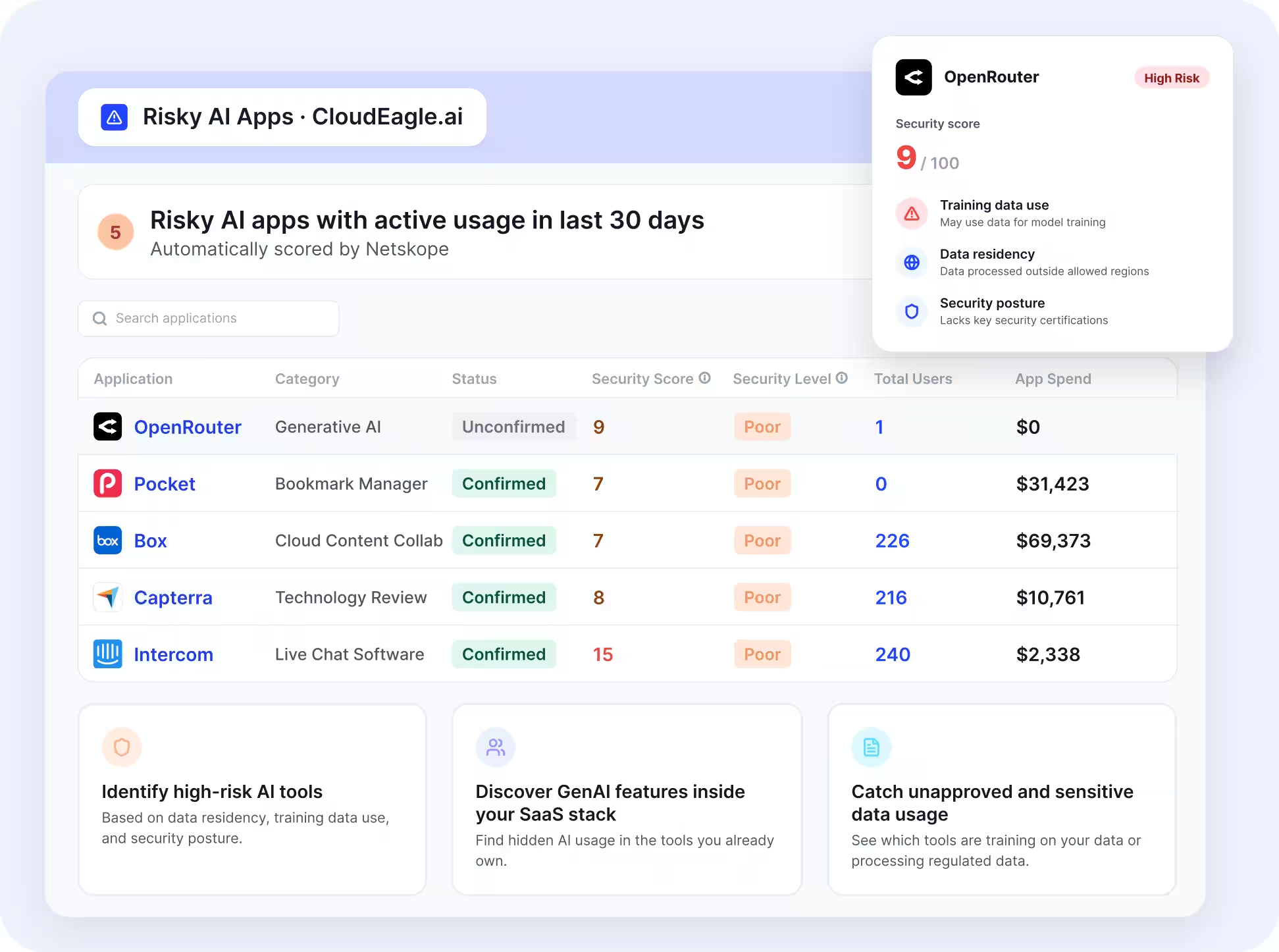
- Alerts IT when a risk signal changes, such as a vendor turning on AI training.
- Sends a vendor security questionnaire automatically when a new AI tool is detected.
That keeps controls 5.19 to 5.22 current between renewals. Benchling found that 63 of its 287 approved vendors had quietly become GenAI platforms and 11 trained on customer data by default. It switched training off for 8 of them in one afternoon, with the action and owner recorded for each, after CloudEagle.ai helped it assign GenAI risk scores across the stack.
Bring AI agents into access reviews
Agents get created in different consoles, inherit credentials, and often outlive the person who built them. Standard access reviews skip them, which leaves 5.16 and 5.18 with a blind spot.
- Discovers agents across consoles with their owner, permissions, and last activity.
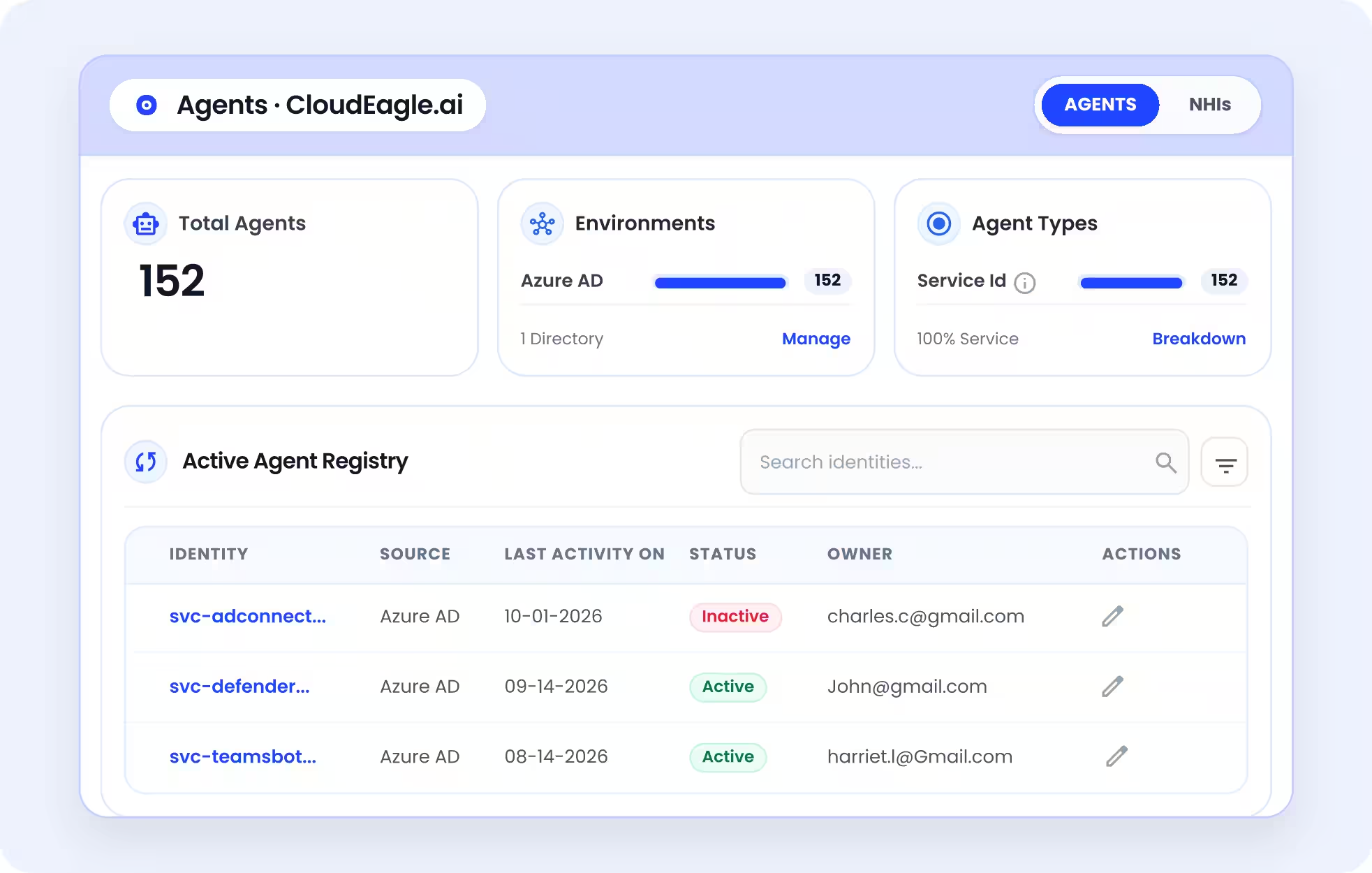
- Adds AI apps and agents to your user access reviews.
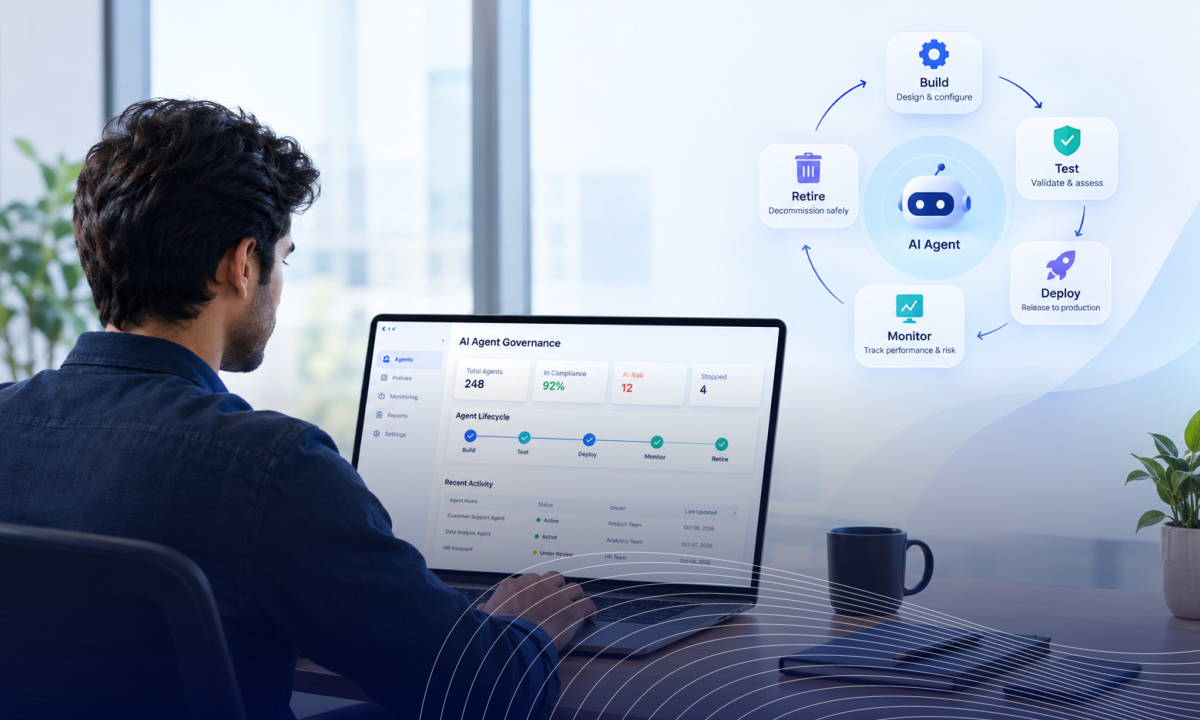
- Shuts down a flagged agent with a kill switch.
Every agent ends up with a named owner and a review record, which is what 5.16 asks for. At Ditto, the first scan found 340 agents, including 19 built by former employees that still held admin access to critical data, and those were closed immediately. Ditto now tracks every AI agent and its permissions in one view.
Enforce the AI policy where employees type
Control 8.12 needs something that operates, and a written policy can't stop a paste. CloudEagle.ai puts the policy inside the browser.
- Detects sensitive data as it's typed and blocks it before it reaches an AI tool, through AI policy enforcement in the Secure Browser.
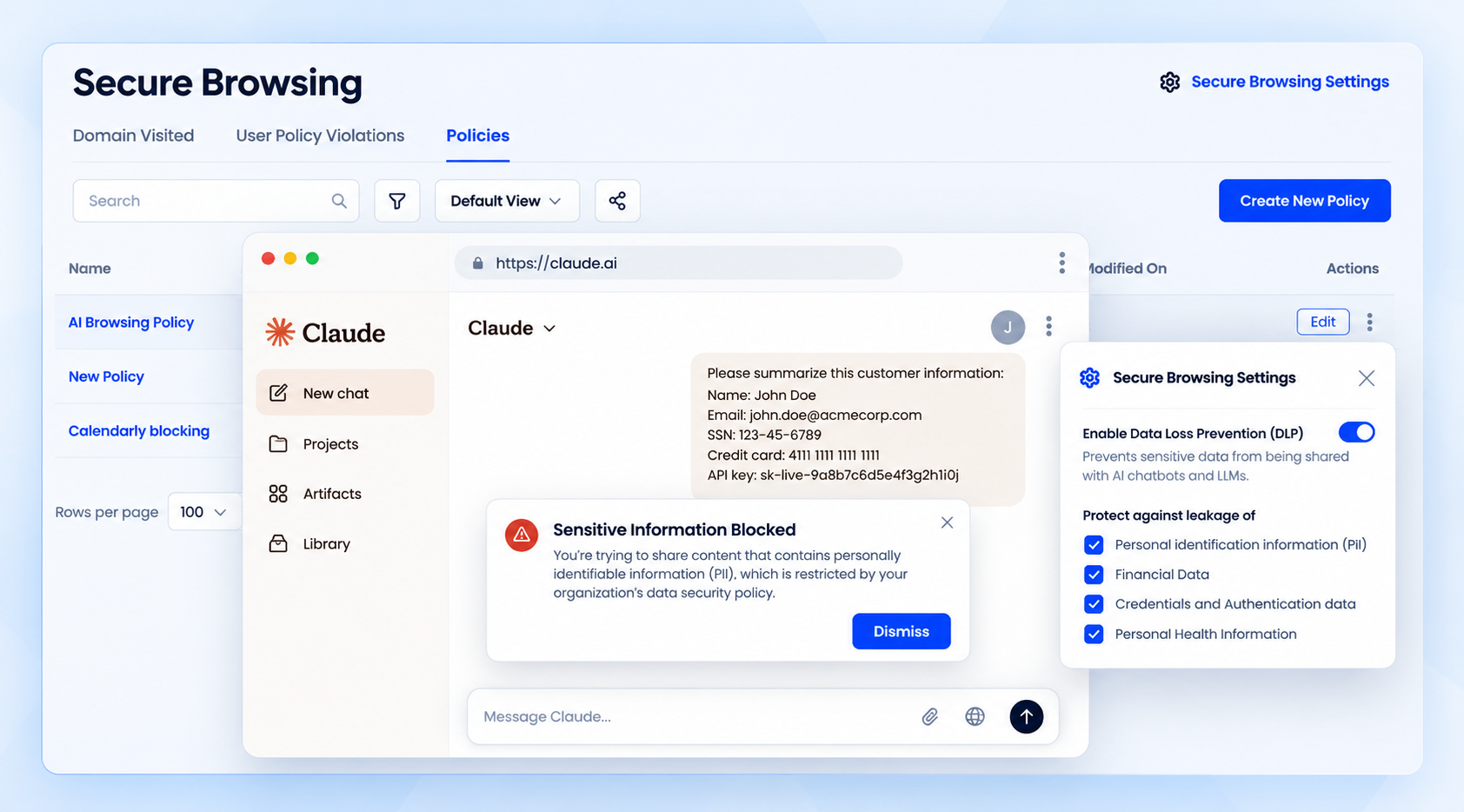
- Redirects employees from unapproved tools to the approved one.
- Logs every flag, redirect, and block automatically.
That turns your acceptable use policy into a working control, with its own evidence trail for 8.12 and 8.16.
Every one of those actions leaves a timestamped record. When your auditor asks how ISO 27001 for AI tools works day to day, you export the evidence instead of rebuilding it from screenshots.
What to Do Before Your Next Surveillance Audit
Bringing AI tools under ISO 27001 is an update to the ISMS you already passed your last audit with. The clauses and controls are already there. What's missing is records that match how your company works today.
If you're starting this week, take it in this order:
- Name AI tools, embedded AI features, and agents in your scope statement.
- Build the AI asset register from more than SSO, with an owner for every tool and agent.
- Fix the access rows first (5.15 to 5.18), since personal accounts and agents are where most gaps sit.
The rest of the six steps can follow over the next few weeks.
Then plan for drift. A register that's accurate in November can be out of date by March, and that's usually how a nonconformity starts. Treat ISO 27001 for AI tools as something you keep current between audits, with discovery running continuously so the next surveillance audit finds the same picture your team sees.
FAQs
Are there ISO standards for AI?
Yes. ISO/IEC 42001 is the certifiable AI management standard, and 27090 gives security guidance for AI systems.
Is ISO 27001 outdated?
No. The 2022 edition is current and technology-neutral, so it covers AI tools through the same risk process and controls.
Which ISO certification for AI?
ISO 27001 for AI tools covers what your teams use. Add ISO/IEC 42001 if you build AI products or customers want AI governance proof.
Which AI tools are GDPR compliant?
None are by default. It depends on the vendor's DPA, data residency, training opt-outs, and how you configure the tool.
What should an AI policy under ISO 27001 include?
Approved tools, data that never goes into prompts, rules for agents, and a way to request new tools, all tied to control 5.10.
Do AI tools put my ISO 27001 certification at risk?
Only if they're missing from your ISMS, unrecorded AI tools tend to surface as nonconformities at surveillance audits.
Want to see which AI tools already fall under ISO 27001 for AI tools in your environment?
Book a demo, and CloudEagle.ai will map every one of them to your ISMS.
Is Your ISMS Missing AI Tools?