You need to enable JavaScript in order to use the AI chatbot tool powered by ChatBot

SaaS License True-Up Negotiation: How to Stop Overpaying at Renewal in 2026

Share via:
blog-cms-banner-bg
Little-Known Negotiation Hacks to Get the Best Deal on Slack
cta-bg-blogDownload Your Copy

HIPAA Compliance Checklist for 2025

Download PDF

Most SaaS renewals do not fail at negotiation. They fail before the conversation even starts.

Over 80% of companies overpay for IT assets, and true-ups are one of the biggest reasons why. The vendor sends an invoice, your team rushes to validate it, and without verified usage data, you end up paying what is presented.

This is where SaaS license true-up negotiations are won or lost. Not in the final call, but in how prepared you are before it.

Here is how to walk into true-up conversations with the right data and the right leverage.

TL;DR

  • A true-up clause reconciles contracted license counts against actual usage. Vendors use it to charge you for overages. You can use it to negotiate down
  • Most enterprises accept the vendor's usage report without pulling independent data, which is the single most expensive mistake in SaaS license true-up negotiation
  • True-down rights, quarterly true-up structures, and price escalation caps are negotiable but rarely included in standard contracts unless you ask
  • Running a pre-true-up audit 90 days before renewal gives you the data to reduce your count before reconciliation hits
  • CloudEagle.ai gives you real-time usage data, license reclamation workflows, and benchmark pricing so you control the true-up conversation

1. True-Up in Software Agreements: Why Most Enterprises Pay More Than They Should

Most procurement teams treat true-up as an unavoidable cost. It is not. It is a negotiation.

SaaS inflation is running at 8.7% year over year, nearly five times the standard G7 inflation rate, per Vertice's 2026 SaaS Inflation Index

True-up is one of the main mechanisms they use to capture additional revenue from existing customers.

What a True-Up Clause Actually Means

A true-up clause is a contractual reconciliation. At a defined interval, usually annually, the vendor compares contracted license counts against actual usage.

Here is how the math works against you by default:

  • If you exceeded your contracted count, you owe the difference at full list price or a premium overage rate
  • If you used fewer licenses, most standard contracts give you no credit
  • The financial exposure runs entirely in one direction unless you have negotiated otherwise

How True-Up Differs Between SaaS and Traditional Licenses

Factor Traditional Enterprise License SaaS True-Up
Timing Annual or at audit Annual, quarterly, or at renewal
Usage measurement Self-reported or audited Vendor dashboard, often unverified
True-down rights Sometimes included Rarely included by default
Overage pricing Negotiated at signing Often, the list price or premium rate
Dispute process Defined in the contract Usually vague

SaaS true-ups move faster and carry less formal dispute protection. That makes independent usage data more important, not less.

Why Vendor Quotes at True-Up Are Almost Always Above Fair Market Value

Vendors' price true-up overages, assuming you have no data and no leverage.

They know most customers will not have pulled independent usage reports. They know the renewal window is tight. And they know most teams would rather pay than delay.

83% of successful renewal negotiations start at least 120 days before the renewal date, per SaaStr research. The teams that win are simply the ones who started earlier than the vendor expected.

Before going deeper into negotiation tactics, understanding what your own usage data looks like is the foundation of every true-up conversation.

📖 Worth a Read: Most teams go into renewal conversations with vendor-supplied numbers. Here is why that always costs more than it should and what to do instead. 👉 How to Centralize Your SaaS Contracts and Streamline Renewals

2. How SaaS License True-Up Negotiation Goes Wrong

True-up negotiations fail in predictable ways. Here are the three most expensive ones.

Accepting the Vendor's Usage Numbers

The vendor's dashboard shows what the vendor wants you to see. It may:

  • Count inactive users as active
  • Include trial or test accounts in the total
  • Measure logins differently than your identity provider does
  • Ignore seats that have been dormant for months

Your own usage data pulled from SSO logs will almost always show a lower active user count than the vendor's report. The difference between those two numbers is your negotiation position.

Missing the Opt-Out Window

Most SaaS contracts require 30, 60, or 90 days' notice to modify seat counts at renewal.

Miss that window, and the contract auto-renews at the current count, including overages from the previous period. One missed notification means another full year of paying for seats nobody is using.

No True-Down Rights in the Contract

True-down rights give you the contractual ability to reduce license counts at renewal without penalty.

Most standard SaaS contracts do not include them. Vendors have no incentive to offer them unprompted. And most procurement teams do not think to ask until they are already locked into a seat count they cannot reduce.

Negotiate true-down rights at signing. By the time you need them, it is too late to add them without significant pushback.

Walking Into a True-Up Without Your Own Usage Data?

That is the vendor's favorite kind of negotiation. Get the SaaS spend optimization guide before your next renewal.
Stop Overpaying

3. The Pre-True-Up Audit: Building Your Negotiation Position

The 90 days before true-up are when the real work happens. Not in the negotiation room. In your own data.

Pull Real Usage Data From Your Identity Provider

Do not start with the vendor's dashboard. Start with your SSO logs.

Pull login activity for every user on the contract over the past 90 days:

  • Filter for users with zero logins in the period
  • Filter for users with fewer than five logins
  • Flag accounts tied to employees who have left the organization
  • Identify shared accounts or service accounts inflating the total count

This gives you an independent usage picture that the vendor cannot dispute.

Calculate Cost Per Active User

Take your total annual contract value and divide it by your verified active user count. Not the contracted seat count. The actual active user count.

This number usually surprises people. When you are paying for 500 seats and 280 of them are active, your real cost per user is almost double what you think it is.

That calculation becomes the anchor for your negotiation conversation.

Run a License Reclamation Exercise 90 Days Before True-Up

Do not wait for the vendor to send the invoice. Act first.

90 days out:

  • Identify all dormant and inactive seats
  • Notify managers of users who have not logged in within 60 days
  • Formally reclaim licenses from departed employees and inactive accounts
  • Document every reclamation with a timestamp

By the time the vendor runs their true-up count, your active user number is lower. And lower is better.

If you want to hear how finance leaders approach SaaS spend and true-up negotiations in practice, this is worth your time.

🎙️ Podcast: Optimizing SaaS Spend Management: Strategies from a Finance Director. Real tactics on how finance teams approach vendor negotiations and build leverage before renewal. 👉 Listen now

4. SaaS License True-Up Negotiation Tactics That Actually Work

1. Never Accept the Vendor's Usage Report as the Starting Point

Always bring your own data. Always. The vendor's report is their opening position, not a neutral fact.

If their count differs from yours, ask for a line-by-line reconciliation. Most vendors will negotiate rather than defend every data point.

2. Benchmark Your Price Against What Peers Actually Pay

Vendor-provided pricing is rarely the lowest available. Before any true-up conversation:

  • Find out what comparable organizations pay for the same tool at similar scale
  • Use benchmarking data to set a target price before the vendor presents their number
  • Reference competitive alternatives even if you have no intention of switching

Benchmark data shifts the conversation from "will you accept the increase" to "what does the market actually support?"

3. Negotiate True-Down Rights Before You Sign

This is the most important clause that most teams forget to include.

Push for language that explicitly allows you to reduce seat counts at renewal by a defined percentage, typically 10 to 20%, without penalty. Vendors will push back. Hold firm. This single clause can save significantly over a multi-year agreement.

4. Push for Quarterly True-Up Structures

Annual true-ups create large, unexpected invoices. Quarterly true-ups spread the reconciliation across the year and give you more frequent opportunities to right-size before the gap compounds.

Not all vendors will agree. But for large contracts, it is worth pushing.

5. Cap Annual Price Escalation in the Contract

Do not just negotiate the first-year price. Negotiate what happens in years two and three.

Push for a cap on annual price increases, ideally tied to CPI or fixed at 3 to 5%. Anything uncapped gives the vendor unlimited pricing flexibility at every subsequent true-up.

6. Use Competitive Alternatives as Leverage

You do not have to be planning to switch to mention that you are evaluating alternatives.

Competitive pressure changes the tone of a true-up negotiation. Vendors who believe you are locked in negotiate differently than vendors who know you have options on the table.

7. Negotiate a Longer Notice Window

Standard contracts give you 30 days to modify seat counts before renewal. That is rarely enough time.

Push for 90 days minimum. This gives you time to run your pre-true-up audit, complete license reclamation, and present a defensible reduced seat count before the vendor locks in their numbers.

5. True-Up in Software Agreements: Clauses to Audit Before Renewal

Before any true-up conversation, pull the contract and review these three sections specifically.

Auto-Renewal Language and the Notice Window

Find the exact opt-out notice requirement. Note the date. Set automated alerts at 120, 90, and 60 days before that date.

If the contract auto-renews before you have completed your audit, you lose your leverage entirely for another full year.

Overage Pricing: What Happens When You Exceed Usage Mid-Term

Most contracts specify a per-seat overage rate for usage above contracted counts.

Check whether that rate is:

  • Fixed at the original per-seat price
  • Set at a premium above the list price
  • Subject to a volume discount that reduces it at higher counts

Overage rates are negotiable at signing. Mid-term, you are stuck with whatever the contract says.

Data Portability and Termination Rights

If negotiations break down completely, you need a clean exit.

Review what data portability looks like, how long the vendor gives you to export your data after termination, and whether there are exit fees tied to early termination. 

Teams that have strong termination rights negotiate from a stronger position because the vendor knows you can actually leave.

Your SaaS Contracts Have Clauses Costing You Money Right Now.

Most teams only find them at renewal. This checklist shows you what to look for before the vendor does.
Review My Contracts Now

6. How CloudEagle.ai Gives You the Usage Data You Need to Win Every True-Up

Most enterprises walk into true-up conversations armed with nothing but the vendor's own numbers. That is not a negotiation. That is an invoice approval.

CloudEagle.ai is an AI-powered SaaS management, security, and identity governance and administration platform that gives enterprises a unified command center to discover, secure, govern, and optimize both human and non-human identities across their entire SaaS and AI ecosystem.

Real-Time License Utilization Across Your Entire Stack

CloudEagle connects to 500+ direct integrations across your SSO, HRIS, finance, and security systems to give you a live, correlated view of every license in your environment.

You get:

  • Active vs. dormant seat counts per application
  • Last login dates and feature-level usage, not just logins
  • Department-level breakdowns to identify where waste is concentrated
  • Accounts tied to departed employees that are still active and still costing money

When the vendor sends their true-up report, you already have independent numbers they cannot argue with.

Automated License Harvesting Before True-Up Hits

Most organizations only discover unused licenses after renewal. CloudEagle flips that.

CloudEagle continuously monitors license activity across all SaaS apps. It identifies unused, underutilized, and duplicate licenses and automates the reclamation process, including sending emails, tracking non-responses, and deprovisioning users automatically.

The result:

  • Licenses are reclaimed and returned to the pool before the true-up window opens
  • Downgrades happen based on feature usage, not just login frequency
  • Every reclamation is timestamped and documented for audit and negotiation evidence
  • Your active seat count is lower and defensible when the vendor runs their reconciliation

Customers using CloudEagle achieve a 10 to 30% reduction in SaaS and AI spend starting from week one, not after a long optimization project.

Benchmark Pricing to Validate Every Vendor Quote

Entering a true-up conversation without market data puts you at the vendor's mercy. CloudEagle's price benchmarking gives you the market intelligence to push back with confidence.

CloudEagle aggregates pricing benchmarks from its SaaS buying team plus market intelligence across vendor channels, procurement user groups, and feature release data. This is not just big vendor coverage.
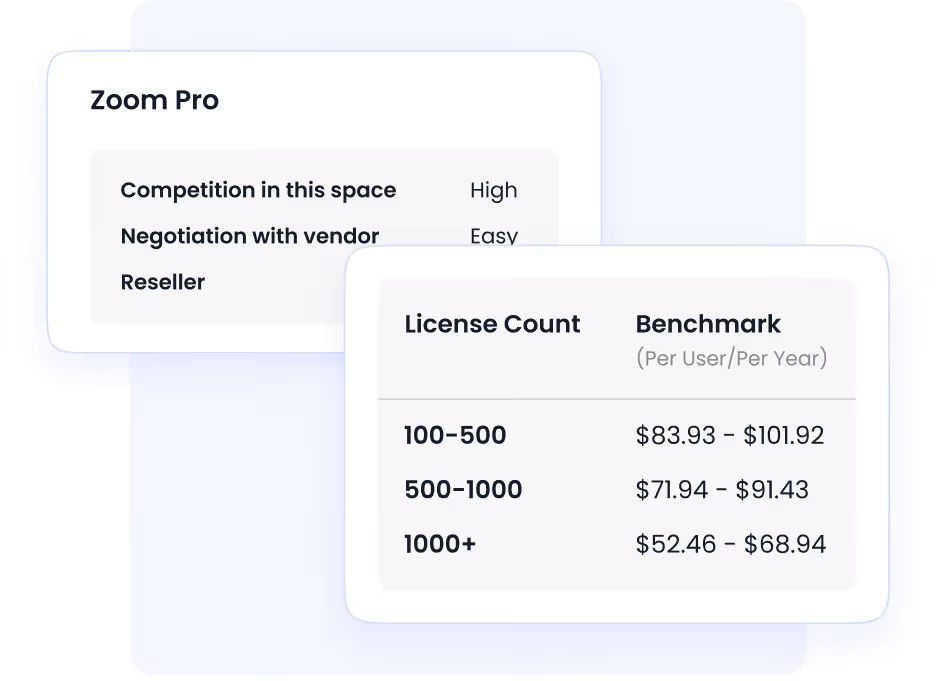
Before any true-up or software license audit conversation:

  • See where your current per-seat price sits relative to what peers of your size actually pay
  • Identify tools where you are significantly above the benchmark
  • Walk into the negotiation with a target price range, not a gut feel

Renewal Calendar and Alert Automation

CloudEagle tracks every contract's renewal date, opt-out notice window, and true-up schedule across your entire vendor portfolio.
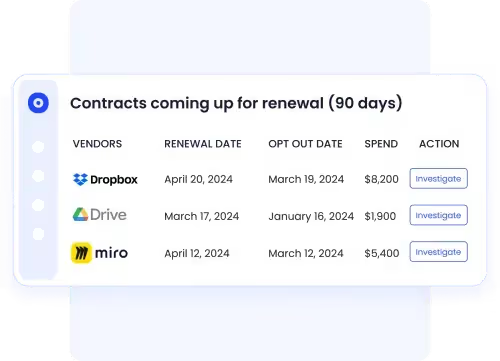
No-code, Slack-enabled workflows trigger automatically:

  • Alerts at 120, 90, 60, and 30 days before each renewal
  • Pre-true-up audit workflows initiated 90 days out, so your team has time to act
  • First renewal message to your team includes current usage data, price benchmarking, competitive alternatives, and an AI-powered recommendation
  • Escalation chains that fire automatically if approvals are delayed

With 30-minute onboarding and $20B+ in spend processed across its customer base, CloudEagle delivers immediate governance and savings visibility from day one, without changing your existing tools or workflows.

Conclusion

SaaS license true-up negotiation is not about pushing back on vendors. It is about showing up with the right data.

The teams that consistently win true-up conversations are not bigger or better resourced. They prepare earlier. They validate their own usage before the vendor does, reclaim licenses ahead of renewal, negotiate flexibility at signing, and benchmark pricing before accepting any quote.

That is the core of effective software license true-up management.

CloudEagle.ai automates the data collection, reclamation workflows, and benchmarking that make true-up licensing negotiations winnable. If you are heading into a true-up conversation in the next 90 days. 

Book a demo with CloudEagle.ai and walk in with numbers the vendor cannot argue with.

Frequently Asked Questions 

1. What is the 70/30 rule in negotiation?

The 70/30 rule means you should listen 70% and talk 30%, helping you uncover needs, control the conversation, and negotiate better outcomes.

2. How to negotiate SaaS contracts?

Benchmark pricing, understand usage, negotiate multi-year discounts, cap renewals, and review terms like SLAs, exit clauses, and data ownership.

3. What is true-up software licensing?

True-up licensing adjusts costs based on actual usage, requiring businesses to pay for any extra licenses used beyond the original agreement.

4. What is true-up in Microsoft licensing?

In Microsoft licensing, true-up is an annual process where you report increased usage and pay for additional licenses used.

5. What are the disadvantages of a true-up?

True-ups can lead to unexpected costs, budget overruns, lack of visibility, and reduced negotiation leverage after usage has already increased.

Advertisement for a SaaS Subscription Tracking Template with a call-to-action button to download and a partial graphic of a tablet showing charts.Banner promoting a SaaS Agreement Checklist to streamline SaaS management and avoid budget waste with a call-to-action button labeled Download checklist.Blue banner with text 'The Ultimate Employee Offboarding Checklist!' and a black button labeled 'Download checklist' alongside partial views of checklist documents from cloudeagle.ai.Digital ad for download checklist titled 'The Ultimate Checklist for IT Leaders to Optimize SaaS Operations' by cloudeagle.ai, showing checklist pages.Slack Buyer's Guide offer with text 'Unlock insider insights to get the best deal on Slack!' and a button labeled 'Get Your Copy', accompanied by a preview of the guide featuring Slack's logo.Monday Pricing Guide by cloudeagle.ai offering exclusive pricing secrets to maximize investment with a call-to-action button labeled Get Your Copy and an image of the guide's cover.Blue banner for Canva Pricing Guide by cloudeagle.ai offering a guide to Canva costs, features, and alternatives with a call-to-action button saying Get Your Copy.Blue banner with white text reading 'Little-Known Negotiation Hacks to Get the Best Deal on Slack' and a white button labeled 'Get Your Copy'.Blue banner with text 'Little-Known Negotiation Hacks to Get the Best Deal on Monday.com' and a white button labeled 'Get Your Copy'.Blue banner with text 'Little-Known Negotiation Hacks to Get the Best Deal on Canva' and a white button labeled 'Get Your Copy'.Banner with text 'Slack Buyer's Guide' and a 'Download Now' button next to images of a guide titled 'Slack Buyer’s Guide: Features, Pricing & Best Practices'.Digital cover of Monday Pricing Guide with a button labeled Get Your Copy on a blue background.Canva Pricing Guide cover with a button labeled Get Your Copy on a blue gradient background.

Enter your email to
unlock the report

Oops! Something went wrong while submitting the form.
License Count
Benchmark
Per User/Per Year

Enter your email to
unlock the report

Oops! Something went wrong while submitting the form.
License Count
Benchmark
Per User/Per Year

Enter your email to
unlock the report

Oops! Something went wrong while submitting the form.
Notion Plus
License Count
Benchmark
Per User/Per Year
100-500
$67.20 - $78.72
500-1000
$59.52 - $72.00
1000+
$51.84 - $57.60
Canva Pro
License Count
Benchmark
Per User/Per Year
100-500
$74.33-$88.71
500-1000
$64.74-$80.32
1000+
$55.14-$62.34

Enter your email to
unlock the report

Oops! Something went wrong while submitting the form.

Enter your email to
unlock the report

Oops! Something went wrong while submitting the form.
Zoom Business
License Count
Benchmark
Per User/Per Year
100-500
$216.00 - $264.00
500-1000
$180.00 - $216.00
1000+
$156.00 - $180.00

Enter your email to
unlock the report

Oops! Something went wrong while submitting the form.

Get the Right Security Platform To Secure Your Cloud Infrastructure

Please enter a business email
Thank you!
The 2023 SaaS report has been sent to your email. Check your promotional or spam folder.
Oops! Something went wrong while submitting the form.

Access full report

Please enter a business email
Thank you!
The 2023 SaaS report has been sent to your email. Check your promotional or spam folder.
Oops! Something went wrong while submitting the form.

Most SaaS renewals do not fail at negotiation. They fail before the conversation even starts.

Over 80% of companies overpay for IT assets, and true-ups are one of the biggest reasons why. The vendor sends an invoice, your team rushes to validate it, and without verified usage data, you end up paying what is presented.

This is where SaaS license true-up negotiations are won or lost. Not in the final call, but in how prepared you are before it.

Here is how to walk into true-up conversations with the right data and the right leverage.

TL;DR

  • A true-up clause reconciles contracted license counts against actual usage. Vendors use it to charge you for overages. You can use it to negotiate down
  • Most enterprises accept the vendor's usage report without pulling independent data, which is the single most expensive mistake in SaaS license true-up negotiation
  • True-down rights, quarterly true-up structures, and price escalation caps are negotiable but rarely included in standard contracts unless you ask
  • Running a pre-true-up audit 90 days before renewal gives you the data to reduce your count before reconciliation hits
  • CloudEagle.ai gives you real-time usage data, license reclamation workflows, and benchmark pricing so you control the true-up conversation

1. True-Up in Software Agreements: Why Most Enterprises Pay More Than They Should

Most procurement teams treat true-up as an unavoidable cost. It is not. It is a negotiation.

SaaS inflation is running at 8.7% year over year, nearly five times the standard G7 inflation rate, per Vertice's 2026 SaaS Inflation Index

True-up is one of the main mechanisms they use to capture additional revenue from existing customers.

What a True-Up Clause Actually Means

A true-up clause is a contractual reconciliation. At a defined interval, usually annually, the vendor compares contracted license counts against actual usage.

Here is how the math works against you by default:

  • If you exceeded your contracted count, you owe the difference at full list price or a premium overage rate
  • If you used fewer licenses, most standard contracts give you no credit
  • The financial exposure runs entirely in one direction unless you have negotiated otherwise

How True-Up Differs Between SaaS and Traditional Licenses

Factor Traditional Enterprise License SaaS True-Up
Timing Annual or at audit Annual, quarterly, or at renewal
Usage measurement Self-reported or audited Vendor dashboard, often unverified
True-down rights Sometimes included Rarely included by default
Overage pricing Negotiated at signing Often, the list price or premium rate
Dispute process Defined in the contract Usually vague

SaaS true-ups move faster and carry less formal dispute protection. That makes independent usage data more important, not less.

Why Vendor Quotes at True-Up Are Almost Always Above Fair Market Value

Vendors' price true-up overages, assuming you have no data and no leverage.

They know most customers will not have pulled independent usage reports. They know the renewal window is tight. And they know most teams would rather pay than delay.

83% of successful renewal negotiations start at least 120 days before the renewal date, per SaaStr research. The teams that win are simply the ones who started earlier than the vendor expected.

Before going deeper into negotiation tactics, understanding what your own usage data looks like is the foundation of every true-up conversation.

📖 Worth a Read: Most teams go into renewal conversations with vendor-supplied numbers. Here is why that always costs more than it should and what to do instead. 👉 How to Centralize Your SaaS Contracts and Streamline Renewals

2. How SaaS License True-Up Negotiation Goes Wrong

True-up negotiations fail in predictable ways. Here are the three most expensive ones.

Accepting the Vendor's Usage Numbers

The vendor's dashboard shows what the vendor wants you to see. It may:

  • Count inactive users as active
  • Include trial or test accounts in the total
  • Measure logins differently than your identity provider does
  • Ignore seats that have been dormant for months

Your own usage data pulled from SSO logs will almost always show a lower active user count than the vendor's report. The difference between those two numbers is your negotiation position.

Missing the Opt-Out Window

Most SaaS contracts require 30, 60, or 90 days' notice to modify seat counts at renewal.

Miss that window, and the contract auto-renews at the current count, including overages from the previous period. One missed notification means another full year of paying for seats nobody is using.

No True-Down Rights in the Contract

True-down rights give you the contractual ability to reduce license counts at renewal without penalty.

Most standard SaaS contracts do not include them. Vendors have no incentive to offer them unprompted. And most procurement teams do not think to ask until they are already locked into a seat count they cannot reduce.

Negotiate true-down rights at signing. By the time you need them, it is too late to add them without significant pushback.

Walking Into a True-Up Without Your Own Usage Data?

That is the vendor's favorite kind of negotiation. Get the SaaS spend optimization guide before your next renewal.
Stop Overpaying

3. The Pre-True-Up Audit: Building Your Negotiation Position

The 90 days before true-up are when the real work happens. Not in the negotiation room. In your own data.

Pull Real Usage Data From Your Identity Provider

Do not start with the vendor's dashboard. Start with your SSO logs.

Pull login activity for every user on the contract over the past 90 days:

  • Filter for users with zero logins in the period
  • Filter for users with fewer than five logins
  • Flag accounts tied to employees who have left the organization
  • Identify shared accounts or service accounts inflating the total count

This gives you an independent usage picture that the vendor cannot dispute.

Calculate Cost Per Active User

Take your total annual contract value and divide it by your verified active user count. Not the contracted seat count. The actual active user count.

This number usually surprises people. When you are paying for 500 seats and 280 of them are active, your real cost per user is almost double what you think it is.

That calculation becomes the anchor for your negotiation conversation.

Run a License Reclamation Exercise 90 Days Before True-Up

Do not wait for the vendor to send the invoice. Act first.

90 days out:

  • Identify all dormant and inactive seats
  • Notify managers of users who have not logged in within 60 days
  • Formally reclaim licenses from departed employees and inactive accounts
  • Document every reclamation with a timestamp

By the time the vendor runs their true-up count, your active user number is lower. And lower is better.

If you want to hear how finance leaders approach SaaS spend and true-up negotiations in practice, this is worth your time.

🎙️ Podcast: Optimizing SaaS Spend Management: Strategies from a Finance Director. Real tactics on how finance teams approach vendor negotiations and build leverage before renewal. 👉 Listen now

4. SaaS License True-Up Negotiation Tactics That Actually Work

1. Never Accept the Vendor's Usage Report as the Starting Point

Always bring your own data. Always. The vendor's report is their opening position, not a neutral fact.

If their count differs from yours, ask for a line-by-line reconciliation. Most vendors will negotiate rather than defend every data point.

2. Benchmark Your Price Against What Peers Actually Pay

Vendor-provided pricing is rarely the lowest available. Before any true-up conversation:

  • Find out what comparable organizations pay for the same tool at similar scale
  • Use benchmarking data to set a target price before the vendor presents their number
  • Reference competitive alternatives even if you have no intention of switching

Benchmark data shifts the conversation from "will you accept the increase" to "what does the market actually support?"

3. Negotiate True-Down Rights Before You Sign

This is the most important clause that most teams forget to include.

Push for language that explicitly allows you to reduce seat counts at renewal by a defined percentage, typically 10 to 20%, without penalty. Vendors will push back. Hold firm. This single clause can save significantly over a multi-year agreement.

4. Push for Quarterly True-Up Structures

Annual true-ups create large, unexpected invoices. Quarterly true-ups spread the reconciliation across the year and give you more frequent opportunities to right-size before the gap compounds.

Not all vendors will agree. But for large contracts, it is worth pushing.

5. Cap Annual Price Escalation in the Contract

Do not just negotiate the first-year price. Negotiate what happens in years two and three.

Push for a cap on annual price increases, ideally tied to CPI or fixed at 3 to 5%. Anything uncapped gives the vendor unlimited pricing flexibility at every subsequent true-up.

6. Use Competitive Alternatives as Leverage

You do not have to be planning to switch to mention that you are evaluating alternatives.

Competitive pressure changes the tone of a true-up negotiation. Vendors who believe you are locked in negotiate differently than vendors who know you have options on the table.

7. Negotiate a Longer Notice Window

Standard contracts give you 30 days to modify seat counts before renewal. That is rarely enough time.

Push for 90 days minimum. This gives you time to run your pre-true-up audit, complete license reclamation, and present a defensible reduced seat count before the vendor locks in their numbers.

5. True-Up in Software Agreements: Clauses to Audit Before Renewal

Before any true-up conversation, pull the contract and review these three sections specifically.

Auto-Renewal Language and the Notice Window

Find the exact opt-out notice requirement. Note the date. Set automated alerts at 120, 90, and 60 days before that date.

If the contract auto-renews before you have completed your audit, you lose your leverage entirely for another full year.

Overage Pricing: What Happens When You Exceed Usage Mid-Term

Most contracts specify a per-seat overage rate for usage above contracted counts.

Check whether that rate is:

  • Fixed at the original per-seat price
  • Set at a premium above the list price
  • Subject to a volume discount that reduces it at higher counts

Overage rates are negotiable at signing. Mid-term, you are stuck with whatever the contract says.

Data Portability and Termination Rights

If negotiations break down completely, you need a clean exit.

Review what data portability looks like, how long the vendor gives you to export your data after termination, and whether there are exit fees tied to early termination. 

Teams that have strong termination rights negotiate from a stronger position because the vendor knows you can actually leave.

Your SaaS Contracts Have Clauses Costing You Money Right Now.

Most teams only find them at renewal. This checklist shows you what to look for before the vendor does.
Review My Contracts Now

6. How CloudEagle.ai Gives You the Usage Data You Need to Win Every True-Up

Most enterprises walk into true-up conversations armed with nothing but the vendor's own numbers. That is not a negotiation. That is an invoice approval.

CloudEagle.ai is an AI-powered SaaS management, security, and identity governance and administration platform that gives enterprises a unified command center to discover, secure, govern, and optimize both human and non-human identities across their entire SaaS and AI ecosystem.

Real-Time License Utilization Across Your Entire Stack

CloudEagle connects to 500+ direct integrations across your SSO, HRIS, finance, and security systems to give you a live, correlated view of every license in your environment.

You get:

  • Active vs. dormant seat counts per application
  • Last login dates and feature-level usage, not just logins
  • Department-level breakdowns to identify where waste is concentrated
  • Accounts tied to departed employees that are still active and still costing money

When the vendor sends their true-up report, you already have independent numbers they cannot argue with.

Automated License Harvesting Before True-Up Hits

Most organizations only discover unused licenses after renewal. CloudEagle flips that.

CloudEagle continuously monitors license activity across all SaaS apps. It identifies unused, underutilized, and duplicate licenses and automates the reclamation process, including sending emails, tracking non-responses, and deprovisioning users automatically.

The result:

  • Licenses are reclaimed and returned to the pool before the true-up window opens
  • Downgrades happen based on feature usage, not just login frequency
  • Every reclamation is timestamped and documented for audit and negotiation evidence
  • Your active seat count is lower and defensible when the vendor runs their reconciliation

Customers using CloudEagle achieve a 10 to 30% reduction in SaaS and AI spend starting from week one, not after a long optimization project.

Benchmark Pricing to Validate Every Vendor Quote

Entering a true-up conversation without market data puts you at the vendor's mercy. CloudEagle's price benchmarking gives you the market intelligence to push back with confidence.

CloudEagle aggregates pricing benchmarks from its SaaS buying team plus market intelligence across vendor channels, procurement user groups, and feature release data. This is not just big vendor coverage.

Before any true-up or software license audit conversation:

  • See where your current per-seat price sits relative to what peers of your size actually pay
  • Identify tools where you are significantly above the benchmark
  • Walk into the negotiation with a target price range, not a gut feel

Renewal Calendar and Alert Automation

CloudEagle tracks every contract's renewal date, opt-out notice window, and true-up schedule across your entire vendor portfolio.

No-code, Slack-enabled workflows trigger automatically:

  • Alerts at 120, 90, 60, and 30 days before each renewal
  • Pre-true-up audit workflows initiated 90 days out, so your team has time to act
  • First renewal message to your team includes current usage data, price benchmarking, competitive alternatives, and an AI-powered recommendation
  • Escalation chains that fire automatically if approvals are delayed

With 30-minute onboarding and $20B+ in spend processed across its customer base, CloudEagle delivers immediate governance and savings visibility from day one, without changing your existing tools or workflows.

Conclusion

SaaS license true-up negotiation is not about pushing back on vendors. It is about showing up with the right data.

The teams that consistently win true-up conversations are not bigger or better resourced. They prepare earlier. They validate their own usage before the vendor does, reclaim licenses ahead of renewal, negotiate flexibility at signing, and benchmark pricing before accepting any quote.

That is the core of effective software license true-up management.

CloudEagle.ai automates the data collection, reclamation workflows, and benchmarking that make true-up licensing negotiations winnable. If you are heading into a true-up conversation in the next 90 days. 

Book a demo with CloudEagle.ai and walk in with numbers the vendor cannot argue with.

Frequently Asked Questions 

1. What is the 70/30 rule in negotiation?

The 70/30 rule means you should listen 70% and talk 30%, helping you uncover needs, control the conversation, and negotiate better outcomes.

2. How to negotiate SaaS contracts?

Benchmark pricing, understand usage, negotiate multi-year discounts, cap renewals, and review terms like SLAs, exit clauses, and data ownership.

3. What is true-up software licensing?

True-up licensing adjusts costs based on actual usage, requiring businesses to pay for any extra licenses used beyond the original agreement.

4. What is true-up in Microsoft licensing?

In Microsoft licensing, true-up is an annual process where you report increased usage and pay for additional licenses used.

5. What are the disadvantages of a true-up?

True-ups can lead to unexpected costs, budget overruns, lack of visibility, and reduced negotiation leverage after usage has already increased.

CloudEagle.ai recognized in the 2025 Gartner® Magic Quadrant™ for SaaS Management Platforms
Download now
gartner chart
5x
Faster employee
onboarding
80%
Reduction in time for
user access reviews
30k
Workflows
automated
$15Bn
Analyzed in
contract spend
$2Bn
Saved in
SaaS spend

Streamline SaaS governance and save 10-30%

Book a Demo with Expert
CTA image
One platform to Manage
all SaaS Products
Learn More