HIPAA Compliance Checklist for 2025

Governance, risk, and compliance (GRC) programs help organizations manage risk and meet regulatory requirements. However, documented policies and completed audits do not always mean controls work as intended.
As businesses adopt more SaaS applications and AI tools, identifying and managing exposure becomes more complex. IBM's 2026 Cost of a Data Breach Report found that one in four malicious data breaches involved AI, with an average cost of $6 million.
A GRC maturity model helps organizations assess their processes, identify control gaps, and prioritize improvements. This guide explains the five maturity levels, how to assess current capabilities, and how to strengthen a GRC program.
1. What Is a GRC Maturity Model?
A GRC maturity model is a framework for evaluating how effectively an organization manages governance, risk, and compliance processes. It assesses whether controls operate consistently, risks have accountable owners, and established procedures lead to measurable results.
Unlike a compliance checklist, a maturity model examines how GRC works in practice. For example, reviewing user access only before an audit indicates lower maturity than conducting regular reviews, removing unnecessary permissions, and tracking exceptions through resolution.
The assessment helps organizations identify weaknesses and build a targeted improvement plan.

2. Why Does GRC Maturity Matter?
GRC maturity affects how consistently an organization identifies risks, enforces controls, and responds to changing requirements. Without a structured approach, teams may duplicate compliance work, overlook risks, or leave issues unresolved.
Assessing maturity helps organizations address five common challenges:
- Limited risk visibility: Fragmented records make it difficult to understand exposure across departments, applications, and vendors.
- Inconsistent controls: Policies may exist, but teams may miss reviews or handle exceptions differently.
- Manual compliance work: Collecting evidence and preparing for audits can consume time and create incomplete records.
- Unclear accountability: Unassigned responsibilities delay risk decisions and remediation.
- SaaS and AI exposure: Unapproved applications, excessive permissions, and unmanaged AI tools can create security and compliance gaps.
A mature GRC program connects policies to daily operations, establishes ownership, and directs resources toward risks with the greatest potential business impact.
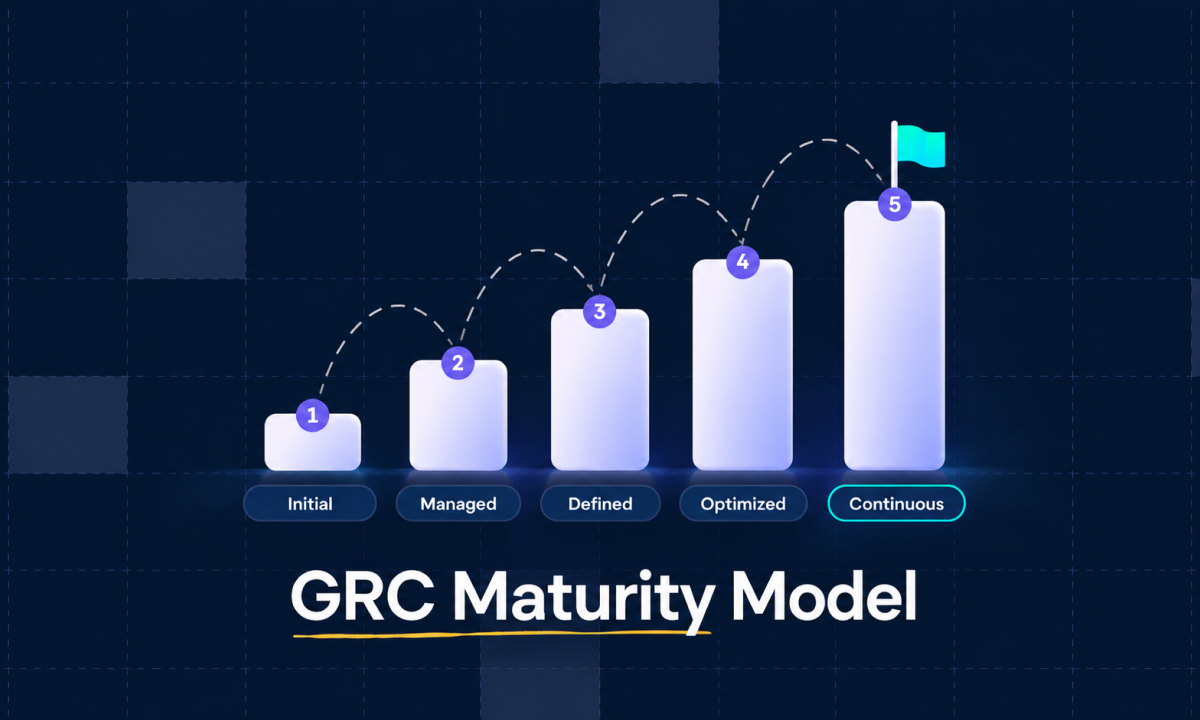
3. What Are the Five Levels of GRC Maturity?
A five-level GRC maturity model describes the progression from reactive risk management to standardized, measurable, and continuously improving processes.
These stages form an illustrative assessment framework, not a universal industry standard. Organizations may use different labels or criteria, and individual capabilities can sit at different maturity levels.
Level 1: Initial
GRC activities are largely reactive. Teams respond to incidents, audit requests, or regulatory deadlines, often relying on spreadsheets, emails, and individual knowledge.
Example: A security team discovers an unapproved SaaS application and must investigate its users, data access, and approval history.
What to prioritize:
- Document critical risks and essential policies.
- Assign owners to key controls and remediation tasks.
- Inventory important applications, vendors, and systems.
The first objective is to establish basic visibility and accountability.
Level 2: Developing
Organizations begin documenting policies, scheduling risk assessments, and defining approval procedures. However, implementation varies across departments, and completing a review may not lead to corrective action.
Example: Managers complete quarterly access reviews but approve permissions without checking whether employees still need them.
What to prioritize:
- Standardize review schedules and evidence requirements.
- Assign owners and deadlines to identified issues.
- Establish escalation procedures for overdue actions.
The focus is on applying documented procedures consistently.
Level 3: Defined
GRC procedures are standardized, responsibilities are documented, and teams follow established processes for risk assessments, control reviews, and exception handling.
Related activities also begin to connect. For example, a vendor risk assessment may inform procurement approval, contractual safeguards, and access requirements.
Example: Critical SaaS applications have assigned business owners, documented approval requirements, and scheduled access reviews.
What to prioritize:
- Link risk assessments to controls and business decisions.
- Standardize reporting across relevant departments.
- Verify that teams follow procedures and resolve exceptions.
At this stage, the organization must determine whether its standardized processes work as intended.
Level 4: Managed
Organizations measure control performance against defined criteria. Reports highlight significant risks, overdue remediation, recurring exceptions, and control failures. Teams use these findings to investigate problems and improve execution.
Example: Repeatedly missed access reviews prompt an investigation into unclear ownership or inefficient workflows rather than another round of reminders.
What to prioritize:
- Track relevant control performance metrics.
- Investigate recurring failures and their causes.
- Escalate overdue actions according to risk severity.
The distinction is that decisions are informed by evidence of control effectiveness, not simply completed activities.
Level 5: Optimized
GRC practices adapt as risks, regulations, and business operations change. Monitoring and automation help identify emerging issues, while risk-based procedures determine when reviews or corrective actions are necessary.
Unlike Level 4, which focuses on measuring and managing control performance, Level 5 uses changing risk conditions and lessons learned to proactively adjust controls.
Example: A significant change in an application's permissions triggers a review so the responsible owner can reassess access and address resulting risks.
What to prioritize:
- Trigger reviews when risk exposure changes.
- Evaluate whether automated controls remain effective.
- Use audit findings and incidents to improve procedures.
Optimization does not eliminate risk or guarantee compliance. It means the organization can monitor control effectiveness and adapt its response systematically.
Assess maturity by capability, not just by an overall score. Strong audit procedures do not compensate for weak SaaS access governance. Identifying these differences helps leaders direct investment toward the most significant risks.
4. How to Assess Your Organization's GRC Maturity
A GRC maturity assessment should evaluate actual control performance, not just the existence of policies. Assess individual capabilities before calculating an overall score, using control records, audit findings, risk assessments, and input from responsible teams.
Evaluate these six dimensions to identify where the organization needs improvement.
A. Governance and Accountability
Determine whether risk ownership, decision-making authority, and escalation procedures are clear.
- Are critical risks and controls assigned to accountable owners?
- Are risk acceptance decisions and exceptions appropriately approved?
- Do unresolved issues have deadlines and escalation paths?
Evidence of maturity: Decisions are documented, and significant risks reach the appropriate decision-makers.
B. Risk Management
Assess whether risks are consistently evaluated and whether the results influence business decisions.
- Are risks prioritized by likelihood, impact, and existing controls?
- Do treatment plans specify owners and deadlines?
- Are risks reassessed when significant changes occur?
Evidence of maturity: Risk assessments lead to prioritized action and documented decisions.
C. Policies and Internal Controls
Check whether documented procedures translate into consistent control execution.
- Are control owners and review frequencies defined?
- Are approvals and access reviews completed as required?
- Are exceptions tracked through resolution?
Evidence of maturity: Records demonstrate that controls operate as intended and corrective actions are completed.
D. Compliance and Audit Readiness
Determine whether the organization can demonstrate compliance throughout the year.
- Can evidence be traced to the relevant control and reporting period?
- Are audit findings assigned and tracked through verified closure?
- Do recurring findings lead to process changes?
Evidence of maturity: Teams maintain reliable evidence and address the causes of recurring findings.
E. Technology and SaaS Governance
Evaluate visibility into applications, vendors, and access permissions, particularly when teams purchase software independently or adopt AI tools.
- Are applications and their business owners identifiable?
- Are access permissions reviewed and unnecessary privileges removed?
- Are vendor assessments and contract renewals tracked?
Evidence of maturity: Application and access information supports timely reviews and risk remediation.
F. Monitoring and Continuous Improvement
Assess whether the organization measures control performance and uses findings to improve its GRC program.
- Are controls measured against defined criteria?
- Are overdue remediation items and recurring exceptions escalated?
- Do monitoring results lead to corrective action?
Evidence of maturity: Teams investigate recurring failures and verify that improvements resolve the underlying issues.
Use the findings to identify weaknesses, determine the evidence needed to validate each rating, and establish which gaps require immediate attention. The checklist below turns this assessment into a consistent scoring exercise.
5. GRC Maturity Assessment Checklist
Use this checklist to rate each capability from 1 to 5 based on actual execution and supporting evidence.
6. Assess These Six GRC Capabilities
How to Interpret Your Score
Add the six ratings and divide the total by six to calculate the average.
These scoring bands are illustrative, not an industry-standard rating or certification.
Do not rely on the average alone. A low score in a critical area, such as privileged access management, may require immediate action even when other capabilities score well. A high average should never override a significant unresolved risk.
For each gap, record the supporting evidence, accountable owner, and corrective action. Prioritize improvements by risk severity, business impact, and remediation effort.
7. What Are the Common GRC Maturity Gaps?
GRC maturity gaps emerge when policies, controls, and risk management processes fail to work together effectively. Organizations may have documented procedures but still struggle with fragmented risk data, inconsistent execution, or unresolved findings. These gaps can weaken oversight and leave critical risks unaddressed.
A. Fragmented Risk Information
Risk registers, vendor assessments, audit findings, and application inventories often sit in separate systems. Without a consolidated view, teams may miss connections between risks or struggle to determine their combined business impact.
How to address it: Connect risk records with relevant controls, accountable owners, and remediation plans. Establish consistent reporting so decision-makers can identify related risks across departments.
B. Unclear Risk and Control Ownership
When responsibilities are assigned to departments rather than specific individuals, approvals can stall and corrective actions may go unresolved. Unclear decision-making authority can also make it difficult to determine who should accept a risk or escalate an exception.
How to address it: Assign an accountable owner to each critical risk and control. Define approval authority, remediation deadlines, and escalation procedures for overdue or high-impact issues.
C. Manual Evidence Collection
Collecting compliance evidence through spreadsheets, email requests, and shared folders makes audit preparation resource-intensive. Records may be incomplete, outdated, or difficult to trace to the control and period they are meant to demonstrate.
How to address it: Standardize evidence requirements and automate repeatable collection workflows where practical. Maintain traceable records and verify that evidence demonstrates the control operated as required.
D. Inconsistent Control Execution
A documented policy does not guarantee that teams follow it. Access reviews may be missed, excessive permissions may remain active, and exceptions may be approved without adequate justification or follow-up.
How to address it: Test controls against actual records, monitor completion rates, and track exceptions through resolution. Investigate recurring failures to determine whether the cause is unclear ownership, ineffective procedures, or inadequate oversight.
E. Limited SaaS and AI Visibility
Applications adopted outside formal procurement processes may escape security reviews and access governance. Unapproved AI tools can introduce additional exposure when employees share sensitive information without appropriate safeguards.
How to address it: Maintain visibility into applications in use, assign business owners, review access permissions, and assess SaaS and AI tools according to their risk and data access. Include relevant vendor and security reviews in the governance process.
F. Weak Remediation Tracking
Audit findings and control weaknesses can persist when corrective actions lack clear owners, deadlines, or verification requirements. Closing a ticket does not necessarily mean the underlying risk has been resolved.
How to address it: Track findings from identification through verified closure. Escalate overdue high-risk actions, investigate recurring issues, and confirm that remediation addresses the root cause.
8. How to Improve GRC Maturity and Strengthen Risk Management
Use assessment findings to guide improvements rather than adding new processes or technology without a defined need.
A. Establish Visibility and Accountability
Identify critical systems, applications, vendors, risks, and controls. Assign owners for risk decisions and remediation, and address gaps such as applications without verified owners or controls lacking reliable evidence.
B. Standardize Policies and Controls
Create consistent procedures for risk assessments, access reviews, vendor evaluations, and exception handling. Map overlapping regulatory requirements to shared controls where appropriate, while retaining the evidence each framework requires.
C. Automate Repeatable GRC Processes
Automate suitable workflows for evidence collection, approvals, access review reminders, and remediation tracking. Retain approval records, flag exceptions, and route significant risks to the right owners. Automation should support effective controls, not replace them.
D. Measure Performance and Address Gaps
Track overdue remediation, repeat audit findings, access review completion, and the proportion of critical applications with verified owners. Investigate recurring failures, assign corrective actions, and verify that changes resolve the underlying issue.
Reassess maturity after significant regulatory, organizational, or technology changes to confirm that controls remain effective.
9. How SaaS Governance Supports GRC Maturity
SaaS governance supports GRC maturity by improving visibility into applications, user access, and software-related risks. Without reliable application inventories and clear ownership, organizations may struggle to enforce policies consistently.
For example, access reviews are less effective when teams cannot identify all application users or track permission changes. Vendor risks can also remain unresolved when assessments, renewals, and follow-up actions are managed separately.
CloudEagle.ai supports this operational layer through SaaS discovery, access governance, spend visibility, and contract and renewal management. These capabilities help teams manage software-related controls more consistently within a broader GRC program.
CloudEagle.ai complements enterprise GRC and compliance platforms rather than replacing them.
GRC Maturity Demands More Than Policies


10. Conclusion
A mature GRC program connects risk assessments with effective controls and clear accountability. Organizations should use assessment findings to identify weaknesses, prioritize high-impact risks, and verify that corrective actions address the underlying issues.
For organizations managing extensive SaaS environments, application visibility and software ownership are equally important. Stronger access governance helps organizations review permissions, address unnecessary access, and maintain better oversight of software-related risks.
By improving these processes, organizations can strengthen operational controls and support broader GRC objectives as business needs, technologies, and risks evolve.
11. Frequently Asked Questions
1. What is the difference between a GRC maturity model and a GRC framework?
A GRC maturity model evaluates how effectively an organization manages governance, risk, and compliance. A GRC framework defines the principles, policies, processes, and controls used to manage these activities. Organizations can use both to evaluate existing capabilities and guide governance decisions.
2. Who should participate in a GRC maturity assessment?
A GRC maturity assessment should involve risk and compliance teams, IT, information security, legal, and relevant business leaders. These stakeholders provide evidence about their processes, controls, and responsibilities, helping the organization identify gaps across departments.
3. Can small businesses use a GRC maturity model?
Yes. Small businesses can use a GRC maturity model to evaluate risk management, internal controls, and compliance practices without building an overly complex program. They can focus on critical risks and essential controls first, then expand their governance processes as the business grows.
4. Is dedicated GRC software necessary for a maturity assessment?
No. Organizations can begin with spreadsheets, documented assessment criteria, control records, and audit evidence. Dedicated GRC software can become useful as regulatory requirements, control inventories, and reporting needs grow, making manual tracking harder to maintain.
5. What is the difference between GRC maturity and compliance?
Compliance means meeting applicable legal, regulatory, and other requirements. GRC maturity measures how consistently and effectively an organization manages governance, risk, and compliance activities. An organization may meet current requirements while still having fragmented processes, inconsistent controls, or limited visibility into emerging risks.
Less Manual Oversight. Stronger Governance