
%201.svg)


HIPAA Compliance Checklist for 2025

Both platforms show up on the same shortlists. Both deal with SaaS access and governance. Both promise to reduce IT tickets and clean up your access mess.
That's why CloudEagle.ai vs Lumos has become a common evaluation for IT, Security, and Procurement teams looking to consolidate tooling.
But here is the thing. They come at the problem from very different angles. And buying the wrong one means spending 12 months with a tool that covers 60% of what you need, while the other 40% either gets ignored or ends up in a second vendor conversation you were trying to avoid.
This is a straight comparison of CloudEagle.ai vs Lumos SaaS management capabilities, identity governance strengths, and where each platform fits best. No filler.
TL;DR
- Lumos is identity-first: strongest on employee self-service access requests, Slack-native workflows, and access reviews in SaaS-heavy mid-market environments
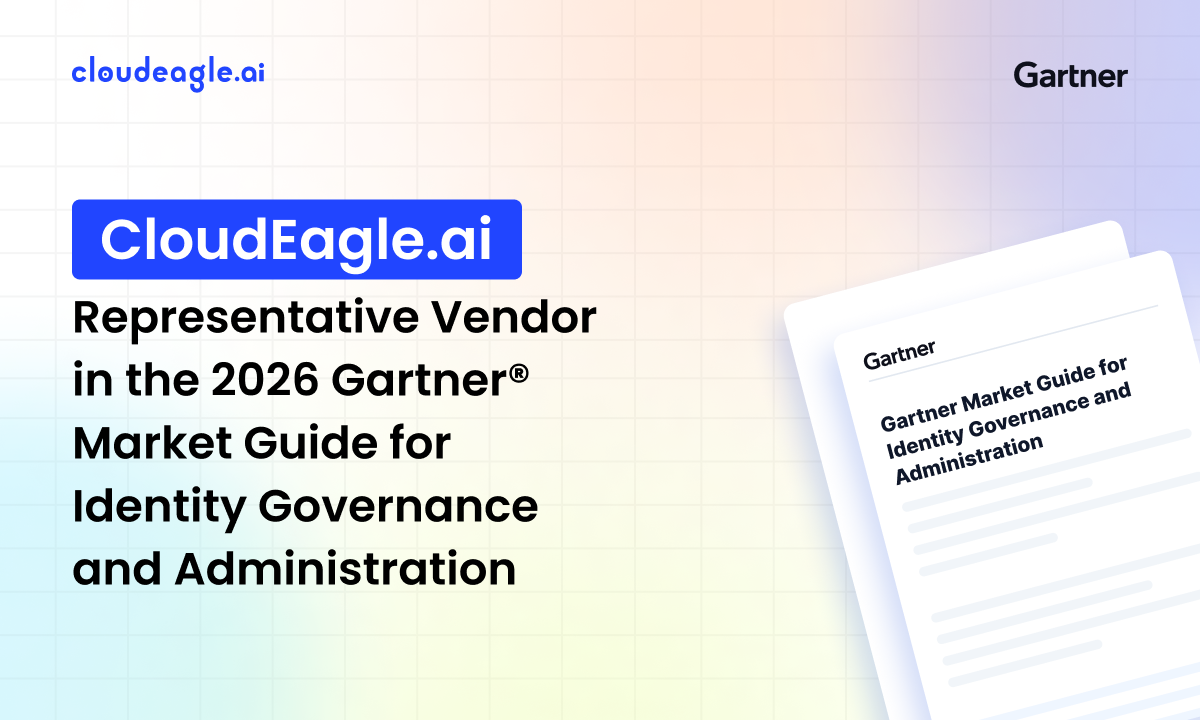
- CloudEagle.ai covers a broader governance use case: SaaS security, AI governance, identity lifecycle automation, access governance, compliance automation, and Shadow IT discovery in one platform.
- They overlap on SaaS discovery, access request workflows, provisioning and deprovisioning, and license tracking
- Where they diverge is significant: CloudEagle.ai has spend, procurement, and AI governance; Lumos has a cleaner employee access experience and faster deployment for IdP-connected environments
- Neither is the right answer if your primary need is deep entitlement visibility across complex on-prem systems. For that, look at Linx or Veza alternatives
1. What Each Platform Is Actually Built to Solve
Here is the honest one-paragraph version before we get into specifics.
At its core, the CloudEagle.ai vs Lumos decision comes down to whether you need a dedicated identity platform or broader SaaS governance capabilities.
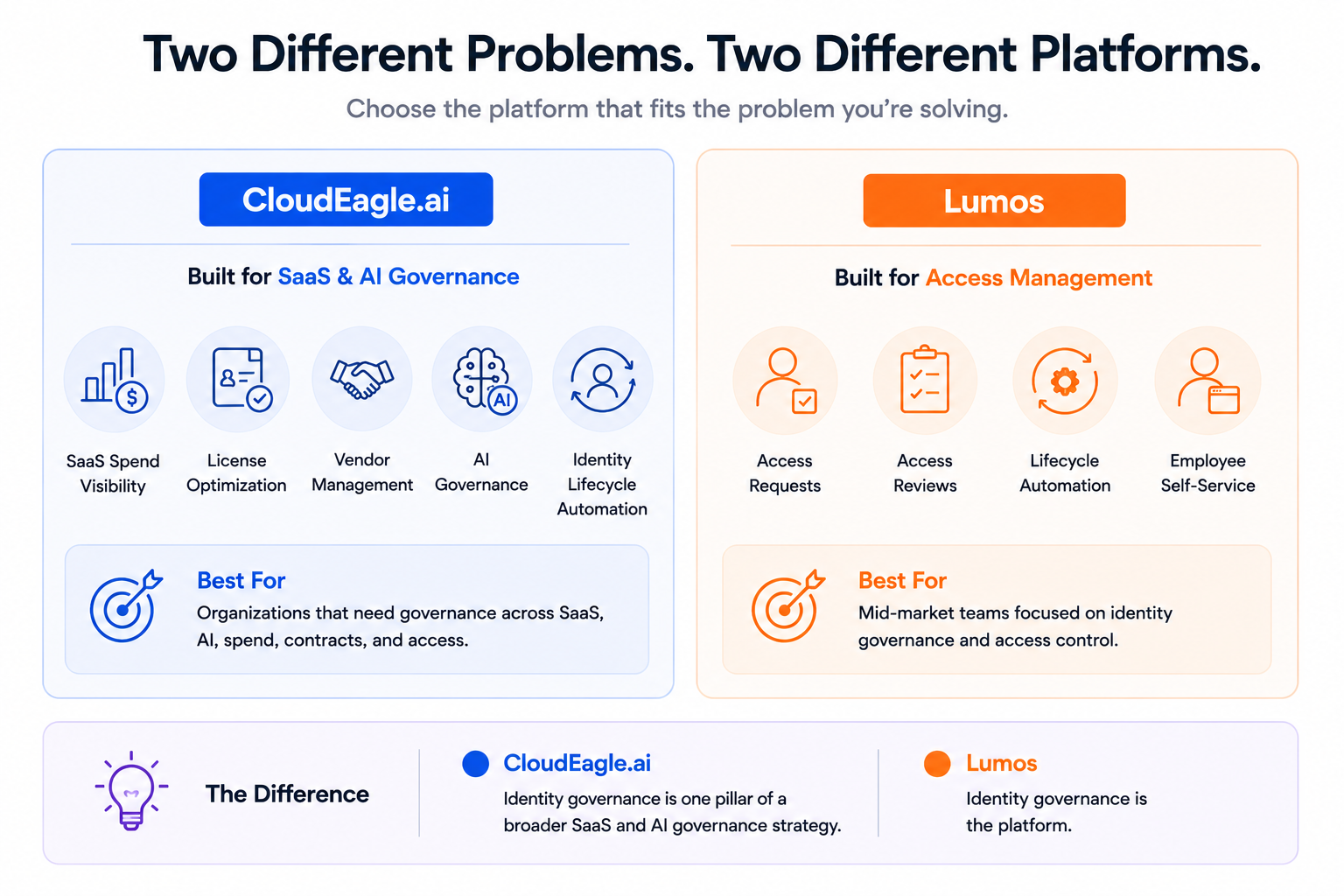
Lumos: It brings together Identity Governance, Privileged Access Management, and SaaS Management under one platform. Lumos is strongest when the core problem is access management in a SaaS-first environment, including:
- Access requests
- Access reviews
- Lifecycle automation
- Employee self-service access
It is particularly well-suited for mid-market teams looking to reduce IT workload and software costs without adding complexity.
CloudEagle.ai: It is an AI-powered SaaS Security, AI Governance, and Identity Governance platform that helps organizations discover Shadow IT and Shadow AI, govern access, enforce least-privilege controls, and maintain continuous compliance across their SaaS and AI ecosystem.
- Identity lifecycle automation
- User access reviews
- Excessive privilege management
- Shadow IT and Shadow AI discovery
- AI governance and usage control
- Compliance automation
The key difference is simple: in Lumos, identity governance is the platform. In CloudEagle.ai, identity governance is one pillar of a broader SaaS and AI governance strategy.

2. Where CloudEagle.ai and Lumos Overlap
In the CloudEagle.ai vs Lumos comparison, these are the capabilities both platforms genuinely cover.
- SaaS app discovery: Both surface what apps are in use across your environment
- Access request workflows: Both provide structured, automated approval flows for access requests
- User provisioning and deprovisioning: Both automate JML lifecycle events triggered by HRIS signals
- License tracking: Both identify unused and underutilized licenses
- Shadow IT detection: Both surface apps that employees are using outside official IT channels
If your evaluation is limited to these five areas, either platform is worth a serious look. The decision comes down to everything else.
📖 Worth a Read: 👉 How to Centralize Your SaaS Contracts and Streamline Renewals
3. Where They Diverge: The Honest Breakdown
Now this is where the CloudEagle.ai vs Lumos evaluation becomes much clearer.
The pattern is clear. Lumos is deeper on the identity and access experience layer. CloudEagle.ai is broader across the SaaS management, spend, and AI governance layers.
4. How CloudEagle.ai Unifies Identity Governance, SaaS Security, and AI Governance
For teams considering CloudEagle.ai specifically for the identity governance use case, here is what that looks like in practice. This is the Identity Governance pillar only, not the full platform.
CloudEagle.ai is an AI-powered SaaS Security, AI Governance, and Identity Governance platform that helps IT and Security teams discover, govern, secure, and control every SaaS and AI application.
"Provisioning and deprovisioning took hours and created security gaps. CloudEagle.ai's automated workflows now deliver Day 1 access for new hires and instant offboarding, saving time and boosting security." Sam Middleton, Head of IT, Bloom & Wild
Self-Service App Catalog That Eliminates Access Tickets
Right now, your employees are requesting access through email and Slack. IT is chasing approvals. Tickets are sitting in a queue. And somewhere in that process, an employee who could not get timely access signed up for a tool themselves.
CloudEagle.ai replaces that with a role-based self-service catalog where employees see only the apps relevant to their team and department. Access requests go through automated approvals with no email chains and no Slack follow-ups.
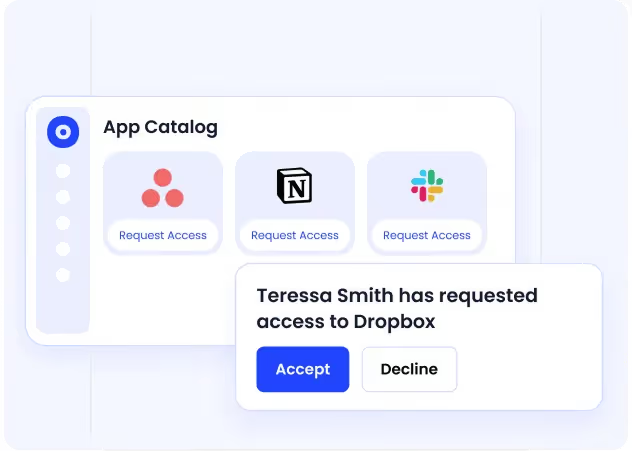
- Engineers see AWS. Sales sees Salesforce. Neither sees what they should not
- MTTR for access requests reduced by up to 80%
- Every request, approval, and provisioning action is tracked end-to-end and audit-ready at any time
- Shadow IT has been eliminated because employees have a fast, governed alternative to signing up independently
Zero-Touch Onboarding and Offboarding That Does Not Depend on Okta Tiers
Most IT teams log into 30 to 40 apps manually for every new hire. That breaks down fast at scale, and when it breaks, new hires wait, and security gaps open.
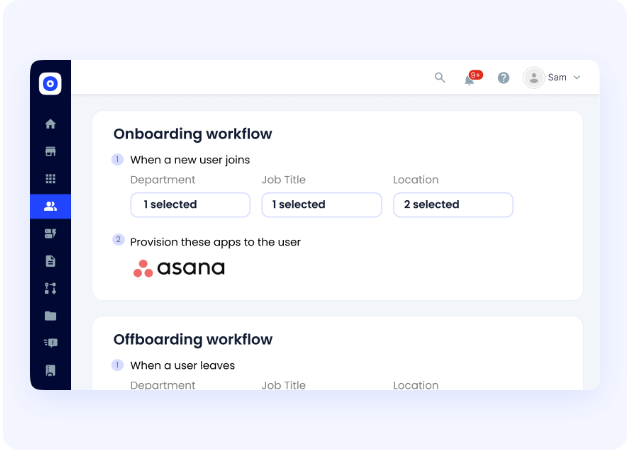
When CloudEagle.ai detects a new employee in your HRIS, it provisions access automatically based on role, department, and location. When they leave, access is revoked across every app, including apps that are not behind your IdP, without requiring expensive SAML enterprise tiers for every tool.
- Role-based access is provisioned the moment a new hire appears in HR systems
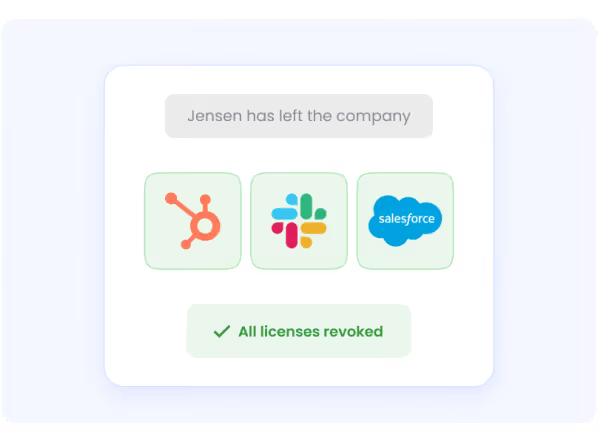
- Offboarding revokes access across SSO and non-SSO apps from one unified console
- Licenses immediately reclaimed and returned to the pool, keeping spend aligned with active headcount
- Complete deprovisioning evidence is generated automatically, with no manual documentation for compliance
Just-in-Time Access That Does Not Become Permanent
Contractors, project-based access, and temporary elevated permissions are the most consistent sources of access sprawl in every environment.
CloudEagle.ai grants Just-in-Time access that expires automatically when the period ends with no manual cleanup required.
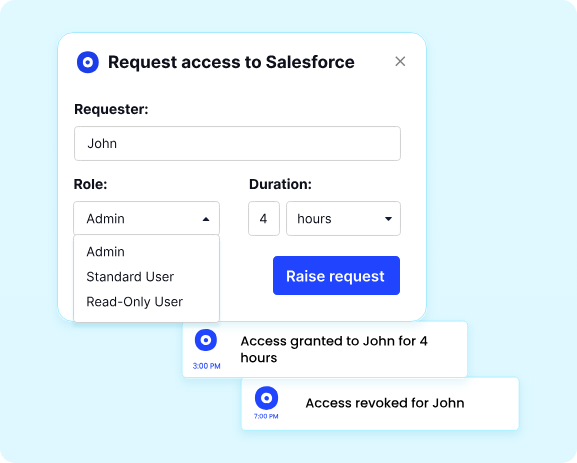
- Access for contractors and sensitive tasks is automatically revoked when the period ends
- Governance stays intact without IT tracking or following up on temporary permissions
- Dormant and unnecessary access is removed continuously, keeping the environment clean
App Access Requests That Don't Depend on IT Tickets
Most access requests still start with an email, Slack message, or help desk ticket. IT ends up chasing approvers, employees wait for access, and there's often little visibility into who approved what.
CloudEagle.ai centralizes app access requests through a governed workflow that connects requests, approvals, and provisioning in a single process. Employees can request access directly from the catalog, managers can approve requests in Slack, and every action is tracked for audit purposes.
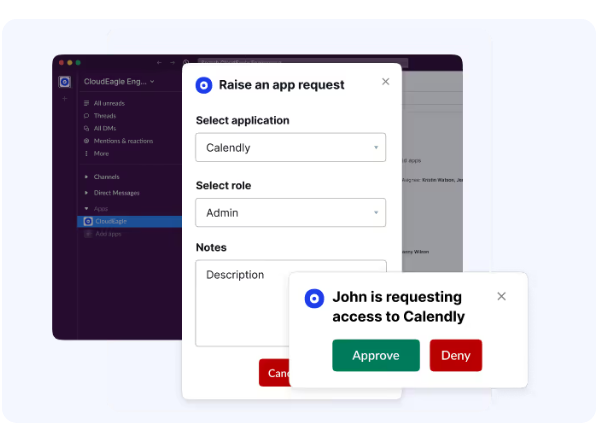
- Access requests are routed automatically based on role, department, and application
- Managers approve or reject requests directly in Slack’
- Approval workflows customized by app sensitivity and access type
- Complete audit trail from request to provisioning
- Automated provisioning for integrated applications
With 500+ direct integrations, CloudEagle helps organizations govern identities, applications, and AI usage beyond what traditional identity providers can see.
Still Managing Access Through Slack and Email?


5. How Lumos Handles Identity Governance
For organizations evaluating CloudEagle.ai vs Lumos, Lumos focuses on simplifying access management through self-service workflows, lifecycle automation, and SaaS-focused identity governance.
Self-Service App Store That Reduces Access Tickets
Employees can request software through a self-service AppStore instead of relying on email chains or help desk tickets.
Key benefits include:
- Faster software access
- Streamlined onboarding and offboarding
- Reduced software waste
- Temporary privileged access management
Slack-Native Access Workflows
Access requests, approvals, and notifications happen directly in Slack.
This helps teams:
- Reduce approval friction
- Eliminate portal switching
- Speed up access requests
Fast Deployment for SaaS-First Environments
Lumos is particularly effective in SaaS-first organizations with an existing identity provider.
- Quick implementation
- Faster user adoption
- Automated access reviews
One enterprise reported access review completion rates increasing from 10% to over 90% after deployment.
6. How Do You Choose Between CloudEagle.ai and Lumos?
The simplest way to think about CloudEagle.ai vs Lumos is to start with the problem you're trying to solve.
In many evaluations, the decision comes down to employee app store vs SaaS management platform capabilities. Lumos leans toward the former, while CloudEagle.ai extends into spend, procurement, and AI governance.
Final Verdict
In the CloudEagle.ai vs Lumos comparison, the choice comes down to priorities.
Lumos is a strong fit for teams focused on employee access management, identity lifecycle automation, and a Slack-first experience.
loudEagle.ai is the better fit when you need identity governance, SaaS security, Shadow AI discovery, AI governance, user access reviews, and compliance automation in one platform.
The honest version: if your biggest pain is access requests, Lumos is worth a serious look. If IT, Finance, and Security all need visibility into software usage, spend, and governance, CloudEagle.ai is the more complete answer.
Neither platform is a mistake. The mistake is buying one when you need the other.
Frequently Asked Questions
1. What is an identity governance platform?
An identity governance platform helps organizations manage user access, automate approvals, and ensure employees have the right access at the right time.
2. What's the best identity governance software?
The best identity governance software depends on your requirements. Popular options include CloudEagle.ai, Lumos, SailPoint, Saviynt, and Veza.
3. What are the 4 pillars of IAM?
The four pillars of IAM are authentication, authorization, identity governance, and privileged access management (PAM).
4. What are IGA platforms?
IGA platforms, or Identity Governance and Administration platforms, help organizations control, review, and automate user access across applications and systems.
5. What are the 4 AI platforms?
AI platforms are generally grouped into four categories: generative AI platforms, machine learning platforms, AI development platforms, and AI governance platforms.
Still Managing Access Through Slack and Email?


.avif)


.avif)
.avif)



.png)





.avif)
.avif)
.avif)


