You need to enable JavaScript in order to use the AI chatbot tool powered by ChatBot

What ISO 42001 Requires and Why Your Customers Will Start Asking About It

Share via:
blog-cms-banner-bg
Little-Known Negotiation Hacks to Get the Best Deal on Slack
cta-bg-blogDownload Your Copy

HIPAA Compliance Checklist for 2025

Download PDF

A procurement team sends over a security questionnaire before renewing your contract. This time, it includes questions about AI governance, AI risk management, and evidence of AI controls. Six months ago, those questions were not there. Today, they can determine whether your deal moves forward.

ISO 42001 is the first international standard for AI management systems, and it is quickly becoming part of enterprise vendor due diligence. While it is not a regulation, many organizations now use it to evaluate whether vendors have the governance needed to manage AI responsibly.

The controls required by ISO 42001, including AI inventory, risk assessments, access governance, policy enforcement, and audit evidence, are capabilities that CloudEagle helps automate. This guide explains what the standard requires and how to demonstrate compliance.

TL;DR

  • ISO 42001 is the ISO standard for AI Management Systems. It requires organizations to demonstrate structured governance over their AI tools, not just a usage policy document
  • Enterprise customers are adding ISO 42001 requirements to vendor questionnaires and RFPs. It is becoming a commercial expectation, not just a compliance checkbox
  • The five core requirements map directly to AI governance controls: inventory of AI tools in use, risk assessment, usage policies with enforcement evidence, access controls, and audit trails
  • The gap most organizations have: a policy document says what employees should do. ISO 42001 requires technical evidence that the controls are actually working
  • CloudEagle acts as the control plane for enterprise AI, delivering the real-time visibility, policy enforcement, and audit evidence that ISO 42001 readiness requires

1. What ISO 42001 Actually Requires

ISO 42001 is a management system standard. It does not prescribe specific AI tools or algorithms. It requires organizations to establish, implement, and maintain an AI Management System with documented policies, risk assessments, and governance controls that can be evidenced, not just described.

The five areas auditors and procurement teams focus on when evaluating ISO 42001 alignment:

Requirement What It Means in Practice
AI inventory A current, maintained register of every AI system in use and its purpose.
Risk assessment Documented assessment of what risks each AI system introduces and how they are mitigated.
Usage policies Documented controls over who can use which AI tools under what conditions.
Access governance Evidence that AI system access is appropriate, reviewed, and revoked when no longer needed.
Audit evidence Documented proof that controls are functioning, not just that they are documented.

Can You Prove Every AI Tool Is Accounted For?

Start with the AI inventory ISO 42001 expects.
Find Hidden AI

2. How CloudEagle.ai Produces the Evidence ISO 42001 Requires

CloudEagle.ai is an AI-powered SaaS Management, AI Governance, and Identity Governance platform that acts as the control plane for enterprise AI. The five ISO 42001 control areas map directly to what CloudEagle already produces, automatically, as part of its AI governance layer.

Discover Shadow AI. Eliminate Excess Access. Reduce SaaS Risk.

"Once AI adoption accelerated across teams, visibility alone wasn't enough. We needed clear rules around who could use AI tools, under what conditions, and how those decisions were enforced and reviewed. CloudEagle helped us move from ad-hoc approvals to structured, defensible AI governance." Aditya Khosla, CTO, Iterative Health

AI Inventory: Every Tool, Sanctioned and Shadow

ISO 42001 requires organizations to maintain an accurate inventory of AI systems. Most organizations cannot.
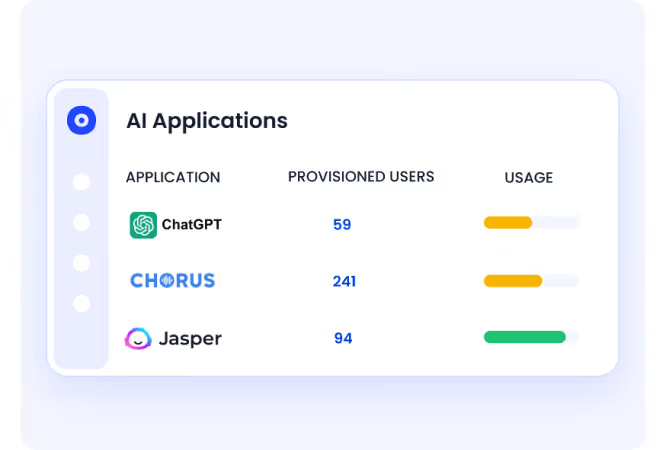
CloudEagle automatically discovers every sanctioned and shadow AI tool by combining SSO data with browser signals, firewall logs, Zscaler, CrowdStrike, and finance integrations into a continuously updated AI inventory.

How it helps

  • Discovers sanctioned and shadow AI tools across the enterprise
  • Correlates browser, SSO, firewall, Zscaler, CrowdStrike, and finance signals
  • Identifies AI features embedded inside approved SaaS applications

Risk Assessment: Continuous, Not Point-in-Time

ISO 42001 requires ongoing risk management, not point-in-time assessments.

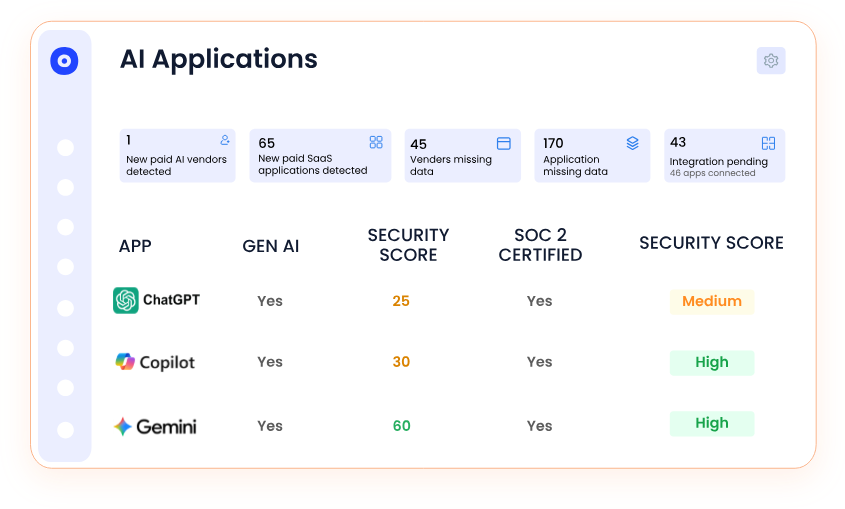
CloudEagle continuously evaluates every AI application and updates risk posture as vendor security, compliance, and AI capabilities change.
How it helps

  • Applies GenAI risk scores through native Netskope integration
  • Evaluates data residency, training data policies, and security posture
  • Flags duplicate copilots, orphaned accounts, and high-risk AI tools
  • Surfaces renewal exposure and unmanaged AI adoption

Usage Policy Enforcement: Technical Controls, Not Just Documentation

ISO 42001 requires organizations to prove AI usage policies are enforced, not simply documented.
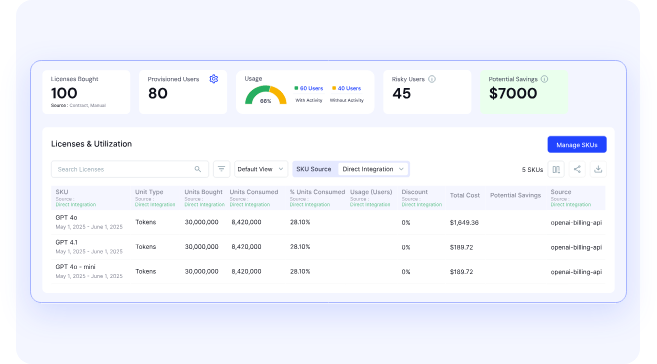
CloudEagle enforces AI governance where employees actually interact with AI tools.

How it helps

  • Uses flash-page redirects to steer users toward approved AI tools
  • Enforces AI usage policies before sensitive data is submitted
  • Monitors or blocks prompts containing sensitive or regulated information
  • Logs every policy intervention as audit-ready evidence

Access Governance: Provisioned on Role, Revoked on Exit

AI access should follow the same governance lifecycle as every other enterprise identity.

CloudEagle extends identity governance beyond the IdP by automating AI access throughout the employee lifecycle.
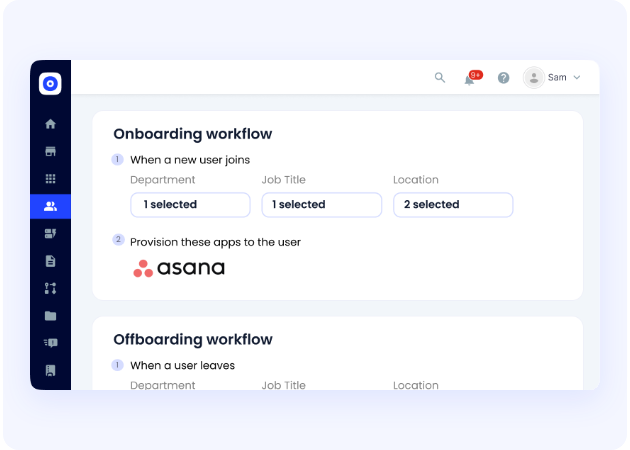
How it helps

  • Automates Joiner-Mover-Leaver workflows across AI applications
  • Provisions and revokes AI access based on role changes
  • Detects orphaned accounts, API tokens, and non-human identities
  • Enforces least-privilege access across AI tools

Audit Evidence: Available on Demand, Not Assembled Manually

ISO 42001 requires continuous evidence that AI governance controls are operating effectively.
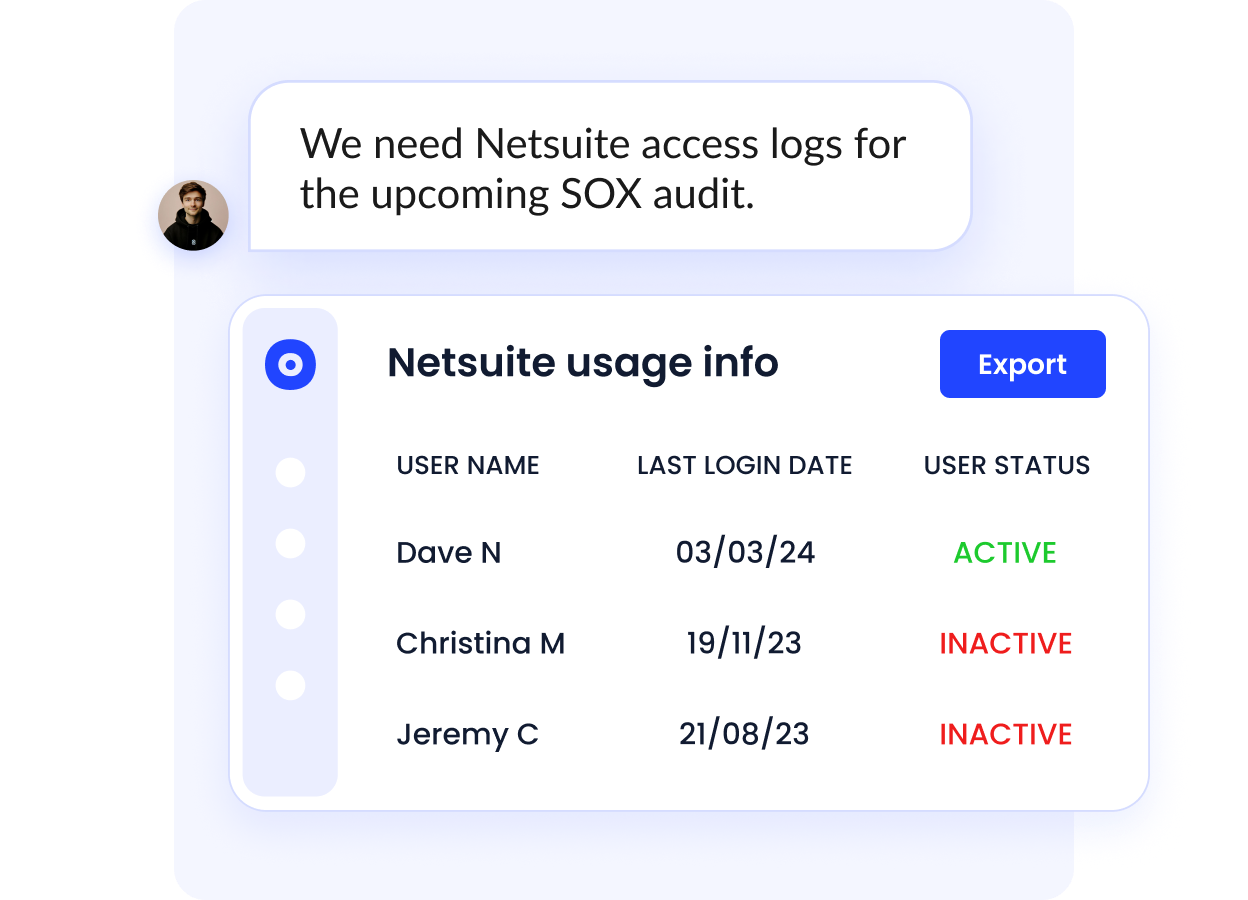
CloudEagle centralizes governance records so organizations can demonstrate compliance without manual evidence gathering.

How it helps

  • Maintains audit-ready AI inventories and access logs
  • Records AI policy enforcement and governance events automatically
  • Preserves AI risk assessment history and remediation actions
  • Generates evidence for ISO 42001 assessments, customer reviews, and board reporting on demand

3. Why Enterprise Customers Are Starting to Ask About ISO 42001 Now

ISO 42001 is not legally required in most jurisdictions today. That is not why it is appearing in vendor questionnaires.

Enterprise customers are adding AI governance requirements to vendor due diligence because they are under increasing pressure to demonstrate control over AI risk. Their boards, auditors, insurers, and regulators expect clear answers about how AI is governed across the organization.

The questions they want answered include:

  • Do you have a complete inventory of AI tools in use?
  • Who has access to AI applications and sensitive data?
  • How do you assess and mitigate AI risk?
  • Can you provide evidence that AI policies are being enforced?

If a vendor cannot answer these questions, the risk shifts to the customer evaluating them. That is why procurement teams are asking before contracts are signed.

The timeline also matters. Achieving ISO 42001 certification typically takes 6 to 18 months, so organizations that begin building their AI governance program now will be better prepared for enterprise security reviews in 2026 and 2027.

For organizations already using CloudEagle's AI governance platform, much of the required governance infrastructure is already in place, making it easier to demonstrate the controls ISO 42001 expects.

📖 Worth a Read - 10 AI Governance Trends in 2026 and What CISOs Are Doing About Them

4. The Gap Between "We Have an AI Policy" and ISO 42001 Compliance

Most organizations have an AI acceptable use policy. That does not mean they are ISO 42001 ready. The standard requires technical controls and evidence, not just documented intent.

The biggest gaps include:

  • No live AI inventory: ISO 42001 requires organizations to know what AI systems are in use, including embedded AI features and unsanctioned tools. A policy cannot provide that visibility. A governance platform can.
  • No policy enforcement: The standard expects controls that prevent policy violations. If employees can still paste sensitive data into unapproved AI tools, the policy is not being enforced.
  • No continuous audit evidence: ISO 42001 requires ongoing proof that controls are working. Manual spreadsheets and quarterly reviews are not enough. Continuous logging, risk assessments, and policy enforcement provide the evidence auditors expect.

AI adoption is happening faster than governance in most organizations. Employees continue adopting tools such as ChatGPT Enterprise, Microsoft Copilot, and Google Gemini outside formal IT workflows. A policy alone cannot change that behavior. Governance must be enforced where AI is being used.

5. What ISO 42001 Readiness Looks Like as a Board-Level Conversation

Boards and audit committees are no longer asking whether employees use AI. They are asking whether the organization can govern it.

The conversation usually comes down to two questions:

ISO 42001 provides the governance framework. CloudEagle provides the evidence through AI discovery, policy enforcement, access governance, risk assessments, and continuous audit trails.

That combination is becoming a competitive advantage. As AI governance requirements become part of enterprise procurement and vendor due diligence, organizations that can demonstrate ISO 42001 alignment will be better positioned to pass security reviews and move through the buying process with fewer delays.

Final Thoughts

ISO 42001 is not asking whether you have AI. It is asking whether you can prove you are governing it.

The five control areas the standard requires, AI inventory, risk assessment, usage policy enforcement, access governance, and audit evidence, are exactly what CloudEagle's AI governance layer produces automatically. 

Organizations that wait to build this infrastructure will be explaining gaps on the questionnaires that are already in circulation. CloudEagle.ai is what makes the proof possible before those conversations start.

Frequently Asked Questions

1. What does ISO 42001 require?
ISO 42001 requires organizations to establish an AI management system with AI inventory, risk assessments, governance policies, access controls, and continuous audit evidence that demonstrates AI risks are managed effectively.

2. Is ISO 42001 mandatory?
No. ISO 42001 is not legally required in most jurisdictions, but it is increasingly included in enterprise security questionnaires and RFPs as customers seek evidence that vendors govern AI responsibly.

3. How long does ISO 42001 certification take?
ISO 42001 certification typically takes 6 to 18 months, depending on your organization's AI governance maturity. Teams with existing AI governance controls and audit evidence can prepare more quickly.

4. What is the difference between ISO 42001 and ISO 27001?
ISO 27001 focuses on information security, while ISO 42001 focuses on AI governance. It introduces AI-specific controls such as AI inventory, risk assessments, usage policies, and governance processes that ISO 27001 does not cover.

5. How does CloudEagle support ISO 42001 compliance?
CloudEagle helps organizations meet ISO 42001 requirements with continuous AI discovery, risk assessments, policy enforcement, access governance, and audit-ready evidence, making it easier to demonstrate AI governance during assessments.

Advertisement for a SaaS Subscription Tracking Template with a call-to-action button to download and a partial graphic of a tablet showing charts.Banner promoting a SaaS Agreement Checklist to streamline SaaS management and avoid budget waste with a call-to-action button labeled Download checklist.Blue banner with text 'The Ultimate Employee Offboarding Checklist!' and a black button labeled 'Download checklist' alongside partial views of checklist documents from cloudeagle.ai.Digital ad for download checklist titled 'The Ultimate Checklist for IT Leaders to Optimize SaaS Operations' by cloudeagle.ai, showing checklist pages.Slack Buyer's Guide offer with text 'Unlock insider insights to get the best deal on Slack!' and a button labeled 'Get Your Copy', accompanied by a preview of the guide featuring Slack's logo.Monday Pricing Guide by cloudeagle.ai offering exclusive pricing secrets to maximize investment with a call-to-action button labeled Get Your Copy and an image of the guide's cover.Blue banner for Canva Pricing Guide by cloudeagle.ai offering a guide to Canva costs, features, and alternatives with a call-to-action button saying Get Your Copy.Blue banner with white text reading 'Little-Known Negotiation Hacks to Get the Best Deal on Slack' and a white button labeled 'Get Your Copy'.Blue banner with text 'Little-Known Negotiation Hacks to Get the Best Deal on Monday.com' and a white button labeled 'Get Your Copy'.Blue banner with text 'Little-Known Negotiation Hacks to Get the Best Deal on Canva' and a white button labeled 'Get Your Copy'.Banner with text 'Slack Buyer's Guide' and a 'Download Now' button next to images of a guide titled 'Slack Buyer’s Guide: Features, Pricing & Best Practices'.Digital cover of Monday Pricing Guide with a button labeled Get Your Copy on a blue background.Canva Pricing Guide cover with a button labeled Get Your Copy on a blue gradient background.

Enter your email to
unlock the report

Oops! Something went wrong while submitting the form.
License Count
Benchmark
Per User/Per Year

Enter your email to
unlock the report

Oops! Something went wrong while submitting the form.
License Count
Benchmark
Per User/Per Year

Enter your email to
unlock the report

Oops! Something went wrong while submitting the form.
Notion Plus
License Count
Benchmark
Per User/Per Year
100-500
$67.20 - $78.72
500-1000
$59.52 - $72.00
1000+
$51.84 - $57.60
Canva Pro
License Count
Benchmark
Per User/Per Year
100-500
$74.33-$88.71
500-1000
$64.74-$80.32
1000+
$55.14-$62.34

Enter your email to
unlock the report

Oops! Something went wrong while submitting the form.

Enter your email to
unlock the report

Oops! Something went wrong while submitting the form.
Zoom Business
License Count
Benchmark
Per User/Per Year
100-500
$216.00 - $264.00
500-1000
$180.00 - $216.00
1000+
$156.00 - $180.00

Enter your email to
unlock the report

Oops! Something went wrong while submitting the form.

Get the Right Security Platform To Secure Your Cloud Infrastructure

Please enter a business email
Thank you!
The 2023 SaaS report has been sent to your email. Check your promotional or spam folder.
Oops! Something went wrong while submitting the form.

Access full report

Please enter a business email
Thank you!
The 2023 SaaS report has been sent to your email. Check your promotional or spam folder.
Oops! Something went wrong while submitting the form.

A procurement team sends over a security questionnaire before renewing your contract. This time, it includes questions about AI governance, AI risk management, and evidence of AI controls. Six months ago, those questions were not there. Today, they can determine whether your deal moves forward.

ISO 42001 is the first international standard for AI management systems, and it is quickly becoming part of enterprise vendor due diligence. While it is not a regulation, many organizations now use it to evaluate whether vendors have the governance needed to manage AI responsibly.

The controls required by ISO 42001, including AI inventory, risk assessments, access governance, policy enforcement, and audit evidence, are capabilities that CloudEagle helps automate. This guide explains what the standard requires and how to demonstrate compliance.

TL;DR

  • ISO 42001 is the ISO standard for AI Management Systems. It requires organizations to demonstrate structured governance over their AI tools, not just a usage policy document
  • Enterprise customers are adding ISO 42001 requirements to vendor questionnaires and RFPs. It is becoming a commercial expectation, not just a compliance checkbox
  • The five core requirements map directly to AI governance controls: inventory of AI tools in use, risk assessment, usage policies with enforcement evidence, access controls, and audit trails
  • The gap most organizations have: a policy document says what employees should do. ISO 42001 requires technical evidence that the controls are actually working
  • CloudEagle acts as the control plane for enterprise AI, delivering the real-time visibility, policy enforcement, and audit evidence that ISO 42001 readiness requires

1. What ISO 42001 Actually Requires

ISO 42001 is a management system standard. It does not prescribe specific AI tools or algorithms. It requires organizations to establish, implement, and maintain an AI Management System with documented policies, risk assessments, and governance controls that can be evidenced, not just described.

The five areas auditors and procurement teams focus on when evaluating ISO 42001 alignment:

Requirement What It Means in Practice
AI inventory A current, maintained register of every AI system in use and its purpose.
Risk assessment Documented assessment of what risks each AI system introduces and how they are mitigated.
Usage policies Documented controls over who can use which AI tools under what conditions.
Access governance Evidence that AI system access is appropriate, reviewed, and revoked when no longer needed.
Audit evidence Documented proof that controls are functioning, not just that they are documented.

Can You Prove Every AI Tool Is Accounted For?

Start with the AI inventory ISO 42001 expects.
Find Hidden AI

2. How CloudEagle.ai Produces the Evidence ISO 42001 Requires

CloudEagle.ai is an AI-powered SaaS Management, AI Governance, and Identity Governance platform that acts as the control plane for enterprise AI. The five ISO 42001 control areas map directly to what CloudEagle already produces, automatically, as part of its AI governance layer.

Discover Shadow AI. Eliminate Excess Access. Reduce SaaS Risk.

"Once AI adoption accelerated across teams, visibility alone wasn't enough. We needed clear rules around who could use AI tools, under what conditions, and how those decisions were enforced and reviewed. CloudEagle helped us move from ad-hoc approvals to structured, defensible AI governance." Aditya Khosla, CTO, Iterative Health

AI Inventory: Every Tool, Sanctioned and Shadow

ISO 42001 requires organizations to maintain an accurate inventory of AI systems. Most organizations cannot.

CloudEagle automatically discovers every sanctioned and shadow AI tool by combining SSO data with browser signals, firewall logs, Zscaler, CrowdStrike, and finance integrations into a continuously updated AI inventory.

How it helps

  • Discovers sanctioned and shadow AI tools across the enterprise
  • Correlates browser, SSO, firewall, Zscaler, CrowdStrike, and finance signals
  • Identifies AI features embedded inside approved SaaS applications

Risk Assessment: Continuous, Not Point-in-Time

ISO 42001 requires ongoing risk management, not point-in-time assessments.

CloudEagle continuously evaluates every AI application and updates risk posture as vendor security, compliance, and AI capabilities change.

How it helps

  • Applies GenAI risk scores through native Netskope integration
  • Evaluates data residency, training data policies, and security posture
  • Flags duplicate copilots, orphaned accounts, and high-risk AI tools
  • Surfaces renewal exposure and unmanaged AI adoption

Usage Policy Enforcement: Technical Controls, Not Just Documentation

ISO 42001 requires organizations to prove AI usage policies are enforced, not simply documented.

CloudEagle enforces AI governance where employees actually interact with AI tools.

How it helps

  • Uses flash-page redirects to steer users toward approved AI tools
  • Enforces AI usage policies before sensitive data is submitted
  • Monitors or blocks prompts containing sensitive or regulated information
  • Logs every policy intervention as audit-ready evidence

Access Governance: Provisioned on Role, Revoked on Exit

AI access should follow the same governance lifecycle as every other enterprise identity.

CloudEagle extends identity governance beyond the IdP by automating AI access throughout the employee lifecycle.

How it helps

  • Automates Joiner-Mover-Leaver workflows across AI applications
  • Provisions and revokes AI access based on role changes
  • Detects orphaned accounts, API tokens, and non-human identities
  • Enforces least-privilege access across AI tools

Audit Evidence: Available on Demand, Not Assembled Manually

ISO 42001 requires continuous evidence that AI governance controls are operating effectively.

CloudEagle centralizes governance records so organizations can demonstrate compliance without manual evidence gathering.

How it helps

  • Maintains audit-ready AI inventories and access logs
  • Records AI policy enforcement and governance events automatically
  • Preserves AI risk assessment history and remediation actions
  • Generates evidence for ISO 42001 assessments, customer reviews, and board reporting on demand

3. Why Enterprise Customers Are Starting to Ask About ISO 42001 Now

ISO 42001 is not legally required in most jurisdictions today. That is not why it is appearing in vendor questionnaires.

Enterprise customers are adding AI governance requirements to vendor due diligence because they are under increasing pressure to demonstrate control over AI risk. Their boards, auditors, insurers, and regulators expect clear answers about how AI is governed across the organization.

The questions they want answered include:

  • Do you have a complete inventory of AI tools in use?
  • Who has access to AI applications and sensitive data?
  • How do you assess and mitigate AI risk?
  • Can you provide evidence that AI policies are being enforced?

If a vendor cannot answer these questions, the risk shifts to the customer evaluating them. That is why procurement teams are asking before contracts are signed.

The timeline also matters. Achieving ISO 42001 certification typically takes 6 to 18 months, so organizations that begin building their AI governance program now will be better prepared for enterprise security reviews in 2026 and 2027.

For organizations already using CloudEagle's AI governance platform, much of the required governance infrastructure is already in place, making it easier to demonstrate the controls ISO 42001 expects.

📖 Worth a Read - 10 AI Governance Trends in 2026 and What CISOs Are Doing About Them

4. The Gap Between "We Have an AI Policy" and ISO 42001 Compliance

Most organizations have an AI acceptable use policy. That does not mean they are ISO 42001 ready. The standard requires technical controls and evidence, not just documented intent.

The biggest gaps include:

  • No live AI inventory: ISO 42001 requires organizations to know what AI systems are in use, including embedded AI features and unsanctioned tools. A policy cannot provide that visibility. A governance platform can.
  • No policy enforcement: The standard expects controls that prevent policy violations. If employees can still paste sensitive data into unapproved AI tools, the policy is not being enforced.
  • No continuous audit evidence: ISO 42001 requires ongoing proof that controls are working. Manual spreadsheets and quarterly reviews are not enough. Continuous logging, risk assessments, and policy enforcement provide the evidence auditors expect.

AI adoption is happening faster than governance in most organizations. Employees continue adopting tools such as ChatGPT Enterprise, Microsoft Copilot, and Google Gemini outside formal IT workflows. A policy alone cannot change that behavior. Governance must be enforced where AI is being used.

5. What ISO 42001 Readiness Looks Like as a Board-Level Conversation

Boards and audit committees are no longer asking whether employees use AI. They are asking whether the organization can govern it.

The conversation usually comes down to two questions:

ISO 42001 provides the governance framework. CloudEagle provides the evidence through AI discovery, policy enforcement, access governance, risk assessments, and continuous audit trails.

That combination is becoming a competitive advantage. As AI governance requirements become part of enterprise procurement and vendor due diligence, organizations that can demonstrate ISO 42001 alignment will be better positioned to pass security reviews and move through the buying process with fewer delays.

Final Thoughts

ISO 42001 is not asking whether you have AI. It is asking whether you can prove you are governing it.

The five control areas the standard requires, AI inventory, risk assessment, usage policy enforcement, access governance, and audit evidence, are exactly what CloudEagle's AI governance layer produces automatically. 

Organizations that wait to build this infrastructure will be explaining gaps on the questionnaires that are already in circulation. CloudEagle.ai is what makes the proof possible before those conversations start.

Frequently Asked Questions

1. What does ISO 42001 require?
ISO 42001 requires organizations to establish an AI management system with AI inventory, risk assessments, governance policies, access controls, and continuous audit evidence that demonstrates AI risks are managed effectively.

2. Is ISO 42001 mandatory?
No. ISO 42001 is not legally required in most jurisdictions, but it is increasingly included in enterprise security questionnaires and RFPs as customers seek evidence that vendors govern AI responsibly.

3. How long does ISO 42001 certification take?
ISO 42001 certification typically takes 6 to 18 months, depending on your organization's AI governance maturity. Teams with existing AI governance controls and audit evidence can prepare more quickly.

4. What is the difference between ISO 42001 and ISO 27001?
ISO 27001 focuses on information security, while ISO 42001 focuses on AI governance. It introduces AI-specific controls such as AI inventory, risk assessments, usage policies, and governance processes that ISO 27001 does not cover.

5. How does CloudEagle support ISO 42001 compliance?
CloudEagle helps organizations meet ISO 42001 requirements with continuous AI discovery, risk assessments, policy enforcement, access governance, and audit-ready evidence, making it easier to demonstrate AI governance during assessments.

CloudEagle.ai recognized in the 2025 Gartner® Magic Quadrant™ for SaaS Management Platforms
Download now
gartner chart
5x
Faster employee
onboarding
80%
Reduction in time for
user access reviews
30k
Workflows
automated
$15Bn
Analyzed in
contract spend
$2Bn
Saved in
SaaS spend

Streamline SaaS governance and save 10-30%

Book a Demo with Expert
CTA image