The Real Cost of Negotiating Without Usage Data

Share via:
blog-cms-banner-bg
Little-Known Negotiation Hacks to Get the Best Deal on Slack
cta-bg-blogDownload Your Copy

HIPAA Compliance Checklist for 2025

Download PDF

Before a renewal negotiation, procurement teams often pull a pricing benchmark. It tells them what similar companies typically pay. But almost nobody stops to ask a more important question: are we actually using all those seats?

The negotiation moves forward assuming the contract size is correct because nothing in the process ever verified it.

That's the gap with pricing intelligence. It tells you what the market pays. It doesn't tell you what you should be paying.The cost isn't losing a negotiation. It's winning one for a number that was wrong before the call even started.

CloudEagle.ai puts usage data, pricing benchmarks, and renewal timing in the same workflow automatically, starting 90 days before every renewal so the negotiation opens from the right seat count.

In this article, we'll show you what that actually costs and what changes when you fix it.

TL;DR

  • Negotiating renewals without usage data often leads to renewing more licenses than your organization actually needs.
  • CloudEagle.ai combines license usage, renewal timing, and pricing benchmarks to build the right renewal strategy.
  • Automated license harvesting and AI-powered contract insights help right-size contracts before renewal deadlines.
  • Pricing benchmarks are valuable, but usage data determines whether you're negotiating the right contract in the first place.
  • CloudEagle.ai enables smarter SaaS renewals by unifying usage insights, benchmarking, automation, and negotiation support in one workflow.

1. The Real Costs of Negotiating a Renewal Without Usage Data

A pricing benchmark helps you negotiate the market rate. But the biggest costs of a renewal often have nothing to do with the price itself. 

Without usage data, teams negotiate the contract they signed months or years ago, not the one their organization actually needs today.

A. The Overpay Cost: Paying Full Price for Seats Nobody's Using

Imagine your renewal contract includes 200 licenses. Before the negotiation, you check a benchmark and confirm the quoted price is in line with the market.

The problem is that the benchmark assumes 200 licenses are still needed because that's the contract you're pricing. It has no way of knowing that only 130 people have actively used the software over the past few months.

The negotiation succeeds. You secure a competitive price for all 200 licenses. But you still renewed 70 licenses nobody was using. A good negotiation on the wrong number is still an overpay.

B. The Timing Cost: Losing Leverage Before the Negotiation Starts

Pricing intelligence is something teams typically pull when a renewal is approaching.

It doesn't monitor contract milestones or remind you that your notice period expires next week. If the auto-renewal deadline passes before anyone reviews the renewal, the conversation changes from 

"How do we optimize this contract?" to "We're already committed for another year."
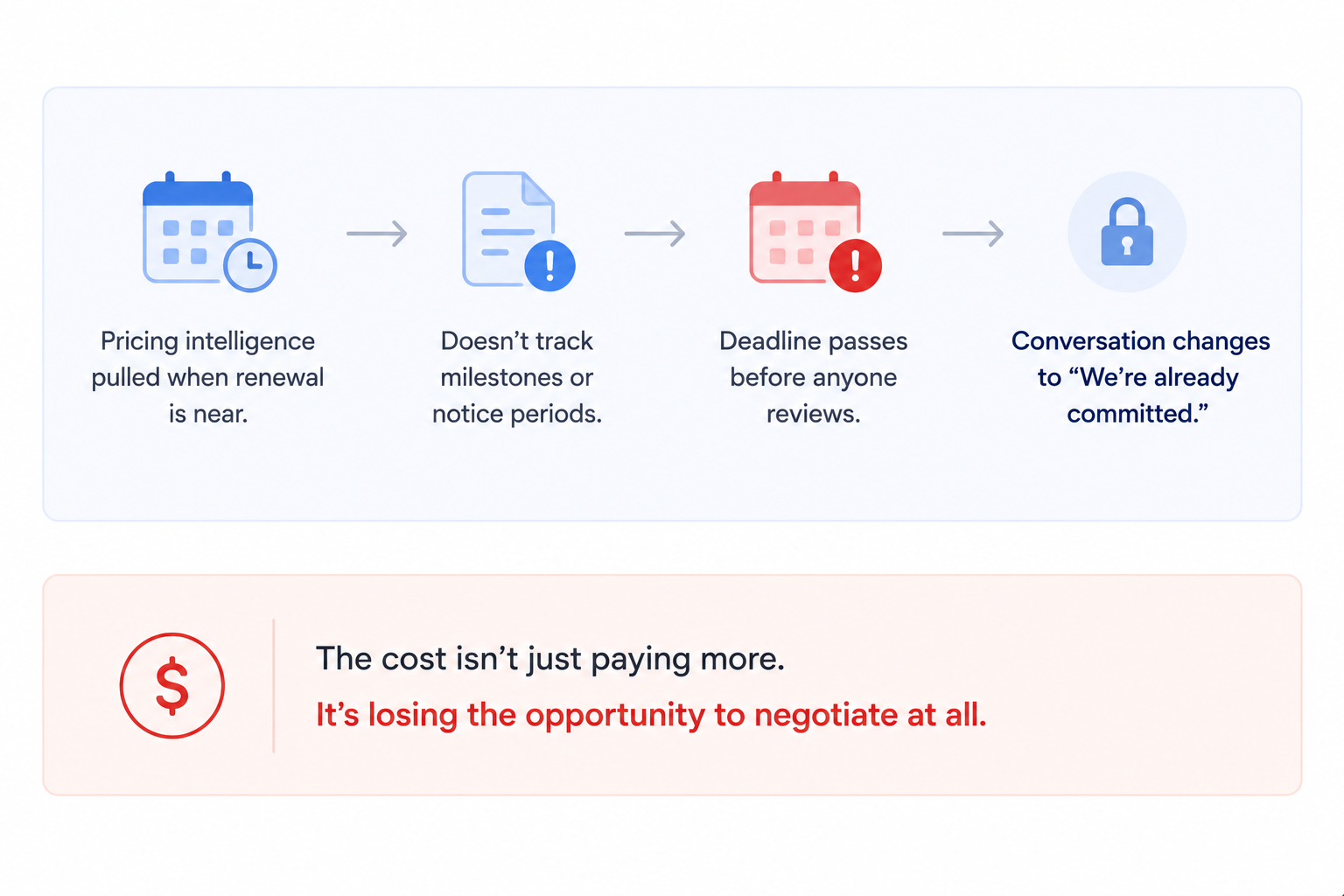
The cost isn't just paying more. It's losing the opportunity to negotiate at all.

C. The Compounding Cost: Why the Same Mistake Repeats Every Cycle

The most expensive cost isn't tied to a single renewal. It's what happens when the same mistake becomes part of your renewal process.

  • A contract renews with inactive licenses because nobody reviewed actual usage.
  • The renewed seat count becomes the starting point for the next negotiation.
  • Another benchmark is pulled against that same seat count, reinforcing the assumption that it's still correct.
  • The cycle repeats across every renewal, gradually locking more unnecessary spend into the software portfolio.

A one-time overpay is a bad quarter. An overpay that repeats across every renewal, for every major vendor, becomes a structural drain on your software budget.

The real cost of negotiating without usage data isn't losing a negotiation. It's winning one for the wrong number, over and over.

Every Renewal Hides An Opportunity

Don't miss it.
Learn More

2. How CloudEagle.ai Puts Usage Data Inside Every Negotiation

CloudEagle.ai builds usage data into every step of the process, from surfacing dormant seats 90 days before the contract renews to attaching utilization trends to the first message a stakeholder sees when the renewal opens. 

Here's how each capability delivers that:

A. License Management: Establish the True Seat Count Before the Negotiation Starts

CloudEagle.ai connects to 500+ applications and pulls real-time license data such as purchased, assigned, and actively used, across every vendor in the stack.

Here's how license management surfaces the usage baseline that the negotiation should be built from:
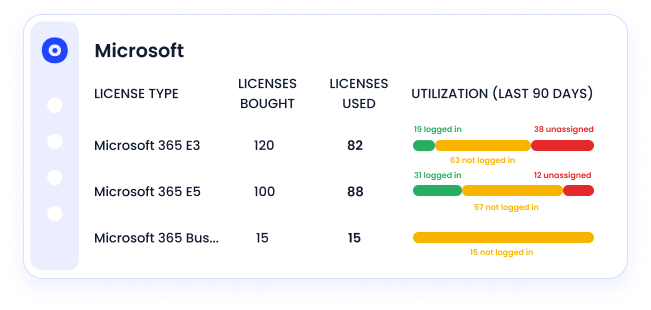
In CloudEagle.ai's license management view, every vendor shows purchased count, assigned count, and actively used count side by side:
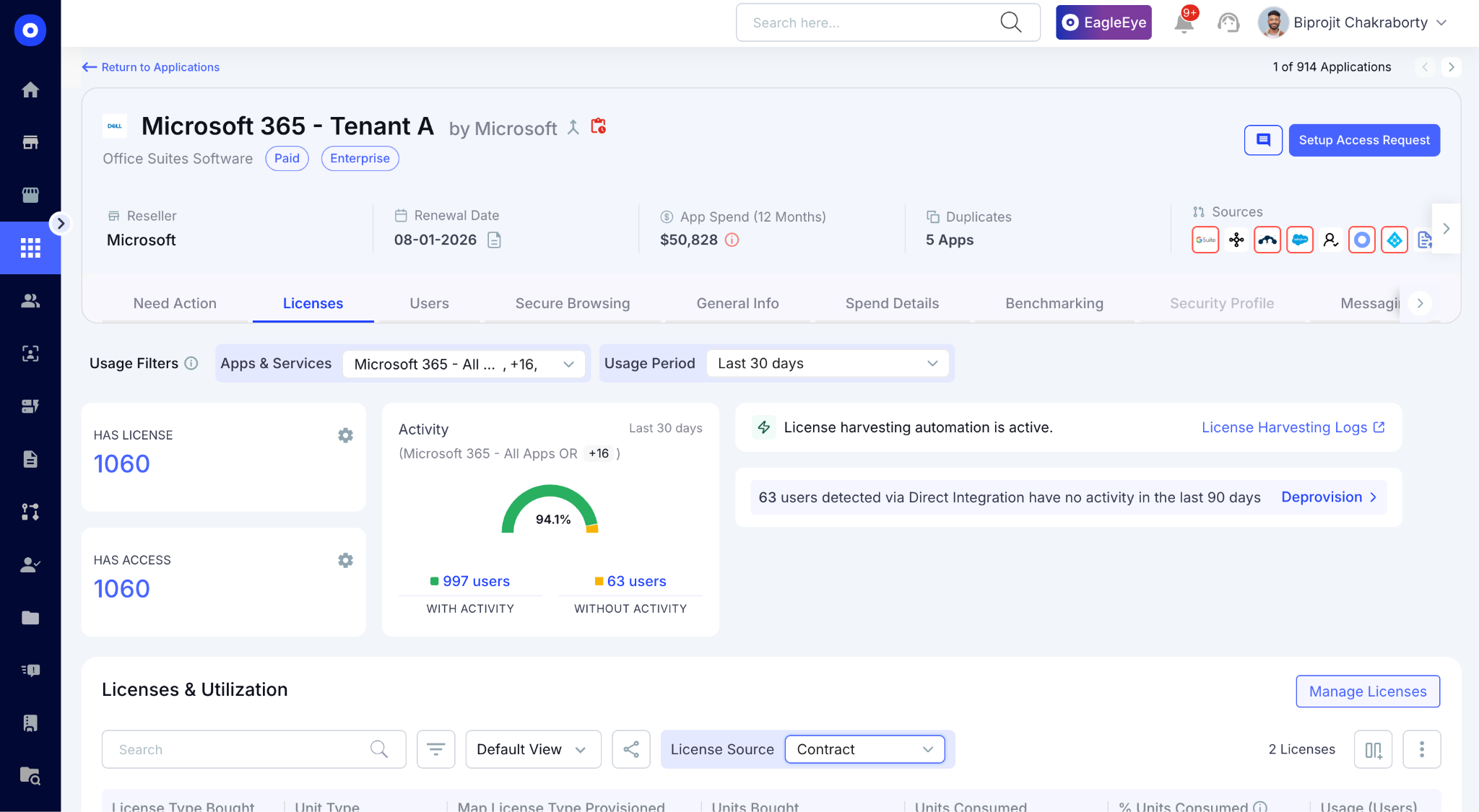
A team negotiating 200 seats because that's the contract number, when only 130 are active, is negotiating the wrong contract from sentence one. This view closes that gap before the vendor call is scheduled.

B. License Harvesting: Surface Dormant Seats in Time to Act

License harvesting identifies which seats have gone dormant and triggers the reclaim workflow early enough that the right-sized number is confirmed before the renewal window closes, not after.

Here's how license harvesting flags inactive seats and builds the right-sized contract number:

In CloudEagle.ai's license harvesting view, every seat inactive for 30, 60, or 90 days is flagged with the last activity date and cost, so the dormant seat count is visible and actionable before renewal:
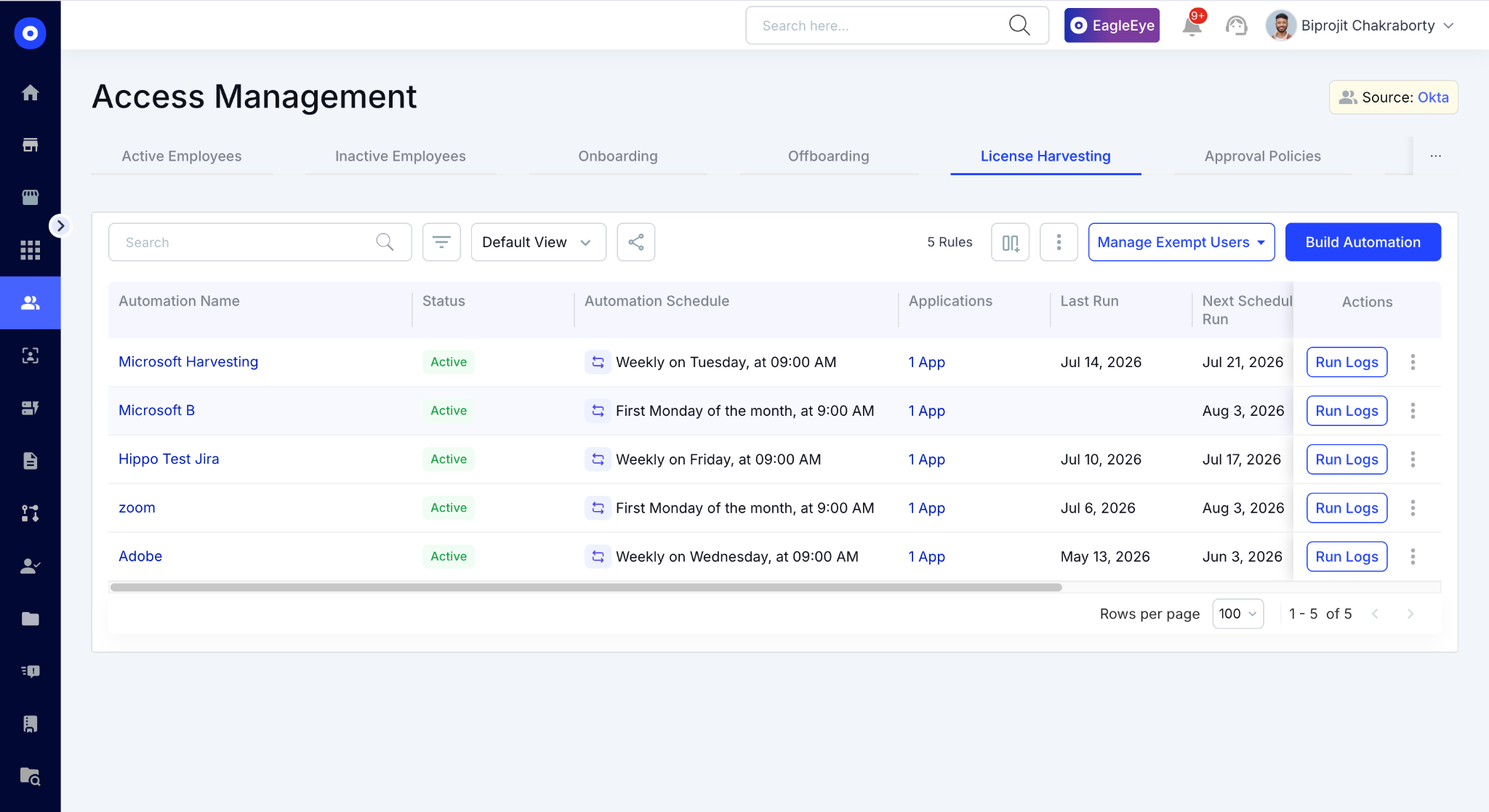
Customers typically recover 10 to 30% of annual SaaS spend within the first 90 days, not from negotiating a better price per seat, but knowing the right seat count before the call.

C. AI Contract Metadata Extraction: Make Sure There's Time to Use the Data

CloudEagle.ai extracts renewal dates, notice periods, opt-out clauses, and auto-renewal terms from uploaded contracts using AIm and builds a live renewal calendar from that data automatically.

Here's how AI contract metadata extraction surfaces the renewal window before it closes:
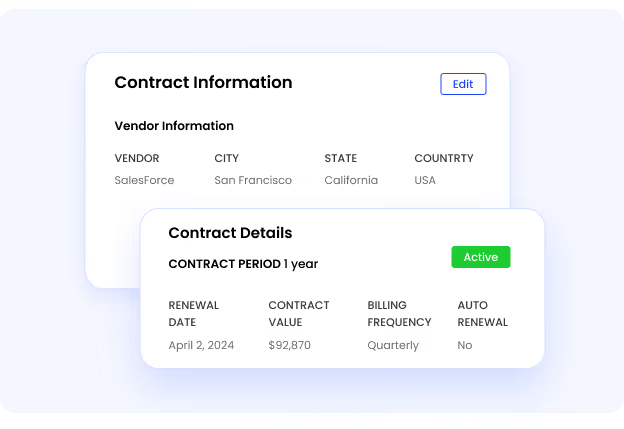
In CloudEagle.ai's contract view, every vendor shows the AI-extracted renewal date, notice period, and opt-out deadline alongside current usage data:

The timing cost from the previous section, losing leverage before the negotiation starts, is closed here. Usage data is only useful if it arrives before the auto-renewal clause fires.

D. 90-Day Renewal Workflow: Usage, Benchmarking, Alternatives, and AI Recommendation in the First Message

CloudEagle.ai triggers a renewal workflow 90 days before every contract date. The first message that goes to stakeholders already contains the full negotiation context and an AI-generated recommendation on whether to renew, right-size, or switch.

No one has to pull the usage report separately. No one has to look up the benchmark. No one has to remember to check whether there's a notice period. It's all in the first message, 90 days out.

Stakeholders are notified via Slack, Teams, and email. Approvals route through Jira, Coupa, or Ironclad, wherever the team already works.

In CloudEagle.ai's renewal calendar, every upcoming contract shows the days remaining, the usage trend, the benchmark price, and the AI recommendation:

Tom Baroch, Head of Global Supply Management at Outrider, described the impact directly: 

"We faced a major issue with missed contract renewals due to manual tracking methods, often leading to automatic renewals at unfavorable terms. CloudEagle.ai automatically extracted critical contract dates and set up timely reminders, ensuring we were always ahead of upcoming renewals."

E. Price Benchmarking and Buying Guides: The Benchmark Applied to the Right Number

CloudEagle.ai's SaaSMap benchmarking database is compiled from over 2 billion transactions across an extensive network of SaaS buyers. The benchmark data covers the same pricing intelligence Vendr provides.
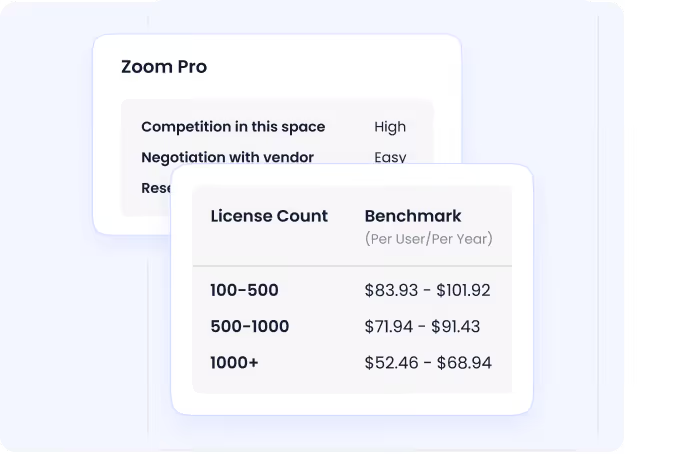
The difference in this workflow: the benchmark is applied to the right-sized seat count that license harvesting already confirmed. The team sees what the market pays for 130 seats, not 200.
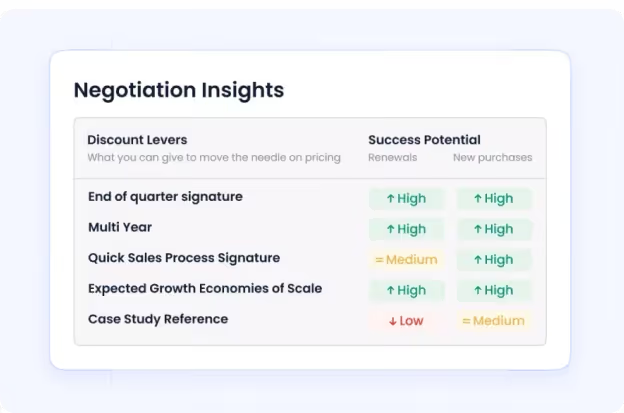
Vendor-specific buying guides surface the negotiation levers, discount patterns, and renewal behaviors that have delivered savings on that specific vendor.
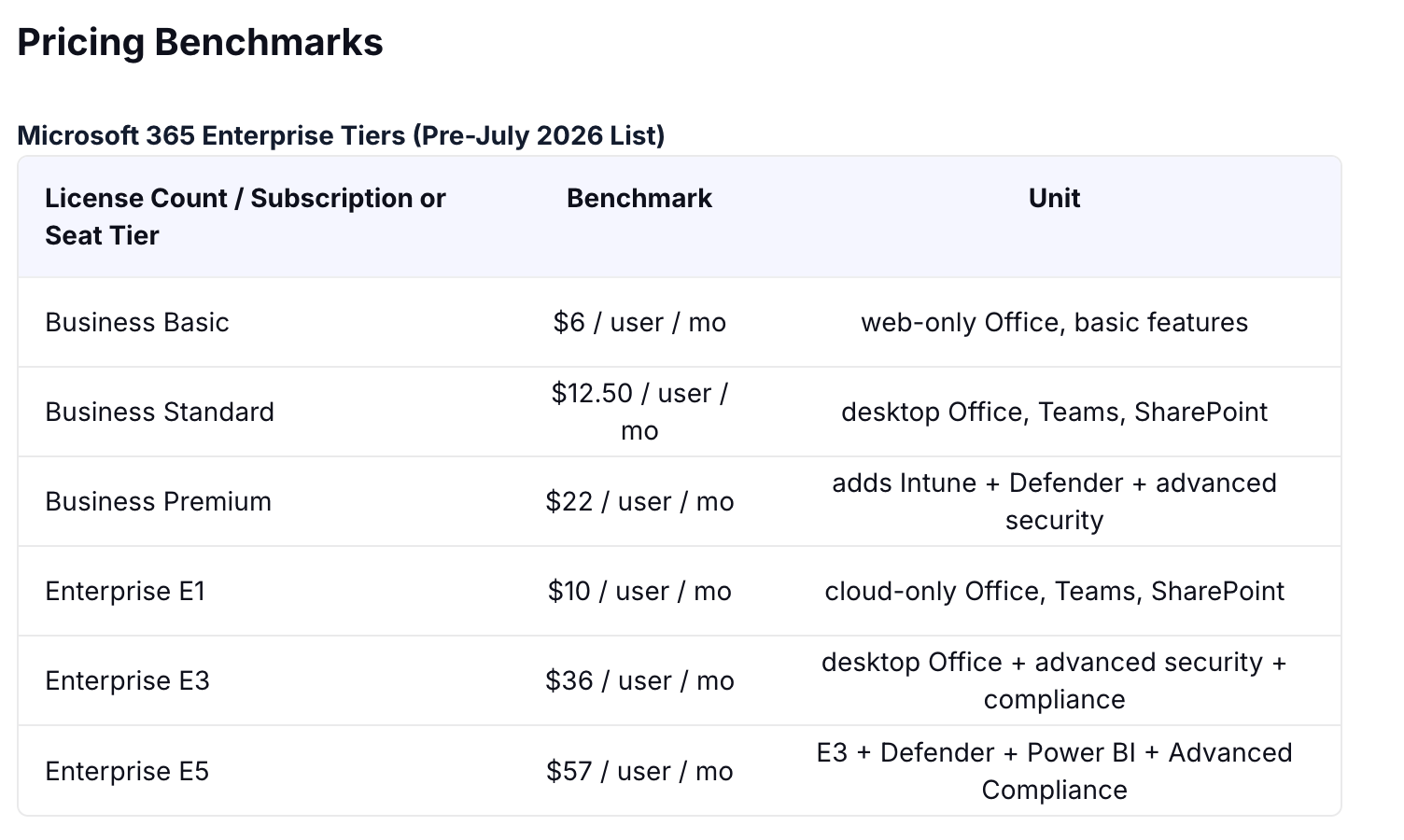
In CloudEagle.ai's benchmarking view, the market rate is shown against the actual seat count the team is negotiating, with the vendor-specific buying guide available in the same workflow:

F. Negotiation Support and Expert Help: Strategy Built From Your Data, Not a Generic Playbook

For high-stakes renewals, CloudEagle.ai provides on-demand negotiation advisory, an analysis of the vendor quote and a strategy to get a better deal.

It’s built from your specific usage history, contract terms, and benchmark data rather than a generic buying guide that every other customer of that tool also has access to.
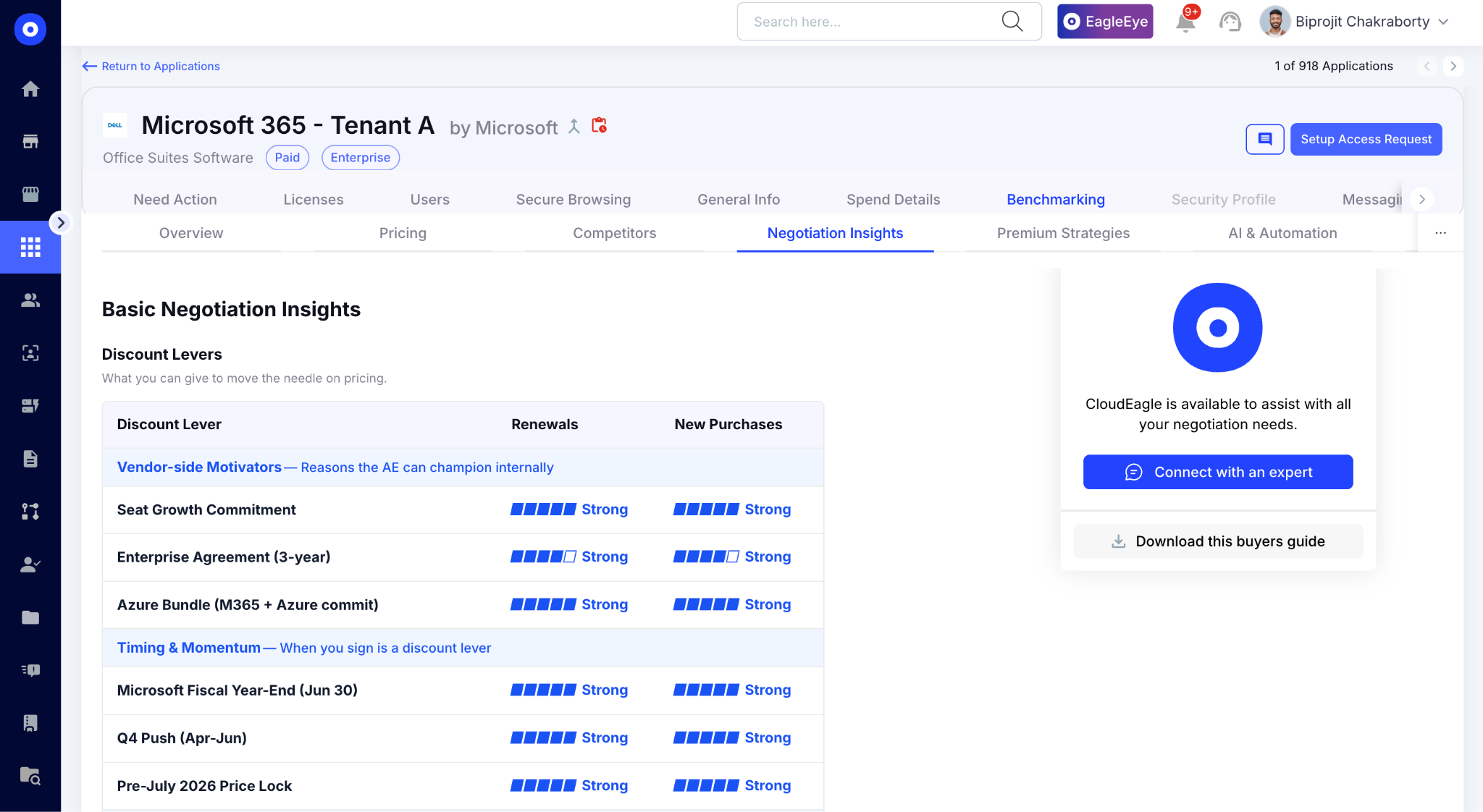
Your usage data is the one input in a negotiation that's specific to your account. CloudEagle.ai's expert advisory uses it, alongside your contract history and the benchmarking database, to build a strategy that reflects your situation.

The difference between a buying guide and a negotiation strategy is the usage data that makes the general advice specific to you. That's what CloudEagle.ai's expert support delivers.

3. Where Vendr's Model Stops Short of an Actual Negotiation Strategy

Pricing intelligence is an important input to a renewal. But it's only one input. Vendr's model prices whatever seat count is already in the contract.

However, it doesn't question whether that number is still right. That's the specific gap that determines whether a renewal negotiation actually saves money or just optimizes the wrong contract.

A. Vendr Gives You a Price. It Doesn't Give You a Renewal Strategy.

A market benchmark answers one question: "What should this cost?"

It doesn't answer a more important one: "Should we even be renewing this many seats?" That decision determines the size of the contract before pricing discussions even begin.
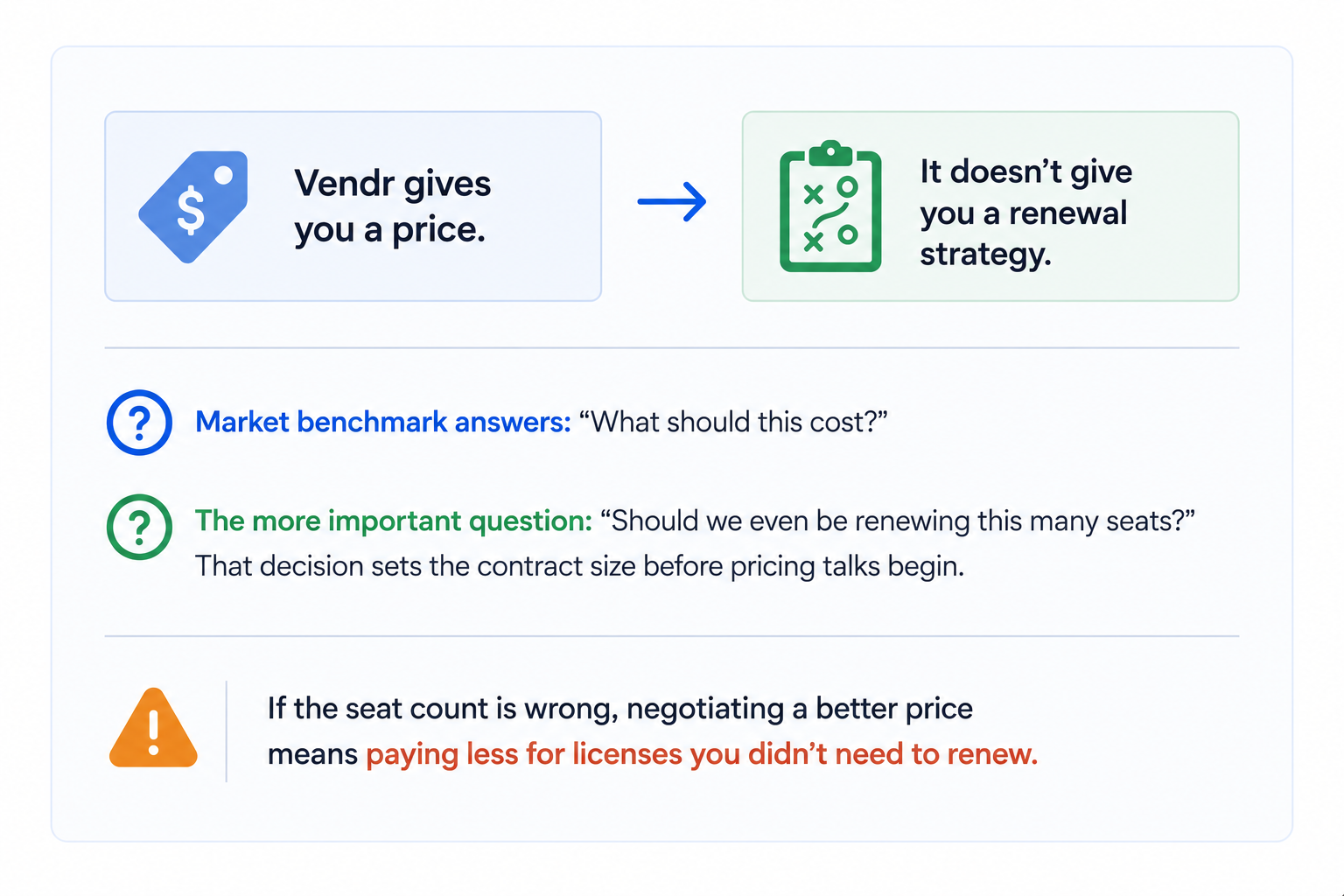
If the seat count is wrong, negotiating a better price simply means you're paying less for licenses you didn't need to renew.

B. Vendr's Buying Guides Are General. Your Usage Data Is Specific to You.

Buying guides are useful because they provide market context. But they're built from what other organizations typically pay, not how your organization actually uses the software.

  • Market Benchmark: Shows what similar companies typically pay for a given seat count, but the same data every other customer negotiating that software also has access to
  • Shared Context: Because every customer has access to similar market pricing data, the benchmark alone gives you no advantage specific to your account
  • Usage Insights: Reveals how many licenses are actually active, underused, or no longer needed in your environment, the one input that's unique to your organization and that Vendr's model doesn't touch
  • Negotiation Leverage: Account-specific usage evidence lets you right-size the contract before the pricing discussion begins, which is the decision that determines the size of the check, not the rate per seat

Usage data is the one negotiation input that's unique to your organization, and it's the piece pricing benchmarks don't capture.

C. What Happens When the Benchmark and the Usage Data Disagree

Imagine the benchmark shows your quote is competitive for 200 licenses. Your usage data, however, shows that only 130 users have been active over the past few months.

You could negotiate aggressively and secure an excellent market rate for all 200 licenses. Or you could renew only the 130 licenses your team actually needs.

The benchmark can't tell you which fight is worth having, negotiating hard on 200 seats or renewing the 130 you actually need. That's the question only usage data can answer.

Procurement Isn't About Buying

It's about negotiating.
See Why

4. Conclusion

The cost of negotiating without usage data was never really about losing a negotiation. It's about winning one for a number that was wrong before the call even started, and repeating that mistake across every renewal cycle.

CloudEagle.ai puts usage data, pricing benchmarks, and negotiation strategy in the same workflow, automatically, starting 90 days before every renewal.

So the seat count going into the vendor call reflects what your organization actually needs, not what last year's contract assumed.

5. FAQs

1. How does CloudEagle.ai calculate which licenses are dormant versus simply used infrequently?

CloudEagle.ai tracks feature-level activity, not just login events so a user who opened an application once in 90 days without creating any records, running any reports, or using any billable features is flagged as dormant rather than active. The inactivity threshold is configurable per application so the definition matches how each tool is actually used.

2. Can CloudEagle.ai track usage for applications that don't have a direct API integration?

For applications outside the 500+ direct integrations, CloudEagle.ai pulls activity signals from SSO logs, finance data, and browser activity to estimate usage patterns. Where direct feature-level data isn't available, CloudEagle.ai flags the gap so procurement knows which vendors have verified usage data and which are estimated.

3. How does CloudEagle.ai handle renewals for multi-year contracts where seat counts can't be changed mid-term?

CloudEagle.ai flags multi-year contracts separately in the renewal calendar, surfacing the specific amendment windows or true-up clauses where seat adjustments are contractually permitted. Usage data is tracked continuously throughout the term so that when the amendment window opens, the dormant seat count is already documented and ready to support the right-sizing conversation.

4. Can CloudEagle.ai track usage trends over time rather than just a point-in-time snapshot?

CloudEagle.ai maintains rolling usage history per application and per user so procurement can see whether a seat has been dormant for 30 days or 18 months, whether adoption is trending up or down ahead of renewal, and whether a recently unused seat belongs to an employee who was on leave versus one who permanently stopped using the tool.

5. Does CloudEagle.ai surface the renewal context for AI tools like Copilot or ChatGPT Enterprise the same way it does for traditional SaaS?

AI tool renewals are handled in the same renewal workflow as traditional SaaS, with usage tracked at the token and seat level, benchmark pricing pulled from the SaaSMap database, and the 90-day first-touch message including current consumption, alternatives, and an AI recommendation. Usage-based billing surprises surface as threshold alerts before the invoice arrives rather than after.

Advertisement for a SaaS Subscription Tracking Template with a call-to-action button to download and a partial graphic of a tablet showing charts.Banner promoting a SaaS Agreement Checklist to streamline SaaS management and avoid budget waste with a call-to-action button labeled Download checklist.Blue banner with text 'The Ultimate Employee Offboarding Checklist!' and a black button labeled 'Download checklist' alongside partial views of checklist documents from cloudeagle.ai.Digital ad for download checklist titled 'The Ultimate Checklist for IT Leaders to Optimize SaaS Operations' by cloudeagle.ai, showing checklist pages.Slack Buyer's Guide offer with text 'Unlock insider insights to get the best deal on Slack!' and a button labeled 'Get Your Copy', accompanied by a preview of the guide featuring Slack's logo.Monday Pricing Guide by cloudeagle.ai offering exclusive pricing secrets to maximize investment with a call-to-action button labeled Get Your Copy and an image of the guide's cover.Blue banner for Canva Pricing Guide by cloudeagle.ai offering a guide to Canva costs, features, and alternatives with a call-to-action button saying Get Your Copy.Blue banner with white text reading 'Little-Known Negotiation Hacks to Get the Best Deal on Slack' and a white button labeled 'Get Your Copy'.Blue banner with text 'Little-Known Negotiation Hacks to Get the Best Deal on Monday.com' and a white button labeled 'Get Your Copy'.Blue banner with text 'Little-Known Negotiation Hacks to Get the Best Deal on Canva' and a white button labeled 'Get Your Copy'.Banner with text 'Slack Buyer's Guide' and a 'Download Now' button next to images of a guide titled 'Slack Buyer’s Guide: Features, Pricing & Best Practices'.Digital cover of Monday Pricing Guide with a button labeled Get Your Copy on a blue background.Canva Pricing Guide cover with a button labeled Get Your Copy on a blue gradient background.

Enter your email to
unlock the report

Oops! Something went wrong while submitting the form.
License Count
Benchmark
Per User/Per Year

Enter your email to
unlock the report

Oops! Something went wrong while submitting the form.
License Count
Benchmark
Per User/Per Year

Enter your email to
unlock the report

Oops! Something went wrong while submitting the form.
Notion Plus
License Count
Benchmark
Per User/Per Year
100-500
$67.20 - $78.72
500-1000
$59.52 - $72.00
1000+
$51.84 - $57.60
Canva Pro
License Count
Benchmark
Per User/Per Year
100-500
$74.33-$88.71
500-1000
$64.74-$80.32
1000+
$55.14-$62.34

Enter your email to
unlock the report

Oops! Something went wrong while submitting the form.

Enter your email to
unlock the report

Oops! Something went wrong while submitting the form.
Zoom Business
License Count
Benchmark
Per User/Per Year
100-500
$216.00 - $264.00
500-1000
$180.00 - $216.00
1000+
$156.00 - $180.00

Enter your email to
unlock the report

Oops! Something went wrong while submitting the form.

Get the Right Security Platform To Secure Your Cloud Infrastructure

Please enter a business email
Thank you!
The 2023 SaaS report has been sent to your email. Check your promotional or spam folder.
Oops! Something went wrong while submitting the form.

Access full report

Please enter a business email
Thank you!
The 2023 SaaS report has been sent to your email. Check your promotional or spam folder.
Oops! Something went wrong while submitting the form.

Before a renewal negotiation, procurement teams often pull a pricing benchmark. It tells them what similar companies typically pay. But almost nobody stops to ask a more important question: are we actually using all those seats?

The negotiation moves forward assuming the contract size is correct because nothing in the process ever verified it.

That's the gap with pricing intelligence. It tells you what the market pays. It doesn't tell you what you should be paying.The cost isn't losing a negotiation. It's winning one for a number that was wrong before the call even started.

CloudEagle.ai puts usage data, pricing benchmarks, and renewal timing in the same workflow automatically, starting 90 days before every renewal so the negotiation opens from the right seat count.

In this article, we'll show you what that actually costs and what changes when you fix it.

TL;DR

  • Negotiating renewals without usage data often leads to renewing more licenses than your organization actually needs.
  • CloudEagle.ai combines license usage, renewal timing, and pricing benchmarks to build the right renewal strategy.
  • Automated license harvesting and AI-powered contract insights help right-size contracts before renewal deadlines.
  • Pricing benchmarks are valuable, but usage data determines whether you're negotiating the right contract in the first place.
  • CloudEagle.ai enables smarter SaaS renewals by unifying usage insights, benchmarking, automation, and negotiation support in one workflow.

1. The Real Costs of Negotiating a Renewal Without Usage Data

A pricing benchmark helps you negotiate the market rate. But the biggest costs of a renewal often have nothing to do with the price itself. 

Without usage data, teams negotiate the contract they signed months or years ago, not the one their organization actually needs today.

A. The Overpay Cost: Paying Full Price for Seats Nobody's Using

Imagine your renewal contract includes 200 licenses. Before the negotiation, you check a benchmark and confirm the quoted price is in line with the market.

The problem is that the benchmark assumes 200 licenses are still needed because that's the contract you're pricing. It has no way of knowing that only 130 people have actively used the software over the past few months.

The negotiation succeeds. You secure a competitive price for all 200 licenses. But you still renewed 70 licenses nobody was using. A good negotiation on the wrong number is still an overpay.

B. The Timing Cost: Losing Leverage Before the Negotiation Starts

Pricing intelligence is something teams typically pull when a renewal is approaching.

It doesn't monitor contract milestones or remind you that your notice period expires next week. If the auto-renewal deadline passes before anyone reviews the renewal, the conversation changes from 

"How do we optimize this contract?" to "We're already committed for another year."

The cost isn't just paying more. It's losing the opportunity to negotiate at all.

C. The Compounding Cost: Why the Same Mistake Repeats Every Cycle

The most expensive cost isn't tied to a single renewal. It's what happens when the same mistake becomes part of your renewal process.

  • A contract renews with inactive licenses because nobody reviewed actual usage.
  • The renewed seat count becomes the starting point for the next negotiation.
  • Another benchmark is pulled against that same seat count, reinforcing the assumption that it's still correct.
  • The cycle repeats across every renewal, gradually locking more unnecessary spend into the software portfolio.

A one-time overpay is a bad quarter. An overpay that repeats across every renewal, for every major vendor, becomes a structural drain on your software budget.

The real cost of negotiating without usage data isn't losing a negotiation. It's winning one for the wrong number, over and over.

Every Renewal Hides An Opportunity

Don't miss it.
Learn More

2. How CloudEagle.ai Puts Usage Data Inside Every Negotiation

CloudEagle.ai builds usage data into every step of the process, from surfacing dormant seats 90 days before the contract renews to attaching utilization trends to the first message a stakeholder sees when the renewal opens. 

Here's how each capability delivers that:

A. License Management: Establish the True Seat Count Before the Negotiation Starts

CloudEagle.ai connects to 500+ applications and pulls real-time license data such as purchased, assigned, and actively used, across every vendor in the stack.

Here's how license management surfaces the usage baseline that the negotiation should be built from:

In CloudEagle.ai's license management view, every vendor shows purchased count, assigned count, and actively used count side by side:

A team negotiating 200 seats because that's the contract number, when only 130 are active, is negotiating the wrong contract from sentence one. This view closes that gap before the vendor call is scheduled.

B. License Harvesting: Surface Dormant Seats in Time to Act

License harvesting identifies which seats have gone dormant and triggers the reclaim workflow early enough that the right-sized number is confirmed before the renewal window closes, not after.

Here's how license harvesting flags inactive seats and builds the right-sized contract number:

In CloudEagle.ai's license harvesting view, every seat inactive for 30, 60, or 90 days is flagged with the last activity date and cost, so the dormant seat count is visible and actionable before renewal:

Customers typically recover 10 to 30% of annual SaaS spend within the first 90 days, not from negotiating a better price per seat, but knowing the right seat count before the call.

C. AI Contract Metadata Extraction: Make Sure There's Time to Use the Data

CloudEagle.ai extracts renewal dates, notice periods, opt-out clauses, and auto-renewal terms from uploaded contracts using AIm and builds a live renewal calendar from that data automatically.

Here's how AI contract metadata extraction surfaces the renewal window before it closes:

In CloudEagle.ai's contract view, every vendor shows the AI-extracted renewal date, notice period, and opt-out deadline alongside current usage data:

The timing cost from the previous section, losing leverage before the negotiation starts, is closed here. Usage data is only useful if it arrives before the auto-renewal clause fires.

D. 90-Day Renewal Workflow: Usage, Benchmarking, Alternatives, and AI Recommendation in the First Message

CloudEagle.ai triggers a renewal workflow 90 days before every contract date. The first message that goes to stakeholders already contains the full negotiation context and an AI-generated recommendation on whether to renew, right-size, or switch.

No one has to pull the usage report separately. No one has to look up the benchmark. No one has to remember to check whether there's a notice period. It's all in the first message, 90 days out.

Stakeholders are notified via Slack, Teams, and email. Approvals route through Jira, Coupa, or Ironclad, wherever the team already works.

In CloudEagle.ai's renewal calendar, every upcoming contract shows the days remaining, the usage trend, the benchmark price, and the AI recommendation:

Tom Baroch, Head of Global Supply Management at Outrider, described the impact directly: 

"We faced a major issue with missed contract renewals due to manual tracking methods, often leading to automatic renewals at unfavorable terms. CloudEagle.ai automatically extracted critical contract dates and set up timely reminders, ensuring we were always ahead of upcoming renewals."

E. Price Benchmarking and Buying Guides: The Benchmark Applied to the Right Number

CloudEagle.ai's SaaSMap benchmarking database is compiled from over 2 billion transactions across an extensive network of SaaS buyers. The benchmark data covers the same pricing intelligence Vendr provides.

The difference in this workflow: the benchmark is applied to the right-sized seat count that license harvesting already confirmed. The team sees what the market pays for 130 seats, not 200.

Vendor-specific buying guides surface the negotiation levers, discount patterns, and renewal behaviors that have delivered savings on that specific vendor.

In CloudEagle.ai's benchmarking view, the market rate is shown against the actual seat count the team is negotiating, with the vendor-specific buying guide available in the same workflow:

F. Negotiation Support and Expert Help: Strategy Built From Your Data, Not a Generic Playbook

For high-stakes renewals, CloudEagle.ai provides on-demand negotiation advisory, an analysis of the vendor quote and a strategy to get a better deal.

It’s built from your specific usage history, contract terms, and benchmark data rather than a generic buying guide that every other customer of that tool also has access to.

Your usage data is the one input in a negotiation that's specific to your account. CloudEagle.ai's expert advisory uses it, alongside your contract history and the benchmarking database, to build a strategy that reflects your situation.

The difference between a buying guide and a negotiation strategy is the usage data that makes the general advice specific to you. That's what CloudEagle.ai's expert support delivers.

3. Where Vendr's Model Stops Short of an Actual Negotiation Strategy

Pricing intelligence is an important input to a renewal. But it's only one input. Vendr's model prices whatever seat count is already in the contract.

However, it doesn't question whether that number is still right. That's the specific gap that determines whether a renewal negotiation actually saves money or just optimizes the wrong contract.

A. Vendr Gives You a Price. It Doesn't Give You a Renewal Strategy.

A market benchmark answers one question: "What should this cost?"

It doesn't answer a more important one: "Should we even be renewing this many seats?" That decision determines the size of the contract before pricing discussions even begin.

If the seat count is wrong, negotiating a better price simply means you're paying less for licenses you didn't need to renew.

B. Vendr's Buying Guides Are General. Your Usage Data Is Specific to You.

Buying guides are useful because they provide market context. But they're built from what other organizations typically pay, not how your organization actually uses the software.

  • Market Benchmark: Shows what similar companies typically pay for a given seat count, but the same data every other customer negotiating that software also has access to
  • Shared Context: Because every customer has access to similar market pricing data, the benchmark alone gives you no advantage specific to your account
  • Usage Insights: Reveals how many licenses are actually active, underused, or no longer needed in your environment, the one input that's unique to your organization and that Vendr's model doesn't touch
  • Negotiation Leverage: Account-specific usage evidence lets you right-size the contract before the pricing discussion begins, which is the decision that determines the size of the check, not the rate per seat

Usage data is the one negotiation input that's unique to your organization, and it's the piece pricing benchmarks don't capture.

C. What Happens When the Benchmark and the Usage Data Disagree

Imagine the benchmark shows your quote is competitive for 200 licenses. Your usage data, however, shows that only 130 users have been active over the past few months.

You could negotiate aggressively and secure an excellent market rate for all 200 licenses. Or you could renew only the 130 licenses your team actually needs.

The benchmark can't tell you which fight is worth having, negotiating hard on 200 seats or renewing the 130 you actually need. That's the question only usage data can answer.

Procurement Isn't About Buying

It's about negotiating.
See Why

4. Conclusion

The cost of negotiating without usage data was never really about losing a negotiation. It's about winning one for a number that was wrong before the call even started, and repeating that mistake across every renewal cycle.

CloudEagle.ai puts usage data, pricing benchmarks, and negotiation strategy in the same workflow, automatically, starting 90 days before every renewal.

So the seat count going into the vendor call reflects what your organization actually needs, not what last year's contract assumed.

5. FAQs

1. How does CloudEagle.ai calculate which licenses are dormant versus simply used infrequently?

CloudEagle.ai tracks feature-level activity, not just login events so a user who opened an application once in 90 days without creating any records, running any reports, or using any billable features is flagged as dormant rather than active. The inactivity threshold is configurable per application so the definition matches how each tool is actually used.

2. Can CloudEagle.ai track usage for applications that don't have a direct API integration?

For applications outside the 500+ direct integrations, CloudEagle.ai pulls activity signals from SSO logs, finance data, and browser activity to estimate usage patterns. Where direct feature-level data isn't available, CloudEagle.ai flags the gap so procurement knows which vendors have verified usage data and which are estimated.

3. How does CloudEagle.ai handle renewals for multi-year contracts where seat counts can't be changed mid-term?

CloudEagle.ai flags multi-year contracts separately in the renewal calendar, surfacing the specific amendment windows or true-up clauses where seat adjustments are contractually permitted. Usage data is tracked continuously throughout the term so that when the amendment window opens, the dormant seat count is already documented and ready to support the right-sizing conversation.

4. Can CloudEagle.ai track usage trends over time rather than just a point-in-time snapshot?

CloudEagle.ai maintains rolling usage history per application and per user so procurement can see whether a seat has been dormant for 30 days or 18 months, whether adoption is trending up or down ahead of renewal, and whether a recently unused seat belongs to an employee who was on leave versus one who permanently stopped using the tool.

5. Does CloudEagle.ai surface the renewal context for AI tools like Copilot or ChatGPT Enterprise the same way it does for traditional SaaS?

AI tool renewals are handled in the same renewal workflow as traditional SaaS, with usage tracked at the token and seat level, benchmark pricing pulled from the SaaSMap database, and the 90-day first-touch message including current consumption, alternatives, and an AI recommendation. Usage-based billing surprises surface as threshold alerts before the invoice arrives rather than after.

CloudEagle.ai recognized in the 2025 Gartner® Magic Quadrant™ for SaaS Management Platforms
Download now
gartner chart
5x
Faster employee
onboarding
80%
Reduction in time for
user access reviews
30k
Workflows
automated
$15Bn
Analyzed in
contract spend
$2Bn
Saved in
SaaS spend

Streamline SaaS governance and save 10-30%

Book a Demo with Expert
CTA image