AI Governance

SaaS Security Posture Management for Healthcare: Compliance, HIPAA, and What to Monitor

Share via:
Written by:
CloudEagle.ai Team
Reviewed by
Nidhi Jain
Last Updated:
August 31, 2026
blog-cms-banner-bg
Little-Known Negotiation Hacks to Get the Best Deal on Slack
cta-bg-blogDownload Your Copy

HIPAA Compliance Checklist for 2025

Download PDF

SaaS security posture management in healthcare is usually sold as a compliance-evidence tool: connect a few sanctioned apps, map their settings to a framework, export the report before the auditor arrives. 

That misses where HIPAA exposure actually sits, in the apps nobody enrolled in SSO, the admin accounts nobody reviewed, and the AI tools staff started using last month. Strong posture starts by seeing all of it, not just the federated list.
How SaaS Security Posture Management Changes in a Healthcare Setting

SaaS security posture management (SSPM) in simple terms is the continuous practice of checking whether every SaaS app is configured and accessed safely.

This can look like: MFA and SSO enforced, admin access limited, sharing controlled and keeping vendor certifications current. 

In healthcare, it is the layer that keeps the apps touching PHI aligned with what HIPAA's Security Rule expects, all the time.

10 Checks Your SSPM Program Needs

A checklist covering MFA enforcement, admin access, and the other must-dos for a secure SaaS portfolio.
Get the Checklist

Why HIPAA Makes SaaS Posture a Continuous Problem, Not an Annual One

HIPAA's Security Rule treats access control, workforce clearance, and audit as ongoing obligations, not a yearly checkbox. 

But your posture drifts between those checks:

  • Someone gets admin rights for a project and keeps them even after the project has ended.
  • A vendor turns on a new AI feature after the contract is signed.
  • An employee leaves and an account lingers for weeks.

A point-in-time review misses all of it. It is accurate the morning you run it and wrong by the end of the week, which is why the honest answer to a continuous obligation is continuous monitoring.

Point-in-time review Continuous monitoring
Accurate the day you run it, stale by the next week Current on any given day
Scoped to the apps you remembered to check Scoped to the whole estate, including newly found apps
Evidence assembled by hand before the audit Evidence generated as the work happens

The Apps Most Likely to Leak PHI Are the Ones You Cannot See

Healthcare SaaS security is hard to monitor for a simple reason: the estate you can see is not the estate you have. 

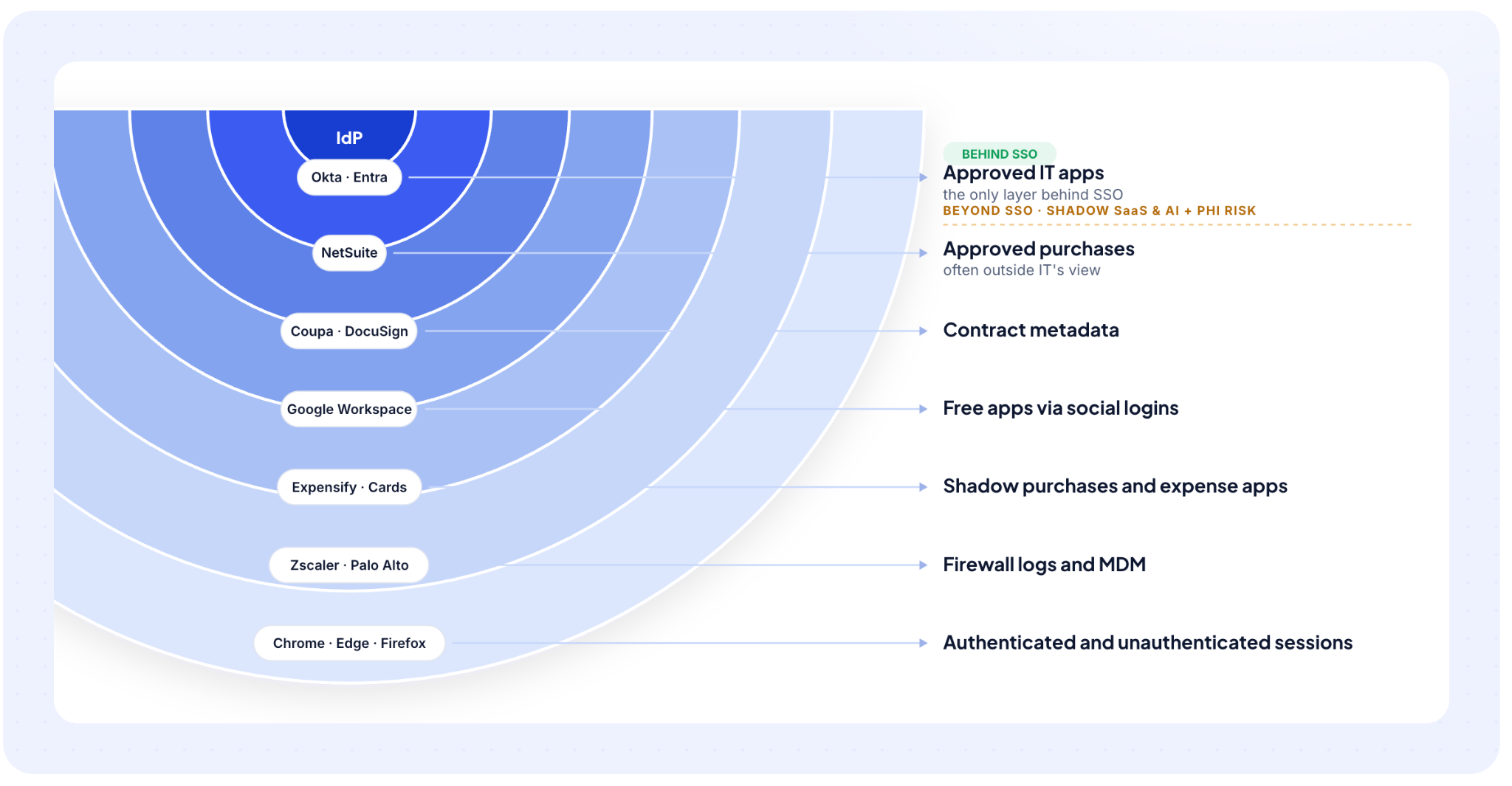
Most teams monitor the apps behind their identity provider, but the apps most likely to touch PHI without oversight sit outside it, and the signals you need to judge posture are scattered across tools that don’t sync.

Shadow SaaS and Shadow AI Where PHI Actually Leaks

The riskiest apps in a healthcare stack are usually the ones IT never enrolled. These can include, but is not limited to:

  • A transcription tool a clinician signed up for with a personal email.
  • A scheduling app bought on a corporate card.
  • An AI assistant fed a page of patient notes.

None appear in your SSO console, so none show up in posture checks that begin from the federated list. 

You cannot score the posture of an app you cannot see, which is why discovery has to come before monitoring. 

The cleanest example was when one of our clients, RingCentral, ran discovery across finance, SSO, and browser signals, it surfaced more than 320 redundant and unsanctioned apps that had built up with no central view. 

In a healthcare org, that same blind spot is where an unmonitored PHI path hides.

Posture Signals Scattered Across Okta, Your CASB, and the SOC

Even for the apps you do see, the data you need lives in different systems:

  • Your identity provider knows MFA and SSO status.
  • Your CASB knows where users browsed.
  • Your SOC knows which alerts fired.

No single one tells you, app by app, whether an application touching PHI is configured safely. 

Healthcare security teams end up filtering endless identity telemetry by hand, and even a managed SOC struggles to correlate it application by application.

A solo analyst cannot reconcile those feeds manually and keep them current, so posture monitoring only works when it correlates those sources into one per-app view.
SSPM Versus CSPM and GRC Compliance Tools

SSPM, CSPM, and GRC tools solve different problems, and healthcare teams often buy one expecting another. 

That mismatch is how a gap survives procurement: the team believes the SaaS layer is covered, and none of the three tools actually catches the app sitting outside all of them. 

Here’s the short version at a glance:

Tool What it watches What it misses for healthcare
SSPM The SaaS apps themselves: access, authentication, and configuration, per app Nothing at the SaaS layer, if discovery is complete
CSPM Cloud infrastructure (AWS, Azure, GCP) for misconfiguration The SaaS apps clinicians and staff actually log into
GRC / evidence automation Proof and control mapping for apps already connected The app you never connected, where posture gaps hide

The distinction matters because evidence-automation platforms prove controls on the apps you already connected. They do not go looking for the app you never connected, which is exactly where healthcare posture gaps live.

📖 Worth a Read 👉 What SaaS Security Posture Management Actually Covers.

What Should a Healthcare Team Actually Monitor Across its SaaS Stack?

Monitor the SaaS-layer controls HIPAA's Security Rule cares about, on every app that could touch PHI. 

This means you need to check how users authenticate, who holds privileged access, whether the vendor is certified and under a BAA, and whether access comes from the people and places you expect. 

The core of the job is knowing, per app, whether those controls are actually on. 

Here is the working baseline.

Signal to monitor What to check per app Why it matters under HIPAA
Authentication SSO enforced, MFA on, sessions time out, no local accounts bypassing the IdP First controls an auditor asks about; first to lapse on a rushed onboarding
Privileged & admin access Who holds admin rights, and whether they still need them Standing privilege on a PHI-adjacent app is a clear, avoidable exposure
Vendor certs & BAA Current SOC 2 / HITRUST, signed BAA, any subprocessor or residency change An app touching PHI without a BAA is a compliance gap on its own
Login geography Which employees reach PHI-access apps, and from where HIPAA and state privacy laws care who touches records, and under what jurisdiction
Non-human accounts Service accounts, API tokens, and AI agents holding access These hold real access nobody reviews, so they belong in the same posture view

Two of these get missed most often. 

Admin rights accumulate quietly, granted for a migration and kept for years, and accounts outlive the people who owned them after role changes and departures. 

This is fixable with a regular cadence rather than a pre-audit sweep, as was seen with one of our client, Lapzo, a healthcare technology company, removed more than 220 excessive admin privileges once reviews ran continuously.

How CloudEagle.ai Brings Healthcare SaaS Posture Into One View

We built SaaS security posture management to start where the risk starts, with discovery, then keep posture and access current on every app without a manual audit. 

CloudEagle.ai correlates identity, finance, browser, and CASB signals into one per-app view, so the whole estate and its posture sit in the same place.

Discovering the Full Estate Before Scoring Its Posture

We find the apps your identity provider cannot. 

By correlating SSO, finance and card spend, browser signals, and CASB logs against our proprietary app catalog, we surface shadow SaaS and shadow AI

Post which we then risk-score each one so your team knows what to bring under governance first instead of treating every unknown app as an equal fire drill.

Continuous Posture and Compliance Tracking Per App

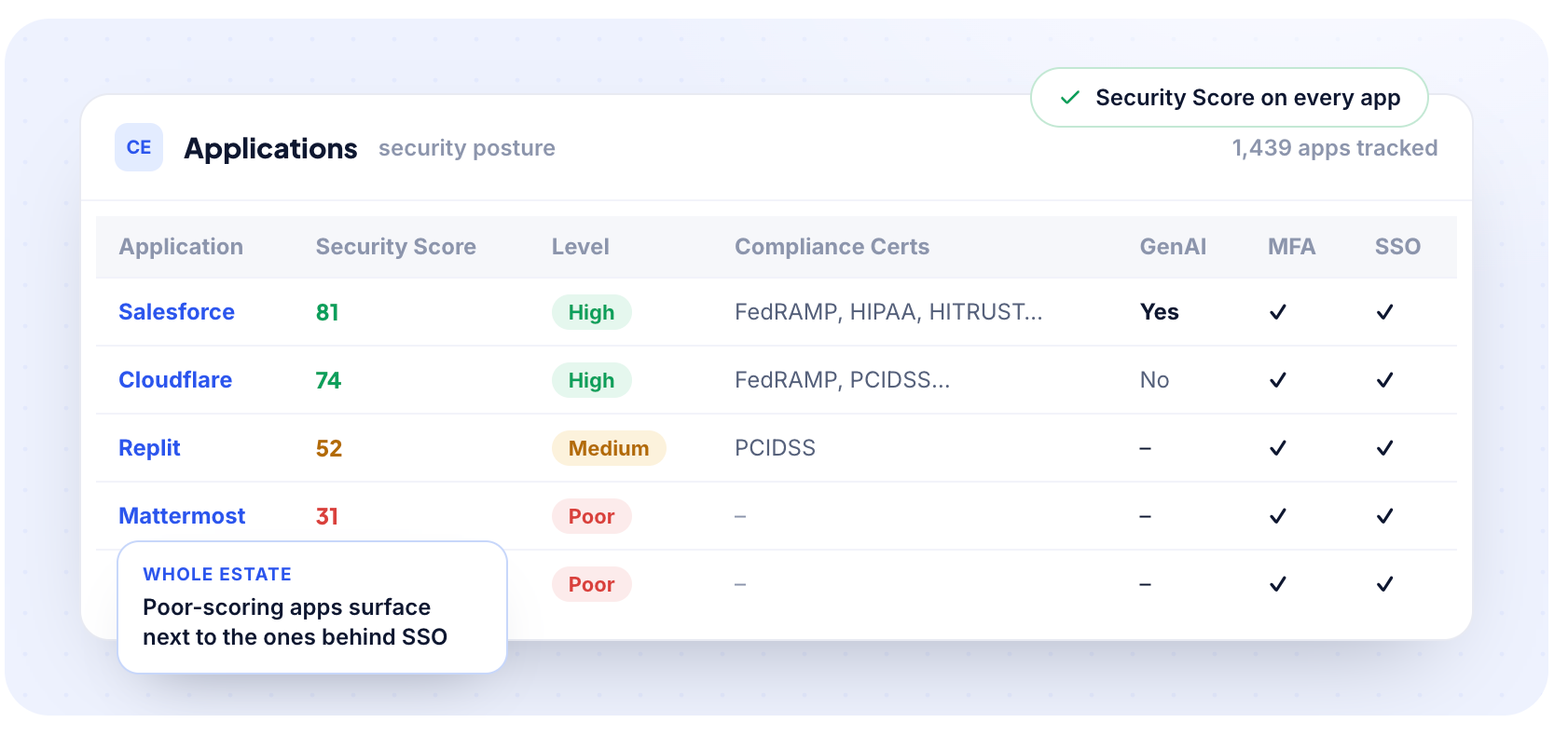
For every app, we track posture continuously and roll it into a security score and a per-signal view:

  • A per-app security score summarizing how the app measures up.
  • MFA and SSO support, pulled from the vendor and your identity provider.
  • Compliance certifications tracked per vendor, including HIPAA, HITRUST, NIST / SP800-53, SOC 2, and ISO 27001.
  • Data center standards and AI signals: whether the vendor uses GenAI, whether it can be disabled, and whether it trains on your data.
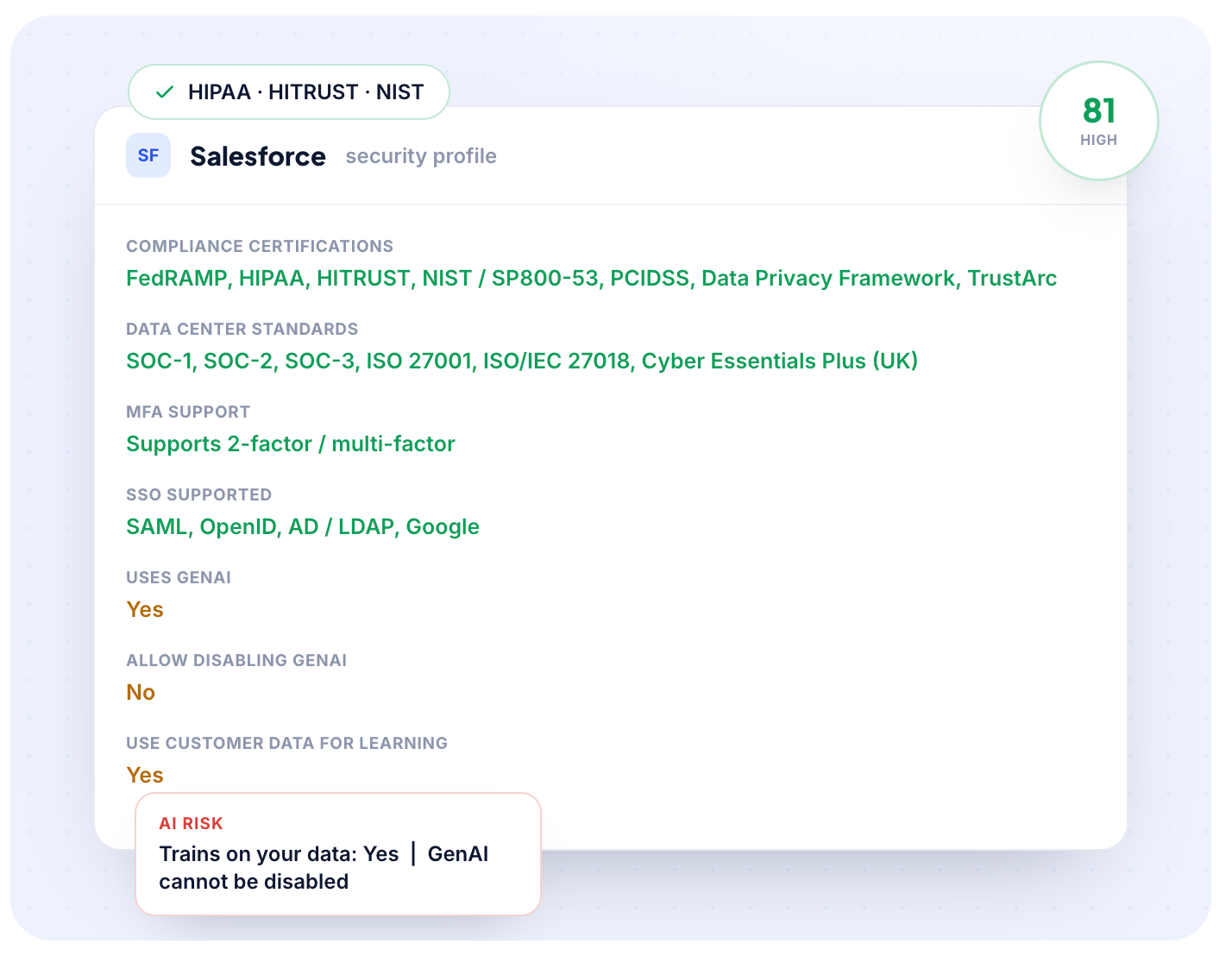
One boundary is that we give you the visibility and the per-app posture across your SaaS security and compliance stack. 

Inline blocking of data in transit stays with your CASB. We tell you where the exposure is and keep it in view; your enforcement layer acts on it.

Access Reviews and Offboarding That Produce Audit Evidence

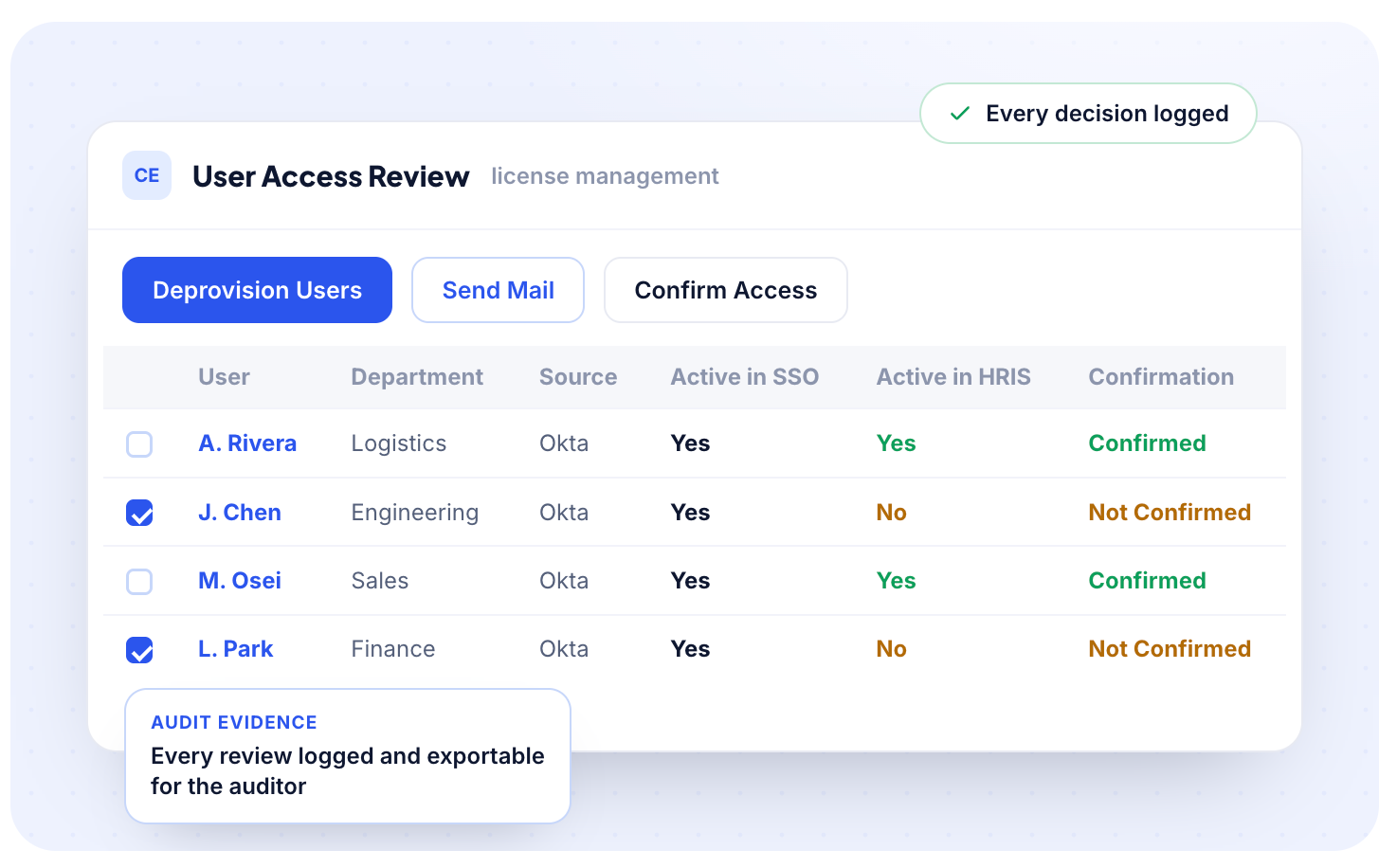
We turn access reviews and offboarding into a continuous process that generates evidence as it runs:

  • Reviews route to the right manager from HRIS data, with reminders.
  • Rejected access triggers deprovisioning automatically.
  • Every decision is logged and exportable in the format auditors expect.

The evidence is a byproduct of the work, not a separate project bolted on before the audit.
How Does Shadow AI Change Healthcare SaaS Posture?

Shadow AI is now the fastest-growing way PHI leaves a healthcare organization, and most teams have no policy behind the tools staff already use. 

AI widens the posture problem because it enters two ways: tools employees adopt on their own, and AI features switching on inside apps you already pay for.

Staff Pasting PHI Into Public AI Tools

The immediate risk is simple:

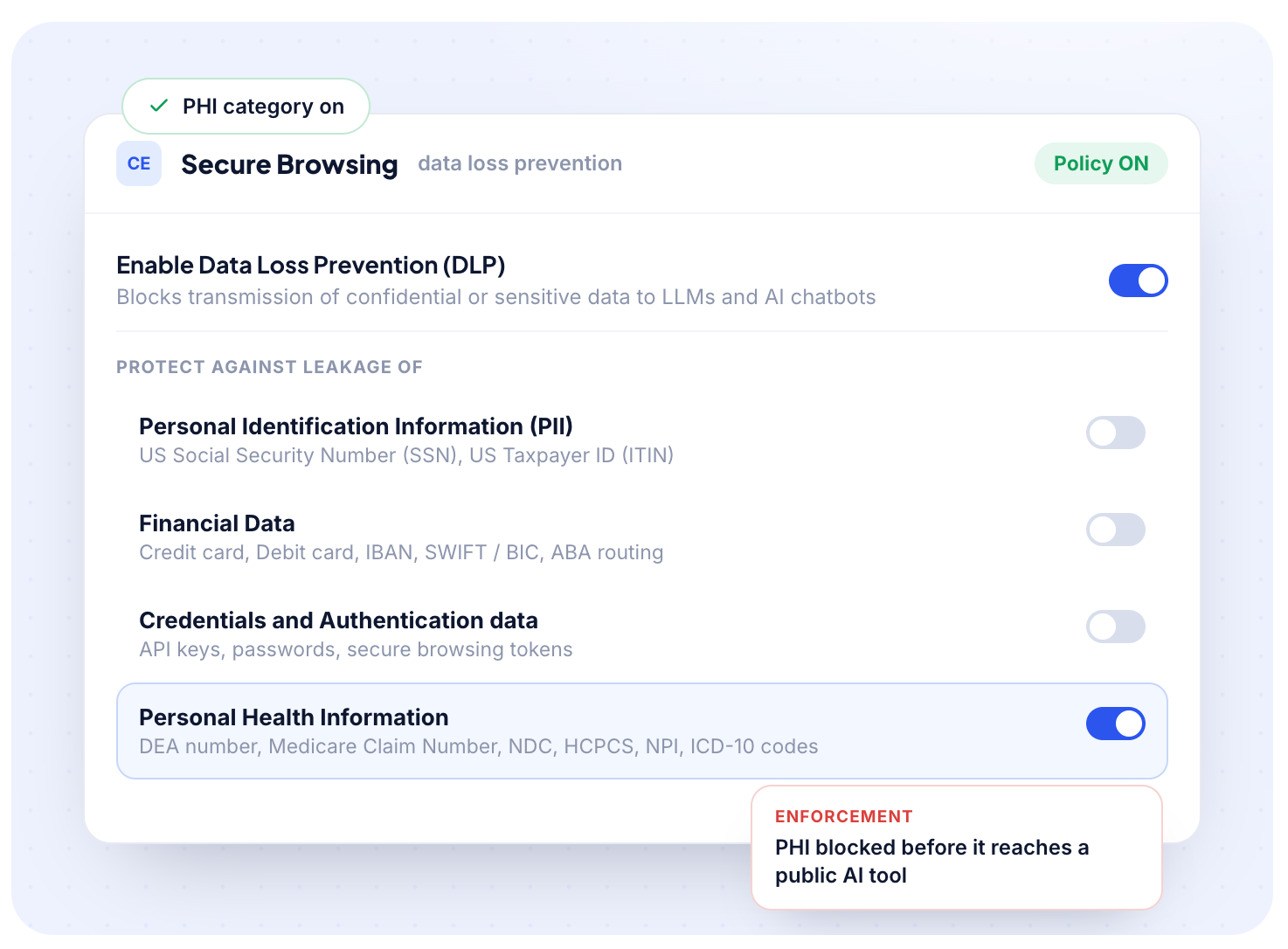
  • A clinician or analyst pastes patient information into a public AI tool with no BAA that may train on what it receives.
  • AI features quietly activate inside collaboration, CRM, or design tools after the contract was signed, with nobody told.

In a regulated environment, either one is a reportable exposure with no audit trail unless something is watching.

When a Fortune 500 firm brought this under one view, it blocked 100% of the PII-exposure incidents it had previously missed. 

We monitor what data enters AI tools, block sensitive content from reaching unmanaged AI apps, and present a flash page that redirects staff to an approved alternative before the paste lands.
Governing AI Access the Same Way You Govern SaaS

AI tools need the same posture discipline as any other app: discovery, risk scoring, access reviews, and offboarding that revokes AI accounts and API tokens when someone leaves. 

Treat AI as a distinct risk category that moves quickly, but govern it inside the same posture program rather than a separate spreadsheet. 

Iterative Health did exactly this, governing more than 500 AI apps with 100% of AI access audited, which is what defensible AI governance looks like when boards start asking which vendors run GenAI on patient data.

📖 Worth a Read 👉 The Shadow AI Governance Gap: Why 63% of Enterprises Have No Shadow AI Policy

How Do You Build a SaaS Posture Program You Can Defend in a HIPAA Audit?

HIPAA compliance for SaaS applications rests on two things: a complete, current inventory of every app that could touch PHI, and continuous evidence that its controls are working. 

If your posture data is assembled by hand the week before an audit, it is neither complete nor current, and auditors can tell.

How HIPAA Compliance for SaaS Applications Becomes Audit-Ready Evidence

When posture checks and access reviews run continuously, audit evidence stops being a project:

  • Each review cycle logs who approved what, and when.
  • Each posture change is timestamped.
  • The export an auditor needs already exists when they ask.

The healthcare-tech team above moved its SOC 2 access-evidence prep from two weeks to a single day on exactly this pattern, and walked into its next audit with zero access-related findings. 

Monitoring you can defend in a HIPAA audit starts with seeing every app that could touch PHI, not just the ones already behind SSO. 

Discover the whole estate, keep posture and access current on all of it, and the next audit request takes an afternoon, not a week.

Frequently Asked Questions

What is SaaS security posture management (SSPM) for healthcare, and how is it different from SSPM elsewhere?

Healthcare SSPM checks the same things as general SSPM, MFA, admin access, sharing controls, but judges them against HIPAA's Security Rule instead of a generic baseline. A signed BAA and a certification like HITRUST matter as much as a configuration setting. General SSPM stops at the setting; healthcare SSPM maps every finding back to a compliance obligation.

Why doesn't a GRC or compliance-automation tool catch shadow SaaS and shadow AI?

Because GRC tools only map controls on apps you've already connected. A scheduling tool bought on a card or an AI assistant signed up with a personal email never touches your identity provider or your GRC system, so it never enters the review. The gap stays invisible until an audit or breach exposes it.

Is an AI tool without a signed BAA still a HIPAA risk if staff are just testing it?

Yes. HIPAA doesn't distinguish between a live workflow and a test the moment PHI enters the tool. If the vendor has no BAA and may train on what it receives, that single paste is a reportable exposure with no audit trail unless something is watching. Intent doesn't change the classification.

Which SaaS security signals do OCR investigators actually look at after a breach?

MFA on privileged and PHI-accessing accounts, a real access-review cadence, and whether the risk analysis covered the full cloud estate, not just IT-approved apps. Current BAAs and deprovisioning records get pulled too. Weak answers here are what turn an investigation into a finding.

How does CloudEagle.ai discover SaaS and AI apps that were never connected to our identity provider?

By correlating signals SSO can't see: card spend, browser activity, and CASB logs, matched against a proprietary app catalog. Each discovered app gets risk-scored, so your team knows which shadow tool to govern first instead of treating every unknown app as an equal fire drill.

Advertisement for a SaaS Subscription Tracking Template with a call-to-action button to download and a partial graphic of a tablet showing charts.Banner promoting a SaaS Agreement Checklist to streamline SaaS management and avoid budget waste with a call-to-action button labeled Download checklist.Blue banner with text 'The Ultimate Employee Offboarding Checklist!' and a black button labeled 'Download checklist' alongside partial views of checklist documents from cloudeagle.ai.Digital ad for download checklist titled 'The Ultimate Checklist for IT Leaders to Optimize SaaS Operations' by cloudeagle.ai, showing checklist pages.Slack Buyer's Guide offer with text 'Unlock insider insights to get the best deal on Slack!' and a button labeled 'Get Your Copy', accompanied by a preview of the guide featuring Slack's logo.Monday Pricing Guide by cloudeagle.ai offering exclusive pricing secrets to maximize investment with a call-to-action button labeled Get Your Copy and an image of the guide's cover.Blue banner for Canva Pricing Guide by cloudeagle.ai offering a guide to Canva costs, features, and alternatives with a call-to-action button saying Get Your Copy.Blue banner with white text reading 'Little-Known Negotiation Hacks to Get the Best Deal on Slack' and a white button labeled 'Get Your Copy'.Blue banner with text 'Little-Known Negotiation Hacks to Get the Best Deal on Monday.com' and a white button labeled 'Get Your Copy'.Blue banner with text 'Little-Known Negotiation Hacks to Get the Best Deal on Canva' and a white button labeled 'Get Your Copy'.Banner with text 'Slack Buyer's Guide' and a 'Download Now' button next to images of a guide titled 'Slack Buyer’s Guide: Features, Pricing & Best Practices'.Digital cover of Monday Pricing Guide with a button labeled Get Your Copy on a blue background.Canva Pricing Guide cover with a button labeled Get Your Copy on a blue gradient background.

Enter your email to
unlock the report

Oops! Something went wrong while submitting the form.
License Count
Benchmark
Per User/Per Year

Enter your email to
unlock the report

Oops! Something went wrong while submitting the form.
License Count
Benchmark
Per User/Per Year

Enter your email to
unlock the report

Oops! Something went wrong while submitting the form.
Notion Plus
License Count
Benchmark
Per User/Per Year
100-500
$67.20 - $78.72
500-1000
$59.52 - $72.00
1000+
$51.84 - $57.60
Canva Pro
License Count
Benchmark
Per User/Per Year
100-500
$74.33-$88.71
500-1000
$64.74-$80.32
1000+
$55.14-$62.34

Enter your email to
unlock the report

Oops! Something went wrong while submitting the form.

Enter your email to
unlock the report

Oops! Something went wrong while submitting the form.
Zoom Business
License Count
Benchmark
Per User/Per Year
100-500
$216.00 - $264.00
500-1000
$180.00 - $216.00
1000+
$156.00 - $180.00

Enter your email to
unlock the report

Oops! Something went wrong while submitting the form.

Get the Right Security Platform To Secure Your Cloud Infrastructure

Please enter a business email
Thank you!
The 2023 SaaS report has been sent to your email. Check your promotional or spam folder.
Oops! Something went wrong while submitting the form.

Access full report

Please enter a business email
Thank you!
The 2023 SaaS report has been sent to your email. Check your promotional or spam folder.
Oops! Something went wrong while submitting the form.

SaaS security posture management in healthcare is usually sold as a compliance-evidence tool: connect a few sanctioned apps, map their settings to a framework, export the report before the auditor arrives. 

That misses where HIPAA exposure actually sits, in the apps nobody enrolled in SSO, the admin accounts nobody reviewed, and the AI tools staff started using last month. Strong posture starts by seeing all of it, not just the federated list.

How SaaS Security Posture Management Changes in a Healthcare Setting

SaaS security posture management (SSPM) in simple terms is the continuous practice of checking whether every SaaS app is configured and accessed safely.

This can look like: MFA and SSO enforced, admin access limited, sharing controlled and keeping vendor certifications current. 

In healthcare, it is the layer that keeps the apps touching PHI aligned with what HIPAA's Security Rule expects, all the time.

10 Checks Your SSPM Program Needs

A checklist covering MFA enforcement, admin access, and the other must-dos for a secure SaaS portfolio.
Get the Checklist

Why HIPAA Makes SaaS Posture a Continuous Problem, Not an Annual One

HIPAA's Security Rule treats access control, workforce clearance, and audit as ongoing obligations, not a yearly checkbox. 

But your posture drifts between those checks:

  • Someone gets admin rights for a project and keeps them even after the project has ended.
  • A vendor turns on a new AI feature after the contract is signed.
  • An employee leaves and an account lingers for weeks.

A point-in-time review misses all of it. It is accurate the morning you run it and wrong by the end of the week, which is why the honest answer to a continuous obligation is continuous monitoring.

Point-in-time review Continuous monitoring
Accurate the day you run it, stale by the next week Current on any given day
Scoped to the apps you remembered to check Scoped to the whole estate, including newly found apps
Evidence assembled by hand before the audit Evidence generated as the work happens

The Apps Most Likely to Leak PHI Are the Ones You Cannot See

Healthcare SaaS security is hard to monitor for a simple reason: the estate you can see is not the estate you have. 

Most teams monitor the apps behind their identity provider, but the apps most likely to touch PHI without oversight sit outside it, and the signals you need to judge posture are scattered across tools that don’t sync.

Shadow SaaS and Shadow AI Where PHI Actually Leaks

The riskiest apps in a healthcare stack are usually the ones IT never enrolled. These can include, but is not limited to:

  • A transcription tool a clinician signed up for with a personal email.
  • A scheduling app bought on a corporate card.
  • An AI assistant fed a page of patient notes.

None appear in your SSO console, so none show up in posture checks that begin from the federated list. 

You cannot score the posture of an app you cannot see, which is why discovery has to come before monitoring. 

The cleanest example was when one of our clients, RingCentral, ran discovery across finance, SSO, and browser signals, it surfaced more than 320 redundant and unsanctioned apps that had built up with no central view. 

In a healthcare org, that same blind spot is where an unmonitored PHI path hides.

Posture Signals Scattered Across Okta, Your CASB, and the SOC

Even for the apps you do see, the data you need lives in different systems:

  • Your identity provider knows MFA and SSO status.
  • Your CASB knows where users browsed.
  • Your SOC knows which alerts fired.

No single one tells you, app by app, whether an application touching PHI is configured safely. 

Healthcare security teams end up filtering endless identity telemetry by hand, and even a managed SOC struggles to correlate it application by application.

A solo analyst cannot reconcile those feeds manually and keep them current, so posture monitoring only works when it correlates those sources into one per-app view.

SSPM Versus CSPM and GRC Compliance Tools

SSPM, CSPM, and GRC tools solve different problems, and healthcare teams often buy one expecting another. 

That mismatch is how a gap survives procurement: the team believes the SaaS layer is covered, and none of the three tools actually catches the app sitting outside all of them. 

Here’s the short version at a glance:

Tool What it watches What it misses for healthcare
SSPM The SaaS apps themselves: access, authentication, and configuration, per app Nothing at the SaaS layer, if discovery is complete
CSPM Cloud infrastructure (AWS, Azure, GCP) for misconfiguration The SaaS apps clinicians and staff actually log into
GRC / evidence automation Proof and control mapping for apps already connected The app you never connected, where posture gaps hide

The distinction matters because evidence-automation platforms prove controls on the apps you already connected. They do not go looking for the app you never connected, which is exactly where healthcare posture gaps live.

📖 Worth a Read 👉 What SaaS Security Posture Management Actually Covers.

What Should a Healthcare Team Actually Monitor Across its SaaS Stack?

Monitor the SaaS-layer controls HIPAA's Security Rule cares about, on every app that could touch PHI. 

This means you need to check how users authenticate, who holds privileged access, whether the vendor is certified and under a BAA, and whether access comes from the people and places you expect. 

The core of the job is knowing, per app, whether those controls are actually on. 

Here is the working baseline.

Signal to monitor What to check per app Why it matters under HIPAA
Authentication SSO enforced, MFA on, sessions time out, no local accounts bypassing the IdP First controls an auditor asks about; first to lapse on a rushed onboarding
Privileged & admin access Who holds admin rights, and whether they still need them Standing privilege on a PHI-adjacent app is a clear, avoidable exposure
Vendor certs & BAA Current SOC 2 / HITRUST, signed BAA, any subprocessor or residency change An app touching PHI without a BAA is a compliance gap on its own
Login geography Which employees reach PHI-access apps, and from where HIPAA and state privacy laws care who touches records, and under what jurisdiction
Non-human accounts Service accounts, API tokens, and AI agents holding access These hold real access nobody reviews, so they belong in the same posture view

Two of these get missed most often. 

Admin rights accumulate quietly, granted for a migration and kept for years, and accounts outlive the people who owned them after role changes and departures. 

This is fixable with a regular cadence rather than a pre-audit sweep, as was seen with one of our client, Lapzo, a healthcare technology company, removed more than 220 excessive admin privileges once reviews ran continuously.

How CloudEagle.ai Brings Healthcare SaaS Posture Into One View

We built SaaS security posture management to start where the risk starts, with discovery, then keep posture and access current on every app without a manual audit. 

CloudEagle.ai correlates identity, finance, browser, and CASB signals into one per-app view, so the whole estate and its posture sit in the same place.

Discovering the Full Estate Before Scoring Its Posture

We find the apps your identity provider cannot. 

By correlating SSO, finance and card spend, browser signals, and CASB logs against our proprietary app catalog, we surface shadow SaaS and shadow AI

Post which we then risk-score each one so your team knows what to bring under governance first instead of treating every unknown app as an equal fire drill.

Continuous Posture and Compliance Tracking Per App

For every app, we track posture continuously and roll it into a security score and a per-signal view:

  • A per-app security score summarizing how the app measures up.
  • MFA and SSO support, pulled from the vendor and your identity provider.
  • Compliance certifications tracked per vendor, including HIPAA, HITRUST, NIST / SP800-53, SOC 2, and ISO 27001.
  • Data center standards and AI signals: whether the vendor uses GenAI, whether it can be disabled, and whether it trains on your data.

One boundary is that we give you the visibility and the per-app posture across your SaaS security and compliance stack. 

Inline blocking of data in transit stays with your CASB. We tell you where the exposure is and keep it in view; your enforcement layer acts on it.

Access Reviews and Offboarding That Produce Audit Evidence

We turn access reviews and offboarding into a continuous process that generates evidence as it runs:

  • Reviews route to the right manager from HRIS data, with reminders.
  • Rejected access triggers deprovisioning automatically.
  • Every decision is logged and exportable in the format auditors expect.

The evidence is a byproduct of the work, not a separate project bolted on before the audit.

How Does Shadow AI Change Healthcare SaaS Posture?

Shadow AI is now the fastest-growing way PHI leaves a healthcare organization, and most teams have no policy behind the tools staff already use. 

AI widens the posture problem because it enters two ways: tools employees adopt on their own, and AI features switching on inside apps you already pay for.

Staff Pasting PHI Into Public AI Tools

The immediate risk is simple:

  • A clinician or analyst pastes patient information into a public AI tool with no BAA that may train on what it receives.
  • AI features quietly activate inside collaboration, CRM, or design tools after the contract was signed, with nobody told.

In a regulated environment, either one is a reportable exposure with no audit trail unless something is watching.

When a Fortune 500 firm brought this under one view, it blocked 100% of the PII-exposure incidents it had previously missed. 

We monitor what data enters AI tools, block sensitive content from reaching unmanaged AI apps, and present a flash page that redirects staff to an approved alternative before the paste lands.

Governing AI Access the Same Way You Govern SaaS

AI tools need the same posture discipline as any other app: discovery, risk scoring, access reviews, and offboarding that revokes AI accounts and API tokens when someone leaves. 

Treat AI as a distinct risk category that moves quickly, but govern it inside the same posture program rather than a separate spreadsheet. 

Iterative Health did exactly this, governing more than 500 AI apps with 100% of AI access audited, which is what defensible AI governance looks like when boards start asking which vendors run GenAI on patient data.

📖 Worth a Read 👉 The Shadow AI Governance Gap: Why 63% of Enterprises Have No Shadow AI Policy

How Do You Build a SaaS Posture Program You Can Defend in a HIPAA Audit?

HIPAA compliance for SaaS applications rests on two things: a complete, current inventory of every app that could touch PHI, and continuous evidence that its controls are working. 

If your posture data is assembled by hand the week before an audit, it is neither complete nor current, and auditors can tell.

How HIPAA Compliance for SaaS Applications Becomes Audit-Ready Evidence

When posture checks and access reviews run continuously, audit evidence stops being a project:

  • Each review cycle logs who approved what, and when.
  • Each posture change is timestamped.
  • The export an auditor needs already exists when they ask.

The healthcare-tech team above moved its SOC 2 access-evidence prep from two weeks to a single day on exactly this pattern, and walked into its next audit with zero access-related findings. 

Monitoring you can defend in a HIPAA audit starts with seeing every app that could touch PHI, not just the ones already behind SSO. 

Discover the whole estate, keep posture and access current on all of it, and the next audit request takes an afternoon, not a week.

Frequently Asked Questions

What is SaaS security posture management (SSPM) for healthcare, and how is it different from SSPM elsewhere?

Healthcare SSPM checks the same things as general SSPM, MFA, admin access, sharing controls, but judges them against HIPAA's Security Rule instead of a generic baseline. A signed BAA and a certification like HITRUST matter as much as a configuration setting. General SSPM stops at the setting; healthcare SSPM maps every finding back to a compliance obligation.

Why doesn't a GRC or compliance-automation tool catch shadow SaaS and shadow AI?

Because GRC tools only map controls on apps you've already connected. A scheduling tool bought on a card or an AI assistant signed up with a personal email never touches your identity provider or your GRC system, so it never enters the review. The gap stays invisible until an audit or breach exposes it.

Is an AI tool without a signed BAA still a HIPAA risk if staff are just testing it?

Yes. HIPAA doesn't distinguish between a live workflow and a test the moment PHI enters the tool. If the vendor has no BAA and may train on what it receives, that single paste is a reportable exposure with no audit trail unless something is watching. Intent doesn't change the classification.

Which SaaS security signals do OCR investigators actually look at after a breach?

MFA on privileged and PHI-accessing accounts, a real access-review cadence, and whether the risk analysis covered the full cloud estate, not just IT-approved apps. Current BAAs and deprovisioning records get pulled too. Weak answers here are what turn an investigation into a finding.

How does CloudEagle.ai discover SaaS and AI apps that were never connected to our identity provider?

By correlating signals SSO can't see: card spend, browser activity, and CASB logs, matched against a proprietary app catalog. Each discovered app gets risk-scored, so your team knows which shadow tool to govern first instead of treating every unknown app as an equal fire drill.

CloudEagle.ai recognized in the 2025 Gartner® Magic Quadrant™ for SaaS Management Platforms
Download now
gartner chart
5x
Faster employee
onboarding
80%
Reduction in time for
user access reviews
30k
Workflows
automated
$15Bn
Analyzed in
contract spend
$2Bn
Saved in
SaaS spend

Streamline SaaS governance and save 10-30%

Book a Demo with Expert
CTA image