%201.svg)


HIPAA Compliance Checklist for 2025

Finance asks what ChatGPT is costing this quarter. IT pulls up the admin console and finds login counts and seat totals, nothing that resembles an actual dollar figure.
Tracking ChatGPT token costs means separating that login data from real per-user, per-key spend. Reducing it means going after the spend that's wasted on unused seats and the wrong model tier, and the spend that's invisible, usage happening outside your sanctioned tenant.
Here's how to do both, starting with the tracking gap most teams don't know they have.
See What ChatGPT Is Actually Costing You
- Separate login data from actual cost data
- Reconcile your seat count against what you're actually paying for
1. Separate Login Data From Actual Cost Data
SSO only shows who logged in. Most enterprises manage ChatGPT token costs using that login number and assume it covers cost too, and that assumption is where the surprise invoice comes from. Real ChatGPT usage tracking starts from token and spend data.
One 400-person company was three weeks into a paid ChatGPT deployment and still couldn't answer "what is this costing us" when finance asked directly. Nobody had set up a direct analytics connection between ChatGPT and their reporting layer, so usage existed but cost visibility didn't.
Gartner's research on token-based AI pricing points at the same root issue: most vendors don't make their token calculations transparent enough for enterprises to forecast spend on their own.
The fix is usually a missing connection step most IT teams skip during initial rollout, a single integration away from being solved.

2. Reconcile Your Seat Count Against What You're Actually Paying For
Platform-reported seat counts and invoiced seat counts drift apart within a few billing cycles. Treat this as a monthly check instead of a renewal-time surprise.
A gap of 300 shown against 325 paid for is common, and it happens because active-user counts and purchased-license counts get pulled from two different systems that rarely talk to each other. Building a monthly reconciliation habit here has a direct payoff: it catches ghost seats before renewal.
Offboarded employees often keep a licensed status long after they lose system access, and eight users with no login activity but active licenses adds up to a recoverable line item worth chasing.
Break Down and Report on That Spend
- Break spend down by API key and use case
- Turn usage data into chargeback numbers finance can use
- Find the ChatGPT spend happening outside your tenant
1. Break Spend Down by API Key and Use Case
Org-level totals blend chat usage, embedded tools, and API calls into one number that tells you nothing actionable. Breaking that number apart is what turns ChatGPT token costs from a mystery into a managed line item.
- By API key: Most platforms need a second, separate connection to unlock this. API usage from internal scripts or integrations often grows quietly alongside seat-based usage.
- By product or use case: A single per-user total can hide chat usage, embedded tools, and automated API calls inside one blended figure.
- By custom report: This breakdown usually has to be built manually, and it's what tells you whether ChatGPT token costs are coming from something worth cutting or scaling.
2. Turn Usage Data Into Chargeback Numbers Finance Can Use
"Chargeback" means something specific to finance: cost split by department, tied to the org chart, ready for invoice allocation. Most AI usage tooling doesn't speak that language by default, which is exactly where AI spend visibility efforts stall out before they reach finance.
Finance needs department-level totals that map to cost centers, not raw usage logs with employee names attached. SSO data and department data usually already exist somewhere, just never connected into one report finance can use directly.
Multi-vendor AI contracts compound this, since Claude, ChatGPT, and Cursor all bill on different cycles, and quarter-end reconciliation becomes a manual export-and-match exercise unless the chargeback layer already unifies them.
3. Find the ChatGPT Spend Happening Outside Your Tenant
Shadow ChatGPT usage happens through personal accounts that never touch the systems you monitor, logins to chatgpt.com outside SSO, and personal ChatGPT Plus subscriptions on expense reports. Cyberhaven's AI Adoption and Risk Report puts nearly a third of all ChatGPT usage on personal rather than corporate accounts, a governance risk as much as a cost one.
Watch for these signals:
- Browsing activity to chatgpt.com from users with no corporate-tenant login on record
- Expense reports with recurring $20 charges to "OpenAI" or "ChatGPT"
- Corporate email addresses used to register personal ChatGPT Plus accounts
This is the same bypass incentive that shows up whenever enterprise token limits get hit, and IT hasn't built a fast path to increase them. Ungoverned data exposure is the bigger risk here, but the untracked spend is what finance notices first.
If you're already mapping this gap for Claude usage too, the per-user Claude consumption breakdown walks through the same visibility model applied to a different vendor, useful if your stack runs both.
How to Reduce ChatGPT Token Costs
- Match the model to the task before usage scales
- Set up an approval path before anyone hits a cap
1. Match the Model to the Task Before Usage Scales
The same category of task can cost wildly different amounts depending on which model tier handles it. This is a default-setting problem: employees rarely pick the cheaper model on their own, so the workflow needs to nudge them toward it.
OpenAI's own enterprise rate card confirms this directly. Input tokens, cached tokens, and output tokens each carry a different rate depending on the model tier selected.
The full ChatGPT pricing breakdown by tier is worth bookmarking if you're negotiating or forecasting, since the gap between tiers is where most of the reducible ChatGPT token costs live. High-volume, low-complexity tasks save the most here, since they're the ones most often running on the wrong tier.
2. Set Up an Approval Path Before Anyone Hits a Cap
Most organizations still handle limit increases manually. Someone asks, IT bumps the limit, and no workflow or record exists afterward.
That creates two problems at once:
- Slow resolution for the person actually blocked from working
- Zero audit trail for finance when the same request repeats next month, which makes rising ChatGPT token costs harder to explain at renewal
A lightweight approval path fixes both. Manager sign-off tied to actual usage data, not a blank-check increase, keeps the request fast for the employee and traceable for finance. This single change also surfaces which teams are consistently under-provisioned, which is useful input for the next time you're negotiating ChatGPT token costs at renewal.
Know What's Automated Today and What Still Needs a Workaround
Some parts of ChatGPT token cost tracking are still catching up industry-wide. Knowing which ones saves you from chasing automation that isn't built yet.
Most of the savings covered above come from the parts already automated, so there's no need to wait on the rest. A structured AI governance model gives finance and IT a shared framework for what's automated today, while the manual gaps close over the next few product cycles.
How CloudEagle.ai Closes the ChatGPT Cost Gap
Every gap covered above traces back to the same root cause: no single system connects usage, identity, and finance data for ChatGPT. CloudEagle.ai is built to close that gap and keep ChatGPT token costs visible without a manual report every time finance asks.
a) See ChatGPT token costs at the user and team level instead of the org total:
How CloudEagle.ai solves it:
- Direct API integration pulls per-user, per-model token consumption for ChatGPT alongside Claude, Cursor, and Gemini
- Usage rolls up automatically by team and department without a manual export
- Spend breaks down by input, cached input, and output tokens to match how OpenAI actually bills
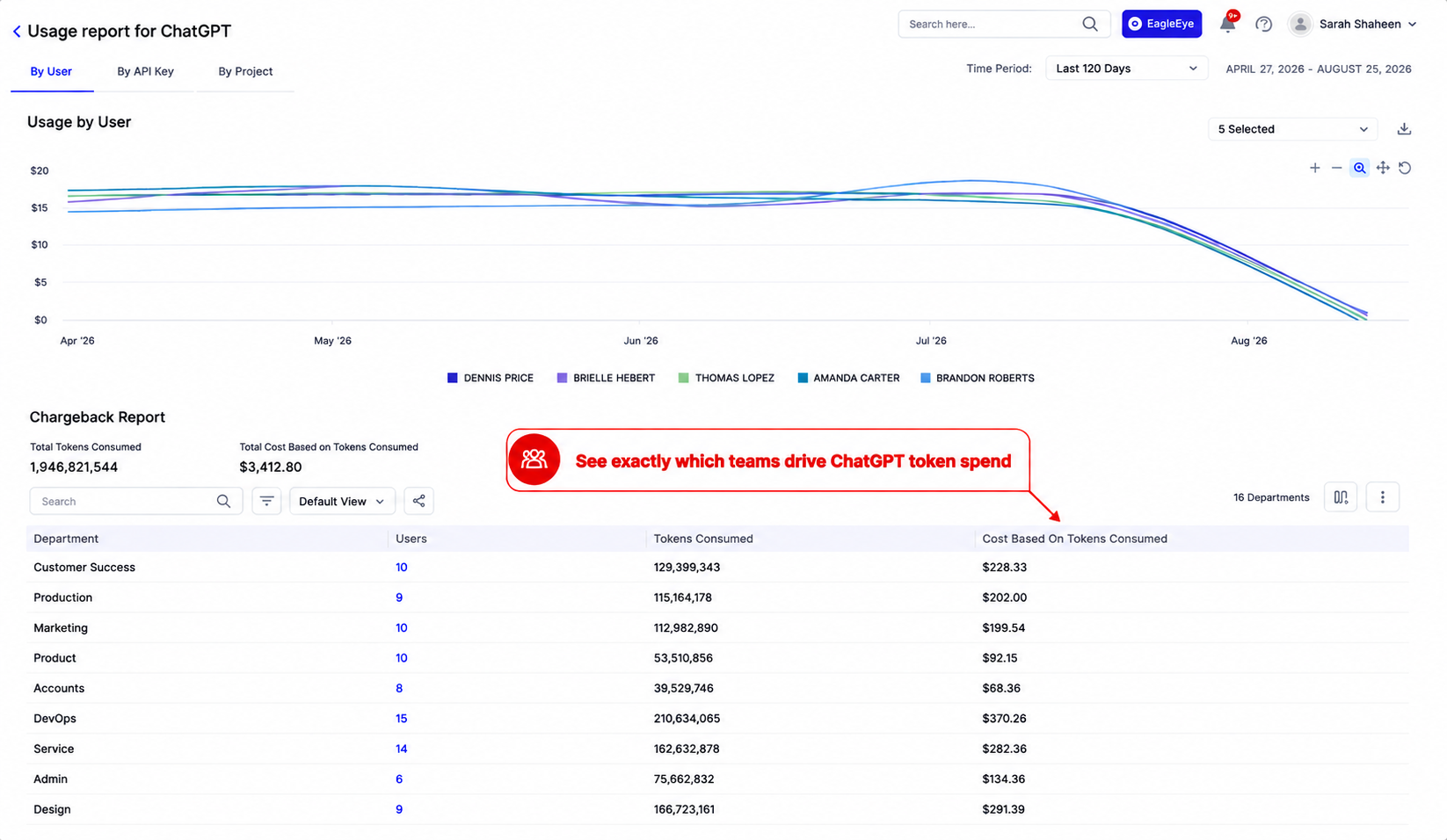
Finance gets chargeback-ready numbers without building a spreadsheet each month, and IT can see which teams are driving ChatGPT token costs before the invoice lands.
b) Catch license drift before renewal:
How CloudEagle.ai solves it:
- Cross-references active-directory status against licensed-seat status on a recurring schedule
- Flags dormant seats and offboarded users still marked as licensed
- Surfaces the gap between platform-reported seats and invoiced seats automatically

That reconciliation, done manually, is a monthly chore. Automated, it's a standing report finance can trust at renewal time.
c) Surface shadow ChatGPT usage before it becomes a security incident:
How CloudEagle.ai solves it:
- Detects personal-account ChatGPT activity through browser-level signals beyond SSO
- Correlates that activity against finance and expense data to flag shadow spend
- Applies policy enforcement to redirect users toward the governed tenant
CloudEagle.ai gives IT, security, and finance the same view of ChatGPT token costs and AI spend visibility across the rest of the AI stack, without needing a custom report built for every new question that comes up.
FAQs
1. How do I track ChatGPT token usage per user?
Connect ChatGPT's admin API to a spend visibility platform that reports usage by user, model, and time period instead of relying on login counts alone.
2. What's the difference between ChatGPT seats and API tokens?
Seats are per-user subscription licenses. API tokens are usage-based charges for calls outside the chat interface, billed on a separate schedule.
3. Can I cap ChatGPT spend by team or department?
Yes. Once usage is broken down by team, you can set spend thresholds and trigger alerts before a department exceeds its allocated budget.
4. How do you calculate ChatGPT token cost?
Multiply tokens processed by the per-token rate for the model tier used, counting input, cached input, and output tokens separately since each is priced differently.
5. Does ChatGPT usage show up in SSO logs?
SSO logs only show login activity, not token consumption or cost, so login data alone cannot answer what ChatGPT is actually costing your organization.
See your actual ChatGPT token costs, broken down by user, team, and model. Book a CloudEagle.ai demo.
Your ChatGPT Bill Has a Breakdown. You Just Can't See It Yet.




.avif)


.avif)
.avif)




.png)




.avif)
.avif)
.avif)


