.avif)
%201.svg)


HIPAA Compliance Checklist for 2025

A SaaS renewal deadline doesn't announce itself early enough. By the time someone notices the auto-renewal clause is about to fire, there are usually days left, not enough time to pull contract terms, check who's actually using the tool, and figure out if the price is fair.
So most teams don't. They renew at whatever rate the vendor sets, often without knowing if it's above market, or if half the seats they're paying for have gone quiet.
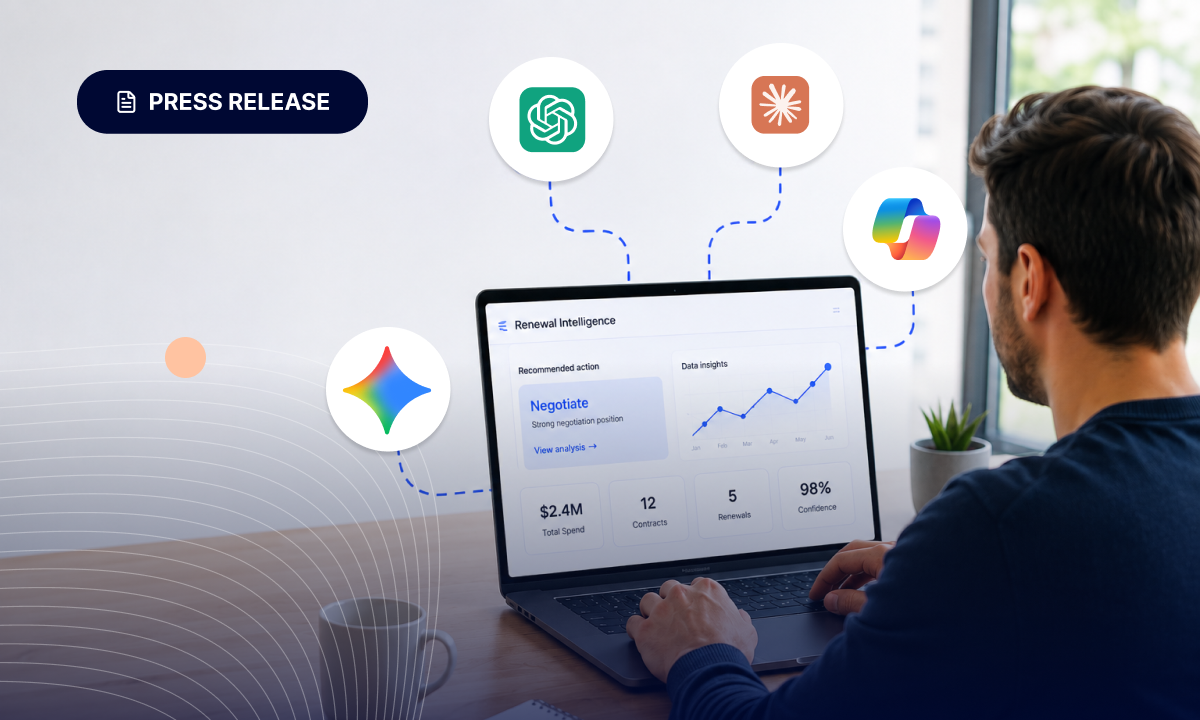
CloudEagle.ai just changed that process. Its autonomous agents now flag a renewal, pull the contract, usage, and market data automatically, and draft the negotiation itself, before the deadline instead of during it.
Read more about the feature here: CloudEagle.ai Launches Renewal Agents That Cut a Week of Renewal Prep Time to Minutes
1. Why SaaS Renewals Are So Easy to Get Wrong
Renewal prep has always been a research task disguised as an admin task: open the original contract, check the pricing clause, pull a usage report, and try to find a fair market rate. That's three or four separate systems, usually under time pressure.
The cost of skipping that work is well documented. Through 2028, organizations without centralized SaaS visibility will overspend by at least 25% due to unused entitlements and overlapping tools, according to Gartner. On a $500-seat contract, a 25% miss is the real budget.
The pattern repeats at nearly every renewal:
- Pricing terms go unchecked: Most contracts lock in a rate for the initial term only, then leave renewal pricing open to whatever the vendor proposes.
- Utilization drifts unnoticed: Seats get provisioned during onboarding and never get revisited, even after a team reorganizes.
- Market rate is a guess: Without a benchmark, there's no way to know if a 13% increase is normal or padded.
The data needed to negotiate well already exists. It's just scattered, and nobody has the hours to assemble it before the deadline hits.

2. The Four Agents Behind Every Renewal Recommendation
CloudEagle.ai's renewal flow runs on four coordinated agents, each pulling one piece of the picture the moment a renewal enters its window:
- Renewal agent: Pulls the renewal date, auto-renew setting, contract value, and notice terms, so nothing about the deadline is missed.
- Usage agent: Pulls internal utilization data, active and inactive user counts, and license counts, straight from the org's actual portfolio.
- Benchmark agent: Checks external market pricing for the same product, confirming whether the current rate is above market.
- Email Agent: Drafts the negotiation message itself, referencing the seat reduction and renewal terms.
Instead of one person manually stitching these together, the agents run in parallel and hand back a single synthesized recommendation.
3. What Happens Between the Flag and the Negotiation Email
The difference isn't just speed. The recommendation comes with a case attached.
In one recent renewal, the agents found that of 200 inactive seats, 180 could be reclaimed immediately. Combined with a multi-year commitment, that rightsizing brought the annual cost down by roughly $40,000, delivered with a full comparison table and the key negotiation dates attached.
From there, an email agent drafts the negotiation message itself, referencing the seat reduction and renewal terms. A week of prep work, spread across contract review, usage pulls, and benchmarking, compresses into a single recommendation someone can act on the same day.
4. Why Most SaaS Tools Stop at Reporting the Problem
Most SaaS tools stop at the alert. They'll tell you a renewal is coming or that seats look underused, and the work still lands on a person.
That gap is bigger than most teams assume. Only 17% of organizations have deployed AI agents to date, though more than 60% expect to within two years, according to Gartner's 2026 CIO and Technology Executive Survey. The intent is there. What's missing is the connective tissue between flagging a problem and fixing it.
Renewals are a clean test case for that gap, because the data required to close it already sits inside most SaaS management tools. The question is whether that data turns into a recommendation before the deadline, or after.
"Autonomy only matters if you can trust what it hands you. Our agents don't guess at a negotiation position; they arrive with the contract terms, the utilization data, and the market benchmark already reconciled," says Nidhi Jain, CEO of CloudEagle.ai. “That's the difference between an agent that hands you a report and one that hands you a decision. Procurement gets the recommendation, not the research project."
5. How CloudEagle.ai's Agents Handle Renewals, Step by Step
CloudEagle.ai is an AI-powered SaaS management, AI governance, and identity governance platform that gives IT, Security, and Procurement teams a single system for tracking, negotiating, and governing every SaaS renewal.
Here's what that looks like in practice:
a) Renewals get missed because the deadline sneaks up on manual processes:
CloudEagle.ai's renewal agent tracks every contract's renewal date, auto-renew status, and notice terms continuously.
- Flags renewals as they enter a negotiation window, not after the deadline passes
- Surfaces the exact notice period and auto-renew clause for each contract
- Removes the need for a manual calendar or spreadsheet tracker
Renewal dates stop being something someone has to remember to check.
b) Rightsizing decisions get skipped because pulling usage data takes too long before every renewal:
The usage and users agents surface exactly which seats are active, inactive, or worth revisiting, without a manual export.
- Pulls live utilization and license counts from the org's actual portfolio
- Flags which specific users are inactive, with login history and per-user cost
- Feeds directly into the renewal recommendation instead of a separate report
Teams walk into the renewal already knowing which seats to cut.
c) Negotiating leverage disappears without a market benchmark:
The benchmark agent checks external pricing for the same product category before the conversation starts.
- Confirms whether the current rate sits above, at, or below market
- Surfaces common negotiation levers, like multi-year terms, tied to that product
- Removes the guesswork from whether an increase is normal or padded
The negotiation starts with a number, not an assumption.
Run together on a single renewal, this is what that looked like in practice: 180 of 200 inactive seats reclaimed, a multi-year commitment negotiated, and the annual cost cut by roughly $40,000.
$40K Saved on One Renewal. Automatically.


6. The Real Shift: From Manual Prep to Automatic Case-Building
None of these four agents are solving a new problem. Contract review, usage checks, and market benchmarking have always been part of renewal prep, just done manually, by one person, under deadline pressure.
What changes is where that work happens: before the renewal conversation instead of scrambled together during it, and as one coordinated recommendation instead of four separate reports nobody has time to reconcile.
A renewal deadline was never really the hard part. Assembling the case before it hit was, the contract terms, the usage numbers, the market rate, all pulled from different places under time pressure. CloudEagle.ai's agents now handle that automatically, so the negotiation starts with a number instead of a guess.
Autonomous renewal agents are available now to CloudEagle.ai customers. See how CloudEagle.ai handles renewals →
Your Next Renewal Is Already in the Window.


.avif)


.avif)
.avif)




.png)






.avif)
.avif)
.avif)


