Contract Management

A Quick Guide on Contract Repository Management

Share via:
Written by:
CloudEagle.ai Team
Reviewed by
Nidhi Jain
Last Updated:
October 30, 2026
blog-cms-banner-bg
Little-Known Negotiation Hacks to Get the Best Deal on Slack
cta-bg-blogDownload Your Copy

HIPAA Compliance Checklist for 2025

Download PDF

‍

Contract repository management is the practice of storing every signed agreement in one searchable system and keeping its terms, owner, and deadlines current enough to act on. For SaaS and AI vendors, it also means keeping each contract in sync with what you pay for and what your teams actually use.

Keeping up is getting harder. Gartner expects 75% of employees to acquire, modify, or create technology outside IT’s visibility by 2027, up from 41% in 2022.

CloudEagle.ai’s own survey of 1,000 CIOs and CISOs found 60% of enterprise SaaS and AI applications already operate outside IT’s visibility. Each of those apps comes with terms someone accepted, usually as a shadow purchase on a corporate card, and almost none land in a contract repository on their own.

This guide covers the basics first (what a repository is, what goes in it, how it differs from a shared drive or a CLM), then the setup method, metrics, and ownership model that keep it from going stale.

‍

What Is Contract Repository Management?

A contract repository is a central, searchable system of record for executed agreements and the documents that modify them. Contract repository management is the discipline around it: deciding what gets captured, who keeps each record accurate, and how deadlines turn into decisions before they pass.

A well-run repository typically holds:

  • Core agreements, such as MSAs, order forms, SOWs, subscription and license agreements, and NDAs
  • Modifying documents, such as amendments, addendums, renewal order forms, and side letters, each linked to its parent
  • Risk and compliance evidence, such as DPAs, SOC 2 reports, security questionnaires, and insurance certificates
  • Click-through terms, captured as the version and date your team accepted, since many SaaS and AI tools have no signed PDF at all

That last item is where most repositories quietly fail. For a large share of software, the "contract" is a URL the vendor can update, so a repository that only accepts uploaded PDFs is incomplete by design.

‍

How Is a Contract Repository Different From a Shared Drive, DMS, or CLM?

Each option solves a different problem:

  • A shared drive stores files
  • A document management system (DMS) adds search, versioning, and permissions
  • A contract repository understands contracts; it treats a notice period as a deadline and links each amendment to the agreement it changes
  • A contract lifecycle management (CLM) platform adds drafting, redlining, and approvals before signature
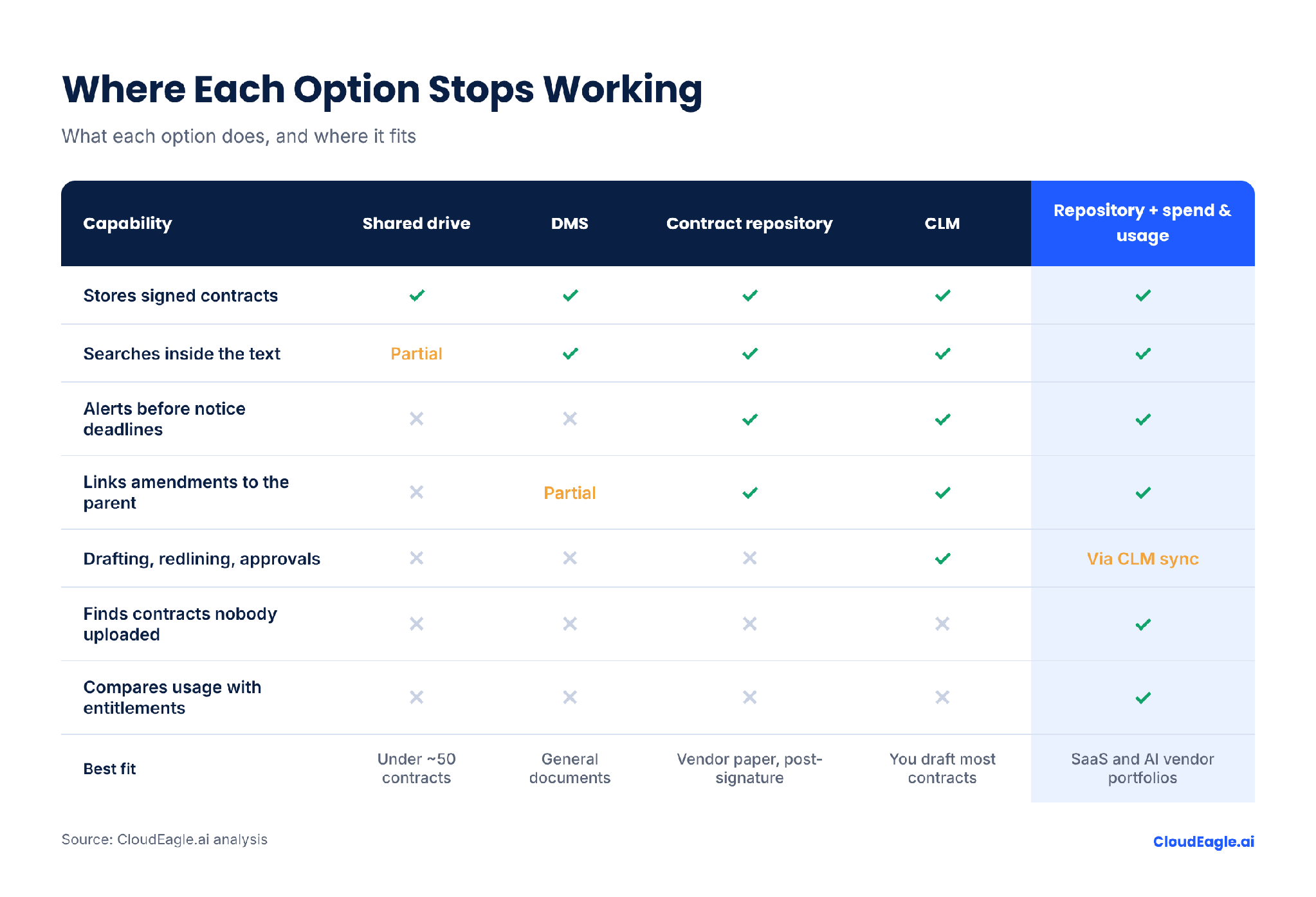
Where each option fits: shared drive vs DMS vs contract repository vs CLM vs repository with spend and usage

‍

Choose a CLM when your team drafts most of its own contracts, because the time savings sit before signature.

Choose a contract repository when most agreements arrive on vendor paper, as SaaS and AI contracts usually do. The work there is post-signature: notice deadlines, renewals, and license counts.

‍

What Does Poor Contract Repository Management Cost?

Research from World Commerce & Contracting, summarized by Deloitte, puts average contract value erosion at 8.6%. The spread matters more than the average: the best performers lose a little over 3%, while the worst lose more than 20%.

Storage does not explain a gap that wide. Every organization in that sample stores its contracts somewhere. The difference is whether three records agree with each other.
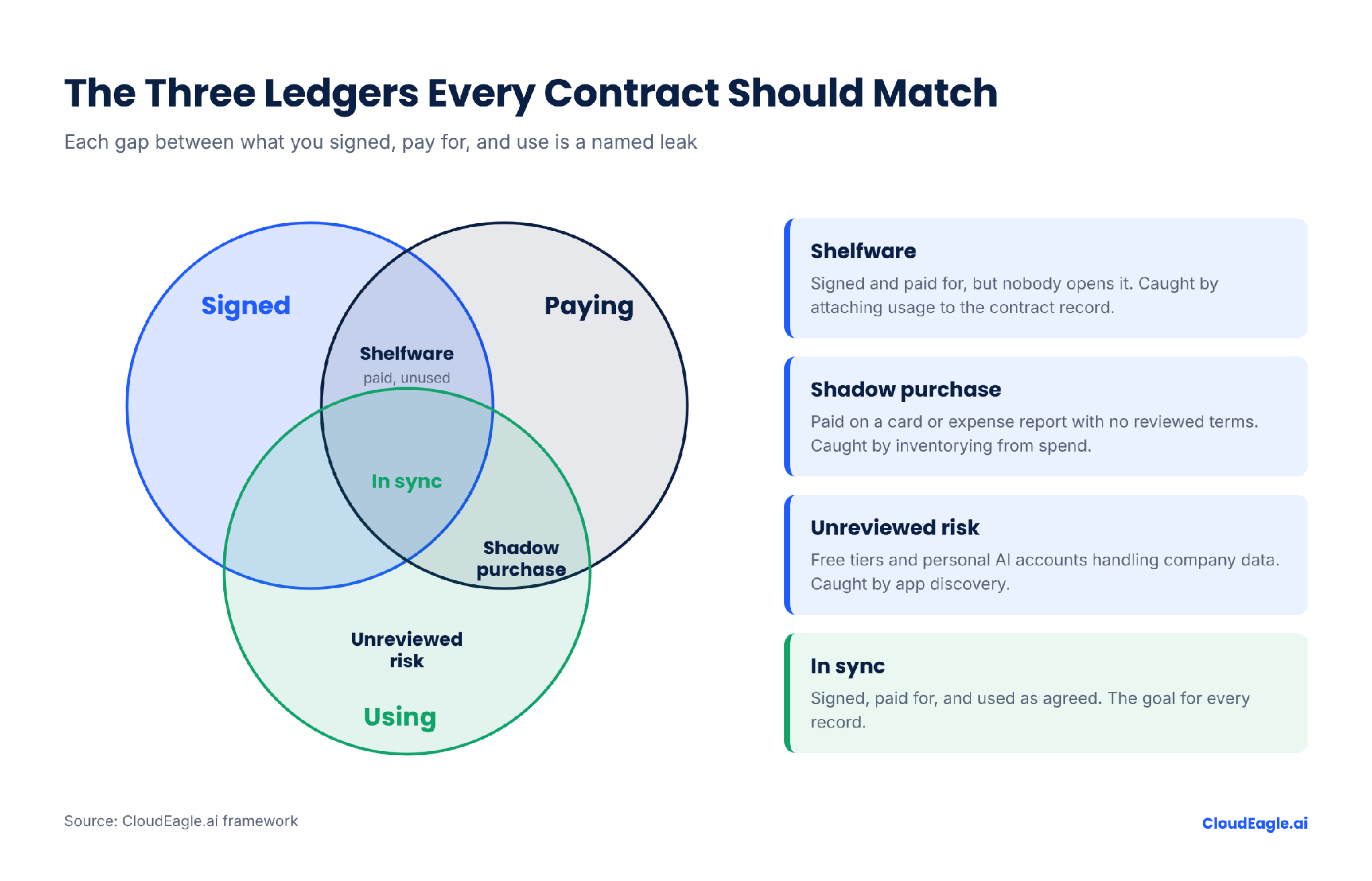
The three ledgers every contract should match: signed, paying, using

‍

Each mismatch between the ledgers is a specific, nameable leak:

  • Signed but not used is shelfware: licenses you are contractually paying for that nobody opens
  • Paying but not signed is a shadow purchase: a card charge or expense line with no reviewed terms behind it
  • Using but not signed is unreviewed risk: an AI tool processing company data under terms nobody in legal or security has read

‍

Why Do Contract Repositories Go Stale?

Repositories rarely fail on launch day. They decay over 12 to 18 months, usually through four predictable gaps.

Coverage Drifts

Contracts enter the repository only when someone uploads them. Card purchases, free tiers that convert to paid, and business-unit budgets never trigger that step, so the repository looks complete while covering a shrinking share of spend.

Owners Leave

When the person who owns a contract changes roles or leaves, nothing reassigns the missed renewal. The vendor keeps emailing a dead inbox, the notice window closes, and the first sign of trouble is an invoice.

Terms Change Without a Signature

Order forms stack on top of MSAs, and online terms update by URL. If amendments and accepted-terms versions are not linked to the parent record, the repository shows terms that are no longer in force. Renewal drafts are where this bites hardest, because a notice window or price escalator can shift between versions; AI contract review catches those changes before signature. 

AI Changes What a Contract Needs to Track

AI vendors introduce clauses that older schemas never captured:

  • Whether your prompts and data can train the vendor's models
  • Usage or token-based pricing instead of seats
  • AI add-ons folded into an existing tool's renewal

CloudEagle.ai has a deeper breakdown of the AI contract clauses worth checking before you sign.

‍

Notice Windows Close Before Anyone Checks

Build the renewal discipline that catches auto-renewals before they lock in.
Download Checklist

‍

What Should Every Contract Record Capture?

A contract record is only as useful as its fields. Capture the renewal date and you know when the contract ends; capture the notice deadline and you know when you can still act.
‍

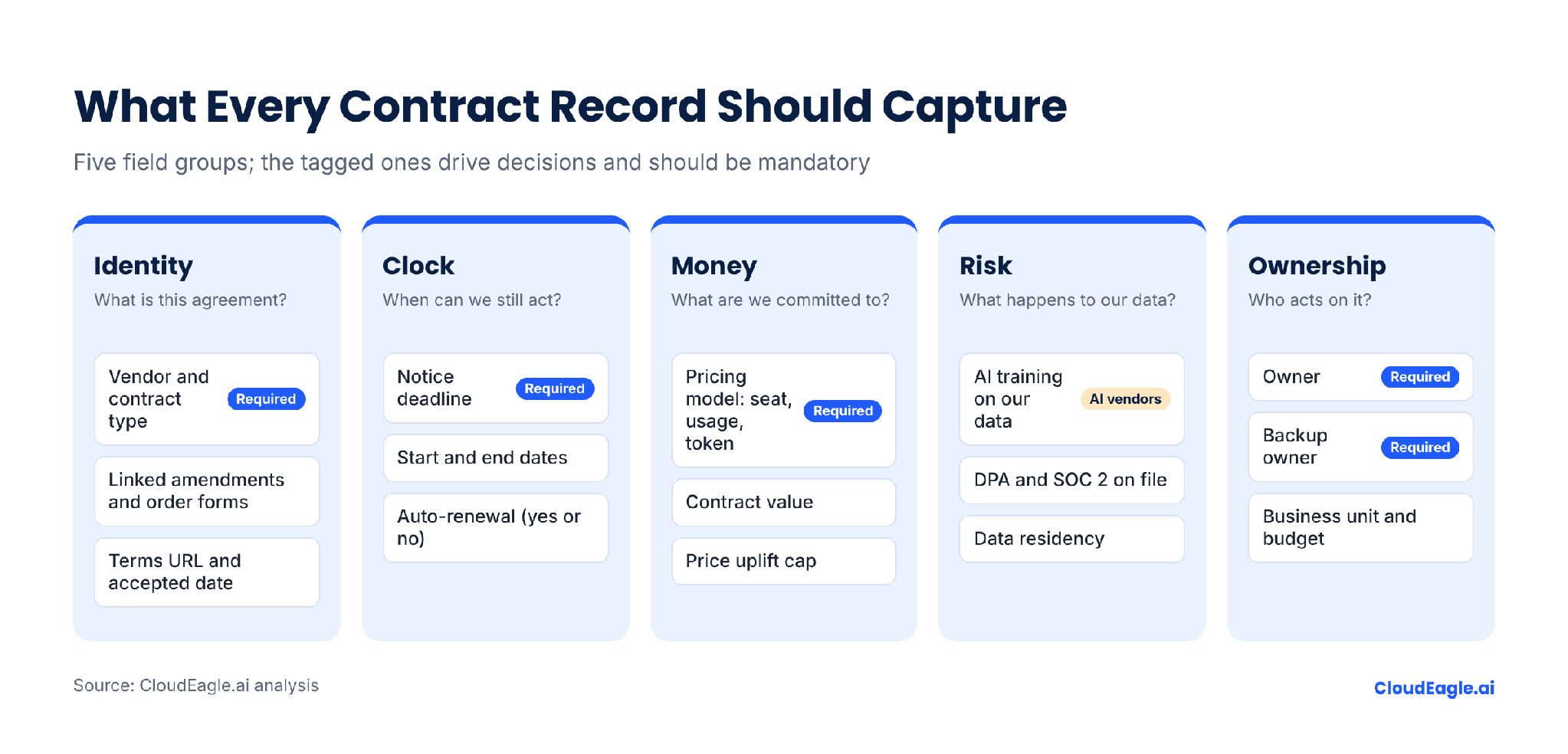
Infographic outlining five essential field groups every contract record should capture: identity, renewal timelines, financial commitments, data risks, and ownership. Highlights mandatory fields such as vendor details, notice deadlines, pricing models, AI data-training terms, and contract owners.

‍

At minimum, every record needs the vendor, contract type, notice deadline, auto-renewal status, pricing model (seat, usage, or token), contract value, owner, and backup owner. For AI vendors, add whether the vendor may train models on your data.

Two rules keep the schema usable. First, make the decision-driving fields mandatory (notice deadline, owner, backup owner, pricing model) and let AI extraction fill the rest. Second, validate extracted fields on a sample of 50 to 100 contracts before trusting them at scale.

Comparing tools to run this on? See CloudEagle.ai's roundup of the best contract repository tools.

How Do You Set Up Contract Repository Management, Step by Step?

Most teams start by gathering every PDF from shared drives. Start from spend instead: it is the only list that includes the contracts nobody uploaded.
‍

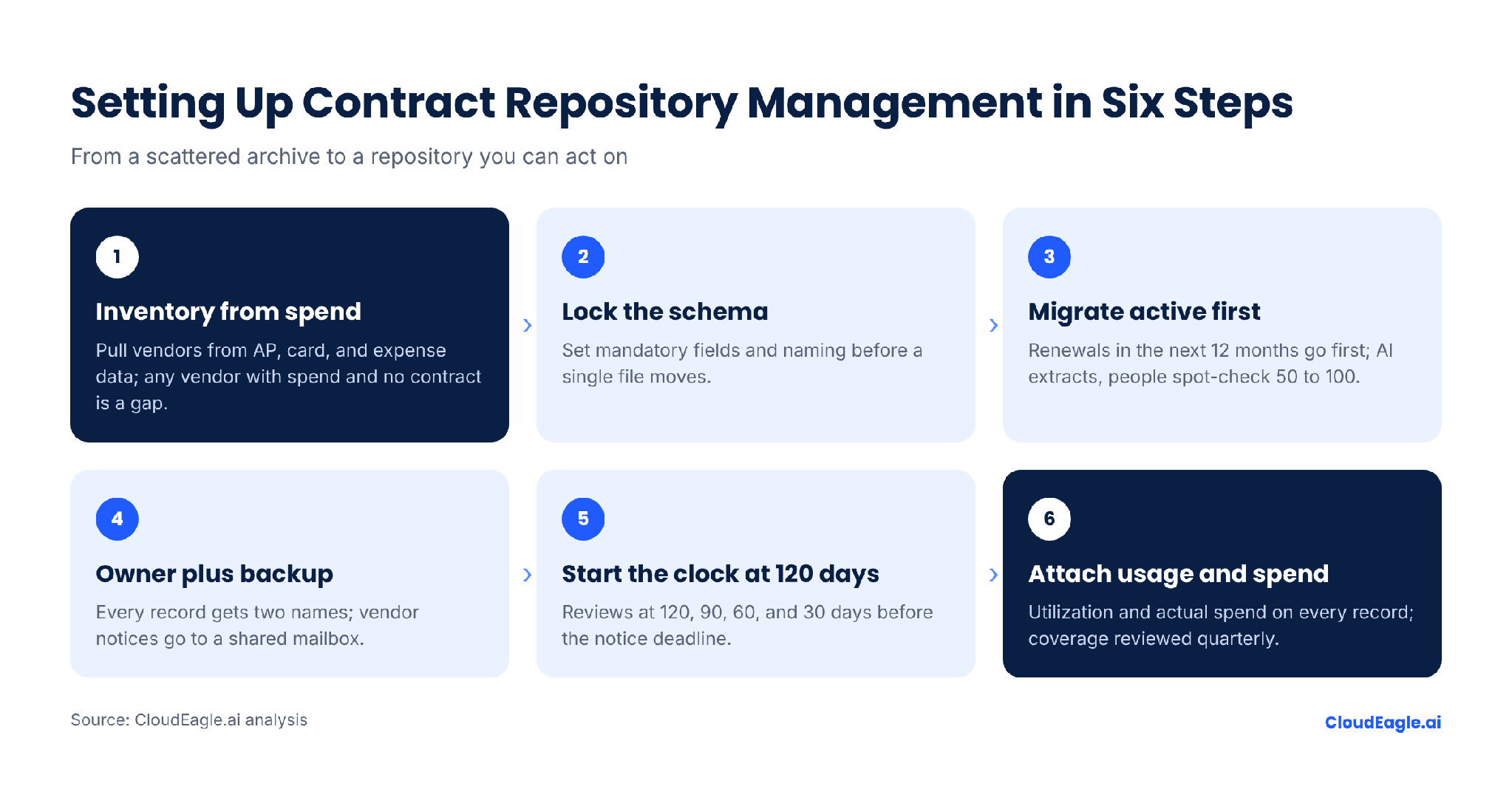
Setting up contract repository management in six steps

‍

  1. Pull every vendor from AP, card, and expense data, then match each one to a contract; vendors with spend and no contract are your first coverage gaps.
  2. Lock mandatory fields and naming before migration, because retagging thousands of records later rarely happens.
  3. Migrate contracts renewing in the next 12 months first, extract metadata with AI, and link every amendment to its parent.
  4. Name an owner and a backup for every record, and route vendor notices to a shared mailbox so a departure never orphans a renewal.
  5. Trigger reviews at 120, 90, 60, and 30 days before the notice deadline, not the renewal date, which leaves time to benchmark, renegotiate terms, or exit. 
  6. Attach license utilization and actual spend to each record, then review coverage and data quality every quarter. 

‍

Shadow Purchases Have No Contract to Pull Up

Close the intake gap before ungoverned spend becomes unreviewed risk.
Download Checklist

‍

Which Metrics Show Your Repository Is Working?

These five measures show whether the repository is current enough to act on.
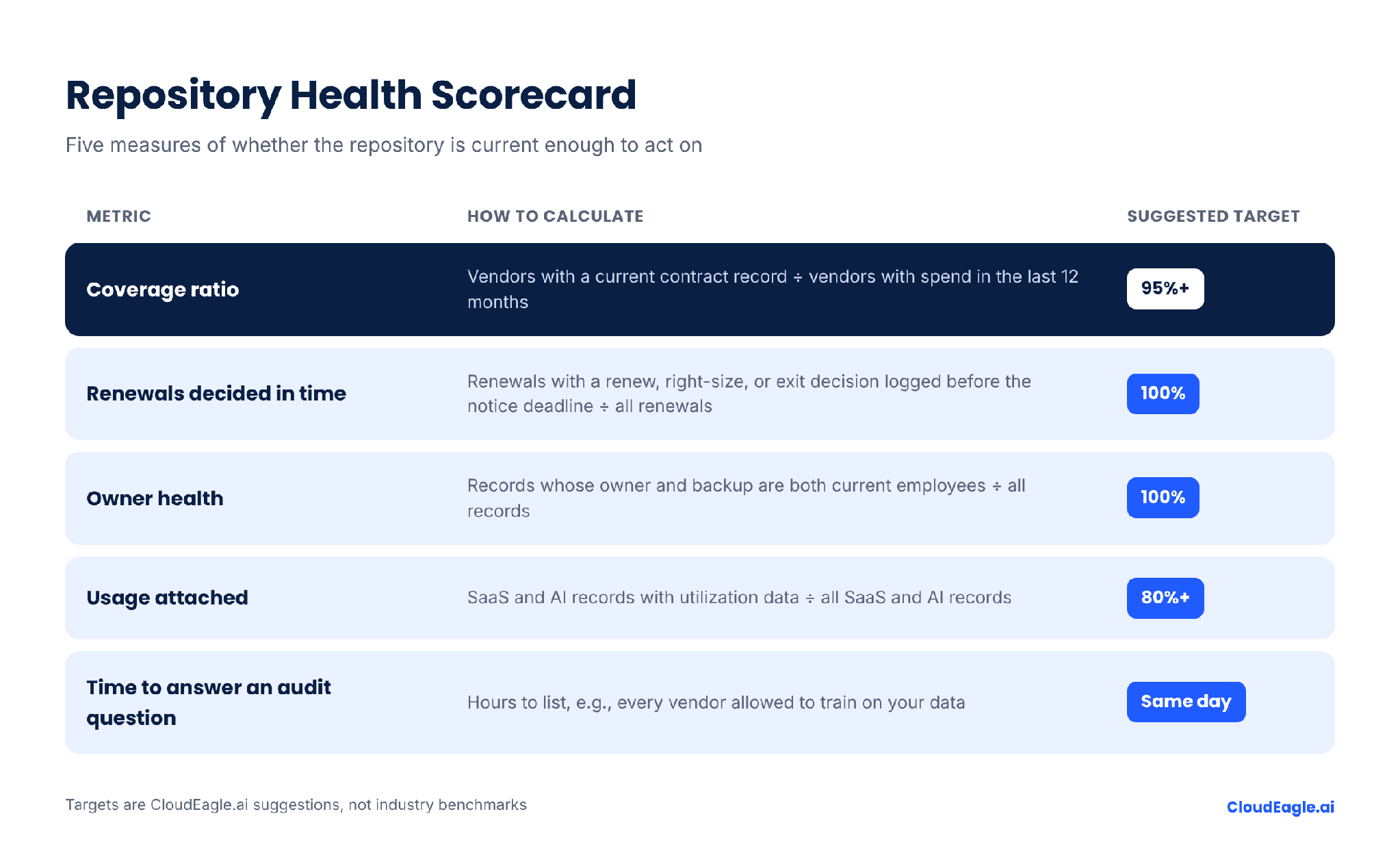
CloudEagle.ai scorecard showing five metrics for measuring contract repository health: contract coverage, timely renewal decisions, owner health, usage data coverage, and audit response time, with suggested performance targets for each metric.

‍

Coverage ratio is the number to report upward: vendors with a current contract record divided by vendors you paid in the last 12 months. Leadership tends to assume it is 100%, and a spend-based count is often the first time anyone checks.

‍

Who Should Own Contract Repository Management?

Legal usually owns contracts, and for drafting and negotiation that is right. For SaaS and AI vendors, though, the data that keeps a record current sits with other teams:

  • Procurement holds pricing and renewal dates
  • IT holds usage and access
  • Finance holds spend
  • Security holds data-processing and AI training terms

A World Commerce & Contracting and KPMG study asked whether contracting can improve without an owner. The practical answer is to assign one accountable owner for the repository and field-level owners for the data, so each team updates what it already knows.

‍

How CloudEagle.ai Keeps SaaS and AI Contracts in Sync

Coverage Without Relying on Uploads

CloudEagle.ai correlates SSO, finance and card spend, browser, and firewall signals across 500+ integrations, so apps bought outside procurement surface with their spend attached. Shadow purchases show up as shadow IT and shadow AI findings, not as surprises at renewal.

Records That Fill Themselves

AI metadata extraction pulls renewal dates, notice periods, opt-out clauses, pricing, and auto-renewal terms from uploaded contracts. Records sync bidirectionally with CLM and procurement systems such as Ironclad, Coupa, and Zip, so the repository works alongside your stack.

AI Contracts Tracked Like SaaS

For AI vendors, CloudEagle.ai tracks token consumption by app, team, and user alongside contract terms. Usage-based bills get checked against what was agreed before renewal, not after the invoice arrives.

Renewals Backed by Usage and Benchmarks

An auto-built renewal calendar can trigger workflows up to 90 days out, with current usage, price benchmarks, and an AI recommendation in the first message, and CloudEagle.ai’s renewal agents now draft the negotiation itself from that data. Approvals route through Slack, Jira, or ServiceNow and escalate automatically when they stall. 

Matterport moved its contracts from scattered inboxes into a single searchable repository with CloudEagle.ai and saved 1,920 hours a year on contract management alone. 

See how CloudEagle.ai's contract management centralizes every SaaS and AI agreement with its renewal dates, usage, and spend.

Book a demo to see your own coverage ratio.

‍

Frequently Asked Questions

What Is the Difference Between a Contract Repository and Contract Management?

A contract repository is the system that stores executed agreements and their data. Contract management is the broader process, covering drafting, negotiation, approval, obligations, and renewals. Repository management is the post-signature part of that process.

Can SharePoint or Google Drive Work as a Contract Repository?

They can store contracts, but they do not track notice deadlines, link amendments, or connect terms to spend and usage. Most teams outgrow them once they pass a few dozen active vendor contracts.

How Often Should a Contract Repository Be Audited?

Review coverage and data quality quarterly, and check owners whenever someone leaves or changes roles. Renewal-level checks should run continuously from 120 days before each notice deadline.

How Does AI Help With Contract Repository Management?

AI extracts metadata such as dates, pricing, and auto-renewal terms from uploaded contracts, which removes most manual tagging. Its accuracy still needs a sample check before teams rely on it at scale.

Does CloudEagle.ai Replace an Existing CLM Like Ironclad?

No. CloudEagle.ai syncs bidirectionally with CLM and procurement systems such as Ironclad, Coupa, and Zip. Legal keeps drafting in the CLM, while CloudEagle.ai adds spend, usage, and renewal workflows to the same contract records.

Can CloudEagle.ai Find SaaS Contracts That Were Never Uploaded?

It finds the apps behind them. By correlating SSO, finance and card spend, browser, and firewall data, CloudEagle.ai surfaces apps bought outside procurement, so teams can see which vendors have spend but no contract record.

‍

Advertisement for a SaaS Subscription Tracking Template with a call-to-action button to download and a partial graphic of a tablet showing charts.Banner promoting a SaaS Agreement Checklist to streamline SaaS management and avoid budget waste with a call-to-action button labeled Download checklist.Blue banner with text 'The Ultimate Employee Offboarding Checklist!' and a black button labeled 'Download checklist' alongside partial views of checklist documents from cloudeagle.ai.Digital ad for download checklist titled 'The Ultimate Checklist for IT Leaders to Optimize SaaS Operations' by cloudeagle.ai, showing checklist pages.Slack Buyer's Guide offer with text 'Unlock insider insights to get the best deal on Slack!' and a button labeled 'Get Your Copy', accompanied by a preview of the guide featuring Slack's logo.Monday Pricing Guide by cloudeagle.ai offering exclusive pricing secrets to maximize investment with a call-to-action button labeled Get Your Copy and an image of the guide's cover.Blue banner for Canva Pricing Guide by cloudeagle.ai offering a guide to Canva costs, features, and alternatives with a call-to-action button saying Get Your Copy.Blue banner with white text reading 'Little-Known Negotiation Hacks to Get the Best Deal on Slack' and a white button labeled 'Get Your Copy'.Blue banner with text 'Little-Known Negotiation Hacks to Get the Best Deal on Monday.com' and a white button labeled 'Get Your Copy'.Blue banner with text 'Little-Known Negotiation Hacks to Get the Best Deal on Canva' and a white button labeled 'Get Your Copy'.Banner with text 'Slack Buyer's Guide' and a 'Download Now' button next to images of a guide titled 'Slack Buyer’s Guide: Features, Pricing & Best Practices'.Digital cover of Monday Pricing Guide with a button labeled Get Your Copy on a blue background.Canva Pricing Guide cover with a button labeled Get Your Copy on a blue gradient background.

Enter your email to
unlock the report

Oops! Something went wrong while submitting the form.
License Count
Benchmark
Per User/Per Year

Enter your email to
unlock the report

Oops! Something went wrong while submitting the form.
License Count
Benchmark
Per User/Per Year

Enter your email to
unlock the report

Oops! Something went wrong while submitting the form.
Notion Plus
License Count
Benchmark
Per User/Per Year
100-500
$67.20 - $78.72
500-1000
$59.52 - $72.00
1000+
$51.84 - $57.60
Canva Pro
License Count
Benchmark
Per User/Per Year
100-500
$74.33-$88.71
500-1000
$64.74-$80.32
1000+
$55.14-$62.34

Enter your email to
unlock the report

Oops! Something went wrong while submitting the form.

Enter your email to
unlock the report

Oops! Something went wrong while submitting the form.
Zoom Business
License Count
Benchmark
Per User/Per Year
100-500
$216.00 - $264.00
500-1000
$180.00 - $216.00
1000+
$156.00 - $180.00

Enter your email to
unlock the report

Oops! Something went wrong while submitting the form.

Get the Right Security Platform To Secure Your Cloud Infrastructure

Please enter a business email
Thank you!
The 2023 SaaS report has been sent to your email. Check your promotional or spam folder.
Oops! Something went wrong while submitting the form.

Access full report

Please enter a business email
Thank you!
The 2023 SaaS report has been sent to your email. Check your promotional or spam folder.
Oops! Something went wrong while submitting the form.

‍

Contract repository management is the practice of storing every signed agreement in one searchable system and keeping its terms, owner, and deadlines current enough to act on. For SaaS and AI vendors, it also means keeping each contract in sync with what you pay for and what your teams actually use.

Keeping up is getting harder. Gartner expects 75% of employees to acquire, modify, or create technology outside IT’s visibility by 2027, up from 41% in 2022.

CloudEagle.ai’s own survey of 1,000 CIOs and CISOs found 60% of enterprise SaaS and AI applications already operate outside IT’s visibility. Each of those apps comes with terms someone accepted, usually as a shadow purchase on a corporate card, and almost none land in a contract repository on their own.

This guide covers the basics first (what a repository is, what goes in it, how it differs from a shared drive or a CLM), then the setup method, metrics, and ownership model that keep it from going stale.

‍

What Is Contract Repository Management?

A contract repository is a central, searchable system of record for executed agreements and the documents that modify them. Contract repository management is the discipline around it: deciding what gets captured, who keeps each record accurate, and how deadlines turn into decisions before they pass.

A well-run repository typically holds:

  • Core agreements, such as MSAs, order forms, SOWs, subscription and license agreements, and NDAs
  • Modifying documents, such as amendments, addendums, renewal order forms, and side letters, each linked to its parent
  • Risk and compliance evidence, such as DPAs, SOC 2 reports, security questionnaires, and insurance certificates
  • Click-through terms, captured as the version and date your team accepted, since many SaaS and AI tools have no signed PDF at all

That last item is where most repositories quietly fail. For a large share of software, the "contract" is a URL the vendor can update, so a repository that only accepts uploaded PDFs is incomplete by design.

‍

How Is a Contract Repository Different From a Shared Drive, DMS, or CLM?

Each option solves a different problem:

  • A shared drive stores files
  • A document management system (DMS) adds search, versioning, and permissions
  • A contract repository understands contracts; it treats a notice period as a deadline and links each amendment to the agreement it changes
  • A contract lifecycle management (CLM) platform adds drafting, redlining, and approvals before signature
Where each option fits: shared drive vs DMS vs contract repository vs CLM vs repository with spend and usage

‍

Choose a CLM when your team drafts most of its own contracts, because the time savings sit before signature.

Choose a contract repository when most agreements arrive on vendor paper, as SaaS and AI contracts usually do. The work there is post-signature: notice deadlines, renewals, and license counts.

‍

What Does Poor Contract Repository Management Cost?

Research from World Commerce & Contracting, summarized by Deloitte, puts average contract value erosion at 8.6%. The spread matters more than the average: the best performers lose a little over 3%, while the worst lose more than 20%.

Storage does not explain a gap that wide. Every organization in that sample stores its contracts somewhere. The difference is whether three records agree with each other.

The three ledgers every contract should match: signed, paying, using

‍

Each mismatch between the ledgers is a specific, nameable leak:

  • Signed but not used is shelfware: licenses you are contractually paying for that nobody opens
  • Paying but not signed is a shadow purchase: a card charge or expense line with no reviewed terms behind it
  • Using but not signed is unreviewed risk: an AI tool processing company data under terms nobody in legal or security has read

‍

Why Do Contract Repositories Go Stale?

Repositories rarely fail on launch day. They decay over 12 to 18 months, usually through four predictable gaps.

Coverage Drifts

Contracts enter the repository only when someone uploads them. Card purchases, free tiers that convert to paid, and business-unit budgets never trigger that step, so the repository looks complete while covering a shrinking share of spend.

Owners Leave

When the person who owns a contract changes roles or leaves, nothing reassigns the missed renewal. The vendor keeps emailing a dead inbox, the notice window closes, and the first sign of trouble is an invoice.

Terms Change Without a Signature

Order forms stack on top of MSAs, and online terms update by URL. If amendments and accepted-terms versions are not linked to the parent record, the repository shows terms that are no longer in force. Renewal drafts are where this bites hardest, because a notice window or price escalator can shift between versions; AI contract review catches those changes before signature. 

AI Changes What a Contract Needs to Track

AI vendors introduce clauses that older schemas never captured:

  • Whether your prompts and data can train the vendor's models
  • Usage or token-based pricing instead of seats
  • AI add-ons folded into an existing tool's renewal

CloudEagle.ai has a deeper breakdown of the AI contract clauses worth checking before you sign.

‍

Notice Windows Close Before Anyone Checks

Build the renewal discipline that catches auto-renewals before they lock in.
Download Checklist

‍

What Should Every Contract Record Capture?

A contract record is only as useful as its fields. Capture the renewal date and you know when the contract ends; capture the notice deadline and you know when you can still act.

‍

Infographic outlining five essential field groups every contract record should capture: identity, renewal timelines, financial commitments, data risks, and ownership. Highlights mandatory fields such as vendor details, notice deadlines, pricing models, AI data-training terms, and contract owners.

‍

At minimum, every record needs the vendor, contract type, notice deadline, auto-renewal status, pricing model (seat, usage, or token), contract value, owner, and backup owner. For AI vendors, add whether the vendor may train models on your data.

Two rules keep the schema usable. First, make the decision-driving fields mandatory (notice deadline, owner, backup owner, pricing model) and let AI extraction fill the rest. Second, validate extracted fields on a sample of 50 to 100 contracts before trusting them at scale.

Comparing tools to run this on? See CloudEagle.ai's roundup of the best contract repository tools.

How Do You Set Up Contract Repository Management, Step by Step?

Most teams start by gathering every PDF from shared drives. Start from spend instead: it is the only list that includes the contracts nobody uploaded.

‍

Setting up contract repository management in six steps

‍

  1. Pull every vendor from AP, card, and expense data, then match each one to a contract; vendors with spend and no contract are your first coverage gaps.
  2. Lock mandatory fields and naming before migration, because retagging thousands of records later rarely happens.
  3. Migrate contracts renewing in the next 12 months first, extract metadata with AI, and link every amendment to its parent.
  4. Name an owner and a backup for every record, and route vendor notices to a shared mailbox so a departure never orphans a renewal.
  5. Trigger reviews at 120, 90, 60, and 30 days before the notice deadline, not the renewal date, which leaves time to benchmark, renegotiate terms, or exit. 
  6. Attach license utilization and actual spend to each record, then review coverage and data quality every quarter. 

‍

Shadow Purchases Have No Contract to Pull Up

Close the intake gap before ungoverned spend becomes unreviewed risk.
Download Checklist

‍

Which Metrics Show Your Repository Is Working?

These five measures show whether the repository is current enough to act on.

CloudEagle.ai scorecard showing five metrics for measuring contract repository health: contract coverage, timely renewal decisions, owner health, usage data coverage, and audit response time, with suggested performance targets for each metric.

‍

Coverage ratio is the number to report upward: vendors with a current contract record divided by vendors you paid in the last 12 months. Leadership tends to assume it is 100%, and a spend-based count is often the first time anyone checks.

‍

Who Should Own Contract Repository Management?

Legal usually owns contracts, and for drafting and negotiation that is right. For SaaS and AI vendors, though, the data that keeps a record current sits with other teams:

  • Procurement holds pricing and renewal dates
  • IT holds usage and access
  • Finance holds spend
  • Security holds data-processing and AI training terms

A World Commerce & Contracting and KPMG study asked whether contracting can improve without an owner. The practical answer is to assign one accountable owner for the repository and field-level owners for the data, so each team updates what it already knows.

‍

How CloudEagle.ai Keeps SaaS and AI Contracts in Sync

Coverage Without Relying on Uploads

CloudEagle.ai correlates SSO, finance and card spend, browser, and firewall signals across 500+ integrations, so apps bought outside procurement surface with their spend attached. Shadow purchases show up as shadow IT and shadow AI findings, not as surprises at renewal.

Records That Fill Themselves

AI metadata extraction pulls renewal dates, notice periods, opt-out clauses, pricing, and auto-renewal terms from uploaded contracts. Records sync bidirectionally with CLM and procurement systems such as Ironclad, Coupa, and Zip, so the repository works alongside your stack.

AI Contracts Tracked Like SaaS

For AI vendors, CloudEagle.ai tracks token consumption by app, team, and user alongside contract terms. Usage-based bills get checked against what was agreed before renewal, not after the invoice arrives.

Renewals Backed by Usage and Benchmarks

An auto-built renewal calendar can trigger workflows up to 90 days out, with current usage, price benchmarks, and an AI recommendation in the first message, and CloudEagle.ai’s renewal agents now draft the negotiation itself from that data. Approvals route through Slack, Jira, or ServiceNow and escalate automatically when they stall. 

Matterport moved its contracts from scattered inboxes into a single searchable repository with CloudEagle.ai and saved 1,920 hours a year on contract management alone. 

See how CloudEagle.ai's contract management centralizes every SaaS and AI agreement with its renewal dates, usage, and spend.

Book a demo to see your own coverage ratio.

‍

Frequently Asked Questions

What Is the Difference Between a Contract Repository and Contract Management?

A contract repository is the system that stores executed agreements and their data. Contract management is the broader process, covering drafting, negotiation, approval, obligations, and renewals. Repository management is the post-signature part of that process.

Can SharePoint or Google Drive Work as a Contract Repository?

They can store contracts, but they do not track notice deadlines, link amendments, or connect terms to spend and usage. Most teams outgrow them once they pass a few dozen active vendor contracts.

How Often Should a Contract Repository Be Audited?

Review coverage and data quality quarterly, and check owners whenever someone leaves or changes roles. Renewal-level checks should run continuously from 120 days before each notice deadline.

How Does AI Help With Contract Repository Management?

AI extracts metadata such as dates, pricing, and auto-renewal terms from uploaded contracts, which removes most manual tagging. Its accuracy still needs a sample check before teams rely on it at scale.

Does CloudEagle.ai Replace an Existing CLM Like Ironclad?

No. CloudEagle.ai syncs bidirectionally with CLM and procurement systems such as Ironclad, Coupa, and Zip. Legal keeps drafting in the CLM, while CloudEagle.ai adds spend, usage, and renewal workflows to the same contract records.

Can CloudEagle.ai Find SaaS Contracts That Were Never Uploaded?

It finds the apps behind them. By correlating SSO, finance and card spend, browser, and firewall data, CloudEagle.ai surfaces apps bought outside procurement, so teams can see which vendors have spend but no contract record.

‍

CloudEagle.ai recognized in the 2025 Gartner® Magic Quadrant™ for SaaS Management Platforms
Download now
gartner chart
5x
Faster employee
onboarding
80%
Reduction in time for
user access reviews
30k
Workflows
automated
$15Bn
Analyzed in
contract spend
$2Bn
Saved in
SaaS spend

Streamline SaaS governance and save 10-30%

Book a Demo with Expert
CTA image