You need to enable JavaScript in order to use the AI chatbot tool powered by ChatBot

5 Best AI Compliance Tools for Risk Monitoring in 2026

Share via:
blog-cms-banner-bg
Little-Known Negotiation Hacks to Get the Best Deal on Slack
cta-bg-blogDownload Your Copy

HIPAA Compliance Checklist for 2025

Download PDF

Let's be honest, most compliance teams weren't built for the pace of today's AI-driven enterprise. Your SaaS stack keeps expanding, employees are spinning up unauthorized AI tools without a second thought, and regulatory bodies are tightening their grip on data governance every quarter. 

The traditional GRC tools you've relied on simply weren't designed for this.

That's exactly why AI compliance tools for risk monitoring have become the new standard for IT, security, and compliance leaders who need real-time visibility and automated enforcement, not more spreadsheets.

In this guide, we break down the 5 best AI compliance tools for risk monitoring in 2026, what sets them apart, and how to choose the right one for your organization's specific needs.

TL;DR 

Platform Best For Rating
CloudEagle.ai Shadow AI detection, identity governance, multi-framework compliance, and autonomous risk enforcement 4.8/5
Secureframe Compliance monitoring, anomaly detection, data governance, and policy enforcement. 4.7/5
Vanta Compliance monitoring, data loss prevention, cloud gap analytics, and vendor access control. 4.6/5
Drata Compliance monitoring, anomaly detection, cloud gap analytics, and security questionnaires. 4.7/5
Sprinto Compliance monitoring, anomaly detection, data loss prevention, and data encryption. 4.7/5

1. Why AI Compliance Tools for Risk Monitoring Are Becoming Essential?

The numbers alone make the case pretty clearly.

$4.88M, Average cost of a data breach in 2024, according to IBM's Cost of a Data Breach Report. A record high.

Beyond the financial risk, compliance workloads are multiplying. Between SOC 2, ISO 27001, HIPAA, GDPR, and the incoming EU AI Act, security and compliance teams are stretched thin managing frameworks that were never designed to talk to each other. 

And that's before you factor in shadow AI, employees quietly adopting AI tools outside of IT approval channels.

Here's what's driving the shift:

  • Real-time risk detection that manual audits simply cannot replicate
  • Automated evidence collection that cuts compliance prep time dramatically
  • Continuous monitoring across your entire SaaS and AI tool stack
  • AI-native governance frameworks that go beyond legacy GRC checklists
  • Cross-framework compliance mapping, one control, many frameworks covered

Worth A Read: CloudEagle.ai Launches EagleEye — The First Agentic AI for Autonomous SaaS and AI Governance

Shadow AI Is Already in Your Stack. Are You Compliant?

8 practices that close the gaps before regulators find them.
Get the Compliance Best Practices Guide

2. What Makes a Great AI Compliance Monitoring Platform?

Not every tool that claims to be "AI-powered" is actually doing meaningful work behind the scenes. When evaluating AI compliance monitoring software, there are a few non-negotiables that separate genuine platforms from glorified dashboards.

1. Real-Time, Continuous Monitoring: Point-in-time audits leave massive gaps. A strong AI risk monitoring platform watches your environment around the clock, flagging anomalies the moment they occur, not three weeks later when a quarterly review rolls around.

2. Multi-Framework Coverage: The best platforms map controls across SOC 2, ISO 27001, HIPAA, GDPR, PCI-DSS, and newer AI-specific frameworks simultaneously. You shouldn't have to rebuild your compliance program from scratch every time a new regulation hits.

3. Shadow AI and Shadow IT Discovery: If a compliance tool can't see the unsanctioned AI apps your employees are using, it's giving you a false sense of security. Shadow AI detection is now a critical feature of any serious AI governance platform.

4. Automated Evidence Collection and Remediation:  Manual Evidence collection is where compliance hours go to die. Look for platforms with native integrations that pull evidence automatically and can trigger remediation workflows without human intervention.

5. Access Governance and User Lifecycle Management: Excess permissions are among the most common compliance failure points. Great tools automate access reviews, flag over-privileged users, and enforce least-privilege policies at scale.

6. Clear, Audit-Ready Reporting: When an auditor shows up, you want clean, exportable reports, not a scramble to compile evidence from five different systems. Reporting quality is often where platforms diverge most dramatically.

3. The 5 Best AI Compliance Tools for Risk Monitoring in 2026

Below is an honest breakdown of the best AI compliance tools for risk monitoring available today, based on feature depth, real-world usability, pricing transparency, and how well each handles the realities of modern AI governance.

1. CloudEagle.ai

If you've been evaluating AI compliance tools for risk monitoring and keep circling back to the same problem, visibility gaps, shadow AI, over-permissioned users, CloudEagle.ai was built to solve exactly those problems. 

VIDEO 

What makes CloudEagle genuinely different is its newly launched EagleEye, the first agentic AI engine designed specifically for autonomous SaaS and AI governance. It doesn't just surface risk; it acts on it.

Shadow AI & Shadow IT Detection

Most organizations have no idea how many unauthorized AI tools are active in their environment. 
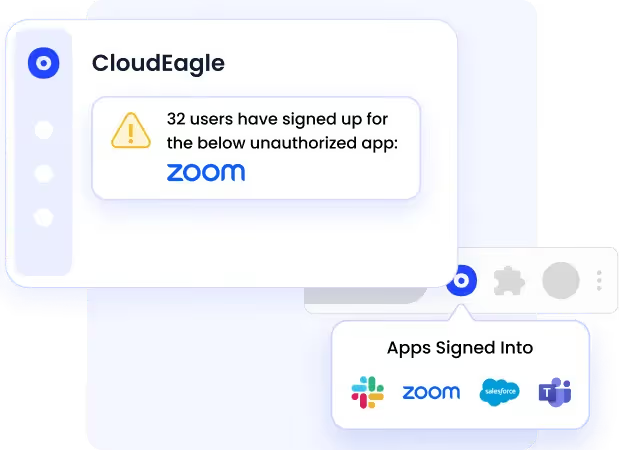
CloudEagle's Shadow AI detection engine discovers every application employees are using, sanctioned or not, by integrating directly with your SSO, browser activity, financial feeds, and network traffic. 

Continuous AI Risk Monitoring

CloudEagle's AI risk monitoring platform doesn't wait for your annual audit to tell you something's wrong. It runs continuous checks across your SaaS stack, monitoring user behavior, access patterns, app permissions, and vendor security postures in real time. 
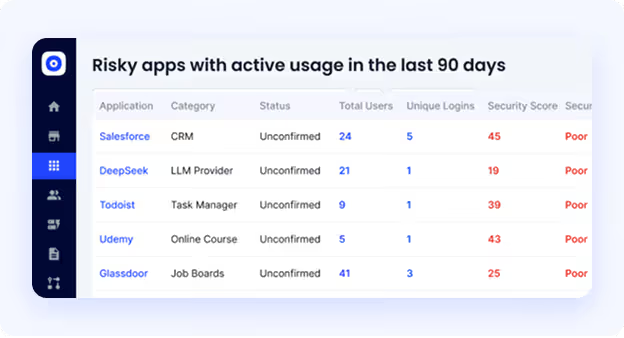
Anomalies trigger instant alerts and can kick off automated remediation workflows before a minor issue becomes a compliance incident.

Multi-Framework Compliance Mapping

CloudEagle maps your controls across SOC 2, ISO 27001, HIPAA, GDPR, PCI-DSS, and the EU AI Act within a single unified control library. When a new regulation comes into scope, you're not rebuilding your compliance program; you're just checking what's already covered. 

This is especially valuable for enterprises operating across multiple geographies and regulatory jurisdictions.

Automated Evidence Collection

With 500+ integrations, CloudEagle pulls compliance evidence automatically from across your stack, HR systems, identity providers, SaaS applications, security tools, and more. 

Evidence is organized, timestamped, and audit-ready without anyone manually chasing down screenshots or log exports.

Identity Governance & Access Control

CloudEagle's access governance module handles the full user lifecycle, from automated provisioning on day one to immediate deprovisioning when an employee leaves. 
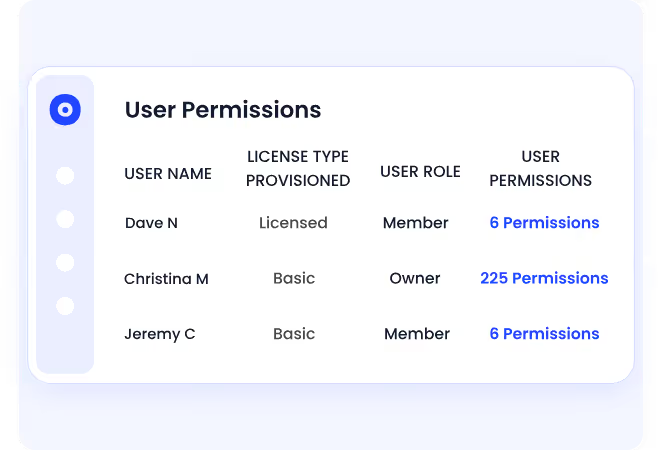
It continuously flags excessive privilege, dormant accounts, and policy violations, and runs automated access review campaigns that satisfy auditor requirements without burdening your team.

EagleEye: Autonomous Agentic AI Enforcement

This is CloudEagle's most distinctive capability. EagleEye is an autonomous AI agent that enforces governance policies without manual intervention. 

"AI is reshaping how enterprises operate, but governance models haven't evolved at the same pace. EagleEye brings autonomous control to SaaS and AI environments, reducing risk, eliminating manual coordination, and helping governance keep up with innovation." — Nidhi Jain, CEO, CloudEagle.ai

It can detect a policy violation, assess its severity, notify the relevant stakeholders, and trigger remediation, all within a single automated workflow.

Manual license harvesting wastes time and hides unused SaaS spend. RingCentral experienced this firsthand before switching to CloudEagle.ai for full visibility and automated license management.

Read the full case study

Pricing: Available on request. 

Descriptions only go so far. If you want to see exactly how CloudEagle.ai handles shadow AI detection, access reviews, and compliance monitoring inside a real environment, the product walkthrough gives you that in under a few minutes, no demo call required.

See the CloudEagle.ai Product Walkthrough

2. Secureframe 

Secureframe has built a solid reputation in the compliance automation space, particularly among startups and mid-market companies chasing SOC 2 and ISO 27001 certifications. 

Key Features:

  • Automated SOC 2, ISO 27001, HIPAA, GDPR, and PCI-DSS readiness
  • AI-powered control mapping and gap analysis
  • Continuous control monitoring with real-time failure alerts
  • 250+ native integrations with cloud, HR, and security tools
  • Vendor risk management with questionnaire automation
  • Personnel security management and security training tracking

Pros:

  • Fast time-to-audit, teams often achieve SOC 2 Type II in under 3 months
  • Clean, intuitive interface that non-technical users can navigate
  • Strong customer support with dedicated compliance managers

Pricing: Starts at approximately $12,000/year for smaller teams, scaling up based on team size and frameworks. Enterprise pricing is available through their sales team. Free demo available, but no self-serve free trial.

3. Vanta 

Vanta is one of the most widely recognized names in compliance automation, particularly for cloud-native companies. 

Their platform combines automated evidence collection with a trust center that lets you share compliance status with customers and prospects, a feature particularly useful for B2B SaaS companies under constant security review from enterprise buyers.

Key Features:

  • Automated evidence collection across AWS, GCP, Azure, and 350+ integrations
  • Continuous control monitoring with policy drift alerts
  • Trust Center for customer-facing compliance transparency
  • Vendor risk assessments with AI-assisted questionnaire completion
  • Access reviews and user permission tracking
  • AI-powered risk register and remediation guidance

Pros:

  • Best-in-class Trust Center for customer-facing compliance sharing
  • Strong brand recognition, auditors and customers know the name
  • Broad framework coverage, including newer standards like CMMC

Pricing: Starts around $15,000/year for a single framework, with multi-framework pricing scaling upward. Enterprise contracts are negotiated directly. Demo available, no public free trial.

4. Drata 

Drata has positioned itself at the premium end of the compliance automation market, targeting enterprise organizations with complex, multi-framework compliance needs. 

Their platform emphasizes depth of control coverage and the quality of their automated monitoring engine.

Key Features:

  • Continuous automated monitoring across 16+ compliance frameworks
  • AI-powered risk assessments and remediation suggestions
  • Custom control frameworks for highly regulated industries
  • Deep audit log and evidence trail management
  • Workforce compliance tracking, including training and background checks
  • Policy lifecycle management with automated employee acknowledgments

Pros:

  • Excellent depth of control coverage, particularly strong for enterprises
  • Highly configurable for organizations with custom compliance requirements
  • Strong audit firm partnerships that streamline the auditor relationship

Pricing: Typically starts around $20,000/year, scaling significantly for enterprise deals with multiple frameworks and large employee counts. Custom pricing available through sales.

5. Sprinto 

Sprinto is a strong option for high-growth SaaS companies that need to move quickly through compliance certifications without dedicated GRC teams. 

Their platform emphasizes speed and guided workflows, making it relatively accessible for compliance beginners.

Key Features:

  • Automated SOC 2, ISO 27001, HIPAA, and GDPR readiness workflows
  • Pre-built compliance programs mapped to specific frameworks
  • Continuous control checks with automated failure notifications
  • HR system integrations for personnel compliance tracking
  • Auditor collaboration tools with direct auditor portal access
  • Risk management with automated risk scoring

Pros:

  • Guided, opinionated workflows that reduce the learning curve for compliance beginners
  • Faster implementation timeline compared to more complex enterprise platforms
  • Responsive support team with strong onboarding experience

Pricing: Starts at approximately $8,000–$10,000/year for a single framework. Multi-framework pricing scales up, with enterprise plans available through their sales team.

Worth A Read: Shadow AI and Shadow IT — What IT Leaders Need to Know in 2026

4. Where to Buy AI Compliance Tools for Risk Monitoring?

If you're actively searching for where to buy AI compliance tools for risk monitoring, here's a practical breakdown of your procurement options:

1. Direct from the Vendor (Recommended): All five platforms covered in this guide offer direct sales processes. For enterprise buyers, this is almost always the right path; you'll get custom pricing, negotiated SLAs, and dedicated implementation support. CloudEagle.ai, Vanta, Drata, Secureframe, and Sprinto all have demo and trial options available through their websites.

2. Cloud Marketplaces (AWS, Azure, GCP): Several of these tools are available through major cloud marketplaces. If your organization already has committed cloud spend, purchasing through a marketplace can be a cost-effective way to consume existing credits. Vanta and Drata, in particular, have a strong marketplace presence.

3. IT Procurement Platforms: CloudEagle.ai's Procurement module gives IT and procurement teams a structured workflow for evaluating, requesting, and purchasing compliance software, including price benchmarking against what similar companies are paying. This removes a lot of the information asymmetry that typically disadvantages buyers in vendor negotiations.

4. G2, Capterra, and Review Platforms: Software review platforms are useful for validating peer experiences, but they're rarely the right purchasing channel for enterprise compliance tools. Use them for due diligence, not for closing a contract.

What to Ask Before You Buy:

  • How many frameworks are included in the base price vs. the add-on cost?
  • What's the implementation timeline, and who handles onboarding?
  • Does the platform include shadow AI detection out of the box?
  • How does the vendor handle audit firm relationships?
  • What's the process for adding new frameworks as compliance needs evolve?

60% of SaaS and AI apps operate outside IT visibility- Kevin Lee, Account Executive at CloudEagle, breaks down what that means for your compliance posture in this sharp, practical session.

Watch the Webinar:
Managing Risk & Compliance in Your SaaS Stack — CloudEagle.ai

5. What's the Best AI Model Governance Platform for Enterprises?

40%+ of enterprise data governance initiatives will incorporate AI-powered monitoring by 2026, per Gartner research.

For enterprise buyers, the key differentiators to prioritize are:

  1. Autonomous Enforcement Capabilities: Enterprise teams can't manually remediate every policy violation across a portfolio of 500+ applications. You need a platform that can take action automatically, revoking access, triggering approval workflows, and blocking unsanctioned app usage, without requiring constant human intervention. This is precisely what CloudEagle's EagleEye agentic AI was built for.
  2. Depth of Integration Coverage: An enterprise compliance platform is only as good as the integrations it can pull from. Look for platforms with deep, bidirectional integrations across your HR systems, identity providers, cloud environments, and business applications, not just shallow read-only connections.
  3. Cross-Functional Visibility: Compliance isn't just an IT problem. Enterprise platforms need to surface relevant risk data for security, finance, legal, and procurement teams simultaneously, with role-based views that give each function what they need without overwhelming them with irrelevant data.
  4. Scalability Without Proportional Cost Growth:  The per-user or per-app pricing models of some tools become punitive at enterprise scale. Look for pricing structures that reward volume and can accommodate growth without compliance costs ballooning proportionally.
  5. Audit-Firm Relationships: The most sophisticated platforms maintain direct relationships with audit firms, streamlining the evidence review process and reducing the back-and-forth that typically adds weeks to an audit cycle. CloudEagle, Vanta, and Drata all have strong audit-firm ecosystems.

Most Compliance Tools Can't See the AI Your Employees Are Using.

Here's the checklist to find and govern every unauthorized tool.
Get the AI Governance Checklist

Conclusion

The compliance landscape in 2026 is genuinely more complex than it was two years ago. Shadow AI is proliferating, regulatory frameworks are multiplying, and the cost of a compliance failure, financial, reputational, and operational, keeps climbing.

The good news is that the best AI compliance tools for risk monitoring have matured significantly. Whether you're a fast-growing startup chasing your first SOC 2 certification or an enterprise managing compliance across multiple geographies, there's a platform purpose-built for your situation.

For most enterprise organizations, especially those grappling with the growing challenge of shadow AI and autonomous risk enforcement, CloudEagle.ai's depth of coverage and agentic AI capabilities make it the standout choice. 

But no tool evaluates itself. Take advantage of the free trials and demos available, run your real compliance scenarios through each platform, and let your actual requirements drive the decision.

Frequently Asked Questions 

  1. What is the best AI for risk management? 

CloudEagle.ai leads in SaaS and AI risk monitoring. For cybersecurity risk, CrowdStrike and Microsoft Sentinel are strong options. The right choice depends on whether your primary risk surface is identity, compliance, or infrastructure.

  1. What are the best AI search monitoring tools? 

Top options include CloudEagle.ai for SaaS and AI governance, Netskope for network-level monitoring, and Vanta or Drata for compliance monitoring. The right tool depends on whether you need visibility at the network, identity, or compliance layer.

  1. What are the 4 types of AI risk? 

Security risk, compliance risk, operational risk, and reputational risk. Most enterprises underestimate compliance and security risk from shadow AI tools adopted without IT approval.

  1. What is the best AI tool for compliance? 

CloudEagle.ai for access governance and continuous monitoring. Vanta and Drata for certification speed. The best fit depends on whether your challenge is governance, certification readiness, or both.

  1. How is AI used in risk management? 

AI monitors user behavior, detects anomalies, automates evidence collection, flags policy violations, and enforces least-privilege access. Platforms like CloudEagle.ai can detect, assess, and remediate risks autonomously.

  1. What is an example of AI governance? 

An employee signs up for an unsanctioned AI tool. CloudEagle.ai detects it, risk-scores it, notifies IT, and triggers an approval or blocking workflow automatically, no manual intervention needed.

Advertisement for a SaaS Subscription Tracking Template with a call-to-action button to download and a partial graphic of a tablet showing charts.Banner promoting a SaaS Agreement Checklist to streamline SaaS management and avoid budget waste with a call-to-action button labeled Download checklist.Blue banner with text 'The Ultimate Employee Offboarding Checklist!' and a black button labeled 'Download checklist' alongside partial views of checklist documents from cloudeagle.ai.Digital ad for download checklist titled 'The Ultimate Checklist for IT Leaders to Optimize SaaS Operations' by cloudeagle.ai, showing checklist pages.Slack Buyer's Guide offer with text 'Unlock insider insights to get the best deal on Slack!' and a button labeled 'Get Your Copy', accompanied by a preview of the guide featuring Slack's logo.Monday Pricing Guide by cloudeagle.ai offering exclusive pricing secrets to maximize investment with a call-to-action button labeled Get Your Copy and an image of the guide's cover.Blue banner for Canva Pricing Guide by cloudeagle.ai offering a guide to Canva costs, features, and alternatives with a call-to-action button saying Get Your Copy.Blue banner with white text reading 'Little-Known Negotiation Hacks to Get the Best Deal on Slack' and a white button labeled 'Get Your Copy'.Blue banner with text 'Little-Known Negotiation Hacks to Get the Best Deal on Monday.com' and a white button labeled 'Get Your Copy'.Blue banner with text 'Little-Known Negotiation Hacks to Get the Best Deal on Canva' and a white button labeled 'Get Your Copy'.Banner with text 'Slack Buyer's Guide' and a 'Download Now' button next to images of a guide titled 'Slack Buyer’s Guide: Features, Pricing & Best Practices'.Digital cover of Monday Pricing Guide with a button labeled Get Your Copy on a blue background.Canva Pricing Guide cover with a button labeled Get Your Copy on a blue gradient background.

Enter your email to
unlock the report

Oops! Something went wrong while submitting the form.
License Count
Benchmark
Per User/Per Year

Enter your email to
unlock the report

Oops! Something went wrong while submitting the form.
License Count
Benchmark
Per User/Per Year

Enter your email to
unlock the report

Oops! Something went wrong while submitting the form.
Notion Plus
License Count
Benchmark
Per User/Per Year
100-500
$67.20 - $78.72
500-1000
$59.52 - $72.00
1000+
$51.84 - $57.60
Canva Pro
License Count
Benchmark
Per User/Per Year
100-500
$74.33-$88.71
500-1000
$64.74-$80.32
1000+
$55.14-$62.34

Enter your email to
unlock the report

Oops! Something went wrong while submitting the form.

Enter your email to
unlock the report

Oops! Something went wrong while submitting the form.
Zoom Business
License Count
Benchmark
Per User/Per Year
100-500
$216.00 - $264.00
500-1000
$180.00 - $216.00
1000+
$156.00 - $180.00

Enter your email to
unlock the report

Oops! Something went wrong while submitting the form.

Get the Right Security Platform To Secure Your Cloud Infrastructure

Please enter a business email
Thank you!
The 2023 SaaS report has been sent to your email. Check your promotional or spam folder.
Oops! Something went wrong while submitting the form.

Access full report

Please enter a business email
Thank you!
The 2023 SaaS report has been sent to your email. Check your promotional or spam folder.
Oops! Something went wrong while submitting the form.

Let's be honest, most compliance teams weren't built for the pace of today's AI-driven enterprise. Your SaaS stack keeps expanding, employees are spinning up unauthorized AI tools without a second thought, and regulatory bodies are tightening their grip on data governance every quarter. 

The traditional GRC tools you've relied on simply weren't designed for this.

That's exactly why AI compliance tools for risk monitoring have become the new standard for IT, security, and compliance leaders who need real-time visibility and automated enforcement, not more spreadsheets.

In this guide, we break down the 5 best AI compliance tools for risk monitoring in 2026, what sets them apart, and how to choose the right one for your organization's specific needs.

TL;DR 

Platform Best For Rating
CloudEagle.ai Shadow AI detection, identity governance, multi-framework compliance, and autonomous risk enforcement 4.8/5
Secureframe Compliance monitoring, anomaly detection, data governance, and policy enforcement. 4.7/5
Vanta Compliance monitoring, data loss prevention, cloud gap analytics, and vendor access control. 4.6/5
Drata Compliance monitoring, anomaly detection, cloud gap analytics, and security questionnaires. 4.7/5
Sprinto Compliance monitoring, anomaly detection, data loss prevention, and data encryption. 4.7/5

1. Why AI Compliance Tools for Risk Monitoring Are Becoming Essential?

The numbers alone make the case pretty clearly.

$4.88M, Average cost of a data breach in 2024, according to IBM's Cost of a Data Breach Report. A record high.

Beyond the financial risk, compliance workloads are multiplying. Between SOC 2, ISO 27001, HIPAA, GDPR, and the incoming EU AI Act, security and compliance teams are stretched thin managing frameworks that were never designed to talk to each other. 

And that's before you factor in shadow AI, employees quietly adopting AI tools outside of IT approval channels.

Here's what's driving the shift:

  • Real-time risk detection that manual audits simply cannot replicate
  • Automated evidence collection that cuts compliance prep time dramatically
  • Continuous monitoring across your entire SaaS and AI tool stack
  • AI-native governance frameworks that go beyond legacy GRC checklists
  • Cross-framework compliance mapping, one control, many frameworks covered

Worth A Read: CloudEagle.ai Launches EagleEye — The First Agentic AI for Autonomous SaaS and AI Governance

Shadow AI Is Already in Your Stack. Are You Compliant?

8 practices that close the gaps before regulators find them.
Get the Compliance Best Practices Guide

2. What Makes a Great AI Compliance Monitoring Platform?

Not every tool that claims to be "AI-powered" is actually doing meaningful work behind the scenes. When evaluating AI compliance monitoring software, there are a few non-negotiables that separate genuine platforms from glorified dashboards.

1. Real-Time, Continuous Monitoring: Point-in-time audits leave massive gaps. A strong AI risk monitoring platform watches your environment around the clock, flagging anomalies the moment they occur, not three weeks later when a quarterly review rolls around.

2. Multi-Framework Coverage: The best platforms map controls across SOC 2, ISO 27001, HIPAA, GDPR, PCI-DSS, and newer AI-specific frameworks simultaneously. You shouldn't have to rebuild your compliance program from scratch every time a new regulation hits.

3. Shadow AI and Shadow IT Discovery: If a compliance tool can't see the unsanctioned AI apps your employees are using, it's giving you a false sense of security. Shadow AI detection is now a critical feature of any serious AI governance platform.

4. Automated Evidence Collection and Remediation:  Manual Evidence collection is where compliance hours go to die. Look for platforms with native integrations that pull evidence automatically and can trigger remediation workflows without human intervention.

5. Access Governance and User Lifecycle Management: Excess permissions are among the most common compliance failure points. Great tools automate access reviews, flag over-privileged users, and enforce least-privilege policies at scale.

6. Clear, Audit-Ready Reporting: When an auditor shows up, you want clean, exportable reports, not a scramble to compile evidence from five different systems. Reporting quality is often where platforms diverge most dramatically.

3. The 5 Best AI Compliance Tools for Risk Monitoring in 2026

Below is an honest breakdown of the best AI compliance tools for risk monitoring available today, based on feature depth, real-world usability, pricing transparency, and how well each handles the realities of modern AI governance.

1. CloudEagle.ai

If you've been evaluating AI compliance tools for risk monitoring and keep circling back to the same problem, visibility gaps, shadow AI, over-permissioned users, CloudEagle.ai was built to solve exactly those problems. 

VIDEO 

What makes CloudEagle genuinely different is its newly launched EagleEye, the first agentic AI engine designed specifically for autonomous SaaS and AI governance. It doesn't just surface risk; it acts on it.

Shadow AI & Shadow IT Detection

Most organizations have no idea how many unauthorized AI tools are active in their environment. 

CloudEagle's Shadow AI detection engine discovers every application employees are using, sanctioned or not, by integrating directly with your SSO, browser activity, financial feeds, and network traffic. 

Continuous AI Risk Monitoring

CloudEagle's AI risk monitoring platform doesn't wait for your annual audit to tell you something's wrong. It runs continuous checks across your SaaS stack, monitoring user behavior, access patterns, app permissions, and vendor security postures in real time. 

Anomalies trigger instant alerts and can kick off automated remediation workflows before a minor issue becomes a compliance incident.

Multi-Framework Compliance Mapping

CloudEagle maps your controls across SOC 2, ISO 27001, HIPAA, GDPR, PCI-DSS, and the EU AI Act within a single unified control library. When a new regulation comes into scope, you're not rebuilding your compliance program; you're just checking what's already covered. 

This is especially valuable for enterprises operating across multiple geographies and regulatory jurisdictions.

Automated Evidence Collection

With 500+ integrations, CloudEagle pulls compliance evidence automatically from across your stack, HR systems, identity providers, SaaS applications, security tools, and more. 

Evidence is organized, timestamped, and audit-ready without anyone manually chasing down screenshots or log exports.

Identity Governance & Access Control

CloudEagle's access governance module handles the full user lifecycle, from automated provisioning on day one to immediate deprovisioning when an employee leaves. 

It continuously flags excessive privilege, dormant accounts, and policy violations, and runs automated access review campaigns that satisfy auditor requirements without burdening your team.

EagleEye: Autonomous Agentic AI Enforcement

This is CloudEagle's most distinctive capability. EagleEye is an autonomous AI agent that enforces governance policies without manual intervention. 

"AI is reshaping how enterprises operate, but governance models haven't evolved at the same pace. EagleEye brings autonomous control to SaaS and AI environments, reducing risk, eliminating manual coordination, and helping governance keep up with innovation." — Nidhi Jain, CEO, CloudEagle.ai

It can detect a policy violation, assess its severity, notify the relevant stakeholders, and trigger remediation, all within a single automated workflow.

Manual license harvesting wastes time and hides unused SaaS spend. RingCentral experienced this firsthand before switching to CloudEagle.ai for full visibility and automated license management.

Read the full case study

Pricing: Available on request. 

Descriptions only go so far. If you want to see exactly how CloudEagle.ai handles shadow AI detection, access reviews, and compliance monitoring inside a real environment, the product walkthrough gives you that in under a few minutes, no demo call required.

See the CloudEagle.ai Product Walkthrough

2. Secureframe 

Secureframe has built a solid reputation in the compliance automation space, particularly among startups and mid-market companies chasing SOC 2 and ISO 27001 certifications. 

Key Features:

  • Automated SOC 2, ISO 27001, HIPAA, GDPR, and PCI-DSS readiness
  • AI-powered control mapping and gap analysis
  • Continuous control monitoring with real-time failure alerts
  • 250+ native integrations with cloud, HR, and security tools
  • Vendor risk management with questionnaire automation
  • Personnel security management and security training tracking

Pros:

  • Fast time-to-audit, teams often achieve SOC 2 Type II in under 3 months
  • Clean, intuitive interface that non-technical users can navigate
  • Strong customer support with dedicated compliance managers

Pricing: Starts at approximately $12,000/year for smaller teams, scaling up based on team size and frameworks. Enterprise pricing is available through their sales team. Free demo available, but no self-serve free trial.

3. Vanta 

Vanta is one of the most widely recognized names in compliance automation, particularly for cloud-native companies. 

Their platform combines automated evidence collection with a trust center that lets you share compliance status with customers and prospects, a feature particularly useful for B2B SaaS companies under constant security review from enterprise buyers.

Key Features:

  • Automated evidence collection across AWS, GCP, Azure, and 350+ integrations
  • Continuous control monitoring with policy drift alerts
  • Trust Center for customer-facing compliance transparency
  • Vendor risk assessments with AI-assisted questionnaire completion
  • Access reviews and user permission tracking
  • AI-powered risk register and remediation guidance

Pros:

  • Best-in-class Trust Center for customer-facing compliance sharing
  • Strong brand recognition, auditors and customers know the name
  • Broad framework coverage, including newer standards like CMMC

Pricing: Starts around $15,000/year for a single framework, with multi-framework pricing scaling upward. Enterprise contracts are negotiated directly. Demo available, no public free trial.

4. Drata 

Drata has positioned itself at the premium end of the compliance automation market, targeting enterprise organizations with complex, multi-framework compliance needs. 

Their platform emphasizes depth of control coverage and the quality of their automated monitoring engine.

Key Features:

  • Continuous automated monitoring across 16+ compliance frameworks
  • AI-powered risk assessments and remediation suggestions
  • Custom control frameworks for highly regulated industries
  • Deep audit log and evidence trail management
  • Workforce compliance tracking, including training and background checks
  • Policy lifecycle management with automated employee acknowledgments

Pros:

  • Excellent depth of control coverage, particularly strong for enterprises
  • Highly configurable for organizations with custom compliance requirements
  • Strong audit firm partnerships that streamline the auditor relationship

Pricing: Typically starts around $20,000/year, scaling significantly for enterprise deals with multiple frameworks and large employee counts. Custom pricing available through sales.

5. Sprinto 

Sprinto is a strong option for high-growth SaaS companies that need to move quickly through compliance certifications without dedicated GRC teams. 

Their platform emphasizes speed and guided workflows, making it relatively accessible for compliance beginners.

Key Features:

  • Automated SOC 2, ISO 27001, HIPAA, and GDPR readiness workflows
  • Pre-built compliance programs mapped to specific frameworks
  • Continuous control checks with automated failure notifications
  • HR system integrations for personnel compliance tracking
  • Auditor collaboration tools with direct auditor portal access
  • Risk management with automated risk scoring

Pros:

  • Guided, opinionated workflows that reduce the learning curve for compliance beginners
  • Faster implementation timeline compared to more complex enterprise platforms
  • Responsive support team with strong onboarding experience

Pricing: Starts at approximately $8,000–$10,000/year for a single framework. Multi-framework pricing scales up, with enterprise plans available through their sales team.

Worth A Read: Shadow AI and Shadow IT — What IT Leaders Need to Know in 2026

4. Where to Buy AI Compliance Tools for Risk Monitoring?

If you're actively searching for where to buy AI compliance tools for risk monitoring, here's a practical breakdown of your procurement options:

1. Direct from the Vendor (Recommended): All five platforms covered in this guide offer direct sales processes. For enterprise buyers, this is almost always the right path; you'll get custom pricing, negotiated SLAs, and dedicated implementation support. CloudEagle.ai, Vanta, Drata, Secureframe, and Sprinto all have demo and trial options available through their websites.

2. Cloud Marketplaces (AWS, Azure, GCP): Several of these tools are available through major cloud marketplaces. If your organization already has committed cloud spend, purchasing through a marketplace can be a cost-effective way to consume existing credits. Vanta and Drata, in particular, have a strong marketplace presence.

3. IT Procurement Platforms: CloudEagle.ai's Procurement module gives IT and procurement teams a structured workflow for evaluating, requesting, and purchasing compliance software, including price benchmarking against what similar companies are paying. This removes a lot of the information asymmetry that typically disadvantages buyers in vendor negotiations.

4. G2, Capterra, and Review Platforms: Software review platforms are useful for validating peer experiences, but they're rarely the right purchasing channel for enterprise compliance tools. Use them for due diligence, not for closing a contract.

What to Ask Before You Buy:

  • How many frameworks are included in the base price vs. the add-on cost?
  • What's the implementation timeline, and who handles onboarding?
  • Does the platform include shadow AI detection out of the box?
  • How does the vendor handle audit firm relationships?
  • What's the process for adding new frameworks as compliance needs evolve?

60% of SaaS and AI apps operate outside IT visibility- Kevin Lee, Account Executive at CloudEagle, breaks down what that means for your compliance posture in this sharp, practical session.

Watch the Webinar:
Managing Risk & Compliance in Your SaaS Stack — CloudEagle.ai

5. What's the Best AI Model Governance Platform for Enterprises?

40%+ of enterprise data governance initiatives will incorporate AI-powered monitoring by 2026, per Gartner research.

For enterprise buyers, the key differentiators to prioritize are:

  1. Autonomous Enforcement Capabilities: Enterprise teams can't manually remediate every policy violation across a portfolio of 500+ applications. You need a platform that can take action automatically, revoking access, triggering approval workflows, and blocking unsanctioned app usage, without requiring constant human intervention. This is precisely what CloudEagle's EagleEye agentic AI was built for.
  2. Depth of Integration Coverage: An enterprise compliance platform is only as good as the integrations it can pull from. Look for platforms with deep, bidirectional integrations across your HR systems, identity providers, cloud environments, and business applications, not just shallow read-only connections.
  3. Cross-Functional Visibility: Compliance isn't just an IT problem. Enterprise platforms need to surface relevant risk data for security, finance, legal, and procurement teams simultaneously, with role-based views that give each function what they need without overwhelming them with irrelevant data.
  4. Scalability Without Proportional Cost Growth:  The per-user or per-app pricing models of some tools become punitive at enterprise scale. Look for pricing structures that reward volume and can accommodate growth without compliance costs ballooning proportionally.
  5. Audit-Firm Relationships: The most sophisticated platforms maintain direct relationships with audit firms, streamlining the evidence review process and reducing the back-and-forth that typically adds weeks to an audit cycle. CloudEagle, Vanta, and Drata all have strong audit-firm ecosystems.

Most Compliance Tools Can't See the AI Your Employees Are Using.

Here's the checklist to find and govern every unauthorized tool.
Get the AI Governance Checklist

Conclusion

The compliance landscape in 2026 is genuinely more complex than it was two years ago. Shadow AI is proliferating, regulatory frameworks are multiplying, and the cost of a compliance failure, financial, reputational, and operational, keeps climbing.

The good news is that the best AI compliance tools for risk monitoring have matured significantly. Whether you're a fast-growing startup chasing your first SOC 2 certification or an enterprise managing compliance across multiple geographies, there's a platform purpose-built for your situation.

For most enterprise organizations, especially those grappling with the growing challenge of shadow AI and autonomous risk enforcement, CloudEagle.ai's depth of coverage and agentic AI capabilities make it the standout choice. 

But no tool evaluates itself. Take advantage of the free trials and demos available, run your real compliance scenarios through each platform, and let your actual requirements drive the decision.

Frequently Asked Questions 

  1. What is the best AI for risk management? 

CloudEagle.ai leads in SaaS and AI risk monitoring. For cybersecurity risk, CrowdStrike and Microsoft Sentinel are strong options. The right choice depends on whether your primary risk surface is identity, compliance, or infrastructure.

  1. What are the best AI search monitoring tools? 

Top options include CloudEagle.ai for SaaS and AI governance, Netskope for network-level monitoring, and Vanta or Drata for compliance monitoring. The right tool depends on whether you need visibility at the network, identity, or compliance layer.

  1. What are the 4 types of AI risk? 

Security risk, compliance risk, operational risk, and reputational risk. Most enterprises underestimate compliance and security risk from shadow AI tools adopted without IT approval.

  1. What is the best AI tool for compliance? 

CloudEagle.ai for access governance and continuous monitoring. Vanta and Drata for certification speed. The best fit depends on whether your challenge is governance, certification readiness, or both.

  1. How is AI used in risk management? 

AI monitors user behavior, detects anomalies, automates evidence collection, flags policy violations, and enforces least-privilege access. Platforms like CloudEagle.ai can detect, assess, and remediate risks autonomously.

  1. What is an example of AI governance? 

An employee signs up for an unsanctioned AI tool. CloudEagle.ai detects it, risk-scores it, notifies IT, and triggers an approval or blocking workflow automatically, no manual intervention needed.

CloudEagle.ai recognized in the 2025 Gartner® Magic Quadrant™ for SaaS Management Platforms
Download now
gartner chart
5x
Faster employee
onboarding
80%
Reduction in time for
user access reviews
30k
Workflows
automated
$15Bn
Analyzed in
contract spend
$2Bn
Saved in
SaaS spend

Streamline SaaS governance and save 10-30%

Book a Demo with Expert
CTA image
One platform to Manage
all SaaS Products
Learn More