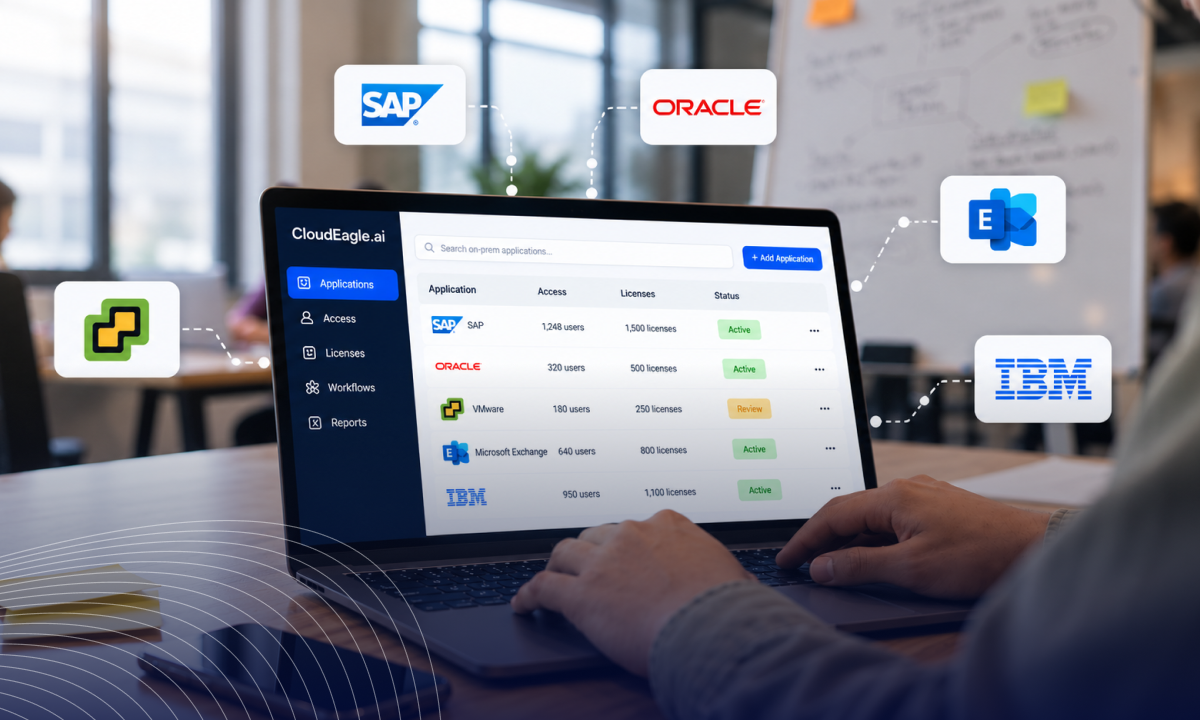
SaaS Management

How to Manage Adobe Licenses with CloudEagle.ai?

Share via:
Written by:
CloudEagle.ai Team
Reviewed by
Nidhi Jain
Last Updated:
February 6, 2025
blog-cms-banner-bg
Little-Known Negotiation Hacks to Get the Best Deal on Slack
cta-bg-blogDownload Your Copy

HIPAA Compliance Checklist for 2025

Download PDF

‍

Are you finding it difficult to manage your Adobe licenses?

With multiple app users, different departmental teams, and ongoing projects, keeping track of Adobe licenses can become complex. Properly managing these licenses ensures you only pay for what you need while staying compliant with Adobe’s licensing terms.

However, you can't effectively manage all these licenses with spreadsheets manually. You need a streamlined license management system that helps optimize costs and reduce security risks.

Here’s where CloudEagle.ai, a powerful SaaS management platform with advanced license management capabilities, can help. It simplifies Adobe license management by enabling centralized tracking, automating license allocation, and streamlining compliance reporting.

Let’s explore how CloudEagle.ai can help you manage your Adobe licenses more efficiently.

‍

TL;DR

  • CloudEagle.ai syncs with the Adobe Admin Console and shows every Adobe license, its cost, and its utilization in one view.
  • Each license is mapped to a user, with last activity and the Adobe apps they actually use.
  • Users who only open Photoshop or Acrobat get flagged for a cheaper single-app license.
  • Unused seats are reclaimed through an approval workflow, so nobody loses access without a check.
  • Renewal counts are set from real usage before Adobe's renewal window opens, so savings land on the anniversary date.
  • CloudEagle.ai integrates with Adobe, syncing all license data and user activity in one place, making tracking and management easier.

‍

What Does Adobe License Management Involve?

Adobe license management means keeping the number of Adobe seats you pay for equal to the number of people who use them, on the right plan. It covers assigning licenses, tracking usage, reclaiming idle seats, and setting the renewal count.

Adobe makes this harder than most vendors. A Creative Cloud Pro for teams seat, which Adobe renamed from All Apps in 2025, lists at $99.99 per user per month on an annual contract in the US. Single-app plans for Photoshop or Acrobat cost far less. Every user on the full suite who opens one app is a license waste you pay for all year.

The usual Adobe license manager setup has three gaps:

  • Usage is hard to see. The Admin Console shows who holds a license under each of the Adobe license types, but IT has to work out who stopped using it.
  • Plan fit is rarely checked. Users get Creative Cloud Pro by default and keep it after their role changes.
  • Changes only count at renewal. Adobe applies reduced license counts on the renewal date, so a seat you find in month three still bills until the anniversary.

‍

Every User on the Full Suite Who Uses One App

Build the license visibility that matches plans to real usage.
Download Checklist

‍

How to Manage Adobe Licenses with CloudEagle.ai

Managing Adobe licenses with CloudEagle.ai starts with the contract and ends with the renewal quantity. Each step uses what the step before it found, so the savings figure at the end traces back to specific users and specific seats.

The example below follows one company with 550 Adobe licenses across three plans and a renewal on March 1, 2027.

A. See every Adobe license you pay for

Adobe seats are often spread across Creative Cloud Pro, single-app plans and Acrobat, sometimes on more than one contract. Before anyone can cut a seat, IT needs one list of what was bought.

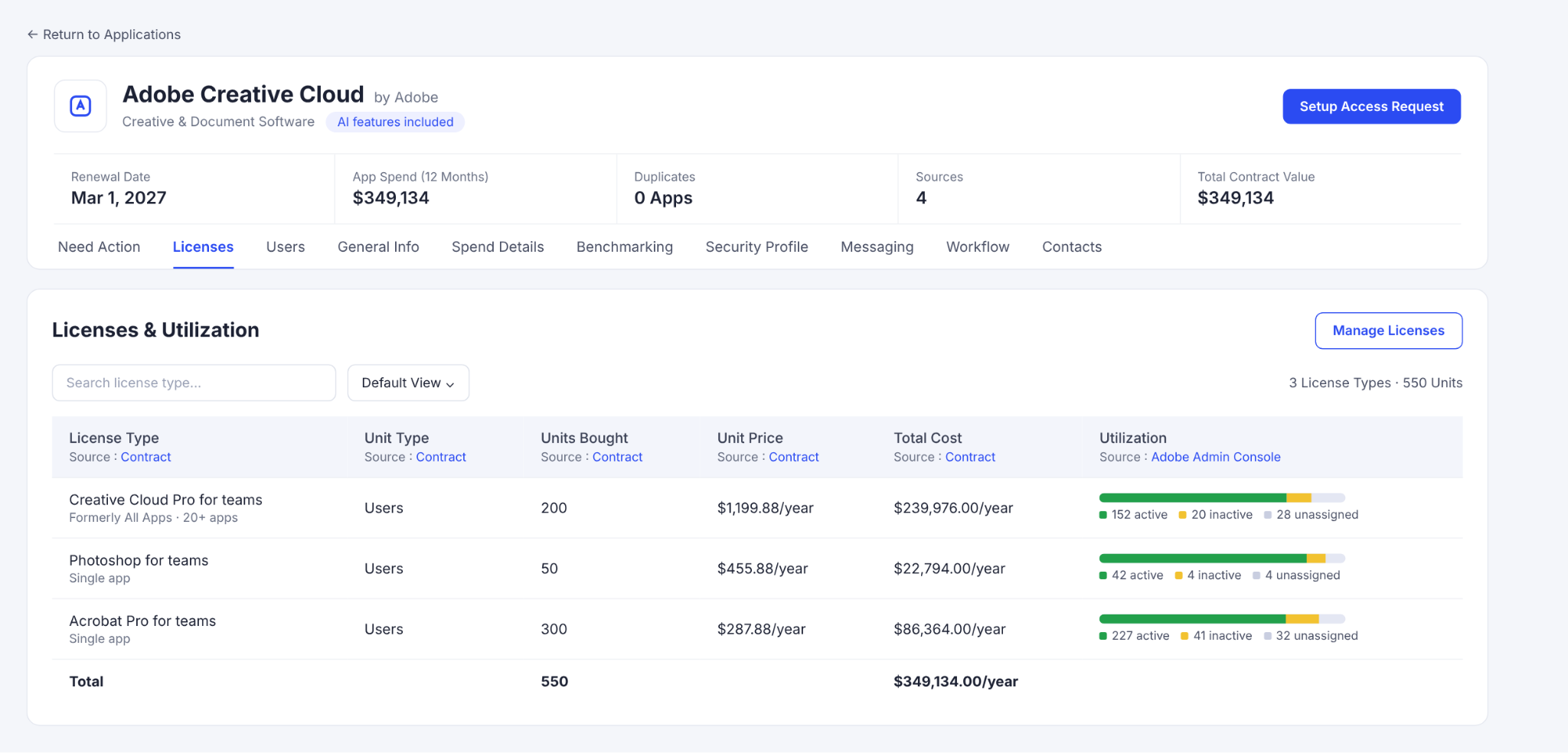
CloudEagle.ai connects to the Adobe Admin Console through its 500+ direct integrations and pulls license types, units bought, unit price, and total cost into one Licenses view. It also reads finance and SSO data, so Adobe subscriptions bought on a card outside the enterprise contract show up through shadow IT discovery.
‍

CloudEagle.ai dashboard showing Adobe Creative Cloud license details, including 550 purchased units across three license types, active and inactive users, unassigned seats, annual spend, and license utilization.

‍

In this example, the company pays $349,134 a year for 550 Adobe licenses. Creative Cloud Pro for teams alone shows 20 inactive and 28 unassigned seats. The next question is who sits behind each of those numbers.

B. Map every Adobe license to a user

A license count tells you how much you bought. The waste sits with specific users.

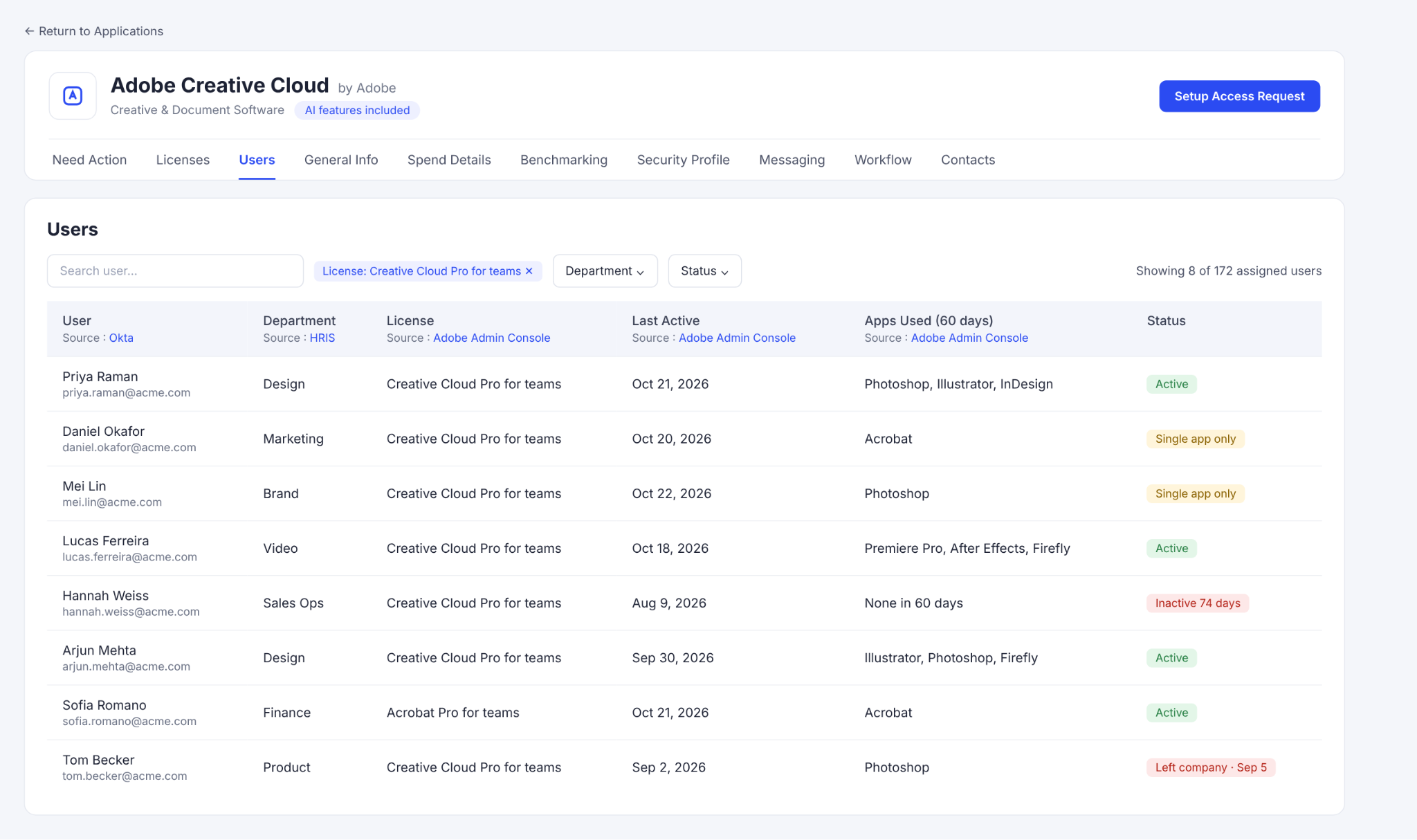
CloudEagle.ai maps each Adobe license to a user, with their department from the HRIS, their last activity, and the Adobe apps they used in the last 60 days.
‍

Dashboard listing assigned users, departments, license types, last activity dates, applications used, and account statuses to identify inactive users, single-app usage, and employees who have left the company.

‍

Three patterns stand out right away: users who open a single app, users inactive for more than 60 days, and users who have left the company but still hold a seat. Each one needs a different fix, so the next step sizes them.

C. Compare Adobe licenses bought vs consumed

Adobe license optimization depends on two numbers: how many seats are used, and how much of each seat is used.

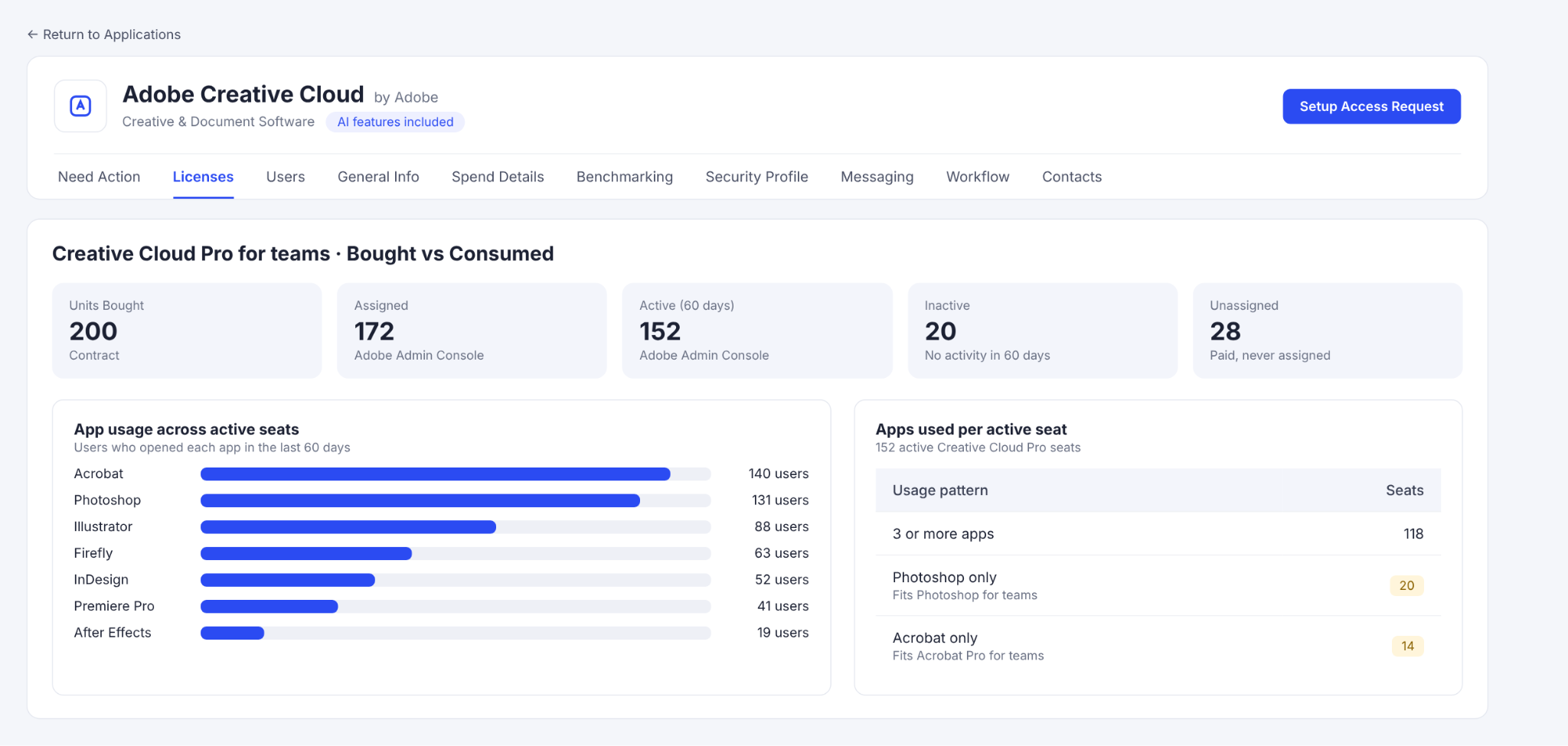
CloudEagle.ai shows units bought, assigned, active, inactive, and unassigned for each Adobe plan. It also breaks down app usage across active seats, including Photoshop, Acrobat, Illustrator, InDesign, Premiere Pro, and Firefly, Adobe's generative AI app. That shows which users need the full suite and which ones would fit a cheaper license tier.
‍

License utilization dashboard comparing 200 purchased seats with 172 assigned, 152 active, 20 inactive, and 28 unassigned seats. App-level usage and usage patterns highlight opportunities to downgrade single-app users.

‍

Of 152 active Creative Cloud Pro seats, 118 use three or more apps. Twenty use only Photoshop and 14 use only Acrobat. With the waste now sized, CloudEagle.ai puts a dollar figure on it.

‍

24% of Adobe Spend Goes to Idle Seats

Track software costs the way finance actually needs to see them.
Download Checklist

‍

D. Calculate potential savings on Adobe licenses

Finance teams approve cuts faster when every dollar traces back to a seat.

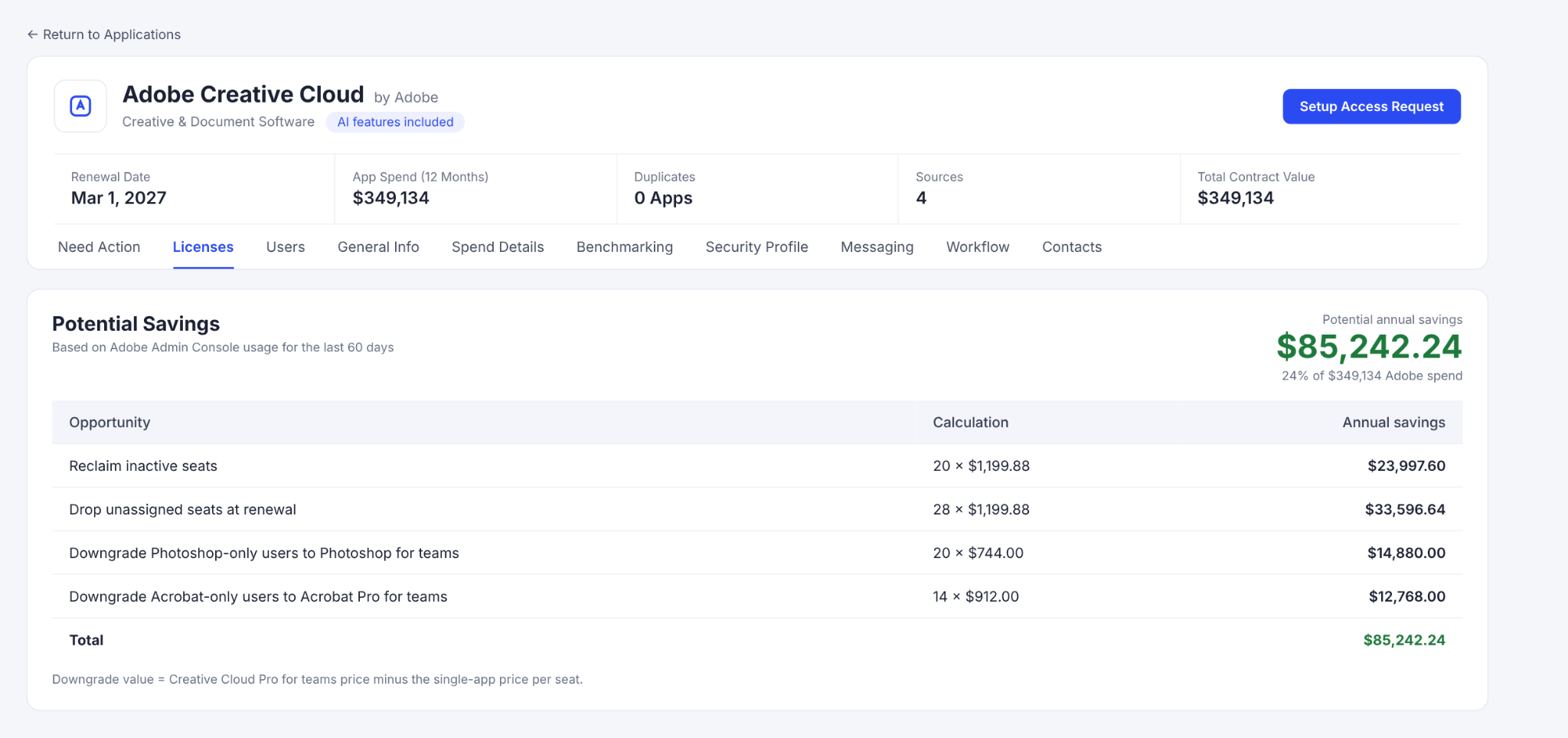
CloudEagle.ai turns the usage data into a savings breakdown. Inactive and unassigned seats count at the full Creative Cloud Pro price. Single-app users count at the difference between Creative Cloud Pro and the single-app plan that fits them.
‍

CloudEagle.ai Potential Savings view for Adobe Creative Cloud showing $85,242.24 in annual savings from reclaiming inactive seats, dropping unassigned seats and downgrading single-app users

‍

The total comes to $85,242 a year, 24% of the company's Adobe spend. The next step is acting on it without cutting off someone who still needs access.

E. Reclaim unused Adobe licenses through approvals

Pulling a license from a designer mid-project creates more cost than it saves. Every reclaim needs a check with the user first.

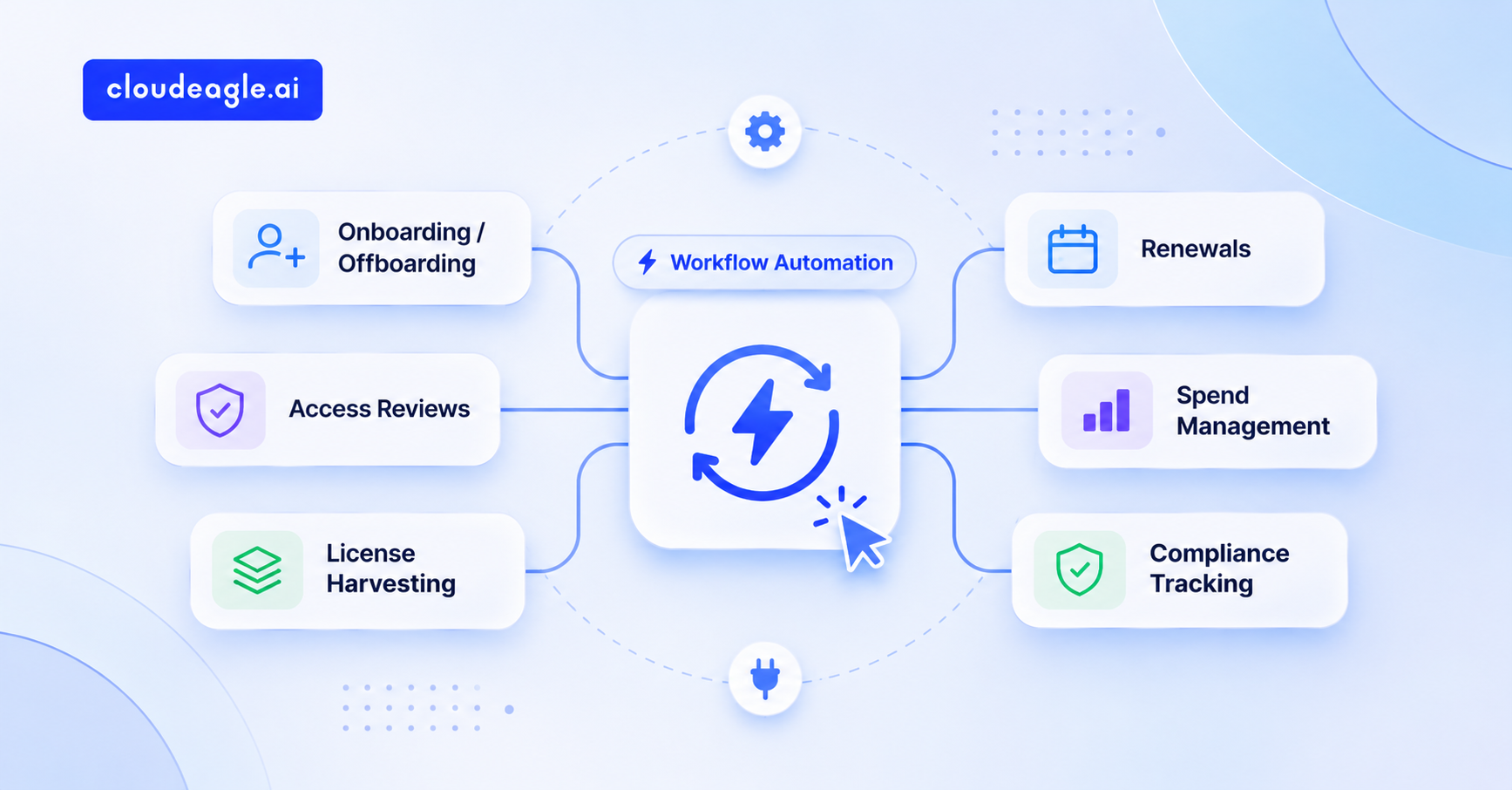
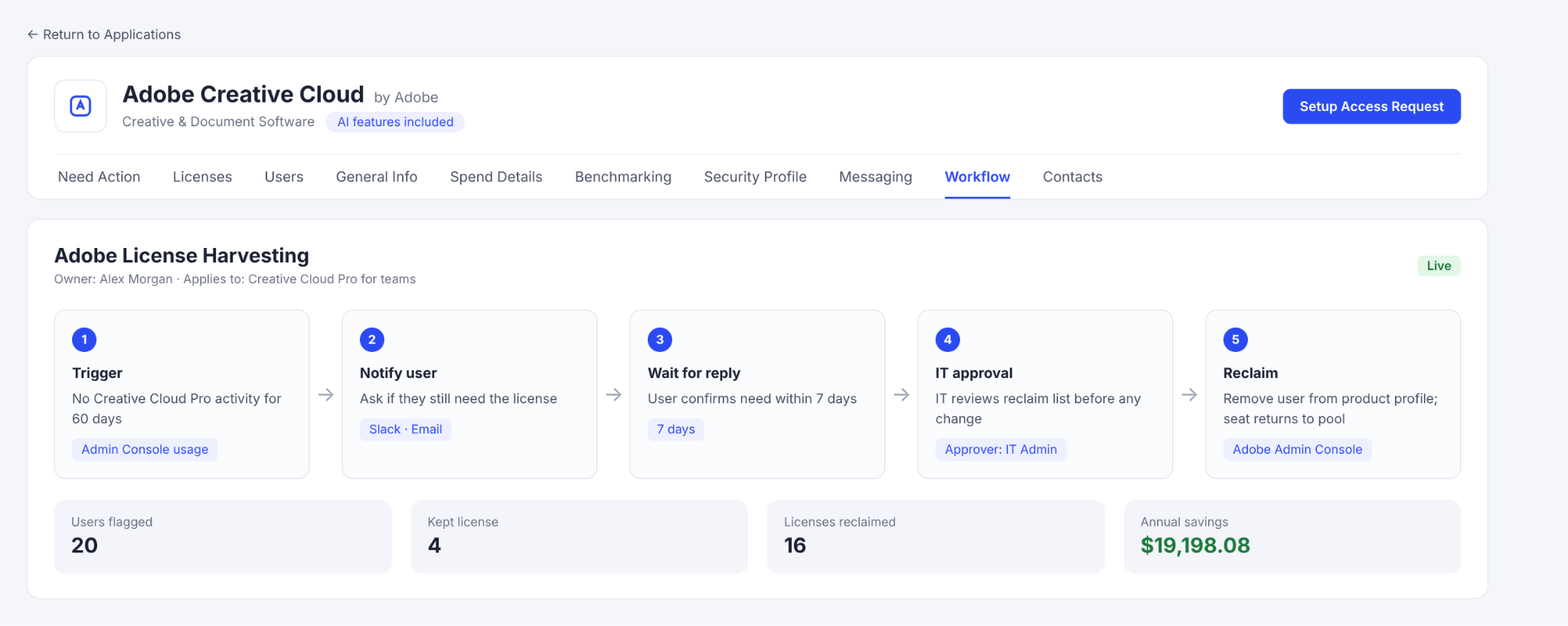
CloudEagle.ai runs license harvesting as a workflow. It flags Creative Cloud Pro users with no activity for 60 days and messages them on Slack or email. If they don't confirm within seven days, IT approves the reclaim and the user is removed from the Adobe product profile. The seat goes back to the pool for the next request.
‍

CloudEagle.ai Adobe License Harvesting workflow with five steps: trigger after 60 days of inactivity, notify user on Slack or email, wait seven days, IT approval, and reclaim from the Adobe product profile

‍

Here, 20 users were flagged, 4 confirmed they still needed Creative Cloud Pro and 16 seats were reclaimed, saving $19,198 a year. Reclaiming once is only half the fix. The same waste comes back unless new Adobe access is controlled.

F. Assign the right Adobe license as people join, move and leave

Most Adobe license waste starts on day one, when a new hire gets the full suite by default, or on the last day, when nobody removes it.

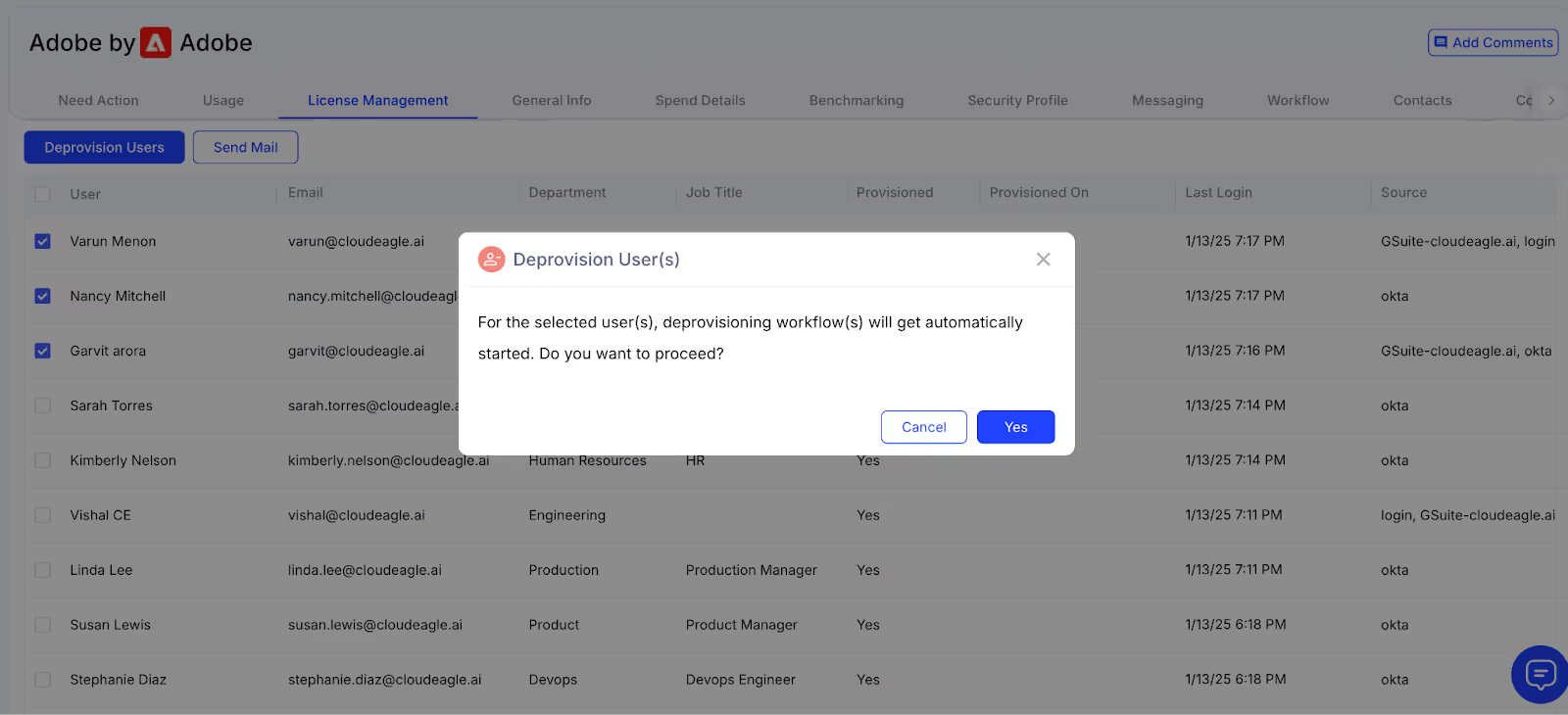
CloudEagle.ai ties Adobe licenses to employee onboarding and offboarding. New hires get the Adobe plan their role needs, movers are switched to the right plan, and leavers are deprovisioned from Adobe when the HRIS marks them as exited. Employees who need more ask through the self-service app catalog, and managers approve in Slack with every request logged for audits.
‍

‍

With seat counts now stable, the last step locks the savings into the contract.

G. Right-size the Adobe contract before the renewal window opens

Adobe only applies reduced counts on the renewal date, so the renewal quantity is where the savings actually land.

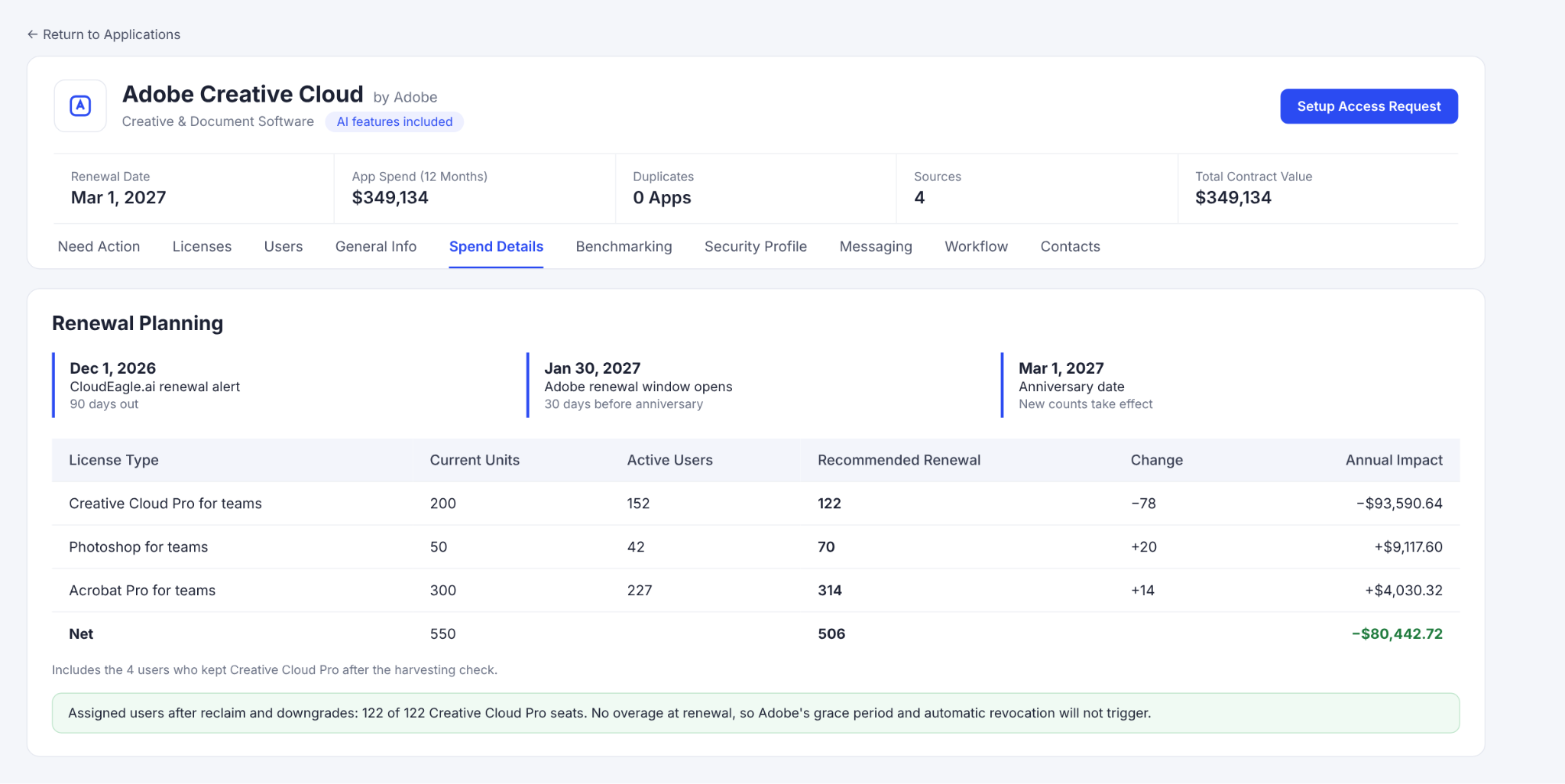
CloudEagle.ai's renewal calendar sends an alert 90 days before the Adobe anniversary date. It shows current units, active users, and a recommended renewal count for each plan. Procurement walks into the renewal with the exact number of Creative Cloud Pro, Photoshop, and Acrobat seats the company needs.
‍

CloudEagle.ai Renewal Planning view for Adobe Creative Cloud showing the renewal alert date, Adobe renewal window, anniversary date and recommended renewal counts for each Adobe plan

‍

The company renews 122 Creative Cloud Pro seats instead of 200, adds 34 single-app seats, and saves $80,442 a year. Assigned users match the new count, so Adobe's overage rules never kick in.

‍

Adobe License Optimization Checklist Before Your Renewal

Adobe license optimization works best 90 days before the anniversary date, because Adobe's own rules decide when a change takes effect. Check these five against your Adobe plan pricing before you send a renewal quantity.

Adobe rule What it means for IT What CloudEagle.ai does
The renewal window opens 30 days before the anniversary date Usage reviews started inside the window are usually too late Sends the renewal alert 90 days out
Reduced counts take effect on the renewal date A seat found mid-term keeps billing until the anniversary Builds the renewal count from live usage
Assigned users above the renewed count put the account out of compliance Adobe starts a grace period, then revokes licenses from the newest users first Reclaims and reassigns before renewal, so assigned users fit the count
A VIP 3-Year Commit locks a set license quantity at each anniversary Over-committing costs you for three years Shows usage trends before you commit
Single-app plans cost far less than Creative Cloud Pro One-app users on the full suite are pure waste Flags single-app users for a downgrade

‍

FAQs

1. Can I reduce Adobe licenses before my renewal date?

Not with immediate effect for most annual plans. Adobe applies reduced counts on the renewal date, so the practical move is to reclaim and reassign idle seats now and lower the quantity at renewal. On a 3-Year Commit, the committed quantity applies at each anniversary.

2. What happens if more users are assigned than Adobe licenses renewed?

The account becomes non-compliant. Adobe gives a grace period, then revokes licenses automatically, starting with the users who have held access for the shortest time. Unassigning extra users before the renewal date avoids this.

3. Which Creative Cloud license should each user get?

Match the plan to the apps the user opens. Designers using several apps need Creative Cloud Pro for teams. Users who only open Photoshop or Acrobat fit the single-app plans, which cost far less per seat.

4. How can an AI agent help reclaim unused software licenses?

An AI agent can scan usage, flag idle seats and draft the reclaim list for approval. CloudEagle.ai's agentic AI, EagleEye, works this way, with approvals running in Slack and EagleEye so a person signs off before any Adobe license changes.

5. We're overspending on Adobe licenses we don't fully use. What now?

Start with the inactive and unassigned seats, since those are the fastest savings. Then move single-app users to cheaper plans and set your renewal count based on active usage. CloudEagle.ai customers typically save 10–30% on software spend this way.

6. Does CloudEagle.ai replace the Adobe Admin Console?

No. The Admin Console stays where Adobe licenses are assigned. CloudEagle.ai connects to it and adds what it lacks: usage-based savings, approval workflows, HRIS-linked offboarding, and renewal planning.

‍

Take Control of Adobe Licenses with CloudEagle.ai

Managing Adobe licenses comes down to one loop: see every seat, match it to real usage, reclaim what's idle, and renew at the right count. Doing that by hand once a year leaves months of waste on every contract.

CloudEagle.ai runs the loop continuously, from the Admin Console sync to the renewal quantity. Teams like RingCentral already use it to save time and cost on license harvesting.

Book a demo to see your Adobe licenses, usage, and savings in one place.

‍

‍

Advertisement for a SaaS Subscription Tracking Template with a call-to-action button to download and a partial graphic of a tablet showing charts.Banner promoting a SaaS Agreement Checklist to streamline SaaS management and avoid budget waste with a call-to-action button labeled Download checklist.Blue banner with text 'The Ultimate Employee Offboarding Checklist!' and a black button labeled 'Download checklist' alongside partial views of checklist documents from cloudeagle.ai.Digital ad for download checklist titled 'The Ultimate Checklist for IT Leaders to Optimize SaaS Operations' by cloudeagle.ai, showing checklist pages.Slack Buyer's Guide offer with text 'Unlock insider insights to get the best deal on Slack!' and a button labeled 'Get Your Copy', accompanied by a preview of the guide featuring Slack's logo.Monday Pricing Guide by cloudeagle.ai offering exclusive pricing secrets to maximize investment with a call-to-action button labeled Get Your Copy and an image of the guide's cover.Blue banner for Canva Pricing Guide by cloudeagle.ai offering a guide to Canva costs, features, and alternatives with a call-to-action button saying Get Your Copy.Blue banner with white text reading 'Little-Known Negotiation Hacks to Get the Best Deal on Slack' and a white button labeled 'Get Your Copy'.Blue banner with text 'Little-Known Negotiation Hacks to Get the Best Deal on Monday.com' and a white button labeled 'Get Your Copy'.Blue banner with text 'Little-Known Negotiation Hacks to Get the Best Deal on Canva' and a white button labeled 'Get Your Copy'.Banner with text 'Slack Buyer's Guide' and a 'Download Now' button next to images of a guide titled 'Slack Buyer’s Guide: Features, Pricing & Best Practices'.Digital cover of Monday Pricing Guide with a button labeled Get Your Copy on a blue background.Canva Pricing Guide cover with a button labeled Get Your Copy on a blue gradient background.

Enter your email to
unlock the report

Oops! Something went wrong while submitting the form.
License Count
Benchmark
Per User/Per Year

Enter your email to
unlock the report

Oops! Something went wrong while submitting the form.
License Count
Benchmark
Per User/Per Year

Enter your email to
unlock the report

Oops! Something went wrong while submitting the form.
Notion Plus
License Count
Benchmark
Per User/Per Year
100-500
$67.20 - $78.72
500-1000
$59.52 - $72.00
1000+
$51.84 - $57.60
Canva Pro
License Count
Benchmark
Per User/Per Year
100-500
$74.33-$88.71
500-1000
$64.74-$80.32
1000+
$55.14-$62.34

Enter your email to
unlock the report

Oops! Something went wrong while submitting the form.

Enter your email to
unlock the report

Oops! Something went wrong while submitting the form.
Zoom Business
License Count
Benchmark
Per User/Per Year
100-500
$216.00 - $264.00
500-1000
$180.00 - $216.00
1000+
$156.00 - $180.00

Enter your email to
unlock the report

Oops! Something went wrong while submitting the form.

Get the Right Security Platform To Secure Your Cloud Infrastructure

Please enter a business email
Thank you!
The 2023 SaaS report has been sent to your email. Check your promotional or spam folder.
Oops! Something went wrong while submitting the form.

Access full report

Please enter a business email
Thank you!
The 2023 SaaS report has been sent to your email. Check your promotional or spam folder.
Oops! Something went wrong while submitting the form.

‍

Are you finding it difficult to manage your Adobe licenses?

With multiple app users, different departmental teams, and ongoing projects, keeping track of Adobe licenses can become complex. Properly managing these licenses ensures you only pay for what you need while staying compliant with Adobe’s licensing terms.

However, you can't effectively manage all these licenses with spreadsheets manually. You need a streamlined license management system that helps optimize costs and reduce security risks.

Here’s where CloudEagle.ai, a powerful SaaS management platform with advanced license management capabilities, can help. It simplifies Adobe license management by enabling centralized tracking, automating license allocation, and streamlining compliance reporting.

Let’s explore how CloudEagle.ai can help you manage your Adobe licenses more efficiently.

‍

TL;DR

  • CloudEagle.ai syncs with the Adobe Admin Console and shows every Adobe license, its cost, and its utilization in one view.
  • Each license is mapped to a user, with last activity and the Adobe apps they actually use.
  • Users who only open Photoshop or Acrobat get flagged for a cheaper single-app license.
  • Unused seats are reclaimed through an approval workflow, so nobody loses access without a check.
  • Renewal counts are set from real usage before Adobe's renewal window opens, so savings land on the anniversary date.
  • CloudEagle.ai integrates with Adobe, syncing all license data and user activity in one place, making tracking and management easier.

‍

What Does Adobe License Management Involve?

Adobe license management means keeping the number of Adobe seats you pay for equal to the number of people who use them, on the right plan. It covers assigning licenses, tracking usage, reclaiming idle seats, and setting the renewal count.

Adobe makes this harder than most vendors. A Creative Cloud Pro for teams seat, which Adobe renamed from All Apps in 2025, lists at $99.99 per user per month on an annual contract in the US. Single-app plans for Photoshop or Acrobat cost far less. Every user on the full suite who opens one app is a license waste you pay for all year.

The usual Adobe license manager setup has three gaps:

  • Usage is hard to see. The Admin Console shows who holds a license under each of the Adobe license types, but IT has to work out who stopped using it.
  • Plan fit is rarely checked. Users get Creative Cloud Pro by default and keep it after their role changes.
  • Changes only count at renewal. Adobe applies reduced license counts on the renewal date, so a seat you find in month three still bills until the anniversary.

‍

Every User on the Full Suite Who Uses One App

Build the license visibility that matches plans to real usage.
Download Checklist

‍

How to Manage Adobe Licenses with CloudEagle.ai

Managing Adobe licenses with CloudEagle.ai starts with the contract and ends with the renewal quantity. Each step uses what the step before it found, so the savings figure at the end traces back to specific users and specific seats.

The example below follows one company with 550 Adobe licenses across three plans and a renewal on March 1, 2027.

A. See every Adobe license you pay for

Adobe seats are often spread across Creative Cloud Pro, single-app plans and Acrobat, sometimes on more than one contract. Before anyone can cut a seat, IT needs one list of what was bought.

CloudEagle.ai connects to the Adobe Admin Console through its 500+ direct integrations and pulls license types, units bought, unit price, and total cost into one Licenses view. It also reads finance and SSO data, so Adobe subscriptions bought on a card outside the enterprise contract show up through shadow IT discovery.

‍

CloudEagle.ai dashboard showing Adobe Creative Cloud license details, including 550 purchased units across three license types, active and inactive users, unassigned seats, annual spend, and license utilization.

‍

In this example, the company pays $349,134 a year for 550 Adobe licenses. Creative Cloud Pro for teams alone shows 20 inactive and 28 unassigned seats. The next question is who sits behind each of those numbers.

B. Map every Adobe license to a user

A license count tells you how much you bought. The waste sits with specific users.

CloudEagle.ai maps each Adobe license to a user, with their department from the HRIS, their last activity, and the Adobe apps they used in the last 60 days.

‍

Dashboard listing assigned users, departments, license types, last activity dates, applications used, and account statuses to identify inactive users, single-app usage, and employees who have left the company.

‍

Three patterns stand out right away: users who open a single app, users inactive for more than 60 days, and users who have left the company but still hold a seat. Each one needs a different fix, so the next step sizes them.

C. Compare Adobe licenses bought vs consumed

Adobe license optimization depends on two numbers: how many seats are used, and how much of each seat is used.

CloudEagle.ai shows units bought, assigned, active, inactive, and unassigned for each Adobe plan. It also breaks down app usage across active seats, including Photoshop, Acrobat, Illustrator, InDesign, Premiere Pro, and Firefly, Adobe's generative AI app. That shows which users need the full suite and which ones would fit a cheaper license tier.

‍

License utilization dashboard comparing 200 purchased seats with 172 assigned, 152 active, 20 inactive, and 28 unassigned seats. App-level usage and usage patterns highlight opportunities to downgrade single-app users.

‍

Of 152 active Creative Cloud Pro seats, 118 use three or more apps. Twenty use only Photoshop and 14 use only Acrobat. With the waste now sized, CloudEagle.ai puts a dollar figure on it.

‍

24% of Adobe Spend Goes to Idle Seats

Track software costs the way finance actually needs to see them.
Download Checklist

‍

D. Calculate potential savings on Adobe licenses

Finance teams approve cuts faster when every dollar traces back to a seat.

CloudEagle.ai turns the usage data into a savings breakdown. Inactive and unassigned seats count at the full Creative Cloud Pro price. Single-app users count at the difference between Creative Cloud Pro and the single-app plan that fits them.

‍

CloudEagle.ai Potential Savings view for Adobe Creative Cloud showing $85,242.24 in annual savings from reclaiming inactive seats, dropping unassigned seats and downgrading single-app users

‍

The total comes to $85,242 a year, 24% of the company's Adobe spend. The next step is acting on it without cutting off someone who still needs access.

E. Reclaim unused Adobe licenses through approvals

Pulling a license from a designer mid-project creates more cost than it saves. Every reclaim needs a check with the user first.

CloudEagle.ai runs license harvesting as a workflow. It flags Creative Cloud Pro users with no activity for 60 days and messages them on Slack or email. If they don't confirm within seven days, IT approves the reclaim and the user is removed from the Adobe product profile. The seat goes back to the pool for the next request.

‍

CloudEagle.ai Adobe License Harvesting workflow with five steps: trigger after 60 days of inactivity, notify user on Slack or email, wait seven days, IT approval, and reclaim from the Adobe product profile

‍

Here, 20 users were flagged, 4 confirmed they still needed Creative Cloud Pro and 16 seats were reclaimed, saving $19,198 a year. Reclaiming once is only half the fix. The same waste comes back unless new Adobe access is controlled.

F. Assign the right Adobe license as people join, move and leave

Most Adobe license waste starts on day one, when a new hire gets the full suite by default, or on the last day, when nobody removes it.

CloudEagle.ai ties Adobe licenses to employee onboarding and offboarding. New hires get the Adobe plan their role needs, movers are switched to the right plan, and leavers are deprovisioned from Adobe when the HRIS marks them as exited. Employees who need more ask through the self-service app catalog, and managers approve in Slack with every request logged for audits.

‍

‍

With seat counts now stable, the last step locks the savings into the contract.

G. Right-size the Adobe contract before the renewal window opens

Adobe only applies reduced counts on the renewal date, so the renewal quantity is where the savings actually land.

CloudEagle.ai's renewal calendar sends an alert 90 days before the Adobe anniversary date. It shows current units, active users, and a recommended renewal count for each plan. Procurement walks into the renewal with the exact number of Creative Cloud Pro, Photoshop, and Acrobat seats the company needs.

‍

CloudEagle.ai Renewal Planning view for Adobe Creative Cloud showing the renewal alert date, Adobe renewal window, anniversary date and recommended renewal counts for each Adobe plan

‍

The company renews 122 Creative Cloud Pro seats instead of 200, adds 34 single-app seats, and saves $80,442 a year. Assigned users match the new count, so Adobe's overage rules never kick in.

‍

Adobe License Optimization Checklist Before Your Renewal

Adobe license optimization works best 90 days before the anniversary date, because Adobe's own rules decide when a change takes effect. Check these five against your Adobe plan pricing before you send a renewal quantity.

Adobe rule What it means for IT What CloudEagle.ai does
The renewal window opens 30 days before the anniversary date Usage reviews started inside the window are usually too late Sends the renewal alert 90 days out
Reduced counts take effect on the renewal date A seat found mid-term keeps billing until the anniversary Builds the renewal count from live usage
Assigned users above the renewed count put the account out of compliance Adobe starts a grace period, then revokes licenses from the newest users first Reclaims and reassigns before renewal, so assigned users fit the count
A VIP 3-Year Commit locks a set license quantity at each anniversary Over-committing costs you for three years Shows usage trends before you commit
Single-app plans cost far less than Creative Cloud Pro One-app users on the full suite are pure waste Flags single-app users for a downgrade

‍

FAQs

1. Can I reduce Adobe licenses before my renewal date?

Not with immediate effect for most annual plans. Adobe applies reduced counts on the renewal date, so the practical move is to reclaim and reassign idle seats now and lower the quantity at renewal. On a 3-Year Commit, the committed quantity applies at each anniversary.

2. What happens if more users are assigned than Adobe licenses renewed?

The account becomes non-compliant. Adobe gives a grace period, then revokes licenses automatically, starting with the users who have held access for the shortest time. Unassigning extra users before the renewal date avoids this.

3. Which Creative Cloud license should each user get?

Match the plan to the apps the user opens. Designers using several apps need Creative Cloud Pro for teams. Users who only open Photoshop or Acrobat fit the single-app plans, which cost far less per seat.

4. How can an AI agent help reclaim unused software licenses?

An AI agent can scan usage, flag idle seats and draft the reclaim list for approval. CloudEagle.ai's agentic AI, EagleEye, works this way, with approvals running in Slack and EagleEye so a person signs off before any Adobe license changes.

5. We're overspending on Adobe licenses we don't fully use. What now?

Start with the inactive and unassigned seats, since those are the fastest savings. Then move single-app users to cheaper plans and set your renewal count based on active usage. CloudEagle.ai customers typically save 10–30% on software spend this way.

6. Does CloudEagle.ai replace the Adobe Admin Console?

No. The Admin Console stays where Adobe licenses are assigned. CloudEagle.ai connects to it and adds what it lacks: usage-based savings, approval workflows, HRIS-linked offboarding, and renewal planning.

‍

Take Control of Adobe Licenses with CloudEagle.ai

Managing Adobe licenses comes down to one loop: see every seat, match it to real usage, reclaim what's idle, and renew at the right count. Doing that by hand once a year leaves months of waste on every contract.

CloudEagle.ai runs the loop continuously, from the Admin Console sync to the renewal quantity. Teams like RingCentral already use it to save time and cost on license harvesting.

Book a demo to see your Adobe licenses, usage, and savings in one place.

‍

‍

CloudEagle.ai recognized in the 2025 Gartner® Magic Quadrant™ for SaaS Management Platforms
Download now
gartner chart
5x
Faster employee
onboarding
80%
Reduction in time for
user access reviews
30k
Workflows
automated
$15Bn
Analyzed in
contract spend
$2Bn
Saved in
SaaS spend

Streamline SaaS governance and save 10-30%

Book a Demo with Expert
CTA image