HIPAA Compliance Checklist for 2025

Your 2019 SaaS contract just became a liability. Vendors are introducing AI features that may involve customer data in ways older agreements never anticipated. Broad data-use permissions may not clearly restrict whether that information can be used for AI training, model evaluation, or product development.
The risk is growing alongside AI adoption. IBM's 2025 Cost of a Data Breach Report found that 13% of surveyed organizations experienced breaches involving AI models or applications. Of those, 97% lacked proper AI access controls.
Not every SaaS vendor uses customer data to train AI models. However, vague contractual language can leave organizations exposed to data uses they never approved, including potential inclusion in AI training datasets.
Before renewing an agreement or enabling new AI features, review these five clauses with legal, procurement, security, and privacy teams..
1. Define How Vendors Can Use Customer Data
Check clauses that let a vendor use customer data to "improve," "develop," or "enhance" its services. These broad terms may not clarify whether data can be used for AI training, fine-tuning, evaluation, or product development.
When these permissions are unclear, organizations may have limited visibility into whether customer information could enter AI training datasets without their intended approval.
What to check in the contract:
- Permitted data use: Does the agreement limit customer data use to providing the contracted service?
- AI training permissions: Can the vendor use prompts, outputs, uploaded files, or feedback to train or fine-tune models?
- Product improvement: Does "service improvement" include AI evaluation, model development, or other secondary uses?
The New York Department of Financial Services' guidance on managing third-party service provider risks recommends considering contractual restrictions on AI use, including whether customer data can be used for model training or shared with additional parties.
What to clarify before signing or renewing:
- Separate data processing required to deliver the service from optional AI training and product improvement.
- Require written approval for additional data uses and specify who can authorize or withdraw it.
- Define what happens to customer data already shared if permission is withdrawn or the contract ends.
Avoid relying on broad promises about appropriate data use. The agreement should clearly state what the vendor can do with customer information and what requires additional approval.

2. Identify AI Subcontractors and Subprocessors
AI features may rely on external model providers, cloud services, or other partners. If the SaaS contract does not address these parties, customer data could be shared beyond the vendor your team originally assessed.
A subprocessor list is useful, but it should also explain what data each provider receives, why it needs access, and how that information is protected. A provider processing prompts may have a different role from one storing logs or supporting the service.
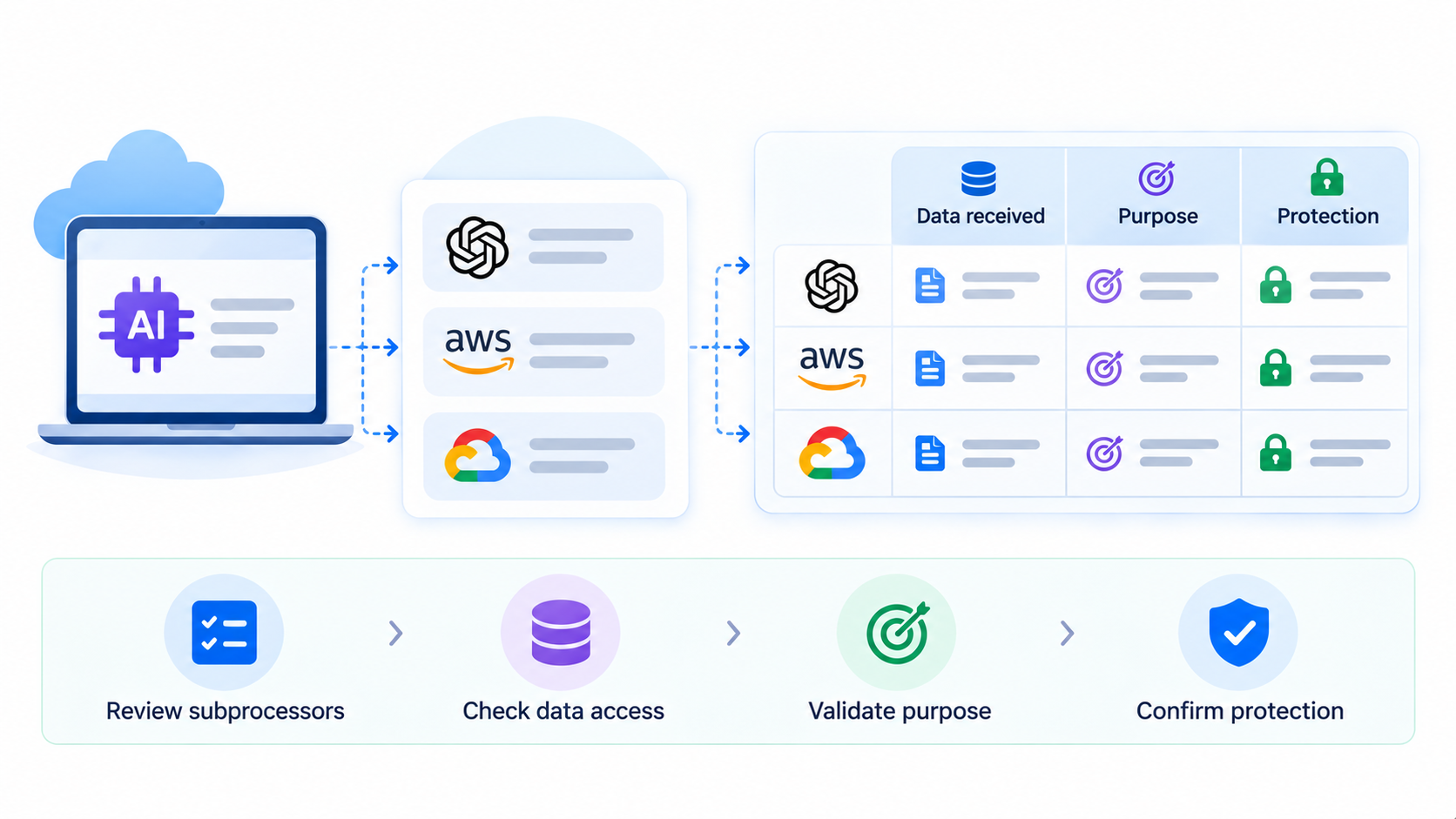
The risks can extend across the AI supply chain. IBM's 2026 Cost of a Data Breach Report found that compromised APIs, applications, or plugins accounted for 27% of reported AI-related breach causes, while cloud misconfigurations accounted for another 27%.
The NIST Generative Artificial Intelligence Profile also highlights the importance of assessing risks associated with third-party generative AI resources.
What to check in the contract:
- Provider identification: Are external model providers and other relevant subprocessors identified?
- Data access: Does the agreement explain what customer information each provider receives and why?
- Changes to providers: Must the vendor notify customers before introducing or changing material subprocessors?
What to clarify before signing or renewing:
- Require subprocessors to follow relevant data-use, confidentiality, security, and deletion obligations.
- Confirm that the SaaS vendor remains accountable for its subprocessors' handling of customer data.
- Address cross-border data transfers and the applicable contractual requirements.
3. Define Confidentiality and De-Identified Data
Older confidentiality clauses may not clearly cover AI prompts, outputs, logs, or other records created while using a service. Some agreements also allow vendors to retain or reuse "aggregated" or "de-identified" data without explaining what those terms mean.
Removing names or account numbers does not automatically establish how information can be reused or what protections still apply.
What to check in the contract:
- Confidential information: Do confidentiality obligations cover prompts, outputs, uploaded content, and logs?
- Access restrictions: Who can access customer information, including vendor employees and subprocessors?
- De-identified data: Does the agreement define aggregated and de-identified data and explain whether vendors can reuse it?
- Contract exceptions: Could broad exceptions for public, independently developed, or aggregated information exclude processed customer data?
What to clarify before signing or renewing:
- Explicitly include AI-generated prompts, outputs, uploaded content, and logs in confidentiality protections.
- Define the standard for de-identification and prohibit attempts to re-identify individuals or organizations.
- Specify whether derived data can be retained or reused and whether confidentiality protections continue after termination.
Clear definitions help prevent disagreements over whether customer information remains protected after it has been processed or combined with other data.
4. Review Liability Caps and Indemnities
Standard liability caps may not reflect the risks of unauthorized data use, security incidents, or third-party intellectual-property claims involving AI outputs. Broad exclusions may also limit the vendor's responsibility.
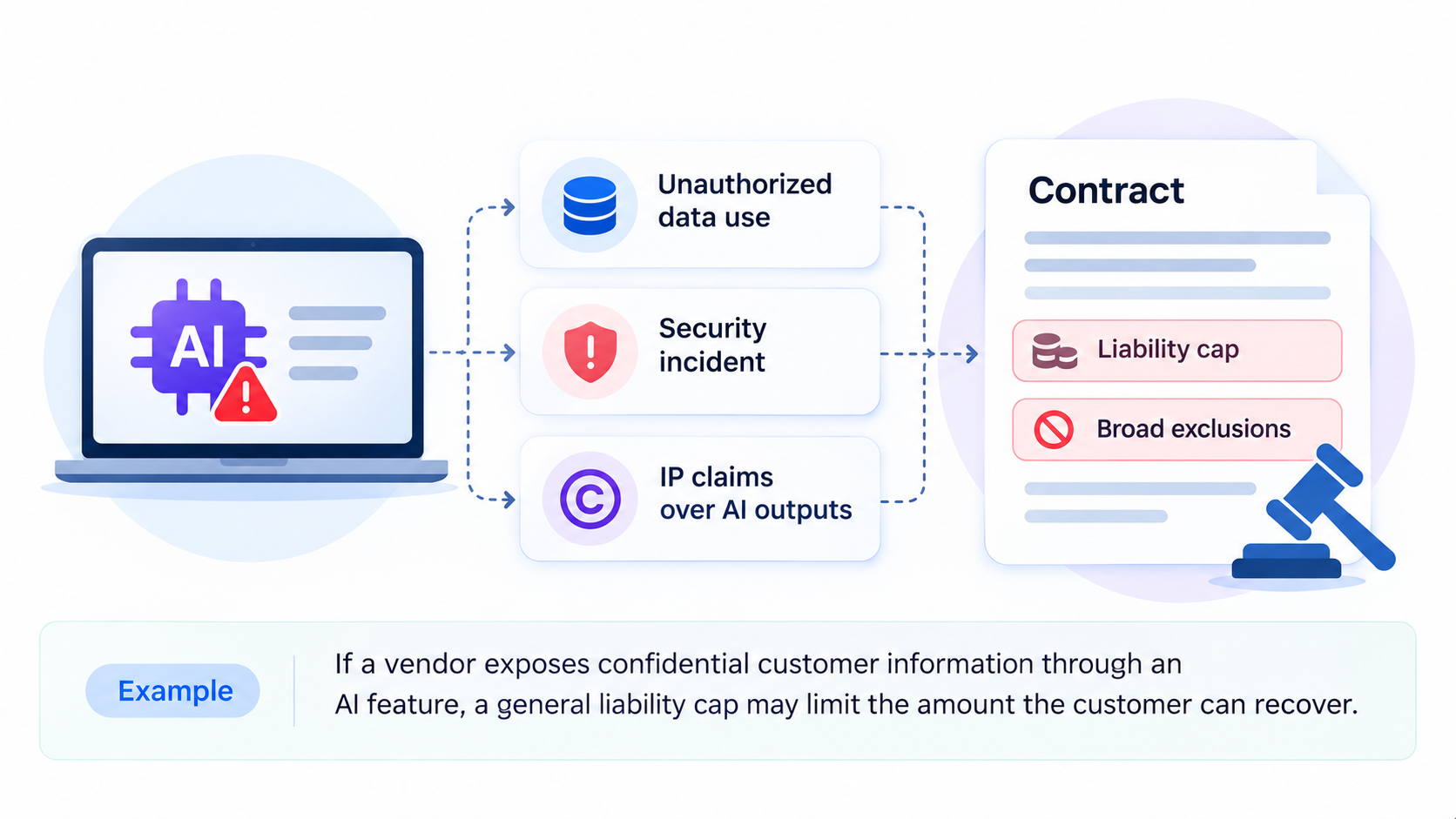
For example, if a vendor exposes confidential customer information through an AI feature, a general liability cap may limit the amount the customer can recover.
The financial impact can be significant. IBM's 2026 Cost of a Data Breach Report found that AI-enabled malicious breaches cost an average of $6 million, compared with the global average of $4.99 million.
What to check in the contract:
- Liability caps: Do limits cover confidentiality breaches, data-protection violations, and security incidents?
- Exclusions: Are AI-related losses excluded from the vendor's responsibility?
- Indemnity coverage: Does the agreement address third-party data misuse and intellectual-property claims involving AI outputs?
- Claims handling: Who controls the defense and pays related costs?
What to clarify before signing or renewing:
- Review which incidents fall under liability caps and which require separate treatment.
- Define responsibility for third-party claims involving AI-generated outputs.
- Check notice requirements, cooperation duties, and settlement restrictions.
There is no single liability structure that fits every SaaS agreement. Terms should reflect the service, data involved, and risks each party can control.
5. Set Clear Data Retention and Deletion Terms
A contract may require a vendor to delete customer data when the agreement ends without explaining what happens to copies held by subprocessors, logs, backups, or derived data. If customer data was used to train a model, deleting the original files may not undo that training.
The agreement should distinguish between information that can be deleted directly and data that may remain temporarily in backups or operational records.
What to check in the contract:
- Deletion deadlines: How soon must the vendor return or delete customer data after termination?
- Subprocessor copies: Do deletion requirements extend to external providers handling customer information?
- Backups and logs: Does the agreement explain how long these records may be retained and why?
- AI training data: Does the contract address what happens to models trained using customer information?
What to clarify before signing or renewing:
- Set clear deadlines for returning or deleting customer data and require written confirmation.
- Define permitted retention periods for backups, logs, and derived data, including the reasons for retaining them.
- If model training is permitted, specify whether the vendor must remove or isolate the contribution of customer data, or restrict such training from the outset.
Do not assume that deleting source files automatically removes data from a trained model. The contract should explain the vendor's deletion obligations and any limitations.
6. 5 Key Questions to Ask Before Renewing a SaaS Contract with AI Features
Before renewing an agreement or enabling new AI features, ask:
- Does the contract separate data needed to provide the service from optional AI training or improvement uses?
- Are AI providers and subprocessors identified, with clear limits on access and data use?
- Do confidentiality terms cover prompts, outputs, logs, and clearly defined de-identified data?
- Do liability caps and indemnities address the service's risks and explain how third-party claims are handled?
- Does the exit clause set deletion deadlines and explain how subprocessors, derived data, and any trained models will be handled?
If the vendor cannot answer these questions from the contract or its supporting terms, document the gaps and resolve them before approving the feature or renewal.
7. Review These Five Clauses Before You Renew
AI features can change how SaaS vendors collect, process, share, and retain customer data. Older contracts may not clearly address these activities or define who is responsible.
Before renewing, revisit the five clauses covered above: customer data use, AI subcontractors and subprocessors, confidentiality, liability and indemnities, and data retention and deletion. Review them with legal and procurement teams, involving security and privacy specialists where needed.
Keeping SaaS contracts, vendor details, and renewal dates organized also helps teams identify agreements that need attention. Platforms such as CloudEagle.ai provide a centralized view of vendor information and renewals, making it easier to coordinate contract reviews before renewal deadlines.
Clarify outdated or broad terms before moving forward so your organization can adopt AI features without leaving critical data-use and accountability gaps.
Your Next Renewal Shouldn't Be a Surprise.


8. FAQs
1. Can a SaaS vendor use customer data to train AI models?
It depends on the contract and the vendor's data-use terms. Check whether the agreement permits training, fine-tuning, evaluation, or other product-improvement uses. If those uses require approval, the contract should specify who can authorize them and how that approval is documented.
2. Does a "no AI training" clause cover every use of customer data?
Not necessarily. It may not address evaluation, logging, or access by subprocessors. Define the data covered and list permitted and prohibited uses rather than relying on a short phrase alone.
3. What should a SaaS contract say about AI subprocessors?
It should identify subprocessors that may access customer data, explain what information they receive and why, and require relevant data-use, confidentiality, security, and deletion protections. It should also address notice of material changes and the vendor's responsibility for its subprocessors.
4. Should companies review SaaS contracts when vendors add AI features?
Yes. Review the agreement before enabling new AI features or renewing the contract. Check whether its data-use, subcontractor, confidentiality, liability, and deletion terms reflect how the feature processes and shares information.
5. What should happen to customer data when a SaaS contract ends?
The contract should set a clear timeline for returning or deleting customer data and address copies held by subprocessors, logs, backups, and derived data. If data was used for model training, it should also explain what happens to that use or the resulting model.
One Platform. Every Vendor. Zero Guesswork.