You need to enable JavaScript in order to use the AI chatbot tool powered by ChatBot

What Questions Should You Include in a Procurement RFP for Technology Solutions?

Share via:
blog-cms-banner-bg
Little-Known Negotiation Hacks to Get the Best Deal on Slack
cta-bg-blogDownload Your Copy

HIPAA Compliance Checklist for 2025

Download PDF

According to Gartner, over 60% of technology contracts end up exceeding expectations due to unclear requirements or missing due-diligence questions. This makes one thing very clear: your RFP questions determine the quality of the vendor you select.

Choosing the right technology vendor is increasingly challenging, especially when 70% of companies now use more than 75 SaaS or IT applications. With so many options, procurement teams rely on well-structured RFPs to evaluate vendors consistently, minimize risk, and ensure solutions align with organizational goals.

Your RFP  is not just a questionnaire, it's the foundation for selecting technology that supports scalability, compliance, and long-term business growth. That’s why asking the right questions matters.

This blog covers the most important RFP questions, categorized for clarity, along with evaluation tips, mistakes to avoid, and a scoring-ready template.

Looking to enhance SaaS procurement?

Our guide simplifies purchasing and ensures maximum return on your software investments.

Download Checklist
CTA Thumbnail

TL;DR

  1. Include structured questions across vendor background, tech capabilities, integrations, security, and pricing.
  2. Security and compliance questions must be prioritized, they’re deal-breakers.
  3. Use weighted scoring to evaluate vendor responses objectively.
  4. Avoid generic questions; tailor them to business needs and industry verticals.
  5. A structured RFP reduces risk, prevents hidden costs, and improves vendor fit.

1. Why Asking the Right Questions in an RFP Matters

A Request for Proposal (RFP) is a standardized method for gathering detailed information from technology vendors. But a modern technology RFP is no longer just a formality, it is a strategic evaluation and risk-mitigation tool.

A well-written RFP helps eliminate guesswork and ensures that vendors respond with the depth and accuracy required to make confident buying decisions. When questions are vague, inconsistent, or too high-level, vendors give generalized answers that hide limitations, costs, and implementation risks.

Asking targeted, well-structured procurement RFP questions dramatically improves the quality of vendor evaluation. Effective questions allow your team to uncover hidden gaps, validate vendor claims, and assess alignment with business goals.

A. Reduces risk and uncertainty

Clear questions expose weaknesses in vendor capabilities, data handling processes, or technical limitations. This helps avoid tools that seem promising in demos but fail in real-world usage.

B. Improves vendor comparability

When every vendor answers the same structured questions, procurement teams can compare solutions side-by-side without ambiguity. This reduces bias and streamlines decision-making.

C. Prevents hidden costs and unexpected contract issues

A strong set of RFP questions uncovers:

  • Additional fees
  • Implementation charges
  • Add-ons
  • Renewal escalations
  • Lock-in clauses
  • Overages

By addressing these early, procurement avoids unwelcome surprises post-purchase.

D. Ensures long-term scalability

Technology needs evolve quickly. RFP questions around product roadmap, scalability, and future-readiness ensure the solution stays relevant.

E. Strengthens negotiation leverage

Clear expectations give procurement stronger negotiating power because every vendor is held to the same detailed requirements.

2. Key Categories of Questions to Include in a Technology RFP

Below is the complete categorization of questions procurement teams must include for comprehensive evaluation.

A. Vendor Background & Experience Questions

These questions aim to establish whether a vendor is credible, reliable, and capable of delivering on promises. They typically cover years in business and track record in your industry, references and case studies from similar organizations, financial stability and organizational size, and key leadership and technical team experience. 

The goal is to ensure the vendor can handle your requirements without risk of failure or abrupt service discontinuation.

B. Product & Technical Capability Questions

These questions focus on understanding what the solution can and cannot do. They may include core functionalities and differentiators, customization or configuration options, performance benchmarks or limitations, and compatibility with your current IT stack. 

This helps you avoid selecting a solution that looks good on paper but lacks essential capabilities for your operations.

C. Integration & Compatibility Questions

Integration questions prevent future operational silos and ensure smooth workflows. They typically explore APIs, connectors, and supported third-party integrations, compatibility with existing software, databases, and platforms, and ease of migrating legacy data. 

Answering these ensures that the new system will work seamlessly with your current environment, avoiding costly rework or disruptions.

D. Implementation & Onboarding Questions

These questions assess deployment complexity and internal resource requirements. They may cover typical implementation timelines and milestones, required internal resources and vendor support, training programs for end-users and admins, and change management processes. 

E. Security, Compliance & Data Protection Questions

Critical for organizations handling sensitive or regulated data. Key areas include data encryption standards (at rest and in transit), compliance with regulations (e.g., GDPR, HIPAA, ISO certifications), access control, audit logs, and incident response protocols, and cloud or on-premise hosting security. 

These questions protect your organization from breaches, fines, or reputational damage.

F. Scalability & Performance Questions

These determine whether the solution can grow with your business. Questions may include maximum user counts or transaction volumes supported, performance under peak loads, options for horizontal or vertical scaling, and roadmap for future capacity improvements. Ensures that your investment remains viable as your organization grows and avoids costly upgrades or replacements later.

G. Support, Training & Maintenance Questions

These evaluate what happens after purchase, including availability and responsiveness of support teams (24/7, SLA terms), training programs for admins and end-users, regular software updates, patches, and maintenance windows, and escalation procedures for critical issues. Helps guarantee continuous smooth operation and minimizes downtime or disruption.

H. Pricing, Licensing & Total Cost of Ownership Questions

Focuses on financial transparency and budget planning. Questions may cover breakdown of license fees, subscriptions, or usage-based charges, hidden costs like onboarding, integrations, or customizations, renewal terms and upgrade costs, and ROI considerations and long-term TCO. Prevents unpleasant surprises and ensures alignment with your financial planning.

I. Risk Management & Legal/Contractual Questions

These questions protect your organization legally and operationally. They may include liability clauses, warranties, and indemnifications, data ownership and IP rights, termination, exit strategies, and migration support, and compliance with industry regulations or standards. Mitigates exposure to legal disputes, non-compliance, or disputes over intellectual property.

J. Innovation, Roadmap & Future-readiness Questions

Assess whether the vendor is forward-looking and aligned with your digital transformation strategy. Questions may cover product roadmap and upcoming features, investment in R&D and emerging technologies, flexibility to adapt to new industry trends or regulations, and commitment to long-term partnership and co-innovation. Ensures that your chosen vendor can evolve with your business needs rather than becoming obsolete.

3. Detailed Breakdown of Questions for Each Category

Below is a full expansion of every category with detailed, high-context explanations.

A. Vendor background-specific questions

Understanding the vendor’s history, scale, customer base, and domain expertise sets the foundation for evaluating reliability.

Ask questions like:

  • How long have you been providing this technology solution?
  • What industries or domains do you specialize in?
  • Provide 2–3 customer references similar to our business size and industry.
  • What is your customer retention or churn rate?
  • Share your company’s financial health and latest funding rounds.

These questions help you avoid immature vendors or platforms with uncertain long-term stability.

B. Technical functionality-specific questions

This section uncovers the platform’s actual capabilities, not just its marketing claims.

Ask questions such as:

  • What core functionalities does your platform provide out-of-the-box?
  • Are there limitations or features that require additional add-ons?
  • Is your platform cloud-native, hybrid, or on-premise?
  • How do you handle data accuracy, quality checks, and system reliability?
  • What is your average historical uptime and reliability?

These details help you understand whether the product aligns with your technical and business requirements.

C. Integration and API-related questions

Integrations define how well the new system fits into your existing ecosystem.

Key questions include:

  • Does your solution integrate natively with our current tech stack?
  • What APIs are available - REST, GraphQL, SOAP?
  • Do integrations require additional development or professional services?
  • How long does a typical integration take?
  • Do you support SSO, SAML, SCIM, or OAuth?

Poor integration capabilities often lead to higher costs and delayed adoption.

D. Implementation timeline and resource questions

This helps you set realistic expectations around go-live timelines and internal resource allocation.

Ask vendors:

  • What is your typical implementation timeline?
  • What responsibilities fall on the vendor and which fall on the customer?
  • Will we have a dedicated implementation manager?
  • Do you provide detailed onboarding documentation?
  • Do you offer migration support for data and historical records?

Understanding this helps you predict adoption friction before signing a contract.

E. Security audits, certifications, and data handling questions

Security is one of the most important sections of a technology RFP.

Ask questions like:

  • Are you SOC 2 Type II, ISO 27001, GDPR, HIPAA, or FedRAMP certified?
  • What encryption methods do you use for data at rest and in transit?
  • What is your incident response process and frequency of audits?
  • How do you manage data residency requirements?
  • Do you conduct independent third-party penetration testing?

If a vendor cannot answer these confidently, it’s a major red flag.

F. Performance benchmarking questions

These questions determine how the system behaves under real-world loads.

Ask:

  • What are your platform’s response times under peak usage?
  • What are your current performance SLAs?
  • How does your architecture support horizontal and vertical scaling?
  • Do you provide uptime guarantees?
  • What are known limitations or dependencies?

This section is crucial for high-traffic or mission-critical systems.

G. Support SLAs and escalation path questions

Support quality determines how efficiently your team can resolve issues post-deployment.

Ask:

  • What support channels do you offer (email, chat, phone)?
  • What are SLA response and resolution times across tiers?
  • Do you provide a dedicated Customer Success Manager?
  • How do you escalate critical issues?
  • What training resources and documentation do you offer?

This ensures transparency around long-term customer experience.

H. Cost breakdown and contractual requirement questions

Pricing transparency is essential to avoid bill shock.

Ask:

  • What is your pricing model? (per user, usage-based, flat tier)
  • What additional fees exist - API calls, implementation, add-ons, overages?
  • How do renewal escalations work?
  • What are the contract lock-in or auto-renewal policies?
  • What discounts apply for multi-year terms?

This helps you calculate true total cost of ownership (TCO).

I. Risk, compliance, and accountability questions

These questions empower procurement to identify potential risks before signing.

Ask:

  • What liabilities do you assume in case of security incidents?
  • Do you hold cyber-risk insurance?
  • Who owns the data?
  • How do you maintain audit logs?
  • What happens if your company is acquired or ceases operations?

This protects your organization from operational and legal exposure.

J. Product roadmap and innovation evaluation questions

Understanding future plans ensures long-term alignment.

Ask:

  • What updates are planned for the next 12–24 months?
  • How do you incorporate customer feedback into your product roadmap?
  • What investments are you making in AI and automation?
  • How frequently do you release new features?
  • What is your long-term innovation vision?

A vendor with a weak roadmap might not support your evolving needs.

Ready to optimize procurement performance?

Our KPI calculator offers tools to measure impact, streamline processes, and elevate strategic outcomes.

Download Resource
CTA Thumbnail

5. How to Evaluate Vendor Responses Effectively

Evaluating vendor responses objectively prevents bias and ensures your decision is based on measurable criteria.

A. Scoring criteria for technical fit

Develop a scoring model that weighs critical product factors:

  • Core functionality
  • Integrations
  • Performance
  • Architecture flexibility
  • Configurability

Assign weights based on priority - for example, functionality (30%), integrations (20%), security (20%), etc.

B. Scoring criteria for pricing and TCO

Look beyond the sticker price. Evaluate:

  • Licensing cost per user/seat
  • Additional modules/add-ons
  • Support and implementation fees
  • Renewal escalations
  • Hidden or usage-based costs

This prevents long-term surprises.

C. Scoring criteria for security and compliance

Assess vendors on:

  • Certification maturity
  • Encryption standards
  • Audit frequency
  • Incident response strength
  • Data governance model

A vendor that scores low here introduces major organizational risk.

D. Scoring criteria for support and customer success

Score based on:

  • SLA response and resolution times
  • Availability of CSM
  • Training resources
  • Customer satisfaction history
  • Elasticity of support tiers

High support scores reduce downtime and adoption friction.

6. Common Mistakes Procurement Teams Make When Writing RFP Questions

A. Asking generic questions instead of business-aligned ones

Generic RFPs lead to generic responses. Vendors often respond with sales language, not practical details. Tailoring questions to your use cases yields more accurate insights.

B. Not considering future scalability or integration needs

Teams often focus on what they need today, not what they’ll need in two years. This leads to costly migrations down the line.

C. Underestimating the importance of security questions

Many RFPs treat security as a checkbox instead of a foundational requirement. But one breach or compliance failure can cost millions.

D. Over-focusing on cost instead of total value

The cheapest solution is often the most expensive long-term due to:

  • Poor adoption
  • Weak integrations
  • Limited scalability
  • Higher support costs
  • Frequent outages

Value > price.

7. Sample RFP Questionnaire Template

Section Details / Examples
A. Vendor Information Company profile, references, customer base, financial stability
B. Technical Requirements Architecture, features, configuration options, dependencies
C. Security & Compliance Certifications, encryption standards, audits, data lifecycle management
D. Pricing & Licensing Tiered pricing, add-ons, service commitments, renewal terms
E. Evaluation & Scoring Weighted scoring criteria for objective comparison of proposals

8. Conclusion

A structured RFP eliminates ambiguity, accelerates vendor comparison, ensures risk-free procurement, and leads to stronger long-term vendor partnerships. By asking the right questions upfront, procurement teams gain clarity, reduce cost, enhance compliance, and choose solutions that scale with the business.

Start building structured RFPs today to streamline vendor selection and secure the best solutions for your business.

Frequently asked questions

1. What are the most important questions to ask in a technology RFP?

Focus on technical capabilities, integrations, security certifications, pricing structure, implementation timelines, and support SLAs.

2. How do you evaluate vendor responses in an RFP?

Use a weighted scoring matrix to compare functionality, pricing, security, support, and scalability based on objective criteria.

3. Why are security and compliance questions critical in tech RFPs?

They help assess data protection, privacy controls, and regulatory compliance—crucial for reducing breach and compliance risks.

4. What should a technology RFP include?

Vendor background, technical requirements, integration needs, security standards, pricing details, support expectations, and scoring guidance.

5. How many vendors should respond to an RFP?

Most procurement teams shortlist 3–5 vendors to ensure balance between competition, evaluation depth, and decision efficiency.

Advertisement for a SaaS Subscription Tracking Template with a call-to-action button to download and a partial graphic of a tablet showing charts.Banner promoting a SaaS Agreement Checklist to streamline SaaS management and avoid budget waste with a call-to-action button labeled Download checklist.Blue banner with text 'The Ultimate Employee Offboarding Checklist!' and a black button labeled 'Download checklist' alongside partial views of checklist documents from cloudeagle.ai.Digital ad for download checklist titled 'The Ultimate Checklist for IT Leaders to Optimize SaaS Operations' by cloudeagle.ai, showing checklist pages.Slack Buyer's Guide offer with text 'Unlock insider insights to get the best deal on Slack!' and a button labeled 'Get Your Copy', accompanied by a preview of the guide featuring Slack's logo.Monday Pricing Guide by cloudeagle.ai offering exclusive pricing secrets to maximize investment with a call-to-action button labeled Get Your Copy and an image of the guide's cover.Blue banner for Canva Pricing Guide by cloudeagle.ai offering a guide to Canva costs, features, and alternatives with a call-to-action button saying Get Your Copy.Blue banner with white text reading 'Little-Known Negotiation Hacks to Get the Best Deal on Slack' and a white button labeled 'Get Your Copy'.Blue banner with text 'Little-Known Negotiation Hacks to Get the Best Deal on Monday.com' and a white button labeled 'Get Your Copy'.Blue banner with text 'Little-Known Negotiation Hacks to Get the Best Deal on Canva' and a white button labeled 'Get Your Copy'.Banner with text 'Slack Buyer's Guide' and a 'Download Now' button next to images of a guide titled 'Slack Buyer’s Guide: Features, Pricing & Best Practices'.Digital cover of Monday Pricing Guide with a button labeled Get Your Copy on a blue background.Canva Pricing Guide cover with a button labeled Get Your Copy on a blue gradient background.

Enter your email to
unlock the report

Oops! Something went wrong while submitting the form.
License Count
Benchmark
Per User/Per Year

Enter your email to
unlock the report

Oops! Something went wrong while submitting the form.
License Count
Benchmark
Per User/Per Year

Enter your email to
unlock the report

Oops! Something went wrong while submitting the form.
Notion Plus
License Count
Benchmark
Per User/Per Year
100-500
$67.20 - $78.72
500-1000
$59.52 - $72.00
1000+
$51.84 - $57.60
Canva Pro
License Count
Benchmark
Per User/Per Year
100-500
$74.33-$88.71
500-1000
$64.74-$80.32
1000+
$55.14-$62.34

Enter your email to
unlock the report

Oops! Something went wrong while submitting the form.

Enter your email to
unlock the report

Oops! Something went wrong while submitting the form.
Zoom Business
License Count
Benchmark
Per User/Per Year
100-500
$216.00 - $264.00
500-1000
$180.00 - $216.00
1000+
$156.00 - $180.00

Enter your email to
unlock the report

Oops! Something went wrong while submitting the form.

Get the Right Security Platform To Secure Your Cloud Infrastructure

Please enter a business email
Thank you!
The 2023 SaaS report has been sent to your email. Check your promotional or spam folder.
Oops! Something went wrong while submitting the form.

Access full report

Please enter a business email
Thank you!
The 2023 SaaS report has been sent to your email. Check your promotional or spam folder.
Oops! Something went wrong while submitting the form.

According to Gartner, over 60% of technology contracts end up exceeding expectations due to unclear requirements or missing due-diligence questions. This makes one thing very clear: your RFP questions determine the quality of the vendor you select.

Choosing the right technology vendor is increasingly challenging, especially when 70% of companies now use more than 75 SaaS or IT applications. With so many options, procurement teams rely on well-structured RFPs to evaluate vendors consistently, minimize risk, and ensure solutions align with organizational goals.

Your RFP  is not just a questionnaire, it's the foundation for selecting technology that supports scalability, compliance, and long-term business growth. That’s why asking the right questions matters.

This blog covers the most important RFP questions, categorized for clarity, along with evaluation tips, mistakes to avoid, and a scoring-ready template.

Looking to enhance SaaS procurement?

Our guide simplifies purchasing and ensures maximum return on your software investments.

Download Checklist
CTA Thumbnail

TL;DR

  1. Include structured questions across vendor background, tech capabilities, integrations, security, and pricing.
  2. Security and compliance questions must be prioritized, they’re deal-breakers.
  3. Use weighted scoring to evaluate vendor responses objectively.
  4. Avoid generic questions; tailor them to business needs and industry verticals.
  5. A structured RFP reduces risk, prevents hidden costs, and improves vendor fit.

1. Why Asking the Right Questions in an RFP Matters

A Request for Proposal (RFP) is a standardized method for gathering detailed information from technology vendors. But a modern technology RFP is no longer just a formality, it is a strategic evaluation and risk-mitigation tool.

A well-written RFP helps eliminate guesswork and ensures that vendors respond with the depth and accuracy required to make confident buying decisions. When questions are vague, inconsistent, or too high-level, vendors give generalized answers that hide limitations, costs, and implementation risks.

Asking targeted, well-structured procurement RFP questions dramatically improves the quality of vendor evaluation. Effective questions allow your team to uncover hidden gaps, validate vendor claims, and assess alignment with business goals.

A. Reduces risk and uncertainty

Clear questions expose weaknesses in vendor capabilities, data handling processes, or technical limitations. This helps avoid tools that seem promising in demos but fail in real-world usage.

B. Improves vendor comparability

When every vendor answers the same structured questions, procurement teams can compare solutions side-by-side without ambiguity. This reduces bias and streamlines decision-making.

C. Prevents hidden costs and unexpected contract issues

A strong set of RFP questions uncovers:

  • Additional fees
  • Implementation charges
  • Add-ons
  • Renewal escalations
  • Lock-in clauses
  • Overages

By addressing these early, procurement avoids unwelcome surprises post-purchase.

D. Ensures long-term scalability

Technology needs evolve quickly. RFP questions around product roadmap, scalability, and future-readiness ensure the solution stays relevant.

E. Strengthens negotiation leverage

Clear expectations give procurement stronger negotiating power because every vendor is held to the same detailed requirements.

2. Key Categories of Questions to Include in a Technology RFP

Below is the complete categorization of questions procurement teams must include for comprehensive evaluation.

A. Vendor Background & Experience Questions

These questions aim to establish whether a vendor is credible, reliable, and capable of delivering on promises. They typically cover years in business and track record in your industry, references and case studies from similar organizations, financial stability and organizational size, and key leadership and technical team experience. 

The goal is to ensure the vendor can handle your requirements without risk of failure or abrupt service discontinuation.

B. Product & Technical Capability Questions

These questions focus on understanding what the solution can and cannot do. They may include core functionalities and differentiators, customization or configuration options, performance benchmarks or limitations, and compatibility with your current IT stack. 

This helps you avoid selecting a solution that looks good on paper but lacks essential capabilities for your operations.

C. Integration & Compatibility Questions

Integration questions prevent future operational silos and ensure smooth workflows. They typically explore APIs, connectors, and supported third-party integrations, compatibility with existing software, databases, and platforms, and ease of migrating legacy data. 

Answering these ensures that the new system will work seamlessly with your current environment, avoiding costly rework or disruptions.

D. Implementation & Onboarding Questions

These questions assess deployment complexity and internal resource requirements. They may cover typical implementation timelines and milestones, required internal resources and vendor support, training programs for end-users and admins, and change management processes. 

E. Security, Compliance & Data Protection Questions

Critical for organizations handling sensitive or regulated data. Key areas include data encryption standards (at rest and in transit), compliance with regulations (e.g., GDPR, HIPAA, ISO certifications), access control, audit logs, and incident response protocols, and cloud or on-premise hosting security. 

These questions protect your organization from breaches, fines, or reputational damage.

F. Scalability & Performance Questions

These determine whether the solution can grow with your business. Questions may include maximum user counts or transaction volumes supported, performance under peak loads, options for horizontal or vertical scaling, and roadmap for future capacity improvements. Ensures that your investment remains viable as your organization grows and avoids costly upgrades or replacements later.

G. Support, Training & Maintenance Questions

These evaluate what happens after purchase, including availability and responsiveness of support teams (24/7, SLA terms), training programs for admins and end-users, regular software updates, patches, and maintenance windows, and escalation procedures for critical issues. Helps guarantee continuous smooth operation and minimizes downtime or disruption.

H. Pricing, Licensing & Total Cost of Ownership Questions

Focuses on financial transparency and budget planning. Questions may cover breakdown of license fees, subscriptions, or usage-based charges, hidden costs like onboarding, integrations, or customizations, renewal terms and upgrade costs, and ROI considerations and long-term TCO. Prevents unpleasant surprises and ensures alignment with your financial planning.

I. Risk Management & Legal/Contractual Questions

These questions protect your organization legally and operationally. They may include liability clauses, warranties, and indemnifications, data ownership and IP rights, termination, exit strategies, and migration support, and compliance with industry regulations or standards. Mitigates exposure to legal disputes, non-compliance, or disputes over intellectual property.

J. Innovation, Roadmap & Future-readiness Questions

Assess whether the vendor is forward-looking and aligned with your digital transformation strategy. Questions may cover product roadmap and upcoming features, investment in R&D and emerging technologies, flexibility to adapt to new industry trends or regulations, and commitment to long-term partnership and co-innovation. Ensures that your chosen vendor can evolve with your business needs rather than becoming obsolete.

3. Detailed Breakdown of Questions for Each Category

Below is a full expansion of every category with detailed, high-context explanations.

A. Vendor background-specific questions

Understanding the vendor’s history, scale, customer base, and domain expertise sets the foundation for evaluating reliability.

Ask questions like:

  • How long have you been providing this technology solution?
  • What industries or domains do you specialize in?
  • Provide 2–3 customer references similar to our business size and industry.
  • What is your customer retention or churn rate?
  • Share your company’s financial health and latest funding rounds.

These questions help you avoid immature vendors or platforms with uncertain long-term stability.

B. Technical functionality-specific questions

This section uncovers the platform’s actual capabilities, not just its marketing claims.

Ask questions such as:

  • What core functionalities does your platform provide out-of-the-box?
  • Are there limitations or features that require additional add-ons?
  • Is your platform cloud-native, hybrid, or on-premise?
  • How do you handle data accuracy, quality checks, and system reliability?
  • What is your average historical uptime and reliability?

These details help you understand whether the product aligns with your technical and business requirements.

C. Integration and API-related questions

Integrations define how well the new system fits into your existing ecosystem.

Key questions include:

  • Does your solution integrate natively with our current tech stack?
  • What APIs are available - REST, GraphQL, SOAP?
  • Do integrations require additional development or professional services?
  • How long does a typical integration take?
  • Do you support SSO, SAML, SCIM, or OAuth?

Poor integration capabilities often lead to higher costs and delayed adoption.

D. Implementation timeline and resource questions

This helps you set realistic expectations around go-live timelines and internal resource allocation.

Ask vendors:

  • What is your typical implementation timeline?
  • What responsibilities fall on the vendor and which fall on the customer?
  • Will we have a dedicated implementation manager?
  • Do you provide detailed onboarding documentation?
  • Do you offer migration support for data and historical records?

Understanding this helps you predict adoption friction before signing a contract.

E. Security audits, certifications, and data handling questions

Security is one of the most important sections of a technology RFP.

Ask questions like:

  • Are you SOC 2 Type II, ISO 27001, GDPR, HIPAA, or FedRAMP certified?
  • What encryption methods do you use for data at rest and in transit?
  • What is your incident response process and frequency of audits?
  • How do you manage data residency requirements?
  • Do you conduct independent third-party penetration testing?

If a vendor cannot answer these confidently, it’s a major red flag.

F. Performance benchmarking questions

These questions determine how the system behaves under real-world loads.

Ask:

  • What are your platform’s response times under peak usage?
  • What are your current performance SLAs?
  • How does your architecture support horizontal and vertical scaling?
  • Do you provide uptime guarantees?
  • What are known limitations or dependencies?

This section is crucial for high-traffic or mission-critical systems.

G. Support SLAs and escalation path questions

Support quality determines how efficiently your team can resolve issues post-deployment.

Ask:

  • What support channels do you offer (email, chat, phone)?
  • What are SLA response and resolution times across tiers?
  • Do you provide a dedicated Customer Success Manager?
  • How do you escalate critical issues?
  • What training resources and documentation do you offer?

This ensures transparency around long-term customer experience.

H. Cost breakdown and contractual requirement questions

Pricing transparency is essential to avoid bill shock.

Ask:

  • What is your pricing model? (per user, usage-based, flat tier)
  • What additional fees exist - API calls, implementation, add-ons, overages?
  • How do renewal escalations work?
  • What are the contract lock-in or auto-renewal policies?
  • What discounts apply for multi-year terms?

This helps you calculate true total cost of ownership (TCO).

I. Risk, compliance, and accountability questions

These questions empower procurement to identify potential risks before signing.

Ask:

  • What liabilities do you assume in case of security incidents?
  • Do you hold cyber-risk insurance?
  • Who owns the data?
  • How do you maintain audit logs?
  • What happens if your company is acquired or ceases operations?

This protects your organization from operational and legal exposure.

J. Product roadmap and innovation evaluation questions

Understanding future plans ensures long-term alignment.

Ask:

  • What updates are planned for the next 12–24 months?
  • How do you incorporate customer feedback into your product roadmap?
  • What investments are you making in AI and automation?
  • How frequently do you release new features?
  • What is your long-term innovation vision?

A vendor with a weak roadmap might not support your evolving needs.

Ready to optimize procurement performance?

Our KPI calculator offers tools to measure impact, streamline processes, and elevate strategic outcomes.

Download Resource
CTA Thumbnail

5. How to Evaluate Vendor Responses Effectively

Evaluating vendor responses objectively prevents bias and ensures your decision is based on measurable criteria.

A. Scoring criteria for technical fit

Develop a scoring model that weighs critical product factors:

  • Core functionality
  • Integrations
  • Performance
  • Architecture flexibility
  • Configurability

Assign weights based on priority - for example, functionality (30%), integrations (20%), security (20%), etc.

B. Scoring criteria for pricing and TCO

Look beyond the sticker price. Evaluate:

  • Licensing cost per user/seat
  • Additional modules/add-ons
  • Support and implementation fees
  • Renewal escalations
  • Hidden or usage-based costs

This prevents long-term surprises.

C. Scoring criteria for security and compliance

Assess vendors on:

  • Certification maturity
  • Encryption standards
  • Audit frequency
  • Incident response strength
  • Data governance model

A vendor that scores low here introduces major organizational risk.

D. Scoring criteria for support and customer success

Score based on:

  • SLA response and resolution times
  • Availability of CSM
  • Training resources
  • Customer satisfaction history
  • Elasticity of support tiers

High support scores reduce downtime and adoption friction.

6. Common Mistakes Procurement Teams Make When Writing RFP Questions

A. Asking generic questions instead of business-aligned ones

Generic RFPs lead to generic responses. Vendors often respond with sales language, not practical details. Tailoring questions to your use cases yields more accurate insights.

B. Not considering future scalability or integration needs

Teams often focus on what they need today, not what they’ll need in two years. This leads to costly migrations down the line.

C. Underestimating the importance of security questions

Many RFPs treat security as a checkbox instead of a foundational requirement. But one breach or compliance failure can cost millions.

D. Over-focusing on cost instead of total value

The cheapest solution is often the most expensive long-term due to:

  • Poor adoption
  • Weak integrations
  • Limited scalability
  • Higher support costs
  • Frequent outages

Value > price.

7. Sample RFP Questionnaire Template

Section Details / Examples
A. Vendor Information Company profile, references, customer base, financial stability
B. Technical Requirements Architecture, features, configuration options, dependencies
C. Security & Compliance Certifications, encryption standards, audits, data lifecycle management
D. Pricing & Licensing Tiered pricing, add-ons, service commitments, renewal terms
E. Evaluation & Scoring Weighted scoring criteria for objective comparison of proposals

8. Conclusion

A structured RFP eliminates ambiguity, accelerates vendor comparison, ensures risk-free procurement, and leads to stronger long-term vendor partnerships. By asking the right questions upfront, procurement teams gain clarity, reduce cost, enhance compliance, and choose solutions that scale with the business.

Start building structured RFPs today to streamline vendor selection and secure the best solutions for your business.

Frequently asked questions

1. What are the most important questions to ask in a technology RFP?

Focus on technical capabilities, integrations, security certifications, pricing structure, implementation timelines, and support SLAs.

2. How do you evaluate vendor responses in an RFP?

Use a weighted scoring matrix to compare functionality, pricing, security, support, and scalability based on objective criteria.

3. Why are security and compliance questions critical in tech RFPs?

They help assess data protection, privacy controls, and regulatory compliance—crucial for reducing breach and compliance risks.

4. What should a technology RFP include?

Vendor background, technical requirements, integration needs, security standards, pricing details, support expectations, and scoring guidance.

5. How many vendors should respond to an RFP?

Most procurement teams shortlist 3–5 vendors to ensure balance between competition, evaluation depth, and decision efficiency.

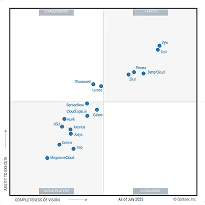
CloudEagle.ai recognized in the 2025 Gartner® Magic Quadrant™ for SaaS Management Platforms
Download now
gartner chart
5x
Faster employee
onboarding
80%
Reduction in time for
user access reviews
30k
Workflows
automated
$15Bn
Analyzed in
contract spend
$2Bn
Saved in
SaaS spend

Recognized as an Industry leader for our AI

CloudEagle.ai is Recognized in the 2024 Gartner® Magic Quadrant™ for SaaS Management Platforms

Recognition highlights CloudEagle’s innovation and leadership in the rapidly evolving SaaS management and procurement space.
Read More
Gartner Magic Quadrant for SaaS Management Platforms showing a chart divided into Challengers and Leaders quadrants with various companies plotted as dots.

CloudEagle.ai Recognized in the GigaOm Radar for SaaS Management Platforms

CloudEagle named a Leader and Outperformer in GigaOm Radar Report, validating its impact in the SaaS management platform landscape.
Read More
gigaom

Everest Group Positions CloudEagle.ai as a Trailblazer in SaaS Management Platforms

CloudEagle recognized as a Trailblazer by Everest Group, showcasing its rapid growth and innovation in SaaS spend and operations management.
Read More
qks

CloudEagle.ai is Recognized in the 2024 Gartner® Magic Quadrant™ for SaaS Management Platforms

Recognition highlights CloudEagle’s innovation and leadership in the rapidly evolving SaaS management and procurement space.
Read More
gartner

Streamline SaaS governance and save 10-30%

Book a Demo with Expert
CTA image
One platform to Manage
all SaaS Products
Learn More