%201.svg)


HIPAA Compliance Checklist for 2025

When we built SaaSMap, we set out to solve one problem: give companies a single, trustworthy picture of the software they actually run. Not a list scraped from SSO. A living map of every app, who touches it, what it costs, and what it puts at risk.
We did that. And then the problem changed.
AI arrived inside the company faster than any software wave before it. Not through procurement, not through SSO, but through browser tabs, IDE plugins, and personal cards. The map we built for SaaS was already the right shape to catch it, because from the start it was never really a map of SaaS. It was a map of your environment.
So today we are renaming it. SaaSMap is now EagleIQ.
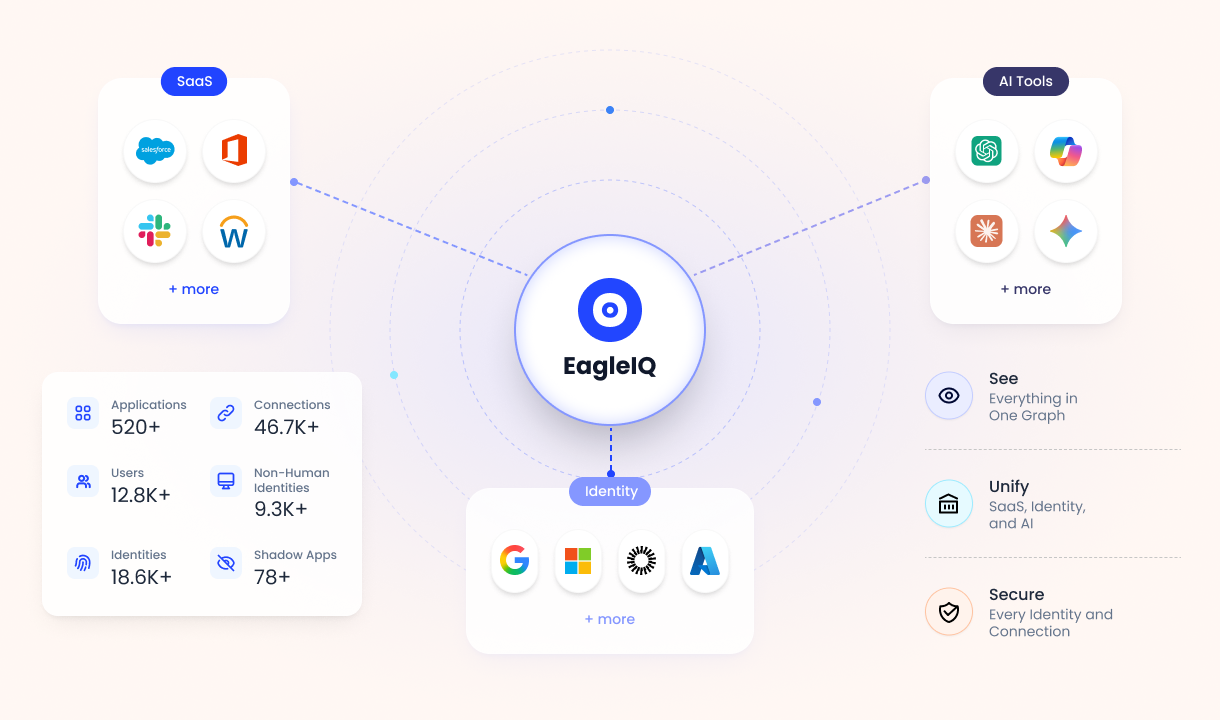
The name catches up to what this layer became. It is the context graph and AI engine beneath everything CloudEagle.ai does, holding your SaaS, your identities, and your AI in one place, and making the connections between them.
To be clear about what this is: a rename, nothing more.
- Your instance is untouched. The connectors and dashboards you configured work exactly as they did yesterday.
- Pricing is unchanged, and there is no new module to buy.
- The new name rolls out across the product and our site over the coming weeks.
Want the thinking behind the rename? SaaSMap Steps Up as EagleIQ for the New AI Era walks through what the context graph is, and why it changed.
What EagleIQ is, and why it's built this way
From inventory to intelligence
Most tools in this market see one thing well. SaaS posture, or network traffic, or identity, or assets. Each hands you an answer and leaves you to connect it to the others.
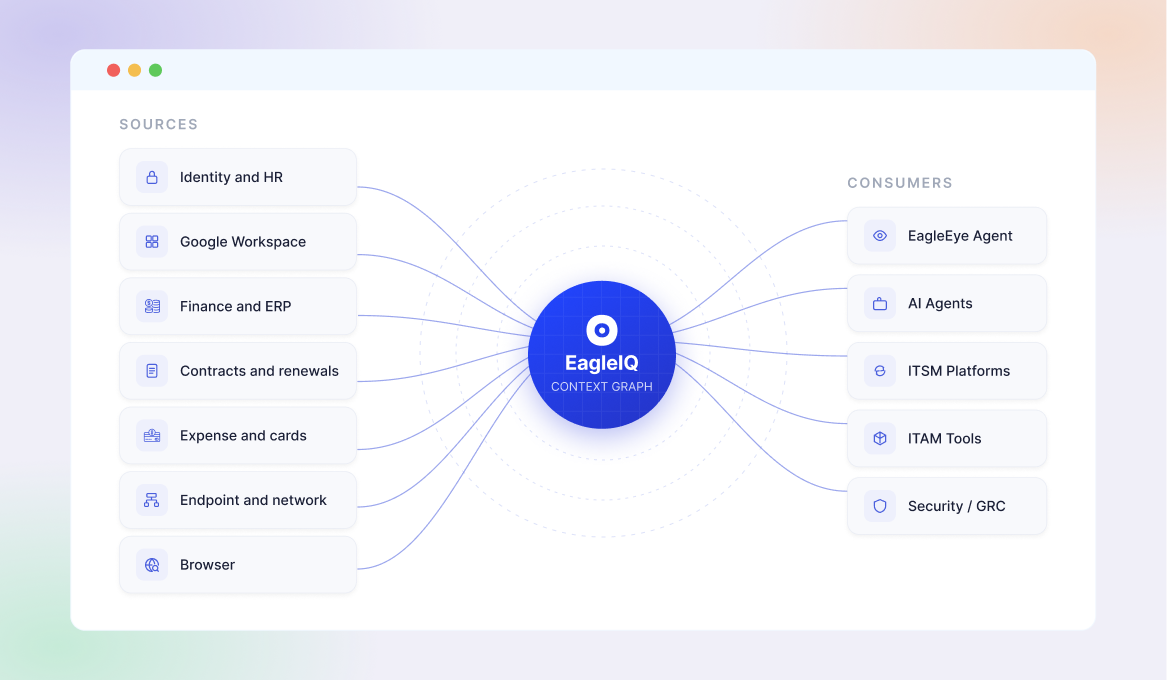
EagleIQ is built the other way around. We read seven sources into one graph, then enrich it with what we know about the outside world.
- Identity and HR: every app tied to a login and every joiner or leaver, from Okta, Entra, and your HRIS.
- Google Workspace: the apps and AI employees signed into with Google, read from the OAuth grants behind "Sign in with Google."
- Finance and ERP: the apps that were paid for before IT ever saw them, from NetSuite, Concur, and your finance systems.
- Contracts and renewals: the terms, renewal dates, and line items pulled straight from your uploaded contracts.
- Expense and cards: the corporate-card and expense-report purchases where unsanctioned tools and one-off AI subscriptions hide.
- Endpoint and network: the apps that never touch SSO, caught from firewall and MDM signals like Netskope and Zscaler.
- Browser: the tools people actually open, including AI reached through a personal login, from a lightweight extension.
Because all seven land in one place, an app never arrives as just a name. It comes with who owns it, what it costs, and what it can reach. That is the difference between an inventory and intelligence. A list tells you an app exists. The graph tells you it matters.
How it finds the AI others miss
EagleIQ finds apps by correlation, not from one feed. It compares those seven sources against our own application catalog and resolves them into one clean view of what is genuinely in use.
The apps that skip your login still surface: the consumer-tier AI opened in a browser tab, the tool bought on a card outside procurement, the one that only ever shows up in a firewall log or an OAuth grant.
Shadow AI is where this earns its name. Compare browser, Zscaler, and CrowdStrike signals against the catalog, and the AI tools your employees quietly signed into surface, including the ones nobody approved.
It is not unusual to find dozens on the first pass. We have watched security teams see their real AI footprint for the first time, then build a defensible governance program on top of it.
Finding the app is the easy part. Connecting it to its owner, its access, its cost, and its risk is the part that changes what you can do about it. And because environments move every week, the graph never stops running.
Why one graph beats a stack of point tools
Three things are driving audits right now: SaaS sprawl, identity risk, and ungoverned AI.
Most companies track them in three systems that do not talk to each other. We put them in one, so a fact in one domain arrives with the others attached, and every AI vendor carries a risk score for data exposure and training use, right next to its spend.
That is also what sets us apart. Most tools lean on SSO, so they see only what logs in through SSO.
We correlate identity, the browser, the endpoint, and finance and more, which is how the consumer-tier AI turns up at all. And because everything sits in one graph rather than four consoles, the service accounts and tokens other tools treat as out of scope get governed here like any other login.
A stack of point tools can each answer its own question. EagleIQ answers the one that runs across all of them, which is almost always the question security actually has. That is why the old name no longer fit. This was never just a map of your SaaS.
See EagleIQ run against your own environment. It surfaces the apps, identities, and AI you're actually running, each one arriving with its owner, cost, and risk already attached.
What's next
AI is not slowing down, and neither is the sprawl of identities and access that comes with it. The companies that stay in control will be the ones that can see all of it in one place and act on it from there.
That is what we are building. EagleIQ is the engine underneath it, and today it finally has the right name.


.avif)


.avif)
.avif)




.png)




.avif)
.avif)
.avif)
.avif)


