AI Governance

ISO 42001 Certification: Cost, Timeline, and How to Choose a Certification Body

Share via:
Written by:
CloudEagle.ai Team
Reviewed by
Nidhi Jain
Last Updated:
November 10, 2026
blog-cms-banner-bg
Little-Known Negotiation Hacks to Get the Best Deal on Slack
cta-bg-blogDownload Your Copy

HIPAA Compliance Checklist for 2025

Download PDF

‍

ISO 42001 certification rarely starts as an internal initiative. It shows up in a vendor security review from an enterprise prospect, or on a European customer's renewal checklist, and by the time it reaches IT, there's already a date attached. Usually nobody has priced the audit yet or checked which firms are accredited to run it.

Schellman, the first ANAB-accredited ISO 42001 body, puts year-one audit fees in the $20,000s to $40,000s, and that figure leaves out the months of readiness work that come before an auditor shows up.

The sections below break down that full bill and a realistic calendar, then how to vet a certification body so the certificate holds up with the customer who asked for it.

Looking for a Lead Auditor course instead? The section on ISO 42001 certification for individuals has prices and exam details.

‍

What ISO 42001 Certification Actually Costs Over Three Years

Expect certification body fees of roughly $46,000 to $80,000+ across the full three-year cycle, using the ranges Schellman publishes in its ISO 42001 FAQ. Readiness work sits on top, and it is usually the larger number.

Certification body fees

Audit event When Typical fee
Stage 1 + Stage 2 Year 1 $20,000s to $40,000s
Surveillance audit Years 2 and 3 $13,000 to $20,000+ each
Recertification End of year 3 Closer to the initial audit

‍

Fees are quoted by the auditor-day. Under IAF MD 5 audit-time rules used for other management systems, a surveillance audit takes about one-third of the initial audit time and recertification about two-thirds.

When you request quotes, ask for these as separate lines:

  • Initial audit: Stage 1 and Stage 2 with audit days stated for each
  • Surveillance: Years 2 and 3, priced now
  • Recertification: The year-3 audit that restarts the cycle

The costs that come before the auditor arrives

The audit tests a management system you have already built and run. Building it is where the ISO 42001 certification cost usually climbs.

  • AI system inventory: Every AI tool, model, and agent in scope, with an owner for each
  • Risk and impact assessments: Documented for each AI system in scope
  • Annex A controls: The standard offers 38 risk controls to select from and justify
  • Internal audit: Required before Stage 1 and run by someone independent of AIMS operations
  • Staff time: Hours from policy owners and system owners, plus the management review
If you need to defend this line item to your CFO, this guide to AI governance budget planning shows how to frame the ask.

What moves your quote up or down

Same-size organizations can get very different quotes because of these levers:

  • Audit days: ISO/IEC 42006 sets the rules certification bodies follow for AIMS audits, so days track scope rather than sales targets
  • AI systems in scope: More systems means more sampling and more interviews
  • Your role: Building AI products usually draws a deeper audit than using third-party AI tools
  • Sites and business units: Each one adds audit time
  • Existing ISO 27001: Shared policies, risk methods, and internal audit programs cut duplicate work. Your ISO 27001 Statement of Applicability is a good model for the AIMS version

Build the AI Inventory Auditors Check

Free checklist to find every AI tool before Stage 1.
Download Checklist

‍

How Long ISO 42001 Certification Takes, Phase by Phase

Most organizations take six to twelve months from the first gap assessment to a certificate when they start without a mature management system.

Phase Typical duration
Scope and gap analysis 2 to 6 weeks
Build the AIMS (inventory, assessments, controls) 2 to 4 months
Run the controls to generate evidence 2 to 3 months
Internal audit and management review 3 to 5 weeks
Stage 1 audit 1 to 2 days
Close Stage 1 findings 4 to 12 weeks
Stage 2 audit and certification decision 1 to 3 weeks

‍

Phase durations draw on Hicomply and Schellman.

Where timelines usually slip:

  • The Stage 1 window: Schellman notes the gap to Stage 2 is typically 4 to 12 weeks and must stay under six months, or Stage 1 has to be redone
  • Evidence age: Auditors want to see controls operating over time, so a policy written last week won't carry Stage 2
  • Auditor availability: Accredited ISO 42001 auditors book up, so lock your Stage 2 date early

For the work inside each phase, this ISO 42001 implementation checklist breaks it down control by control.

‍

How to Choose an ISO 42001 Certification Body

Pick a body with ISO 42001 on a verifiable accreditation scope that hasn't consulted for you on the same system.

The five-point vetting test

  • Verifiable accreditation: Confirm ISO 42001 is on the body's accreditation scope through IAF CertSearch or the accreditor's own register. A logo on a website is a claim, and the register is the proof
  • ISO/IEC 42006 competence: Published in July 2025, it adds AI-specific requirements on top of ISO/IEC 17021-1, so ask how the body applies it to auditor competence and audit time
  • Impartiality: An accredited body can't certify a system it also consulted on, so keep your readiness advisor and your auditor separate
  • AI audit experience: Ask how many ISO 42001 audits the assigned lead auditor has run, and in which industries
  • Transparent quoting: Insist on audit days per stage and a priced three-year schedule

Accredited bodies worth shortlisting

Body ISO 42001 accreditation Worth knowing
Schellman ANAB First ANAB-accredited ISO 42001 body
BSI UKAS, RvA, ANAB First with all three as of March 2026
A-LIGN ANAB Early accredited body for ISO 42001
DNV Accredited body Offers training, gap analysis and certification

‍

BSI ISO 42001 certification suits teams selling into both the UK and US. Because BSI also trains and advises, the impartiality rule applies if you want BSI ISO 42001 certification and BSI readiness support together.

This table reflects public announcements, so verify each row on the accreditor's register before you sign.

ISO 42001 certification in India

Teams pursuing ISO 42001 certification in India can use a body accredited by NABCB, India's accreditation board under the Quality Council of India, or by any IAF-recognized accreditor such as ANAB or UKAS.

  • NABCB criteria: NABCB has published AIMS accreditation criteria built on ISO/IEC 42001 and ISO/IEC 42006, including rules on audit time
  • What to ask: Whether the body's NABCB scope explicitly lists ISO 42001, and whether its certificates carry the NABCB mark
  • Export buyers: If your customers are in the US or EU, confirm they accept your accreditor before you commit

Access Review Evidence Before Stage 2

Free checklist to run access reviews your auditor will accept.
Download Checklist

‍

ISO 42001 Certification for Individuals: Training, Exam Cost, and Free Options

Individual credentials prove a person can implement or audit an AIMS, but your organization still needs its own accredited audit.

Course Who it's for Indicative price
PECB Foundation Anyone new to the standard From about $299
PECB Lead Implementer People building an AIMS About $599 to $659 self-study
PECB Lead Auditor People auditing an AIMS About $599 self-study, €2,795 classroom
BSI courses Requirements through Lead Auditor Quoted per course and region
GSDC Lead Auditor Self-paced learners About $400 with practice exams

‍

What to know about the ISO 42001 certification exam cost and format:

  • Bundled fees: Most PECB partners include the exam voucher in the course price, so the ISO 42001 certification exam cost rarely appears as a separate line
  • PECB Lead Auditor exam: 80 multiple-choice questions over three hours, open book
  • Experience tiers: PECB awards Provisional Auditor with no experience and the full Lead Auditor title once you log AI work and audit hours

Looking for free ISO 42001 certification training? Free options cover learning rather than credentials:

  • ISO's Online Browsing Platform: A free preview of the standard's opening sections
  • Certification body webinars: BSI, DNV and others run free sessions on the standard
If you're weighing ISO 42001 certification training against other frameworks, this comparison of ISO 42001, NIST AI RMF and the EU AI Act shows what each one proves.

‍

How CloudEagle.ai Gets Your AI Scope Audit-Ready

CloudEagle.ai handles the part of ISO 42001 certification that auditors test first: knowing which AI systems you run and who can access them. It doesn't certify you. It gives you the inventory and the access evidence your AIMS depends on, in the order the audit needs them.

A complete AI scope before Stage 1

ISO 42001 asks you to define which AI systems your AIMS covers, and auditors check that scope before anything else. Most teams build it from the SSO app list, missing every tool employees reach through browser sign-ups or IDE plugins.

How CloudEagle.ai solves it:

  • Shadow AI discovery finds AI apps across the SaaS and browser layer, including tools opened through IDE plugins and direct URLs
‍

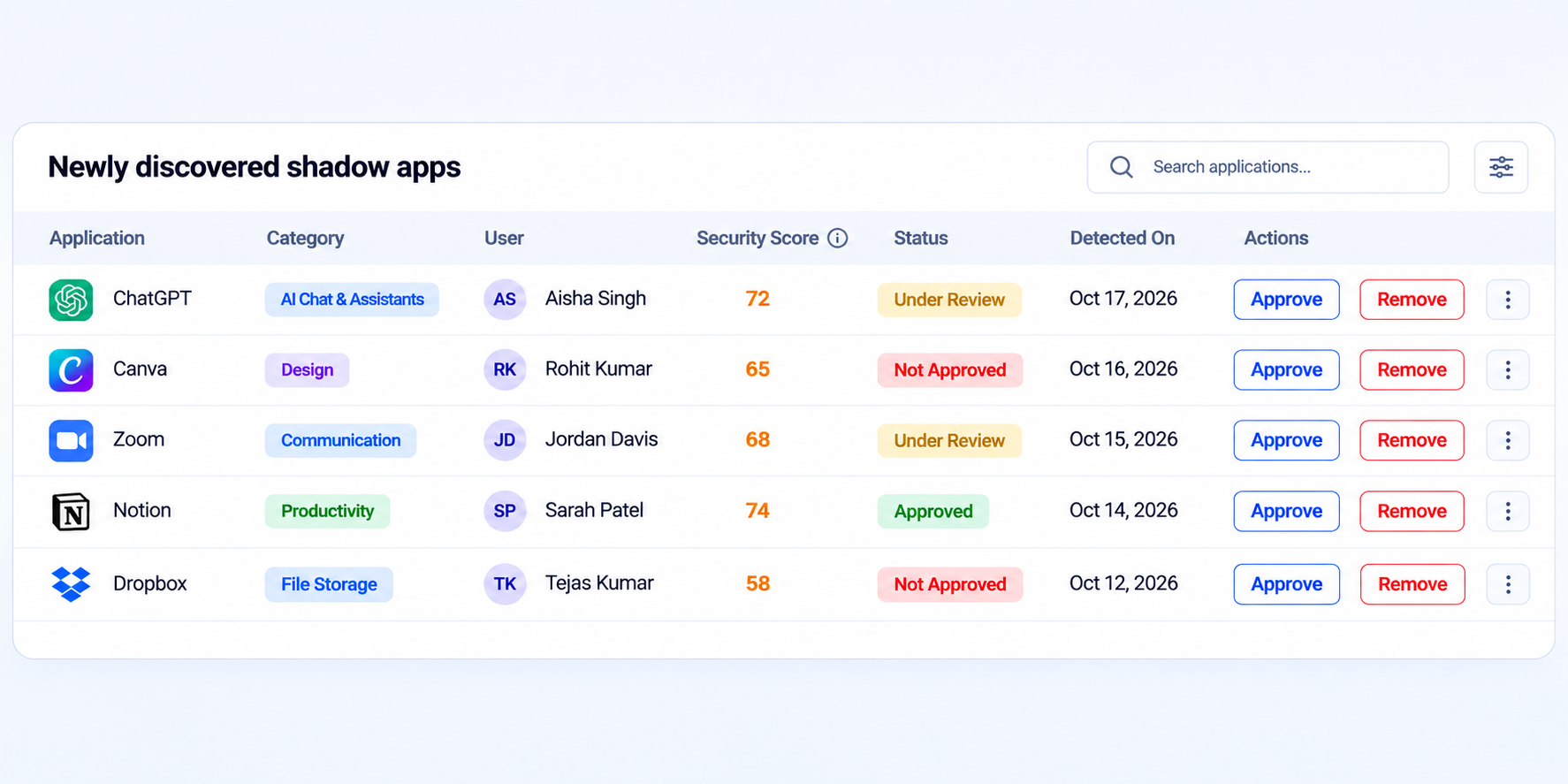
CloudEagle.ai dashboard displaying newly discovered shadow applications, including ChatGPT, Canva, Zoom, Notion, and Dropbox, with security scores, user details, approval status, detection dates, and options to approve or remove unauthorized apps.
  • Every discovered app lands in one inventory, sanctioned or not

Your scope statement matches what is actually running. Plex counted 30 sanctioned AI tools before CloudEagle.ai surfaced 73 more, and had a board-ready inventory within 14 days.

“Our internal position was that we had 30 sanctioned AI tools. CloudEagle found 73 shadow AI tools; that was the moment our AI governance program moved from a slide deck to a defensible control set the board could actually review.”
- Scott Olechowski, Chief Product Officer and Co-Founder, Plex

‍

Risk assessments that start from scored, owned systems

Every AI system in scope needs a documented risk and impact assessment. That work stalls when nobody can say who owns a tool or what data it handles.

How CloudEagle.ai solves it:

  • Each AI app gets a risk score and a data-sensitivity tier
‍

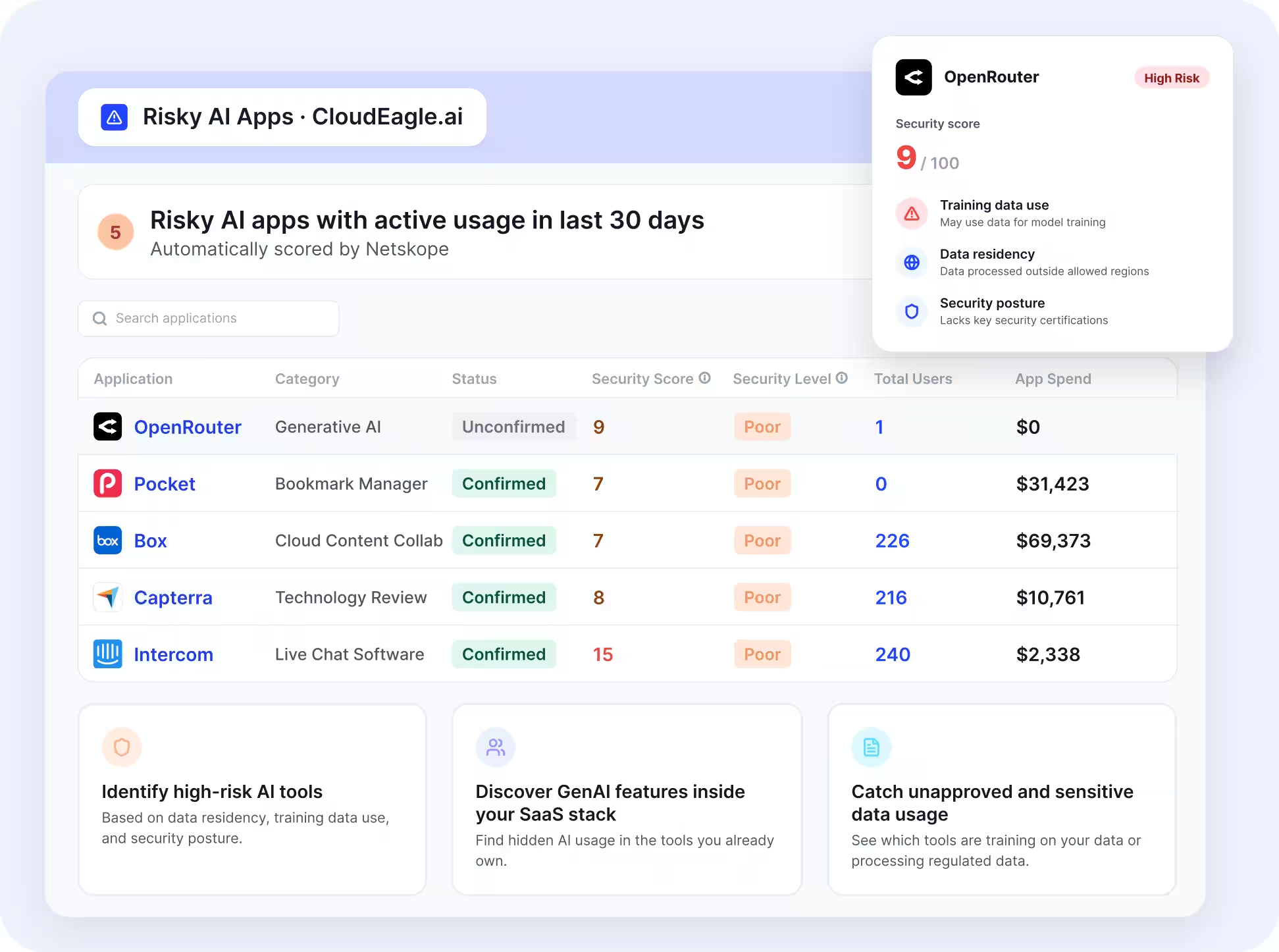
CloudEagle.ai Risky AI Apps dashboard highlighting applications with active usage in the last 30 days, security scores, risk levels, user counts, and app spend. A detailed OpenRouter risk assessment identifies concerns related to AI training data usage, data residency, and security posture.
  • Vendor records hold DPA status and contract dates in one governance view

Assessors start from a prioritized list, with the highest-risk systems at the top. Plex mapped 100% of its AI apps to a sensitivity tier this way.

Access evidence for every AI system, including machine identities

Auditors ask who can reach each AI system and how often that access is reviewed. API tokens and service accounts usually fall outside reviews that were designed around people.

How CloudEagle.ai solves it:

‍

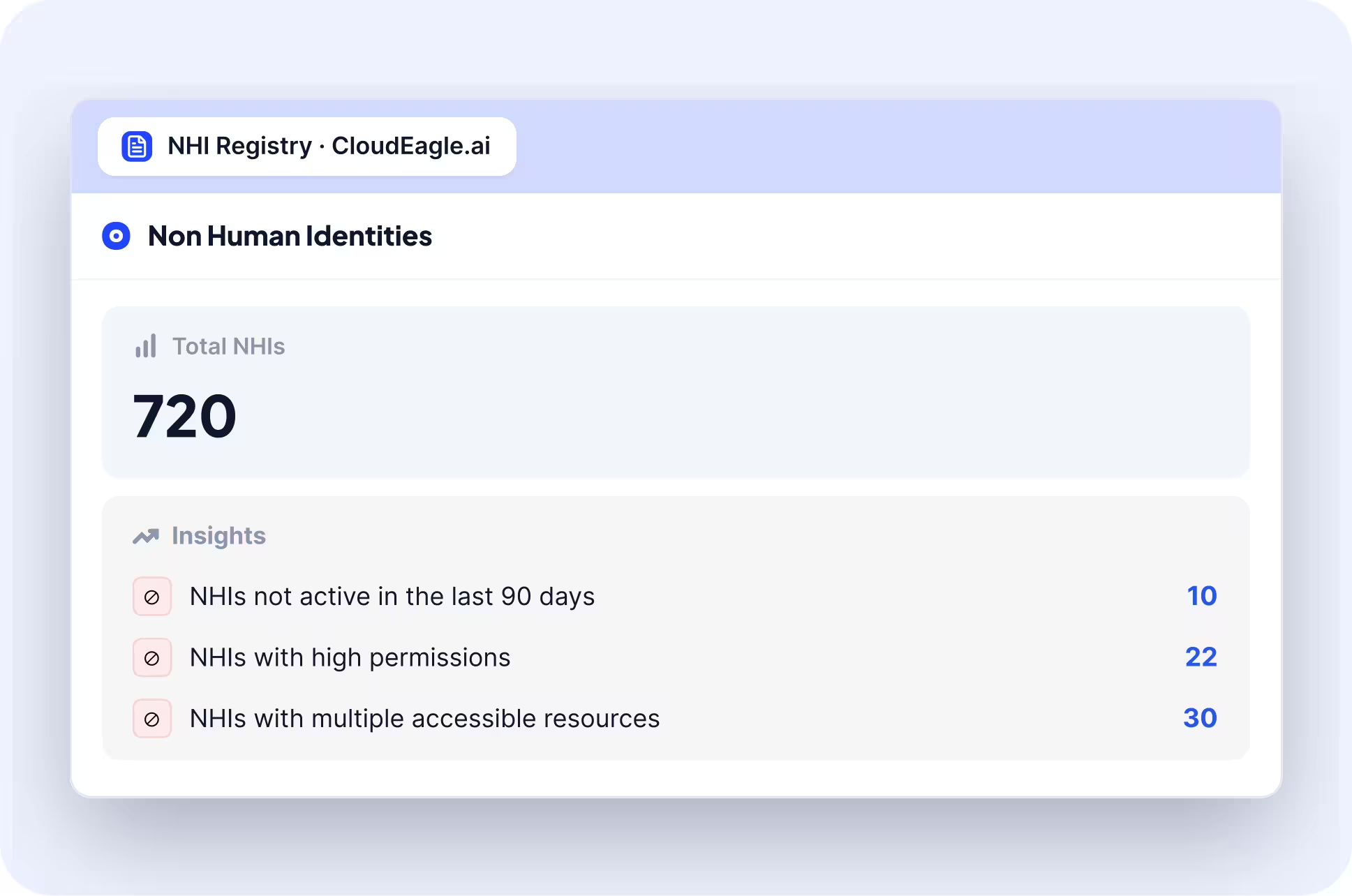
CloudEagle.ai dashboard showing 720 discovered non-human identities (NHIs), with insights into inactive identities, excessive permissions, and identities with access to multiple resources.

Each review decision leaves an evidence record, so surveillance audits draw on proof you already have. Plex moved its AI access reviews from annual to continuous.

Proof that your AI policy is enforced

A written AI usage policy passes the documentation check in Stage 1. Stage 2 tests whether it works, and a policy that employees can bypass by opening an unapproved tool turns into a nonconformity.

How CloudEagle.ai solves it:

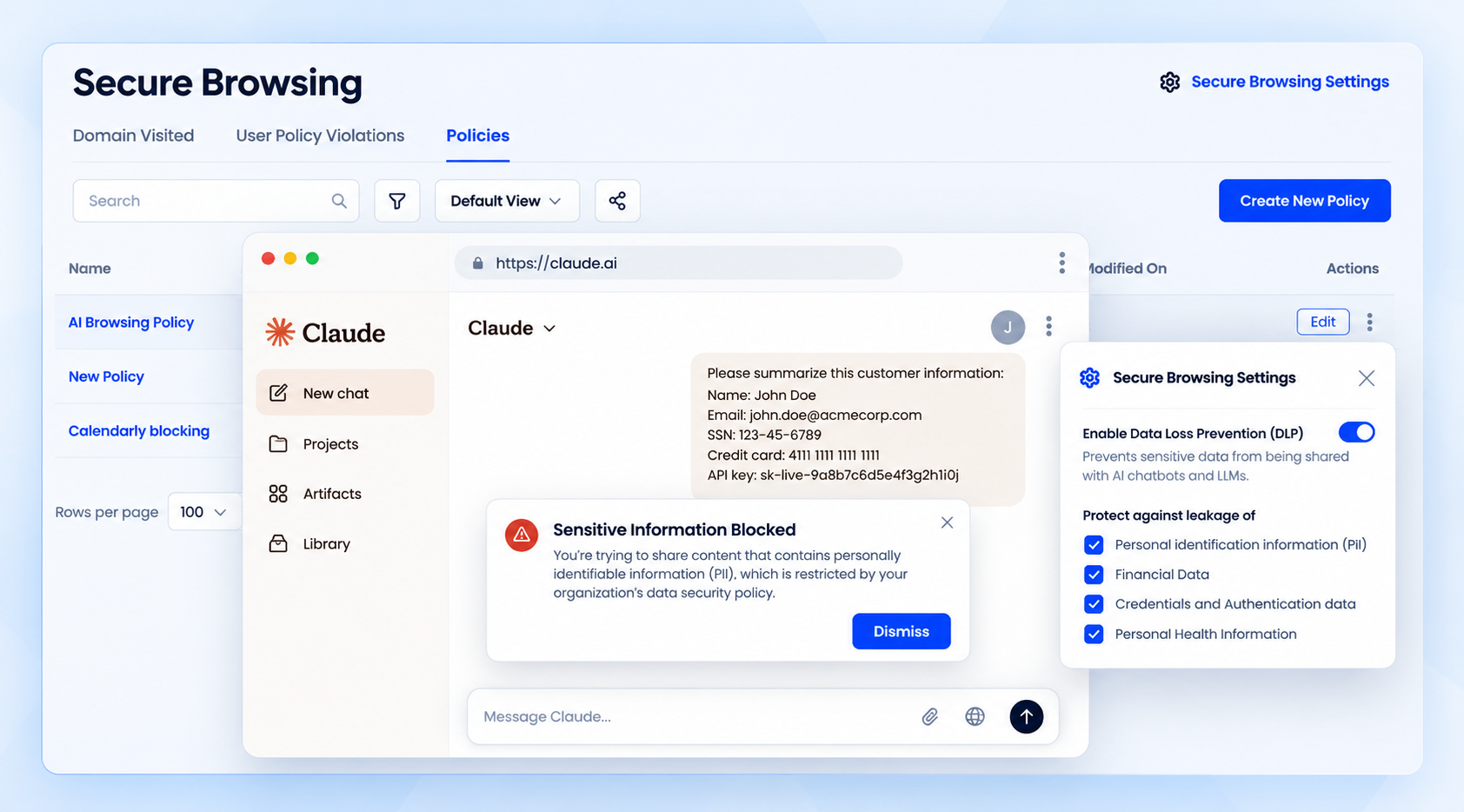
  • AI policy enforcement blocks unapproved AI tools in the browser
  • Sensitive data is flagged before it reaches an AI tool
‍

CloudEagle.ai Secure Browsing dashboard displaying AI browsing policies and a Claude interaction blocked for containing sensitive information. The DLP settings show protection against exposure of personally identifiable information (PII), financial data, credentials, and personal health information.

‍

You can show the auditor the control running next to the policy that defines it. Plex blocked or renegotiated 18 AI tools that handled regulated data without a signed DPA.

‍

Where to Start Your ISO 42001 Certification This Quarter

Start with the customer who asked. Find out which accreditation they recognize and when they need the certificate, because those two answers set your auditor shortlist and your deadline.

From there, the first month usually looks like this:

  • Request three quotes: Ask each accredited body for audit days per stage and a priced three-year schedule
  • Lock a Stage 2 window: Work back from it to set your internal audit date
  • Build the AI inventory: Every later step, from risk assessments to access reviews, depends on it

Most delays trace back to that third step. A scope that misses half your AI tools surfaces at Stage 1 and pushes everything after it, so get the inventory right before you sign with an auditor.

‍

FAQs

1. Is ISO 42001 certification worth it? 

It pays off when customers or RFPs ask for it, or when AI is part of your product. If you only use AI internally and nobody has asked, aligning to the standard without the audit may be enough.

2. How much does ISO 42001 certification cost? 

Audit fees at one accredited body run from the $20,000s to the $40,000s in year one, plus $13,000 to $20,000+ per surveillance year. Readiness work and staff time add more.

3. What is the difference between ISO 27001 and ISO 42001? 

ISO 27001 governs information security. ISO 42001 governs how you develop and use AI, covering risk, impact, and oversight. Both share a structure, so a 27001 system shortens 42001 work.

4. What does it mean to be ISO 42001 certified? 

An accredited body has audited your AI management system and confirmed it meets ISO/IEC 42001. The certificate covers a defined scope for three years, with annual surveillance audits.

‍

Start your ISO 42001 certification with a complete AI inventory. Book a CloudEagle.ai demo.

‍

Advertisement for a SaaS Subscription Tracking Template with a call-to-action button to download and a partial graphic of a tablet showing charts.Banner promoting a SaaS Agreement Checklist to streamline SaaS management and avoid budget waste with a call-to-action button labeled Download checklist.Blue banner with text 'The Ultimate Employee Offboarding Checklist!' and a black button labeled 'Download checklist' alongside partial views of checklist documents from cloudeagle.ai.Digital ad for download checklist titled 'The Ultimate Checklist for IT Leaders to Optimize SaaS Operations' by cloudeagle.ai, showing checklist pages.Slack Buyer's Guide offer with text 'Unlock insider insights to get the best deal on Slack!' and a button labeled 'Get Your Copy', accompanied by a preview of the guide featuring Slack's logo.Monday Pricing Guide by cloudeagle.ai offering exclusive pricing secrets to maximize investment with a call-to-action button labeled Get Your Copy and an image of the guide's cover.Blue banner for Canva Pricing Guide by cloudeagle.ai offering a guide to Canva costs, features, and alternatives with a call-to-action button saying Get Your Copy.Blue banner with white text reading 'Little-Known Negotiation Hacks to Get the Best Deal on Slack' and a white button labeled 'Get Your Copy'.Blue banner with text 'Little-Known Negotiation Hacks to Get the Best Deal on Monday.com' and a white button labeled 'Get Your Copy'.Blue banner with text 'Little-Known Negotiation Hacks to Get the Best Deal on Canva' and a white button labeled 'Get Your Copy'.Banner with text 'Slack Buyer's Guide' and a 'Download Now' button next to images of a guide titled 'Slack Buyer’s Guide: Features, Pricing & Best Practices'.Digital cover of Monday Pricing Guide with a button labeled Get Your Copy on a blue background.Canva Pricing Guide cover with a button labeled Get Your Copy on a blue gradient background.

Enter your email to
unlock the report

Oops! Something went wrong while submitting the form.
License Count
Benchmark
Per User/Per Year

Enter your email to
unlock the report

Oops! Something went wrong while submitting the form.
License Count
Benchmark
Per User/Per Year

Enter your email to
unlock the report

Oops! Something went wrong while submitting the form.
Notion Plus
License Count
Benchmark
Per User/Per Year
100-500
$67.20 - $78.72
500-1000
$59.52 - $72.00
1000+
$51.84 - $57.60
Canva Pro
License Count
Benchmark
Per User/Per Year
100-500
$74.33-$88.71
500-1000
$64.74-$80.32
1000+
$55.14-$62.34

Enter your email to
unlock the report

Oops! Something went wrong while submitting the form.

Enter your email to
unlock the report

Oops! Something went wrong while submitting the form.
Zoom Business
License Count
Benchmark
Per User/Per Year
100-500
$216.00 - $264.00
500-1000
$180.00 - $216.00
1000+
$156.00 - $180.00

Enter your email to
unlock the report

Oops! Something went wrong while submitting the form.

Get the Right Security Platform To Secure Your Cloud Infrastructure

Please enter a business email
Thank you!
The 2023 SaaS report has been sent to your email. Check your promotional or spam folder.
Oops! Something went wrong while submitting the form.

Access full report

Please enter a business email
Thank you!
The 2023 SaaS report has been sent to your email. Check your promotional or spam folder.
Oops! Something went wrong while submitting the form.

TL;DR

  • Certification body fees alone run about $46,000 to $80,000+ over a three-year cycle at one accredited body's published rates, before any readiness work.
  • Most organizations need six to twelve months from gap assessment to certificate, and faster if an ISO 27001 system already exists.
  • The gap between Stage 1 and Stage 2 can't exceed six months, or Stage 1 is repeated.
  • Choose an accredited body that audits to ISO/IEC 42006 and hasn't consulted for you on the same system.
  • Lead Auditor and Lead Implementer courses certify people. They don't certify the company they work for.

‍

‍

ISO 42001 certification rarely starts as an internal initiative. It shows up in a vendor security review from an enterprise prospect, or on a European customer's renewal checklist, and by the time it reaches IT, there's already a date attached. Usually nobody has priced the audit yet or checked which firms are accredited to run it.

Schellman, the first ANAB-accredited ISO 42001 body, puts year-one audit fees in the $20,000s to $40,000s, and that figure leaves out the months of readiness work that come before an auditor shows up.

The sections below break down that full bill and a realistic calendar, then how to vet a certification body so the certificate holds up with the customer who asked for it.

Looking for a Lead Auditor course instead? The section on ISO 42001 certification for individuals has prices and exam details.

‍

What ISO 42001 Certification Actually Costs Over Three Years

Expect certification body fees of roughly $46,000 to $80,000+ across the full three-year cycle, using the ranges Schellman publishes in its ISO 42001 FAQ. Readiness work sits on top, and it is usually the larger number.

Certification body fees

Audit event When Typical fee
Stage 1 + Stage 2 Year 1 $20,000s to $40,000s
Surveillance audit Years 2 and 3 $13,000 to $20,000+ each
Recertification End of year 3 Closer to the initial audit

‍

Fees are quoted by the auditor-day. Under IAF MD 5 audit-time rules used for other management systems, a surveillance audit takes about one-third of the initial audit time and recertification about two-thirds.

When you request quotes, ask for these as separate lines:

  • Initial audit: Stage 1 and Stage 2 with audit days stated for each
  • Surveillance: Years 2 and 3, priced now
  • Recertification: The year-3 audit that restarts the cycle

The costs that come before the auditor arrives

The audit tests a management system you have already built and run. Building it is where the ISO 42001 certification cost usually climbs.

  • AI system inventory: Every AI tool, model, and agent in scope, with an owner for each
  • Risk and impact assessments: Documented for each AI system in scope
  • Annex A controls: The standard offers 38 risk controls to select from and justify
  • Internal audit: Required before Stage 1 and run by someone independent of AIMS operations
  • Staff time: Hours from policy owners and system owners, plus the management review
If you need to defend this line item to your CFO, this guide to AI governance budget planning shows how to frame the ask.

What moves your quote up or down

Same-size organizations can get very different quotes because of these levers:

  • Audit days: ISO/IEC 42006 sets the rules certification bodies follow for AIMS audits, so days track scope rather than sales targets
  • AI systems in scope: More systems means more sampling and more interviews
  • Your role: Building AI products usually draws a deeper audit than using third-party AI tools
  • Sites and business units: Each one adds audit time
  • Existing ISO 27001: Shared policies, risk methods, and internal audit programs cut duplicate work. Your ISO 27001 Statement of Applicability is a good model for the AIMS version

Build the AI Inventory Auditors Check

Free checklist to find every AI tool before Stage 1.
Download Checklist

‍

How Long ISO 42001 Certification Takes, Phase by Phase

Most organizations take six to twelve months from the first gap assessment to a certificate when they start without a mature management system.

Phase Typical duration
Scope and gap analysis 2 to 6 weeks
Build the AIMS (inventory, assessments, controls) 2 to 4 months
Run the controls to generate evidence 2 to 3 months
Internal audit and management review 3 to 5 weeks
Stage 1 audit 1 to 2 days
Close Stage 1 findings 4 to 12 weeks
Stage 2 audit and certification decision 1 to 3 weeks

‍

Phase durations draw on Hicomply and Schellman.

Where timelines usually slip:

  • The Stage 1 window: Schellman notes the gap to Stage 2 is typically 4 to 12 weeks and must stay under six months, or Stage 1 has to be redone
  • Evidence age: Auditors want to see controls operating over time, so a policy written last week won't carry Stage 2
  • Auditor availability: Accredited ISO 42001 auditors book up, so lock your Stage 2 date early

For the work inside each phase, this ISO 42001 implementation checklist breaks it down control by control.

‍

How to Choose an ISO 42001 Certification Body

Pick a body with ISO 42001 on a verifiable accreditation scope that hasn't consulted for you on the same system.

The five-point vetting test

  • Verifiable accreditation: Confirm ISO 42001 is on the body's accreditation scope through IAF CertSearch or the accreditor's own register. A logo on a website is a claim, and the register is the proof
  • ISO/IEC 42006 competence: Published in July 2025, it adds AI-specific requirements on top of ISO/IEC 17021-1, so ask how the body applies it to auditor competence and audit time
  • Impartiality: An accredited body can't certify a system it also consulted on, so keep your readiness advisor and your auditor separate
  • AI audit experience: Ask how many ISO 42001 audits the assigned lead auditor has run, and in which industries
  • Transparent quoting: Insist on audit days per stage and a priced three-year schedule

Accredited bodies worth shortlisting

Body ISO 42001 accreditation Worth knowing
Schellman ANAB First ANAB-accredited ISO 42001 body
BSI UKAS, RvA, ANAB First with all three as of March 2026
A-LIGN ANAB Early accredited body for ISO 42001
DNV Accredited body Offers training, gap analysis and certification

‍

BSI ISO 42001 certification suits teams selling into both the UK and US. Because BSI also trains and advises, the impartiality rule applies if you want BSI ISO 42001 certification and BSI readiness support together.

This table reflects public announcements, so verify each row on the accreditor's register before you sign.

ISO 42001 certification in India

Teams pursuing ISO 42001 certification in India can use a body accredited by NABCB, India's accreditation board under the Quality Council of India, or by any IAF-recognized accreditor such as ANAB or UKAS.

  • NABCB criteria: NABCB has published AIMS accreditation criteria built on ISO/IEC 42001 and ISO/IEC 42006, including rules on audit time
  • What to ask: Whether the body's NABCB scope explicitly lists ISO 42001, and whether its certificates carry the NABCB mark
  • Export buyers: If your customers are in the US or EU, confirm they accept your accreditor before you commit

Access Review Evidence Before Stage 2

Free checklist to run access reviews your auditor will accept.
Download Checklist

‍

ISO 42001 Certification for Individuals: Training, Exam Cost, and Free Options

Individual credentials prove a person can implement or audit an AIMS, but your organization still needs its own accredited audit.

Course Who it's for Indicative price
PECB Foundation Anyone new to the standard From about $299
PECB Lead Implementer People building an AIMS About $599 to $659 self-study
PECB Lead Auditor People auditing an AIMS About $599 self-study, €2,795 classroom
BSI courses Requirements through Lead Auditor Quoted per course and region
GSDC Lead Auditor Self-paced learners About $400 with practice exams

‍

What to know about the ISO 42001 certification exam cost and format:

  • Bundled fees: Most PECB partners include the exam voucher in the course price, so the ISO 42001 certification exam cost rarely appears as a separate line
  • PECB Lead Auditor exam: 80 multiple-choice questions over three hours, open book
  • Experience tiers: PECB awards Provisional Auditor with no experience and the full Lead Auditor title once you log AI work and audit hours

Looking for free ISO 42001 certification training? Free options cover learning rather than credentials:

  • ISO's Online Browsing Platform: A free preview of the standard's opening sections
  • Certification body webinars: BSI, DNV and others run free sessions on the standard
If you're weighing ISO 42001 certification training against other frameworks, this comparison of ISO 42001, NIST AI RMF and the EU AI Act shows what each one proves.

‍

How CloudEagle.ai Gets Your AI Scope Audit-Ready

CloudEagle.ai handles the part of ISO 42001 certification that auditors test first: knowing which AI systems you run and who can access them. It doesn't certify you. It gives you the inventory and the access evidence your AIMS depends on, in the order the audit needs them.

A complete AI scope before Stage 1

ISO 42001 asks you to define which AI systems your AIMS covers, and auditors check that scope before anything else. Most teams build it from the SSO app list, missing every tool employees reach through browser sign-ups or IDE plugins.

How CloudEagle.ai solves it:

  • Shadow AI discovery finds AI apps across the SaaS and browser layer, including tools opened through IDE plugins and direct URLs

‍

CloudEagle.ai dashboard displaying newly discovered shadow applications, including ChatGPT, Canva, Zoom, Notion, and Dropbox, with security scores, user details, approval status, detection dates, and options to approve or remove unauthorized apps.
  • Every discovered app lands in one inventory, sanctioned or not

Your scope statement matches what is actually running. Plex counted 30 sanctioned AI tools before CloudEagle.ai surfaced 73 more, and had a board-ready inventory within 14 days.

“Our internal position was that we had 30 sanctioned AI tools. CloudEagle found 73 shadow AI tools; that was the moment our AI governance program moved from a slide deck to a defensible control set the board could actually review.”
- Scott Olechowski, Chief Product Officer and Co-Founder, Plex

‍

Risk assessments that start from scored, owned systems

Every AI system in scope needs a documented risk and impact assessment. That work stalls when nobody can say who owns a tool or what data it handles.

How CloudEagle.ai solves it:

  • Each AI app gets a risk score and a data-sensitivity tier

‍

CloudEagle.ai Risky AI Apps dashboard highlighting applications with active usage in the last 30 days, security scores, risk levels, user counts, and app spend. A detailed OpenRouter risk assessment identifies concerns related to AI training data usage, data residency, and security posture.
  • Vendor records hold DPA status and contract dates in one governance view

Assessors start from a prioritized list, with the highest-risk systems at the top. Plex mapped 100% of its AI apps to a sensitivity tier this way.

Access evidence for every AI system, including machine identities

Auditors ask who can reach each AI system and how often that access is reviewed. API tokens and service accounts usually fall outside reviews that were designed around people.

How CloudEagle.ai solves it:

‍

CloudEagle.ai dashboard showing 720 discovered non-human identities (NHIs), with insights into inactive identities, excessive permissions, and identities with access to multiple resources.

Each review decision leaves an evidence record, so surveillance audits draw on proof you already have. Plex moved its AI access reviews from annual to continuous.

Proof that your AI policy is enforced

A written AI usage policy passes the documentation check in Stage 1. Stage 2 tests whether it works, and a policy that employees can bypass by opening an unapproved tool turns into a nonconformity.

How CloudEagle.ai solves it:

  • AI policy enforcement blocks unapproved AI tools in the browser
  • Sensitive data is flagged before it reaches an AI tool

‍

CloudEagle.ai Secure Browsing dashboard displaying AI browsing policies and a Claude interaction blocked for containing sensitive information. The DLP settings show protection against exposure of personally identifiable information (PII), financial data, credentials, and personal health information.

‍

You can show the auditor the control running next to the policy that defines it. Plex blocked or renegotiated 18 AI tools that handled regulated data without a signed DPA.

‍

Where to Start Your ISO 42001 Certification This Quarter

Start with the customer who asked. Find out which accreditation they recognize and when they need the certificate, because those two answers set your auditor shortlist and your deadline.

From there, the first month usually looks like this:

  • Request three quotes: Ask each accredited body for audit days per stage and a priced three-year schedule
  • Lock a Stage 2 window: Work back from it to set your internal audit date
  • Build the AI inventory: Every later step, from risk assessments to access reviews, depends on it

Most delays trace back to that third step. A scope that misses half your AI tools surfaces at Stage 1 and pushes everything after it, so get the inventory right before you sign with an auditor.

‍

FAQs

1. Is ISO 42001 certification worth it? 

It pays off when customers or RFPs ask for it, or when AI is part of your product. If you only use AI internally and nobody has asked, aligning to the standard without the audit may be enough.

2. How much does ISO 42001 certification cost? 

Audit fees at one accredited body run from the $20,000s to the $40,000s in year one, plus $13,000 to $20,000+ per surveillance year. Readiness work and staff time add more.

3. What is the difference between ISO 27001 and ISO 42001? 

ISO 27001 governs information security. ISO 42001 governs how you develop and use AI, covering risk, impact, and oversight. Both share a structure, so a 27001 system shortens 42001 work.

4. What does it mean to be ISO 42001 certified? 

An accredited body has audited your AI management system and confirmed it meets ISO/IEC 42001. The certificate covers a defined scope for three years, with annual surveillance audits.

‍

Start your ISO 42001 certification with a complete AI inventory. Book a CloudEagle.ai demo.

‍

CloudEagle.ai recognized in the 2025 Gartner® Magic Quadrant™ for SaaS Management Platforms
Download now
gartner chart
5x
Faster employee
onboarding
80%
Reduction in time for
user access reviews
30k
Workflows
automated
$15Bn
Analyzed in
contract spend
$2Bn
Saved in
SaaS spend

Streamline SaaS governance and save 10-30%

Book a Demo with Expert
CTA image