.avif)
%201.svg)


HIPAA Compliance Checklist for 2025

Flexera does one thing well: on-premise software license tracking and IT compliance for complex enterprise environments. If that's the core problem, it's a solid tool.
But in 2026, most IT teams are dealing with SaaS sprawl, shadow AI, identity lifecycle automation, and procurement intelligence, none of which Flexera was built for.
Flexera wasn't built for that environment. CloudEagle.ai combines SaaS management, identity governance, AI governance, and SaaS procurement in a single platform for teams that need one place to govern their entire SaaS and AI estate.
In this article, we'll look at seven Flexera alternatives that go beyond traditional ITAM and help organizations manage the SaaS-first environment they're actually operating in.
TL;DR
- Flexera is effective for on-premise software asset management and IT compliance, but most modern IT environments have moved well beyond that scope.
- In 2026, organizations need to govern SaaS sprawl, shadow AI, identity lifecycle, and procurement alongside traditional ITAM.
- Leading Flexera alternatives include CloudEagle.ai, LeanIX, ServiceNow, USU, BetterCloud, AssetSonar, and Cledara, each addressing different parts of the modern IT management stack.
- These platforms vary significantly across SaaS discovery, identity governance, AI governance, spend management, and procurement.
- CloudEagle.ai is the only platform on this list that covers SaaS management, identity governance, AI governance, and procurement in one place.
1. What Flexera Does Well (And Where Most Teams Outgrow It)
Flexera helps IT teams track on-premise software licenses, manage hardware assets, and maintain compliance across complex enterprise environments.
For organizations asking "what software do we own, are we compliant, and are we paying the right amount on traditional licenses," Flexera provides a strong answer.
The challenge is that most IT environments in 2026 don't stop at on-premise asset management.
As organizations grow, SaaS portfolios expand to hundreds of applications that never touch Flexera's discovery layer. Security teams get pulled into shadow IT and shadow AI governance.
Procurement needs renewal intelligence and benchmarking data. Identity teams need automated provisioning and access reviews that go beyond license counts.
- SaaS Discovery Becomes the Primary Visibility Problem
- Shadow AI Introduces Ungoverned Tools Faster Than Manual Processes Can Track
- Identity Lifecycle Automation Requires More Than License Assignment
- Procurement Teams Need Renewal Workflows and Vendor Benchmarking
- Spend Optimization Requires Usage Data Across the Full SaaS Stack
If your only question is "are we compliant with our on-premise software licenses," Flexera answers it. If your question is "what is our entire SaaS and AI posture, what is it costing us, and who has access to what," you need a broader platform.

2. 7 Best Flexera Alternatives & Competitors
Here are some excellent Flexera alternatives you can choose in 2026.
1. CloudEagle
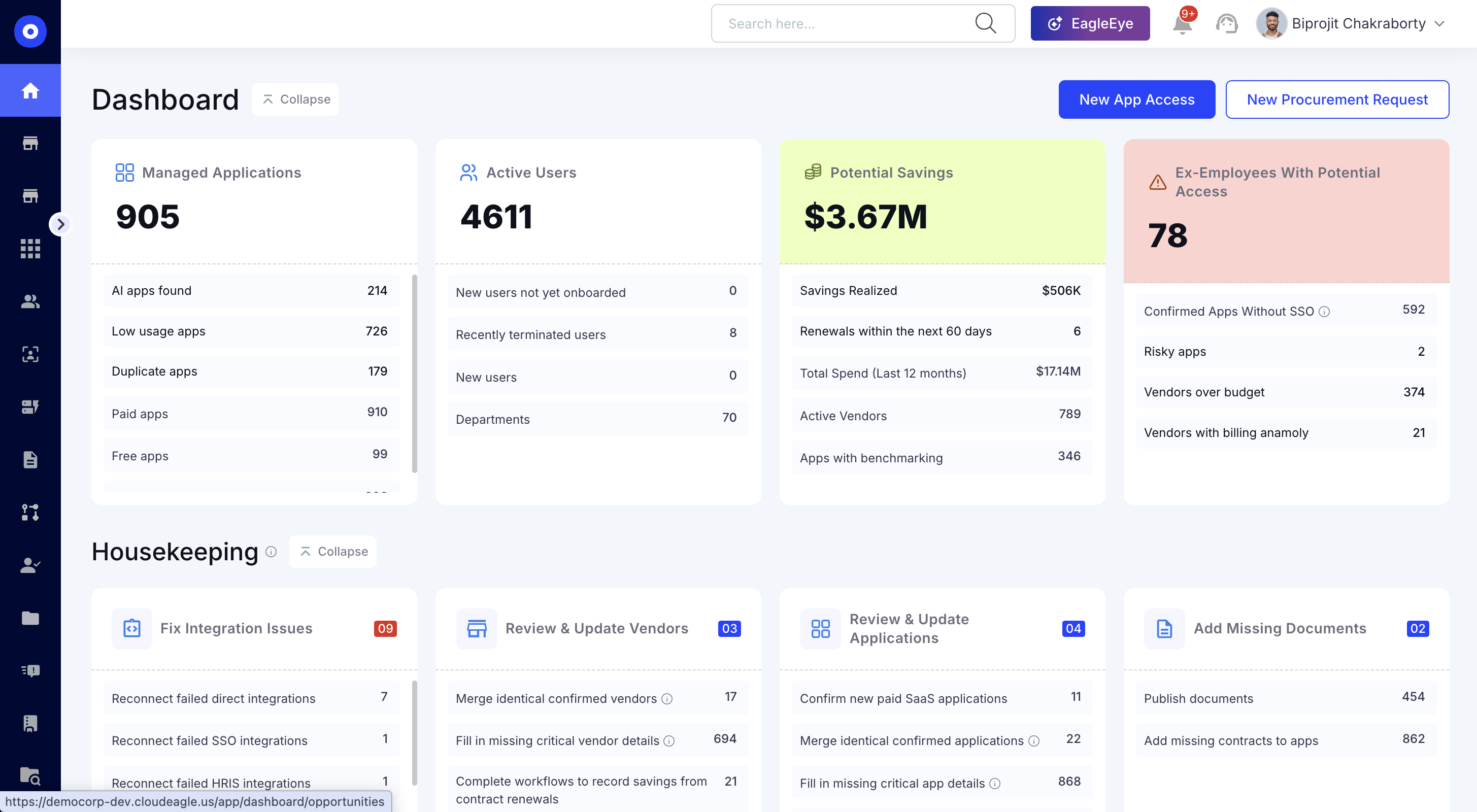
CloudEagle.ai is the only alternative on this list that covers SaaS management, AI governance, identity governance, and SaaS procurement in a single platform.
Where Flexera focuses on on-premise software and hardware asset tracking, CloudEagle.ai governs the full SaaS and AI estate with 500+ direct integrations, 30-minute onboarding, and customers typically recovering 10-30% of annual SaaS spend within the first 90 days.
It's built for mid-market and enterprise teams that have outgrown point solutions and need one platform to replace several.
When RingCentral connected CloudEagle.ai, automated license reclamation workflows identified and recovered 932 unused licenses instantly.
"Harvesting 932 unused Salesforce licenses in a single workflow was the turning point. CloudEagle helped us return $2.5M to the business without a single support ticket. License management stopped being a quarterly spreadsheet exercise and became a continuous operating process." — Fred Chin, AVP, Head of IT Operations, RingCentral
Key Features:
- SaaS and Shadow IT Discovery: Multi-layer discovery across SSO, HRIS, finance, and browser signals surfaces every sanctioned and unsanctioned application.
- Shadow AI Detection: Detects unauthorized AI tools across the organization and blocks access at the prompt level before company data is entered.
- License Management and Harvesting: Feature-level dormancy detection with configurable thresholds and automated reclaim workflows that return unused licenses to the pool.
- Contract Management: AI extracts renewal dates, notice periods, and spend commitments from contracts and triggers renewal workflows up to 90 days in advance via Slack and email.
- Identity Governance and JML Automation: Automated provisioning and deprovisioning triggered by HRIS lifecycle events across IDP and non-IDP apps.
- Continuous Access Reviews: AI-driven, event-triggered reviews with automated reviewer assignment and audit-ready compliance logs.
- Procurement Workflows: No-code procurement workflows route purchase requests to the right stakeholders automatically via Slack and email.
- Price Benchmarking and Buying Guides: SaaSMap benchmarking surfaces verified pricing data and negotiation levers for thousands of vendors.
- Vendor Research: Detailed vendor intelligence including reviews, pricing comparisons, and peer benchmarks available directly inside the platform.
- Slack Integration: Employees request, approve, and deny app access directly from Slack, including renewals, procurement approvals, and access requests.
Strengths:
4.7/5 on G2 from verified reviews. Reviewers consistently highlight automation depth, ease of use, and measurable cost savings. Strongest all-in-one coverage on this list with 30-minute onboarding and no steep learning curve.
Limitations:
The breadth of features can feel overwhelming during initial setup. Better suited for mid-market and enterprise teams managing 50+ SaaS applications than smaller environments.
Pricing:
Book a personalized demo with the team to get a custom quote.
Managing SaaS Shouldn't Feel This Hard


2. Cledara

Cledara is a SaaS management platform built around subscription control and spend visibility. It gives finance and operations teams a centralized dashboard for managing software subscriptions, tracking usage, and controlling SaaS payments through virtual cards.
Key Features:
- Subscription Management: Manages all software subscriptions in one place with renewal dates, costs, and ownership tracked centrally.
- Expense Tracking: Tracks SaaS spend and provides insights into budget allocation across subscriptions.
- Automated Workflows: Automates subscription approvals, renewals, and cancellations.
- Compliance and Security: Tracks user access and permissions to ensure only authorized personnel access critical applications.
- Virtual Card Payments: Controls SaaS payments through virtual cards, preventing unauthorized purchases.
Strengths:
Clean subscription management and spend visibility for finance and operations teams. Virtual card controls add a unique layer of payment governance. Easy to get started for small to mid-sized teams.
Limitations:
Feature set is narrower than most platforms on this list. Doesn't cover identity governance, AI discovery, access reviews, or procurement benchmarking.
Pricing:
Book a demo with the team.
3. SAP LeanIx

SAP LeanIX specializes in Enterprise Architecture Management and SaaS discovery.
Now part of SAP, it helps IT teams maintain an accurate view of their software landscape, track license compliance, and identify optimization opportunities across complex IT environments.
Key Features:
- Automated Discovery and Inventory: Discovers and inventories software assets across the network, providing an up-to-date view of the IT landscape.
- License Compliance Management: Tracks software licenses and usage to help organizations maintain compliance and avoid legal exposure.
- Cost Optimization: Identifies underused or unused licenses and surfaces optimization opportunities across the software portfolio.
- Enterprise Architecture Mapping: Maps how applications connect across the business to support informed rationalization decisions.
- Integration Capabilities: Integrates with ITSM, ERP, and other enterprise systems for unified asset management.
Strengths:
Strong focus on enterprise architecture and license compliance. Well suited for medium to large organizations managing complex IT landscapes, particularly those already in the SAP ecosystem.
Limitations:
Initial setup can be time-consuming for complex environments. Doesn't cover SaaS procurement workflows, identity governance, or AI governance.
Pricing:
Based on number of applications. Schedule a demo with their team to learn more.
4. ServiceNow

ServiceNow is a broad IT service management platform with IT asset management and software asset management capabilities.
It's designed for enterprises that want to consolidate IT operations, automate workflows, and maintain a unified view of their environment through a CMDB.
Key Features:
- IT Asset Management: Tracks IT assets from acquisition to disposal with full lifecycle visibility and control.
- Software Asset Management: Tracks software usage and optimizes license utilization across the organization.
- Configuration Management Database: Maintains an accurate record of the IT environment and the relationships between assets and services.
- Automation and Workflows: Automates repetitive IT tasks and streamlines operational processes.
- Integration Ecosystem: Connects with a wide range of IT tools and systems for unified operations management.
Strengths:
Extensive automation capabilities and deep ITSM integration. Highly customizable for complex organizational needs. Strong fit for enterprises already running ServiceNow for ITSM.
Limitations:
Complex to set up, often requiring dedicated implementation resources. Doesn't cover SaaS-specific governance, AI discovery, or procurement benchmarking.
Pricing:
Contact the sales team for custom pricing.
5. USU

USU provides software asset management and IT service management solutions for enterprises managing large, complex software portfolios. Its focus is license optimization, compliance, and contract management for traditional software environments.
Key Features:
- Software Asset Management: Monitors and manages software licenses across the organization.
- License Optimization: Identifies underused or unused licenses and surfaces reallocation opportunities.
- Contract and Vendor Management: Manages contracts and vendor relationships with a centralized repository for all contractual obligations.
- Analytics and Reporting: Provides detailed insights into IT asset usage for data-driven decisions.
- Compliance Management: Tracks license compliance and reduces exposure to audit risk.
Strengths:
Effective license optimization tools for traditional software environments. Comprehensive ITAM capabilities for enterprises with large on-premise portfolios. Strong compliance and audit support.
Limitations:
Requires significant training to use effectively. Complex initial setup. Doesn't cover SaaS discovery, identity governance, or AI governance.
Pricing:
Get in touch with the sales team for a customized quote.
6. BetterCloud

BetterCloud is a SaaS Operations Management platform focused on giving IT teams control over cloud applications. It provides visibility into SaaS usage, automates user lifecycle workflows, and helps enforce security policies across cloud platforms.
Key Features:
- SaaS Discovery and Inventory: Automatically discovers and catalogs SaaS applications in use across the organization.
- User Lifecycle Management: Automates onboarding, offboarding, and mid-lifecycle changes across SaaS applications.
- Security and Compliance: Sets security rules, detects unusual activity, and addresses threats across SaaS apps.
- Automated Workflows: Automates user provisioning, data backups, and security policy enforcement.
- Multi-Platform Coverage: Works across Google Workspace, Microsoft 365, and other major SaaS platforms.
Strengths:
Strong automation for user lifecycle management across cloud applications. Good fit for IT teams primarily managing Google Workspace or Microsoft 365 environments.
Limitations:
Pricing is non-transparent. Customization options are limited for complex or niche use cases. Doesn't cover procurement workflows, AI governance, or price benchmarking.
Pricing:
Request a demo and the team will provide a customized quote.
7. AssetSonar

AssetSonar is an IT asset management platform for organizations that need to track physical and digital assets alongside software licenses. It focuses on asset visibility, compliance, and integration with helpdesk systems.
Key Features:
- IT Asset Management: Tracks and manages IT assets with real-time visibility into status, location, and usage.
- Automated Alerts and Notifications: Sends alerts for maintenance, warranty expirations, and license renewals.
- Helpdesk Integration: Integrates with popular service desk platforms for unified asset and ticket management.
- Audit Trails: Maintains detailed audit histories of all asset transactions and changes.
- Mobile Access: Allows IT teams to manage assets from a mobile app.
Strengths:
Clean UI with straightforward asset tracking and helpdesk integration. Good fit for organizations that need hardware and software asset management in one place.
Limitations:
Steep learning curve for new users. Reporting features are complex and require configuration. Doesn't cover SaaS governance, identity lifecycle, or procurement workflows.
Pricing:
Starts at $44.99/month. Final price depends on number of users, admins, and registered software license seats.
3. Conclusion
Choosing the right IT asset management software can make all the difference in controlling costs, managing licenses, and preventing shadow IT.
Whether you’re looking to overcome the challenges of managing complex IT environments or searching for tools to optimize costs and improve workflows, these seven alternatives offer tailored solutions for businesses of all sizes.
If managing your software feels like a juggling act, CloudEagle.ai is the solution you've been looking for. Its intuitive platform takes the guesswork out of SaaS management, making it easier to track licenses, control costs, and prevent overspending.
With transparent pricing, powerful integrations, and automation features, CloudEagle ensures your IT and procurement teams can focus on what really matters, driving efficiency and saving money.
4. FAQs
1. What is the difference between IT Asset Management and SaaS Management?
ITAM tracks hardware and on-premise software across their lifecycle. SaaS management focuses on cloud subscriptions, discovering apps, optimizing licenses, automating access, and managing renewals. Most enterprises need both, but SaaS-heavy teams get more actionable value from dedicated SaaS management platforms.
2. Can a SaaS management platform replace an Identity Provider like Okta or Azure AD?
No. Identity Providers handle authentication and SSO. SaaS management platforms layer governance on top, license optimization, access reviews, and provisioning workflows across apps that aren't behind SSO. The two are complementary, not competing.
3. How do organizations discover shadow IT and unauthorized SaaS in 2026?
The most complete approach combines SSO logs, finance data, browser activity, and network telemetry. Relying on SSO alone misses apps bought on corporate cards or accessed through personal accounts. Platforms that correlate multiple sources consistently surface more unauthorized tools.
4. What should IT teams evaluate when comparing Flexera alternatives?
Discovery coverage beyond on-premise assets, integration depth with HRIS and SSO tools, identity lifecycle automation, AI governance capabilities, and whether the platform generates audit-ready output without manual effort.
5. Is it possible to govern SaaS and AI spend from one platform in 2026?
Yes, though most platforms still cover one better than the other. The strongest options now extend across SaaS discovery, AI token spend tracking, and shadow AI detection. Organizations should evaluate whether a platform governs both categories rather than treating them separately.
Visibility Is The Starting Point


.avif)


.avif)
.avif)



.png)





.avif)
.avif)
.avif)


