.avif)
%201.svg)


HIPAA Compliance Checklist for 2025

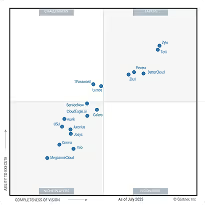
KuppingerCole's annual Leadership Compass is one of the most exacting evaluations in identity security. The 2026 edition covers more than 30 vendors across privileged access management, and CloudEagle.ai has joined the 2026 edition for the first time. Read the full report here.
We're announcing it today: Read the full press release here.
1. What Counts as Privileged Access Just Changed
For two decades, PAM meant one thing: vault the domain admin password, record the RDP session, and audit the result. That model was built when "privileged" described a small population of infrastructure engineers logging into servers.
It does not describe today. In 2025 alone, 80% of companies reported security incidents tied to privileged access, according to CloudEagle.ai's IGA Report. The reason is straightforward: privilege has spread far beyond the domain controller, and most PAM tools haven't followed it there.
The definition of privileged access has widened. It is no longer just a domain admin password. It is a Salesforce admin profile, a Workday role with payroll edit rights, a Claude tenant with access to source code, and a service account in NetSuite that no one has touched in three years. All of it qualifies as privileged. None of it shows up in a traditional PAM tool.
This is the gap the 2026 report is pointing at, and it is the gap CloudEagle.ai was built to close.
2. Three Shifts Reshaping PAM This Year
The report tracks several structural changes in the market. Three matter most for enterprise buyers:
- Privilege is widening. Non-human identities, service accounts, API keys, and AI agents now outnumber human users in most enterprises. They run unattended. They carry standing access. They are where attackers are heading.
- PAM and IGA are converging. Governance and enforcement used to be separate disciplines. They are now the same conversation. The vendors that win are the ones that handle both.
- Standing privilege is the new attack surface. Just-in-time access, time-bound elevation, and zero standing privilege are no longer aspirational. They are the baseline. Anything still relying on persistent admin rights is operating on borrowed time.
If you are a CISO reading the report, none of these will surprise you. What may surprise you is how few traditional PAM platforms cover the SaaS and AI side of this picture.
3. How CloudEagle.ai Governs Privilege at the SaaS and Identity Layer
CloudEagle.ai is an AI-powered SaaS management, AI governance, and identity governance platform. We govern privilege where it actually lives now: inside business applications, AI tools, and the identities that connect to them.
That looks different in practice from what a vault-and-session-recording vendor does. Three examples make the difference concrete.
Standing admin access that finally goes away
Standing admin rights in business applications are one of the most common audit findings, and the hardest to clean up manually. Finance analysts need elevated NetSuite access for quarter-end. Sales ops needs a Salesforce admin for a migration. IT grants the access, the project ends, and the access stays.
- What CloudEagle.ai does: Provisions elevation through an approval workflow tied to a fixed window, then revokes it automatically on the date the approver set.
- What changes: The audit finding goes away because the access is no longer there to find.
AI tool sprawl caught the day it appears
Engineers adopt Claude Code, Cursor, and Copilot before procurement is involved. Security finds out months later, usually when the invoice lands or an auditor asks.
- What CloudEagle.ai does: Discovers the AI tools already in use, runs access requests for new ones through the right reviewer, and pulls licenses back when usage drops to zero.
- What changes: Security sees AI exposure the day it appears, not the quarter after.
Access reviews that actually mean something
Quarterly access reviews drown reviewers in lists of permissions they have no context for. Most get rubber-stamped. The few that don't take weeks to complete.
- What CloudEagle.ai does: Maps every elevated permission across 500+ integrated SaaS and AI apps to actual usage data, flags ex-employees and high-risk roles automatically, and auto-attaches evidence for the audit report.
- What changes: Reviews finish in days, and the certifications that come out of them actually mean something.
Standing Privilege Is the New Attack Surface. Close It.


None of this requires a separate PAM tool, a separate vault, or a separate identity governance platform. It runs on the same SaaSMap Context Graph that powers our visibility into spend, usage, and risk.

That is the problem CloudEagle.ai was built to solve: treating SaaS access governance, AI governance, and identity governance as a single continuous problem rather than three separate ones.
"Joining the KuppingerCole Leadership Compass on PAM is meaningful for the entire team," said Nidhi Jain, CEO of CloudEagle.ai. "Our customers have been asking us to govern privilege wherever it lives, inside SaaS apps, inside AI tools, inside the identities that connect to them. This recognition belongs to the team that shipped hard things every week, and to the customers who trusted us early."
If you want to see what governing SaaS, AI, and identity from a single platform actually looks like, book a demo.
Privilege Has Spread Beyond Your PAM Tool. Time to Catch Up.


.avif)


.avif)
.avif)




.png)







.avif)
.avif)
.avif)


