
%201.svg)


HIPAA Compliance Checklist for 2025

The average enterprise now runs 130+ SaaS applications. Finance teams are chasing renewal deadlines in spreadsheets. IT teams are logging into 40 admin consoles to figure out who is using what. Procurement teams are negotiating renewals without any benchmarking data.
Zylo was built to help with some of this. It offers SaaS visibility, spend tracking, and renewal management. But its hidden pricing, heavy reliance on Okta for usage tracking, and limited automation have led many teams to look for something that goes further.
If you are evaluating Zylo alternatives, this guide covers seven SaaS management platforms worth considering in 2026, what they do well, where they fall short, and how they compare.
TL;DR
1. Why Teams Are Looking Beyond Zylo for SaaS Management
Zylo is a capable tool for large enterprises that need SaaS spend visibility. But teams that have worked with it consistently run into the same friction points.
- Hidden pricing: Zylo does not publish pricing publicly. Most teams only discover the cost during a sales call, and it typically skews toward enterprise budgets. Organizations of all sizes need transparent, predictable pricing.
- Heavy Okta dependency: Zylo relies significantly on Okta for usage tracking. If employees log in through other methods or use apps that are not behind Okta, that activity often goes uncaptured. For organizations with a diverse identity stack, this creates blind spots that defeat the purpose of a SaaS management platform.
- Limited procurement automation: Zylo surfaces insights well, but does not close the loop on action. There are no assisted buying services, no structured procurement workflows, and no expert negotiation support. Teams still have to do the heavy lifting themselves after getting the data.
- No application rationalization is built in: Identifying duplicate tools and overlapping functionality requires manual effort. Zylo does not automatically detect which apps serve the same purpose or which users hold redundant seats across similar tools.
These gaps are why the Zylo alternatives in this list have gained serious traction with IT, finance, and procurement teams looking for a platform that moves from visibility to action.

2. 7 Best Zylo Alternatives for SaaS Management in 2026
1. CloudEagle.ai
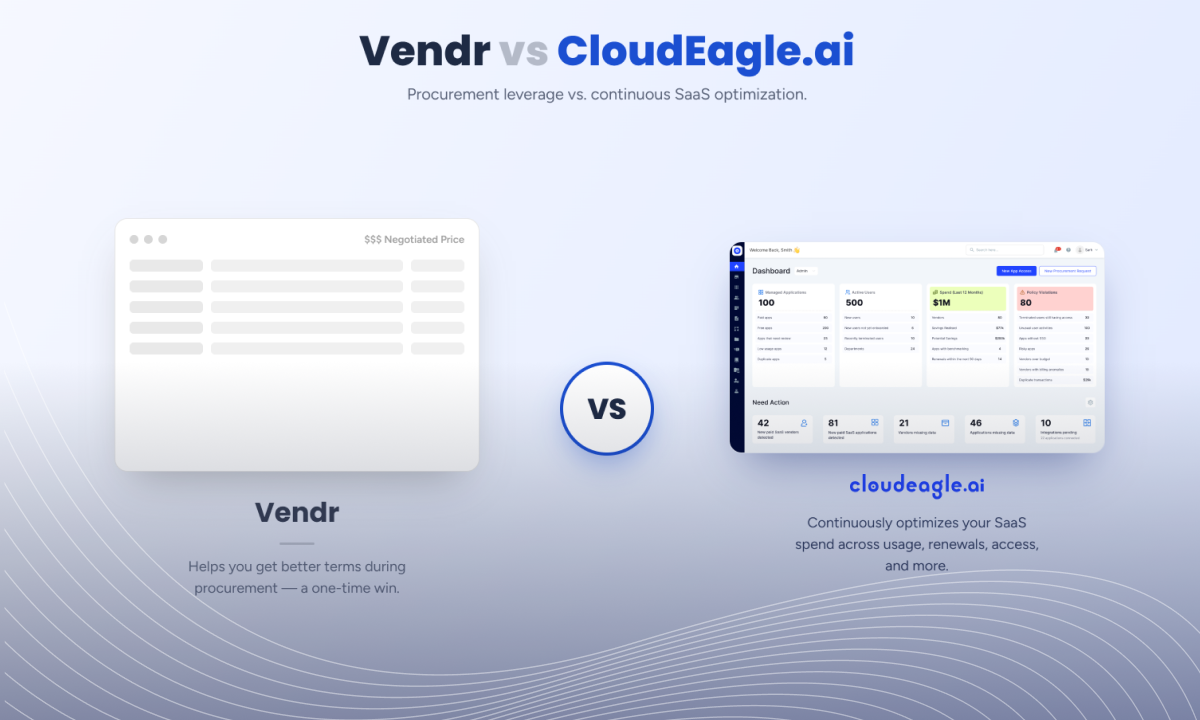
CloudEagle.ai is the most complete Zylo alternative available. While Zylo focuses primarily on spend visibility, CloudEagle covers the full SaaS lifecycle: discovery, optimization, procurement, security, and identity governance in one platform.
Where Zylo tells you what is happening in your SaaS stack, CloudEagle tells you what is happening and then does something about it automatically.
Trusted by enterprises like RingCentral, Rec Room, ICEYE, and Lapzo, CloudEagle has analyzed $50Bn worth of contracts, delivered $3Bn in SaaS savings, and supports 500+ direct integrations with 30-minute onboarding.
As Eric Silver, AVP Head of Procurement at RingCentral, put it: "We lacked visibility into overlapping apps, but CloudEagle fixed that fast. It revealed duplicates, showed which users had access, and helped remove unoptimized licenses to cut waste."
SaaS Management
Most enterprises know they have wasted SaaS spend. The problem is connecting usage, renewals, contracts, and ownership data before the next renewal cycle hits.
CloudEagle continuously tracks feature-level usage across SaaS applications, centralizes contract metadata, and uses AI to detect duplicate apps and overlapping vendors before spend compounds.
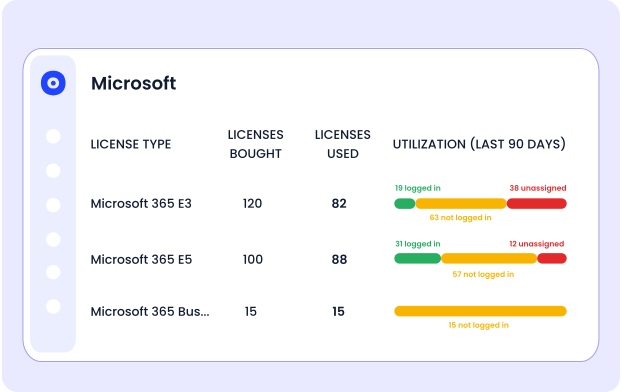
How it helps:
- Tracks inactive, underutilized, and duplicate licenses automatically
- Centralizes contracts, renewal dates, SKUs, pricing terms, and spend commitments
- Detects overlapping apps and duplicate vendors using AI-driven rationalization
- Sends proactive renewal alerts with usage and benchmarking context attached
Outcome:
Teams reduce SaaS waste, avoid unnecessary renewals, and make consolidation decisions using real operational data instead of spreadsheets.
SaaS Procurement
Most procurement workflows still rely on emails, Slack threads, spreadsheets, and disconnected approvals, slowing purchasing cycles and weakening vendor negotiations.
CloudEagle connects intake, approvals, benchmarking, renewals, and procurement orchestration into one workflow.
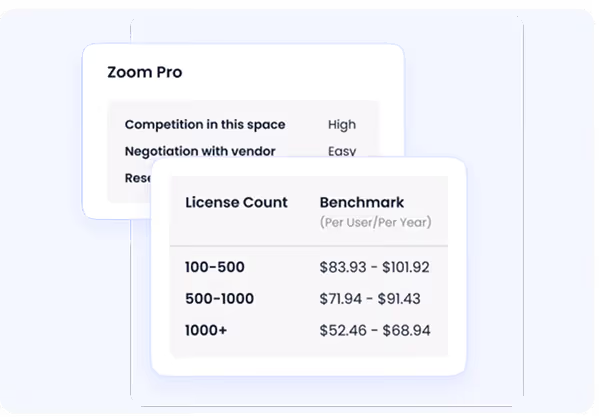
How it helps:
- Provides peer pricing benchmarks and buying guides using SaaSMap market data
- Automates procurement approvals across Slack, email, and procurement systems
- Builds renewal workflows 90 days before contract deadlines
- Integrates with Coupa, Zip, Ironclad, and JIRA without replacing existing systems
Outcome:
Procurement teams negotiate from a position of visibility, accelerate approvals, and reduce renewal exposure before contracts auto-renew.
SaaS Security & Compliance
Most security teams still struggle with shadow IT, excessive privileged users, and manual access reviews across SaaS applications.
CloudEagle extends governance beyond the IdP with continuous SaaS discovery, least-privilege enforcement, automated access reviews, and audit-ready compliance visibility across the entire SaaS environment.
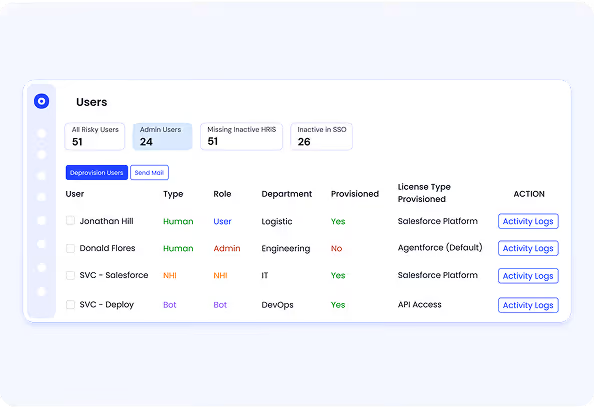
How it helps:
- Discovers shadow IT and shadow AI through browser signals, SSO, finance, Zscaler, and CrowdStrike data
- Flags excessive privileged users, orphaned accounts, and permission mismatches automatically
- Automates continuous user access reviews with audit-ready evidence attached
- Maintains compliance visibility across SOC 2, GDPR, and ISO workflows
Outcome:
Security teams reduce governance gaps, eliminate manual review fatigue, and stay continuously audit-ready.
Identity Governance
Most onboarding, offboarding, and access requests still happen manually across tickets, emails, and spreadsheets, creating delays and orphaned accounts.
CloudEagle automates identity lifecycle management across SaaS and AI applications, including apps outside traditional SSO visibility.
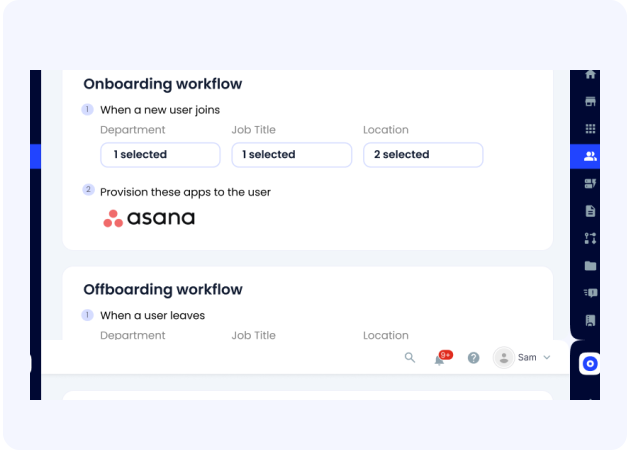
How it helps:
- Supports zero-touch onboarding and automated offboarding workflows
- Provides role-based self-service app catalogs for employees
- Automates app access requests, approvals, and provisioning workflows
- Supports just-in-time access with automatic expiration policies
Outcome:
Organizations reduce excessive access, eliminate orphaned accounts faster, and enforce least-privilege governance without manual overhead.
AI Governance
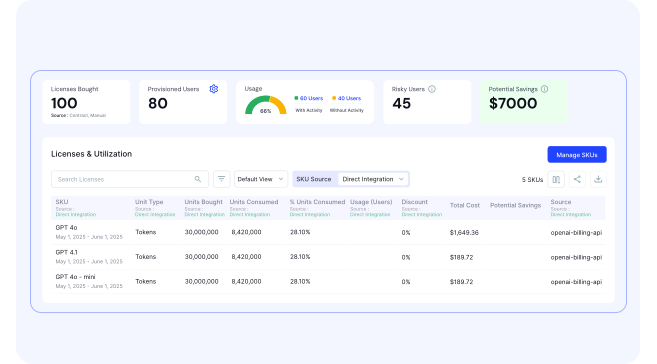
Most enterprises still cannot answer basic AI governance questions: which AI tools are being used, who has access, what data is being shared, and whether AI agents are operating outside approved workflows.
CloudEagle extends governance beyond the IdP by giving enterprises real-time visibility, policy enforcement, spend governance, and risk control across their entire AI ecosystem.
How it helps:
- Discovers shadow AI through browser signals, SSO, Zscaler, CrowdStrike, and finance integrations
- Detects AI agents, duplicate copilots, and GenAI capabilities embedded inside SaaS applications
- Uses flash-page redirects to enforce approved AI usage policies in real time
- Applies GenAI risk scores, monitors token consumption, and surfaces risky AI usage automatically
Outcome:
Enterprises gain defensible AI governance with visibility into AI usage, spend, risk, non-human identities, and shadow AI operating outside SSO visibility.
Pricing:
CloudEagle.ai offers custom pricing tailored to your needs. Learn more about CloudEagle.ai pricing or book a demo for a personalized quote.
Stop Guessing What Is in Your SaaS Stack. Start Knowing


2. Productiv
Productiv is built for enterprises that want deep engagement analytics on their SaaS apps. It tracks how employees actually use applications across more than 50 engagement dimensions, helping teams understand which tools are delivering real value and which are quietly wasting budget.
It is particularly strong for IT, procurement, and finance leaders who need to justify SaaS investments with usage evidence rather than anecdotal feedback.
Key Features
- Granular app usage tracking across custom periods, departments, and specific contracts
- License optimization suggestions based on actual engagement patterns
- Centralized contract and renewal data for informed decision-making
- Customizable reporting tailored to organizational needs
- Real-time SaaS utilization tracking, including integrated app usage
Cons
- Limited procurement automation and no assisted buying capability
- Weaker security and governance features compared to broader platforms
- Enterprise-only pricing with no public tiers
Pricing: Custom packages based on business requirements. Contact Productiv for a quote.
3. BetterCloud
BetterCloud is built specifically for IT teams that need strong security controls and workflow automation across their SaaS stack. It excels at discovering, managing, and governing critical SaaS applications, particularly around access policies and user lifecycle management.
If your primary driver is security and compliance automation rather than spend optimization, BetterCloud is a strong contender.
Key Features
- Holistic app discovery across the entire SaaS environment
- Security and compliance controls with configurable user roles and permissions
- Workflow automation for onboarding, offboarding, and access changes
- File security monitoring with alerts for unauthorized sharing
- Vulnerability scanning to identify and address security risks proactively
Cons
- No embedded AI detection for shadow AI or emerging AI tool sprawl
- Complex setup process that can challenge smaller IT teams
- Limited spend optimization and procurement workflow capabilities
Pricing: Enterprise-only. Contact BetterCloud for pricing.
4. Tropic
Tropic is a procurement-as-a-service platform that positions itself as a full-service alternative for organizations that want to outsource their SaaS sourcing and renewal negotiations entirely. It combines software with human expertise, allowing procurement teams to delegate the heavy lifting.
It is particularly strong for fintech enterprises and organizations where procurement bandwidth is thin.
Key Features
- Automated approval workflows for faster procurement without manual intervention
- Centralized SaaS contract management with full visibility across agreements
- End-to-end procurement with the option to delegate to Tropic's expert team
- SaaS spend optimization through streamlined procurement and automation
- SaaS app discovery to find the right tools for specific business needs
Cons
- Less suitable for teams that want to keep procurement fully in-house with visibility tools
- Limited SaaS discovery and usage analytics compared to dedicated SaaS management software
- Pricing scales based on spend under management, which can get expensive
Pricing: Three tiers: Essentials, Plus, and Premium. Contact Tropic for full pricing details.
5. Vendr
Vendr is a SaaS buying platform designed specifically for fast-growing enterprises that need to control SaaS sprawl and purchase software quickly with guaranteed savings. It combines a procurement platform with human-driven buying services.
It is particularly strong for organizations scaling rapidly, where procurement cycles need to move fast without sacrificing cost discipline.
Key Features
- Infrastructure and resource management across hardware and software
- Threat notification for identifying potential SaaS application risks
- Policy enforcement for security and data governance across the stack
- Data management with administrative controls over sensitive user information
- Government and industry compliance facilitation
Cons
- Less depth in SaaS usage analytics and license optimization
- Higher price point with starter packages beginning at $36,000 annually
- Limited identity governance and access management capabilities
Pricing: Three plans ranging from $36,000 to $120,000 annually.
6. Cledara
Cledara is built for fintech startups and mid-sized businesses that need a straightforward, cost-effective way to manage SaaS subscriptions without enterprise-level complexity. It handles purchases, administration, and cancellations from a single interface.
If you are a growing company that needs SaaS visibility and financial controls without the overhead of a full enterprise SaaS management platform, Cledara is worth evaluating.
Key Features
- Single SaaS dashboard giving full subscription visibility in one place
- Easy approval workflows with manager-driven authorization for new tools
- Intelligent analytics with real-time subscription and user data
- Automated invoice management based on incoming email data
- Direct integration with accounting and financial systems
Cons
- Limited security, identity governance, and advanced automation features
- Not designed for enterprise-scale SaaS portfolios with hundreds of applications
- Lacks the procurement workflow depth that larger organizations need
Pricing: Essential at $271/month, Plus at $542/month, Pro on request.
7. Torii
Torii is built for modern IT teams that need a unified hub for SaaS usage and expenditure control with strong workflow automation. It emphasizes integration, compliance, and expenditure management, making it a solid choice for enterprises that want to scale IT operations without proportional headcount growth.
Key Features
- App discovery through SSO, finance systems, and network logs
- Workflow automation for joiner, mover, and leaver processes
- SaaS spend and renewal monitoring with proactive tracking
- Intuitive administration panel with an accessible user interface
- Detailed logging for full accountability and audit trails
Cons
- Limited embedded AI discovery capabilities for emerging AI tool sprawl
- Basic compliance workflows compared to dedicated governance platforms
- Spend management depth is narrower than dedicated procurement tools
Pricing: Custom packages. Contact Torii for a specialized quote.
3. What to Look for in a Zylo Alternative
Before picking a replacement, get clear on what you actually need. Not every SaaS management platform covers the same ground.
4. How to Choose the Right SaaS Management Platform for Your Team
Not every Zylo alternative is right for every organization. Here is a practical framework for narrowing it down:
Questions to ask before deciding:
- Does the platform go beyond logins to track feature-level usage? Logins alone do not tell you whether a paid license is delivering value.
- Can it discover apps outside your SSO? If not, shadow IT stays invisible.
- Does it automate action on insights, or just surface them? Visibility without automation still requires manual work.
- Is pricing transparent? A platform with hidden costs will always create friction at renewal time.
- Does it cover both spend optimization and identity governance? Most teams eventually need both, and buying separate tools creates integration overhead.
Conclusion
Zylo works well for large enterprises focused primarily on SaaS spend visibility. But when organizations need automated license harvesting, contract intelligence, application rationalization, procurement workflows, or identity governance, most teams find themselves patching gaps with additional tools or doing manual work that should not exist.
The seven Zylo alternatives in this guide each address different parts of that gap. Productiv for analytics depth. BetterCloud for security automation. Tropic and Vendr for procurement outsourcing. Cledara for simplicity. Torii for IT workflow efficiency.
CloudEagle.ai is the only platform on this list that covers the full SaaS lifecycle in one place: AI-powered app discovery, including shadow IT, feature-level usage intelligence, automated license harvesting, centralized contract management, application rationalization, procurement workflows, and identity governance across 500+ direct integrations.
If you want to move from spreadsheet-based SaaS management to a self-optimizing stack that catches waste before it compounds, CloudEagle.ai is the most complete starting point.
Ready to see what is actually happening in your SaaS stack? Book a demo with CloudEagle.ai today.
FAQs
- What are the best Zylo alternatives for SaaS management?
The best Zylo alternatives for SaaS management in 2026 include CloudEagle.ai for full lifecycle coverage, Productiv for engagement analytics, BetterCloud for security automation, Tropic and Vendr for procurement outsourcing, Cledara for mid-market simplicity, and Torii for IT workflow automation.
- Why do teams look for Zylo competitors?
Teams look for Zylo alternatives primarily because of hidden pricing, heavy reliance on Okta for usage tracking that creates blind spots, limited procurement automation, and the absence of assisted buying or expert negotiation support. Organizations that need more than visibility typically outgrow Zylo's capabilities.
- What is the difference between a SaaS management platform and SaaS management software?
SaaS management platforms are typically broader solutions that cover multiple aspects of SaaS governance, including discovery, optimization, procurement, and identity. SaaS management software can refer to more specific point solutions focused on a single function like spend tracking or license management.
- What should I look for in a SaaS management platform?
Look for feature-level usage tracking beyond logins, app discovery outside your SSO, automated license harvesting, contract management with proactive renewal alerts, application rationalization capabilities, and transparent pricing. The best SaaS management software closes the loop between insight and action automatically.
- How does CloudEagle.ai compare to Zylo?
CloudEagle.ai covers SaaS management, optimization, procurement, security, and identity governance in one platform with 500+ direct integrations and transparent pricing. Zylo focuses primarily on spend visibility with limited automation and does not offer assisted buying, application rationalization, or identity lifecycle management. CloudEagle.ai goes beyond visibility to automate the actions that actually reduce SaaS spend and security risk.
Stop Guessing What Is in Your SaaS Stack. Start Knowing


.avif)


.avif)
.avif)


.png)





.avif)
.avif)
.avif)


